

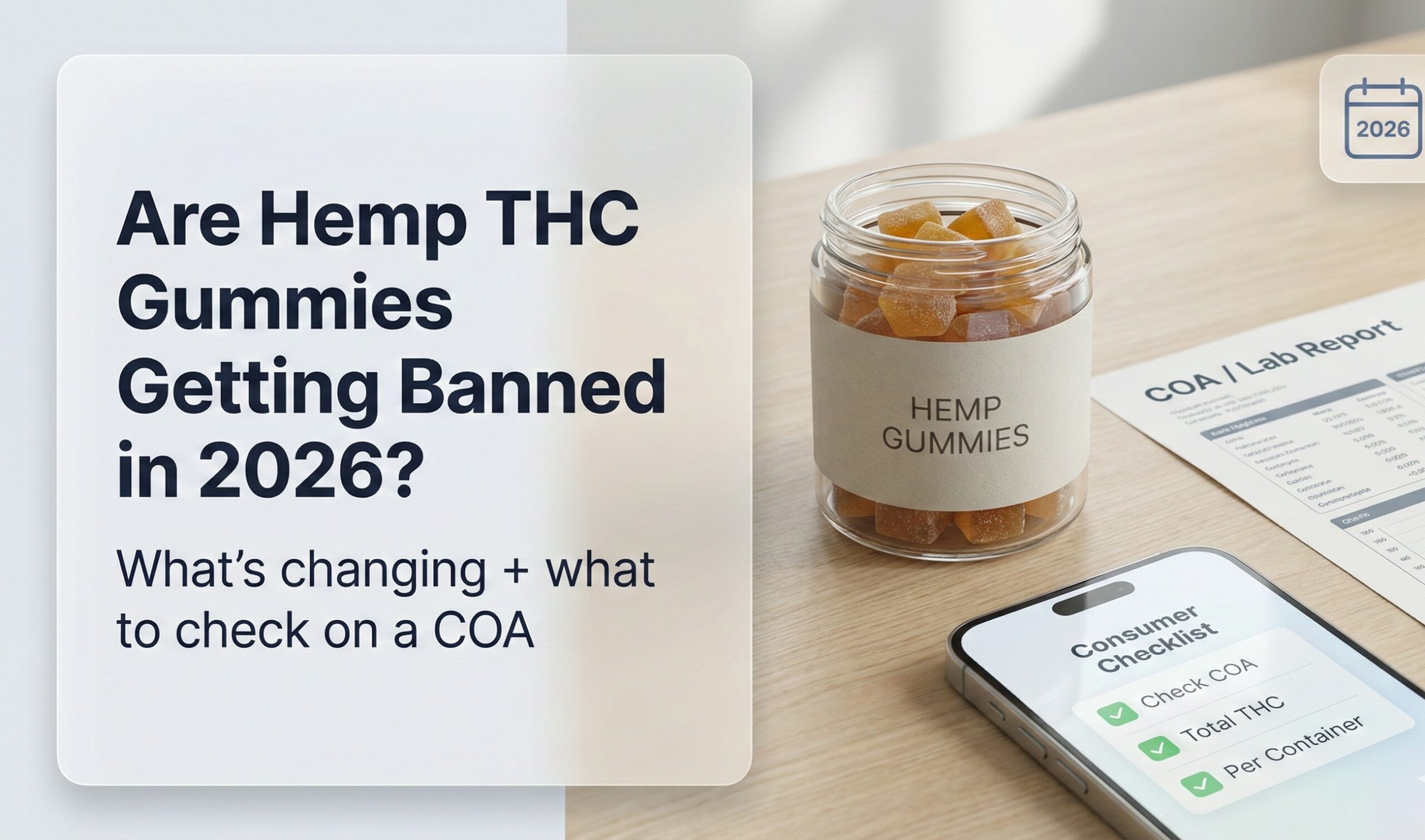
Quick Answer: Are Hemp-Derived THC Gummies Banned in 2026?
Not everywhere right now. As of May 2026, hemp-derived THC gummies are still available in many places, but a major federal hemp-definition change is scheduled to take effect on November 12, 2026. The biggest change is that the rule looks at total THC, not only delta-9 THC, and it includes a very strict limit for many finished hemp-derived consumer products.
For shoppers, the simple takeaway is this: do not trust only the front label. Check the COA, total THC, THCA, Delta-8, Delta-9, full package amount, batch number, and your state’s rules before buying gummies online.
Key Takeaways in 60 Seconds
- THC gummies are not automatically banned everywhere today, but 2026 is a serious transition year for hemp-derived cannabinoid products.
- November 12, 2026 is the big date shoppers and brands are watching because the federal hemp definition is scheduled to change.
- Total THC matters more than delta-9 THC alone. That means THCA and other THC-type cannabinoids can matter when reading a lab report.
- The container limit is the part many shoppers miss. A rule can apply to the full jar, bag, bottle, or package, not only one gummy.
- State rules still matter. A hemp-derived gummy may be treated differently in New York, California, Massachusetts, Washington, Florida, or another state.
- FDA approval is not the same as store availability. A CBD gummy being sold online does not mean it is FDA-approved.
- Your safest shopping habit: buy from transparent sellers, check the COA, match the batch number, and avoid products with mystery blends or medical cure claims.
Table of Contents
- May 2026 Update: What Is Changing?
- Current Hemp Gummy Rules vs November 2026 Changes
- What Is Changing in 2026 in Plain Language?
- Definitions That Matter: Total THC, THCA, Container, Finished Product
- Are CBD and THC Gummies Legal in Every State?
- Does FDA Approve CBD Gummies?
- Can You Buy CBD Gummies at Walmart or Amazon?
- Do THCA Gummies and Delta-8 Gummies Face the Same Issue?
- Shopper Checklist: What to Check Before Buying
- Smart Shopping Paths at Mary Jane’s Bakery Co
- FAQ
- Sources
May 2026 Update: What Is Changing?
A lot of shoppers are asking the same thing right now: are THC gummies getting banned in 2026? The honest answer is not a simple yes or no. Some hemp-derived gummies are still being sold today, but the rules around them are moving into a much stricter place.
The main issue is the federal hemp-definition change scheduled for November 12, 2026. Older hemp marketing often focused on whether a product had less than 0.3% delta-9 THC by dry weight. The new discussion is different. It focuses more on total THC, which can include THCA and other THC-type cannabinoids, depending on how the product is measured and classified.
That matters a lot for gummies because gummies are usually finished consumer products. They are already packaged, labeled, and ready for a customer to buy. So when a rule talks about a container limit, it can point to the full retail package, not just one piece inside the bag.
If you want a deeper breakdown of the package-limit side, read Mary Jane’s guide to the 0.4 mg THC per container rule. It explains why “per container” is not the same as “per gummy” or “per serving.”
Current Hemp Gummy Rules vs November 2026 Changes
This is where many buyers get confused. The old hemp conversation and the new hemp conversation are not exactly the same.
| Topic | What Many Shoppers Were Used To | What Changes in November 2026 |
|---|---|---|
| THC measurement | Most shoppers looked for “less than 0.3% delta-9 THC.” | The new definition focuses on total THC, including THCA, not only delta-9 THC. |
| Gummies and edibles | People often checked the mg amount per gummy or per serving. | The full retail container can matter, meaning the whole jar, bag, box, or bottle. |
| THCA products | Some shoppers treated THCA as separate from THC. | THCA can matter in total THC conversations because it may be counted in broader calculations. |
| Delta-8 and similar cannabinoids | Delta-8 was often sold as a hemp-derived option under the older hemp market. | THC-like cannabinoids and synthesized/manufactured cannabinoids may face much tighter treatment. |
| Online shipping | Many products shipped where state rules allowed. | Brands may limit shipping, reformulate products, or remove certain products before the effective date. |
| State laws | Some buyers assumed federal hemp rules answered everything. | State rules still matter and may be stricter than the federal baseline. |
Plain-English takeaway: a gummy can look simple on the front label but still be complicated on the lab report. In 2026, the real answer depends on the full formula, total THC, COA, package size, state rules, and how the seller handles shipping.
What Is Changing in 2026 in Plain Language?
For years, many hemp gummies were marketed around one number: delta-9 THC. That made shoppers ask questions like, “Is this under 0.3% delta-9 THC?” But the 2026 rule change moves the conversation toward total THC and finished-product limits.
Why does that matter? Because a gummy may contain more than one THC-related compound. It might list Delta-8, Delta-9, THCA, Delta-10, or other cannabinoids on the COA. Some of these may be treated differently depending on the rule, the state, and the product type.
If you want a simple refresher on the old hemp vs marijuana difference, start here: difference between hemp and marijuana.
Definitions That Matter: Total THC, THCA, Container, Finished Product
1) What “total THC” means
Total THC is a broader way of looking at THC-related content. It does not only focus on delta-9 THC. In many legal and lab-report conversations, total THC can include THCA because THCA can convert into delta-9 THC under certain conditions.
That is why a shopper should not stop at the front label. The COA is where you look for the full cannabinoid panel.
Helpful Mary Jane guides:
2) What “container” means for gummies
In plain shopping language, the container usually means the retail unit you buy. Think about the jar, bag, bottle, pouch, or box. For gummies, that can mean the full pack, not one gummy.
This is important because many shoppers only look at “mg per gummy.” That is not enough anymore. You also need to ask:
- How many gummies are in the package?
- What is the total cannabinoid amount in the full container?
- Does the COA show Delta-8, Delta-9, THCA, or other THC-type cannabinoids?
- Does the COA match the exact batch or lot number?
3) What “finished product” means
A finished product is the consumer-ready item. Gummies, drinks, tinctures, vapes, chocolates, and packaged edibles can all fall into this kind of buyer-facing category when they are already labeled and ready for sale.
This matters because the 2026 rule discussion treats finished consumer products differently from bulk ingredients or intermediate materials. For a regular shopper, the takeaway is simple: read the label and COA for the actual product you are buying, not just a general brand claim.
4) What “intermediate product” means
An intermediate product is usually something not yet in its final retail form. It may be an extract, ingredient, or material used before the final consumer product is made. Most shoppers are not buying intermediate hemp material. They are buying finished products, like gummies.
Are CBD and THC Gummies Legal in Every State in 2026?
No, shoppers should not assume CBD gummies or THC gummies are legal in every state just because the product says “hemp-derived.” Federal hemp rules are one layer. State hemp, cannabis, edible, packaging, age, and shipping rules are another layer.
This is one of the biggest reasons buyers get confused. A product may be sold in one state, restricted in another, and unavailable for shipping to a third state. Some states also treat Delta-8, Delta-9, THCA, CBD edibles, and hemp-derived intoxicating products differently.
States shoppers often ask about
- New York: hemp-derived THC and THCA products can face stricter cannabis-market rules than many shoppers expect.
- California: intoxicating hemp products have faced tighter restrictions, so buyers should not assume all hemp gummies can be sold or shipped there.
- Massachusetts: CBD-only products, hemp-derived THC products, and edibles may be treated differently depending on format and labeling.
- Washington: hemp-derived cannabinoid products can face state-level limits that are separate from federal hemp wording.
- Florida: shoppers should follow current Florida hemp rules and also watch the federal 2026 timeline.
- Arizona, Virginia, and Michigan: rules can change, especially around Delta-8, THC edibles, and online shipping.
Important: this is not a state-by-state legal guide. The safe move is to check your state’s current hemp or cannabis rules before buying. Also check the seller’s shipping policy because stores may restrict checkout even before a law fully changes.
For Florida-specific reading, see: Florida Hemp Law Update 2026.
Does FDA Approve CBD Gummies?
No, shoppers should not assume a CBD gummy is FDA-approved just because it is sold online, in a smoke shop, or on a marketplace. FDA has approved certain cannabis-derived or cannabis-related drug products, but ordinary CBD gummies sold as general wellness products are not the same thing as FDA-approved medicine.
FDA has also warned about CBD products sold with unproven medical claims, unclear quality, or unsafe marketing. So if a gummy brand promises to cure a disease, treat a condition, or replace medical care, that is a red flag.
What this means for shoppers
- Do not buy CBD gummies based only on big claims.
- Look for a batch-specific COA.
- Check whether the CBD, THC, Delta-8, Delta-9, and THCA numbers are clearly shown.
- Avoid products that hide ingredients or use vague “proprietary blend” wording.
- If you take medication, are pregnant, nursing, or have a health condition, speak with a qualified healthcare professional before using CBD or THC products.
That may sound basic, but it is exactly where safer shopping starts. Good products should be clear about what they contain. They should not need fake medical promises to sell.
Can You Buy CBD Gummies at Walmart or Amazon in 2026?
Many shoppers search big retailers first. The problem is that large marketplaces can be confusing when it comes to CBD and THC products.
Some big-box retailers have carried certain hemp or CBD-related products in limited ways, often more around topical products than actual CBD gummies. That does not mean every store sells CBD gummies, THC gummies, or hemp-derived edibles. Availability can change by location, state rules, retailer policy, and product type.
Amazon can also be confusing because many listings use “hemp” wording without clearly showing real CBD or THC content. A product may say hemp gummies, but that does not always mean it contains CBD. It may be made with hemp seed oil or use broad marketing language that does not tell you much.
What to check before buying gummies from any marketplace
- Does the product clearly say CBD, Delta-8, Delta-9, THCA, or THC?
- Is there a real COA from a third-party lab?
- Does the COA match the batch or lot number?
- Does the seller explain shipping limits by state?
- Are the ingredients clear?
- Are there medical claims that sound too good to be true?
If you are shopping for real CBD or THC gummies, it is usually better to buy from a seller that clearly explains lab testing, cannabinoid content, product type, and shipping rules. Mary Jane’s Bakery Co carries CBD and THC products for adults 21+, with shipping across the U.S. where legal.
Do THCA Gummies and Delta-8 Gummies Face the Same Issue?
They can. The 2026 hemp-law conversation is not only about classic delta-9 THC gummies. It also affects how shoppers should think about THCA, Delta-8, Delta-10, and other THC-type cannabinoids.
THCA matters because it can show up in total THC calculations. Delta-8 matters because many Delta-8 products grew under the older hemp market, but the newer rule language is much tighter around THC-like cannabinoids and cannabinoids produced or manufactured outside the plant.
This does not mean every THCA or Delta-8 product has the same answer in every state. It means you should stop trusting simple label claims like “hemp-derived” or “legal THC.” Those phrases are not enough by themselves.
To understand the difference between common cannabinoids, read:
Confirmed vs Still Unclear
Some parts of the 2026 hemp change are clear enough for shoppers to pay attention to now. Other parts can still vary depending on state enforcement, product type, brand decisions, and future guidance.
| Topic | What Is Clear | What Can Still Vary |
|---|---|---|
| Total THC | The new definition moves away from delta-9-only thinking and focuses on total THC, including THCA. | How brands explain it on labels and how shoppers see it on COAs. |
| 0.4 mg container limit | Final hemp-derived cannabinoid products over the limit may no longer fit the hemp definition after the effective date. | How brands reformulate, stop selling, or change shipping before November 2026. |
| State rules | States can be stricter than federal hemp rules. | Each state’s treatment of CBD, Delta-8, Delta-9, THCA, edibles, and online shipping. |
| FDA role | FDA does not treat ordinary CBD gummies as broadly FDA-approved products. | Future regulatory pathways and enforcement priorities can change. |
| Online shopping | Shipping eligibility can change based on product type and destination. | Each store may adjust checkout rules differently. |
Bottom line: avoid any seller that says, “Everything is legal everywhere, no need to check.” That is not how 2026 hemp shopping works. The safer habit is to check the COA, check your state, and buy from a transparent seller.
Shopper Checklist: What to Check Before Buying Hemp Gummies in 2026
If you only do one thing after reading this guide, do this: open the COA and make sure it matches the exact product and batch you are buying.
1) Match the COA to the batch or lot number
- Look for a batch or lot number on the package.
- Confirm the COA shows the same batch or a clearly connected code.
- If the COA is old, missing, or generic, be careful.
2) Read the full cannabinoid panel
Do not only look at the front label. Check the lab report for CBD, Delta-8, Delta-9, THCA, total THC, and any other listed cannabinoids.
3) Check per gummy and per container
Many shoppers only check “mg per gummy.” In 2026, that is not enough. Also check:
- How many gummies are in the jar or bag
- The total amount in the whole package
- Whether the product shows total THC clearly
- Whether the COA lines up with the label
4) Watch for medical claims
A gummy brand should not promise to cure pain, anxiety, cancer, insomnia, or any disease. That type of claim is a major warning sign. Good sellers keep the information practical and product-focused.
5) Check state shipping rules before checkout
Even if a product is available online, it may not ship to every state. If checkout blocks your address, that usually means the seller is trying to follow state restrictions or internal compliance rules.
6) Store gummies safely at home
- Adults 21+ only.
- Keep away from children and pets.
- Do not drive after using THC products.
- Do not mix with alcohol or other intoxicating substances.
- If you are new, start low, go slowly, and wait before taking more.
For a calm safety overview, read: how to use THC products safely.
If you are researching because product experiences feel inconsistent, these guides can help:
Smart Shopping Paths at Mary Jane’s Bakery Co
If you are reading this because 2026 hemp rules feel confusing, the goal is not to panic. The goal is to shop more carefully. A good product should give you clear label information, batch testing, and realistic shipping details.
Path A: Browse hemp-derived Delta-9 edibles where available and lawful
If you are looking specifically for adult-use edibles, start here: Delta-9 THC edibles.
Path B: Explore CBD edible options
If you prefer CBD-focused products, this overview is a helpful starting point: CBD products guide.
You can also browse Mary Jane’s CBD edible selection here: CBD edibles for sale.
Path C: Compare CBD gummies before buying
If you want a simple CBD gummy example, see: CBD gummies 1000 mg guide.
Path D: Learn first, then buy
- Hemp vs marijuana
- Delta-8 vs Delta-9 vs CBD
- What is THCA?
- 2026 Hemp Cliff: Total THC and 0.4 mg Per Container Guide
- Can you fly with THC gummies in 2026?
Shipping note: Mary Jane’s Bakery Co ships across the U.S. where legal. If federal rules, state rules, or product-category restrictions change, checkout availability may also change. Always follow local laws.
FAQ
Are hemp-derived THC gummies illegal right now?
Not automatically everywhere. It depends on the product, the cannabinoids inside it, the COA, the package amount, your state rules, and how the seller handles shipping. Some hemp-derived cannabinoid products are restricted locally even before the federal 2026 change takes effect.
Are THC gummies banned in 2026?
Many hemp-derived THC gummies may be affected by the November 12, 2026 federal hemp-definition change, especially if they exceed total THC limits for finished consumer products. That does not mean every gummy has the same legal status in every state today.
What happens on November 12, 2026?
The new federal hemp definition is scheduled to take effect. It focuses on total THC, includes THCA in the total THC discussion, and excludes many final hemp-derived cannabinoid products that contain more than a tiny combined total amount per container.
What does “per container” mean for gummies?
It usually points to the retail package you buy, such as the jar, bag, bottle, pouch, or box. So if a package has many gummies, you should not only check one gummy. You should also look at the total amount in the full package.
Does THCA count toward total THC?
In many total THC approaches, THCA matters because it can convert into delta-9 THC. If you buy THCA products, read the COA carefully and check your local rules.
Are Delta-8 gummies affected by the 2026 hemp rule?
They can be. Delta-8 is one of the cannabinoids that caused a lot of attention around the hemp market after the 2018 Farm Bill. In 2026, shoppers should check whether Delta-8 is allowed in their state and how the product is listed on the COA.
Are CBD gummies legal in all U.S. states in 2026?
No. CBD gummies are not treated the same way in every state or marketplace. Some states may allow certain CBD products while restricting products with THC, Delta-8, THCA, or edible formats. Always check your state rules before buying.
Are CBD gummies FDA-approved?
Ordinary CBD gummies sold online or in stores are not broadly FDA-approved. FDA has approved a prescription CBD drug for specific seizure conditions, but that is not the same as general CBD gummies sold as consumer products.
Can you buy CBD gummies at Walmart in 2026?
Availability can vary by retailer, location, product type, and state rules. Some big retailers may carry certain hemp or CBD-related products, but that does not mean all Walmart stores sell CBD gummies or hemp-derived THC gummies.
Can you buy CBD gummies on Amazon?
Marketplace listings can be confusing. Many products use “hemp” wording, but that does not always mean they contain CBD. Before buying any gummy online, check whether the product has a real COA, clear cannabinoid content, and transparent seller information.
Are THCA gummies legal in New York in 2026?
New York has stricter cannabis and hemp-derived cannabinoid rules than many shoppers expect. Do not judge THCA gummies only by a hemp label. Check current New York rules, testing details, and legal retail requirements before buying.
Are CBD gummies legal in Massachusetts in 2026?
Massachusetts rules can differ based on whether the product is CBD-only, hemp-derived THC, or sold as an edible. Check the COA and current state rules before ordering.
Are CBD gummies legal in California in 2026?
California has taken a stricter approach toward some intoxicating hemp products. Shoppers should not assume that every hemp-derived gummy can be sold or shipped there.
Will online shipping stop for THC gummies?
No one can promise what every brand will do. Some brands may limit shipping to certain states, reformulate products, or adjust product lines before the effective date. Always verify shipping eligibility at checkout and follow local laws.
What should I do if a gummy feels too strong or not strong at all?
Experience can vary based on serving size, timing, food, body chemistry, and tolerance. If you are new, go slowly and avoid taking more too quickly. For a steady overview, see how to use THC products safely.
Sources
For transparency, here are official and regulatory sources that discuss hemp-definition changes, FDA cannabis/CBD policy, and related compliance context. These links are provided for reference, not legal advice.
- Congressional Research Service: Changes to the Statutory Definition of Hemp and Issues for Congress
- Congressional Research Service: Change to Federal Definition of Hemp and Implications for Federal Enforcement
- U.S. Code: Office of the Law Revision Counsel
- eCFR: Electronic Code of Federal Regulations
- USDA AMS: Hemp Rules and Regulations
- FDA: Regulation of Cannabis and Cannabis-Derived Products, Including CBD
- FDA Consumer Update: Products Containing Cannabis or Cannabis-Derived Compounds
Related Reading from Mary Jane’s Bakery Co
- The 0.4 mg THC Per Container Rule Explained
- 2026 Hemp Cliff: Total THC and 0.4 mg Per Container Guide
- Total THC vs Delta-9 THC
- Delta-9 THC Edibles
- CBD Products Guide
- CBD Edibles and CBD Gummies Guide 2026
- Difference Between Hemp and Marijuana
- THC Products Guide 2025
- What Is THCA?
- Can You Fly With THC Gummies in 2026?
Compliance reminder: Adults 21+ only. Follow local laws. This content is for general information and does not replace professional legal advice. No medical claims are made. Product availability and shipping eligibility can change based on federal, state, and local rules.