

Last updated: January 30, 2026
Drug testing rules, lab methods, and cutoffs vary by employer and program.
If you have a drug test coming up, this topic stops being “interesting.” It becomes a real decision.
And CBD tinctures are often described as hemp-derived and non-intoxicating, so it feels like it should be simple.
It is not always simple.
Here is the core idea to keep in your head:
most workplace drug tests are looking for THC (and THC metabolites), not CBD.
CBD usually does not trigger the test. THC exposure is the part that can create problems.
Quick answer (read this first)
- CBD is not what most tests are targeting. Tests typically target THC metabolites.
- Full spectrum CBD tinctures can contain THC (even if it is “trace” on the label).
- Broad spectrum and isolate may reduce risk, but there is no honest “zero risk” guarantee across the market.
- If your job or license depends on passing a test, the safest choice is to avoid cannabinoid products unless you have professional guidance.
- If you still shop, use a COA (lab report) and verify batch matching, THC values, and lab limits (ND/LOD/LOQ).
Read the official notice here:
DOT “CBD” Notice.
Want a quick CBD basics refresher (tinctures vs gummies vs vapes)? Start here:
CBD Products Guide.
Table of contents
- What drug tests look for (CBD vs THC)
- Test types (urine vs saliva vs hair vs blood)
- Why CBD products can still cause positives
- Full spectrum vs broad spectrum vs isolate (risk comparison)
- COA checklist (what to check before you buy)
- COA THC decoder: Delta-9 THC, THCA, Total THC, ND/LOD/LOQ
- If you are tested at work (practical options)
- CBD tinctures to browse (Mary Jane’s Bakery Co)
- FAQ
- Sources
What Drug Tests Look For (CBD vs THC)
Most workplace “cannabis” testing is not searching for CBD. It is typically designed to detect THC exposure by measuring THC metabolites.
Many programs follow a screen + confirmation approach (for example, a common framework referenced by SAMHSA uses a 50 ng/mL initial cutoff and a 15 ng/mL confirmatory cutoff for the THC metabolite used in testing).
See:
SAMHSA Medical Review Officer Manual (PDF).
That is why “CBD only” sounds safe in theory.
The real risk for many people is not “CBD showing up.” It is THC being present in a product or accumulating through consistent use.
Test Types (Urine vs Saliva vs Hair vs Blood)
People also search this because the type of test changes the conversation. Here is a plain, no-hype overview.
Detection windows vary widely and are affected by frequency of use, body chemistry, and the exact lab method. Do not treat charts as promises.
| Test type | What it usually detects | Practical note |
|---|---|---|
| Urine | THC metabolites (not CBD) | Most common workplace test; positives are tied to THC exposure |
| Saliva (oral fluid) | More recent THC exposure | Often used for “recent use” scenarios; policies vary |
| Blood | Very recent THC exposure | Less common for standard workplace screening |
| Hair | Longer look-back window for THC exposure | Less common, but higher anxiety because people feel “stuck” with the results |
For a general overview of how long THC can be detected across different test types (again: not a promise), see:
Healthline: How long does weed stay in your system?
Why CBD Products Can Still Cause Positives
1) Full spectrum products may contain THC
“Full spectrum” usually means CBD plus other cannabinoids and plant compounds. That can include THC at low levels.
A well-cited open-label study reported that some consistent users of a full-spectrum, hemp-derived CBD extract had positive urinary drug screens for the THC metabolite used in workplace testing.
You can read the research summary here:
JAMA Psychiatry study.
2) Labels and “THC-free” claims can be unreliable
Some products contain more THC than shoppers expect, and “THC-free” wording does not always match lab reality.
Consumer-facing explainers point out that CBD itself should not cause a positive test, but THC in the product can.
See:
Healthline: Does CBD show up on a drug test?.
3) Small THC exposure can matter for some people
People metabolize cannabinoids differently. Frequency of use matters. Product quality matters.
Some people never have issues. Others do, especially with consistent full-spectrum use or products with unexpected THC content.
If your risk tolerance is near zero, the safest choice is to avoid cannabinoid products unless you have professional guidance.
Full Spectrum vs Broad Spectrum vs Isolate (Risk Comparison)
| Type | What it usually means | Drug test risk (plain language) |
|---|---|---|
| Full spectrum | CBD + other cannabinoids + terpenes; may include THC | Higher risk because THC may be present and can accumulate |
| Broad spectrum | CBD + other compounds; THC removed as much as possible (still confirm via COA) | Lower risk than full spectrum, but not a guarantee |
| CBD isolate | CBD only (in theory); quality control still matters | Lowest risk, but avoid “zero risk” claims |
If you want the simple version of terpenes (often mentioned with full spectrum), read:
What are terpenes?
If you want a baseline explanation of hemp vs marijuana (and why hemp can still include trace THC), see:
Difference between hemp and marijuana.
COA Checklist (What to Check Before You Buy)
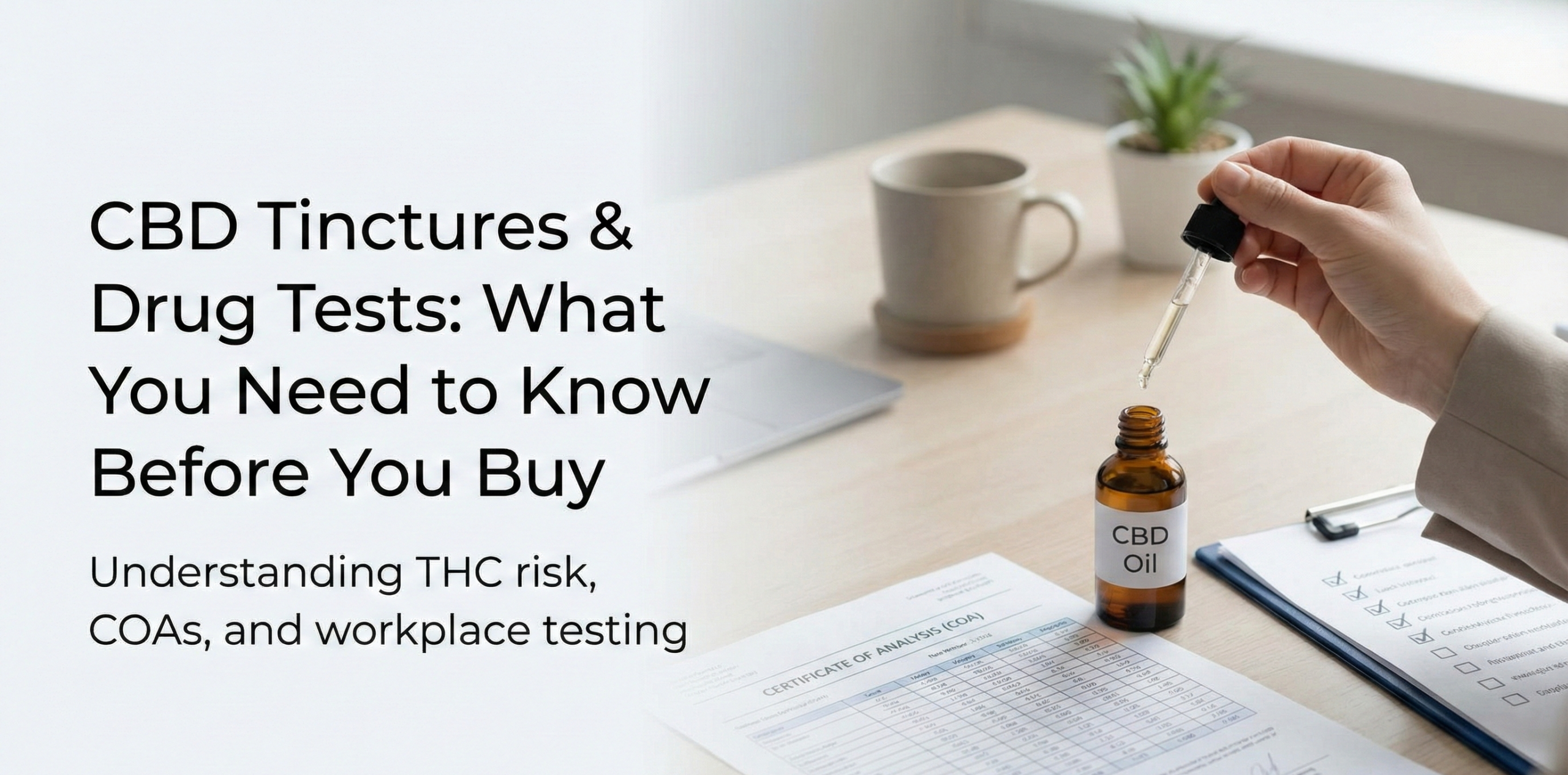
COA means Certificate of Analysis. It is the batch lab report.
If you are drug-test cautious, COAs matter more than labels.
If you also want to understand tincture strength numbers (mg per bottle vs mg/mL) before you shop, use this quick guide:
CBD Tincture Strength Guide (1000 vs 5000 vs 10,000 mg).
- Batch/lot match: The COA should match the batch listed on the product (or clearly state which batch it covers).
- Cannabinoid panel: Confirm CBD levels and check THC-related lines (Delta-9 THC, THCA, Total THC).
- Lab limits: Understand ND, LOD, LOQ (explained below). “ND” is not the same as “zero.”
- Contaminants: Heavy metals, pesticides, residual solvents, microbials (when included).
- Date + lab identity: Recent testing, lab name, and clear methods. If it looks vague, treat it as a red flag.
If your risk tolerance is near zero, the safest choice is to avoid cannabinoid products unless you have professional guidance.
COA THC Decoder: Delta-9 THC, THCA, Total THC, ND/LOD/LOQ
1) Delta-9 THC
This is the THC line most people recognize. If you are drug-test cautious, you should not ignore it.
2) THCA (the “precursor”)
THCA is often listed on COAs. It can convert to THC with heat. Some programs and rules care about “total THC” rather than only Delta-9 THC.
3) Total THC (the simple formula)
A common reference formula is:
Total THC = (THCA × 0.877) + THC.
The 0.877 factor is used because the molecule changes during conversion.
Reference:
Connecticut: How is total THC calculated?
4) ND, LOD, LOQ (why “ND” is not the same as “zero”)
- ND (Not Detected): Not detected above the lab’s detection limit.
- LOD (Limit of Detection): The lowest level the lab can reliably detect.
- LOQ (Limit of Quantification): The lowest level the lab can reliably quantify.
Helpful COA reading reference:
New Jersey: How to Read a COA (PDF).
If You Are Tested at Work (Practical Options)
Option 1: If the test truly matters, pause cannabinoid products
This is the closest thing to “low risk.” If you are DOT regulated, safety-sensitive, or in a strict employer program,
it is not worth gambling on product labels.
Option 2: If you still choose CBD, do not shop blind
Read COAs, confirm batch matching, and be honest about your risk tolerance.
Full spectrum tends to carry more THC exposure risk than broad spectrum or isolate, but there is no universal guarantee.
Option 3: Ask what program you are actually under
- Is it DOT/safety-sensitive testing or a company policy?
- What test type is it (urine, saliva, hair, blood)?
- Is there a medical review officer (MRO) process for confirmed positives?
For adult safety basics (non-medical, practical), see:
How to use THC products safely.
CBD Tinctures to Browse (Mary Jane’s Bakery Co)
If you want to browse tinctures, start here:
CBD Oil Tinctures.
We ship across the U.S. where legal (rules vary by state).
1) 1,000 mg Full Spectrum CBD Tincture
A lower-strength option in the tincture lineup.
2) 5,000 mg Full Spectrum CBD Oil Tincture
A higher-concentration option for experienced shoppers.
3) 10,000 mg Full Spectrum CBD Oil Tincture
The most concentrated option in this lineup.
If you want to compare strengths clearly, use:
CBD Tincture Strength Guide.
FAQ
Will CBD show up on a drug test?
Most workplace tests are looking for THC metabolites, not CBD. The risk usually comes from THC being present in the product or accumulating with consistent use.
Can full spectrum CBD tinctures cause a positive THC result?
They can, especially with consistent use. Research and lab commentary report that some full-spectrum CBD users had positive urinary screens for THC metabolites.
Is broad spectrum CBD safer for drug testing?
Broad spectrum products are designed to reduce THC exposure, but you should still confirm the COA. There is no universal “zero risk” promise across the market.
Does CBD isolate guarantee I will pass?
No brand can honestly guarantee that. Isolate may reduce risk because it is intended to contain CBD only, but product quality and your specific testing program still matter.
What does ND mean on a COA?
ND means “Not Detected” above the lab’s limit of detection. It does not always mean “zero.” Check the lab’s LOD and LOQ values.
What if a product says “THC-free” but the COA shows THC?
Trust the COA over marketing text. If THC shows up on the COA and you are drug-test cautious, that product is not a good fit for your situation.
Can secondhand exposure cause a positive test?
It is generally considered unlikely in normal situations, but extreme exposure scenarios can still raise questions.
If passing a test is critical, do not rely on “unlikely” as a strategy.
Sources
References included for transparency and general education (not medical or legal advice):
- DOT “CBD” Notice:
transportation.gov - SAMHSA Medical Review Officer Manual (cutoffs and testing framework):
samhsa.gov (PDF) - Healthline: Does CBD show up on a drug test?
healthline.com - Quest Diagnostics: Full-spectrum CBD may trigger positive THC result:
questdiagnostics.com - JAMA Psychiatry study: Urinary THC after 4 weeks of full-spectrum hemp-derived CBD:
jamanetwork.com - How to Read a COA (NJ Cannabis Regulatory Commission):
nj.gov (PDF) - Total THC formula reference:
portal.ct.gov
COAs help, but they do not create a zero-risk promise.