

Updated Feb 10, 2026
THCA • Delta-9 • Total THC
Quick answer
Total THC is a calculation that estimates the maximum potential THC in a product by adding:
delta-9 THC + THCA after conversion. That conversion uses the factor 0.877.
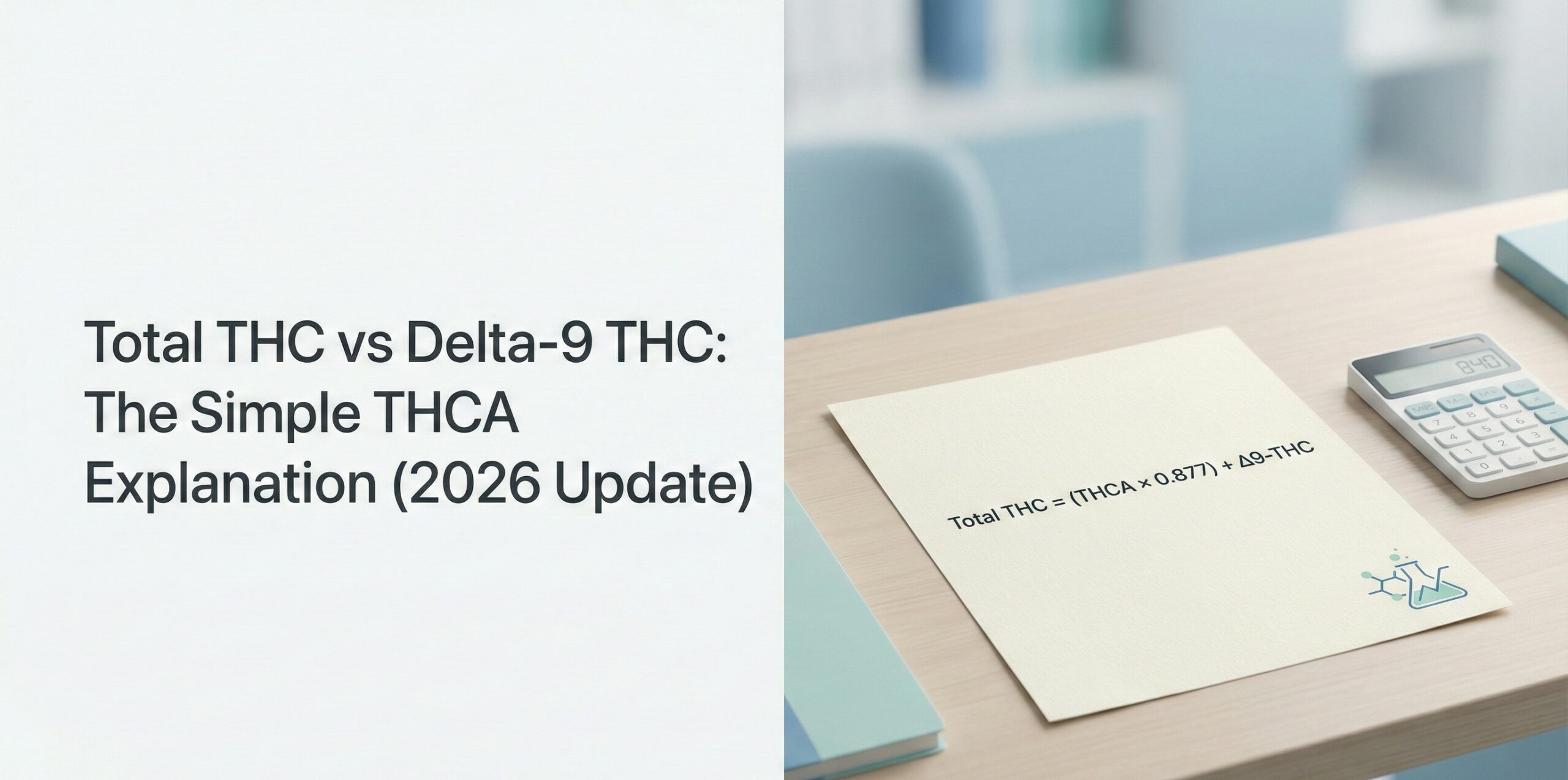
Total THC = (THCA × 0.877) + Δ9-THCKeep reading for simple examples, why 0.877 exists, how to read a COA, and what “total THC” changes may mean heading into late 2026.
1) What “total THC” means
Most labels show delta-9 THC because that’s the THC most people recognize. But a lot of cannabis/hemp chemistry shows up in the
“before heat” form — especially THCA.
THCA is the acidic precursor to THC. On its own, THCA is generally described as non-intoxicating, but when heat is applied
(smoking, vaping, baking), THCA can convert into delta-9 THC through a reaction called decarboxylation.
If you want the basics first, read: What is THCA?
“We are counting delta-9 THC plus the THC that can form from THCA.”
2) The formula (and what each part means)
Total THC = (THCA × 0.877) + Δ9-THCYou’ll see this exact approach in official hemp testing language, including the federal hemp program rules that define how labs estimate total THC.
A clean reference for the formula appears in the Code of Federal Regulations for the USDA hemp program.
(Official reference: 7 CFR Part 990)
| Piece | What it is | Why it shows up on COAs |
|---|---|---|
| Δ9-THC | The “active” THC that’s already present as delta-9 THC. | It’s the number people recognize, and it is commonly regulated. |
| THCA | The acidic precursor found in raw flower (and many THCA products). | It can convert into delta-9 THC with heat. |
| 0.877 | A conversion factor used to estimate how much THC could result from THCA. | It helps standardize reporting for “total THC” style rules. |
In official rule explanations, the “total THC” formula is described as a theoretical maximum because it assumes 100% conversion.
(See the USDA final rule discussion in the Federal Register:
Federal Register, Jan 19, 2021)
3) Why the number 0.877 shows up
0.877 looks random until you know what’s happening chemically.
When THCA converts into THC, a small part of the molecule (a CO₂ group) is removed. That means the resulting THC has less mass than THCA.
The 0.877 factor reflects that molecular weight difference — basically a standardized way to estimate “potential THC” from measured THCA.
Some state-level explainers also mention 0.877 directly, including Connecticut’s government knowledge base.
(See: Connecticut: How is total THC calculated?)
4) Two real examples (flower % + edibles mg)
Example A: Hemp/THCA flower (percent on a COA)
Let’s say a COA shows:
- Δ9-THC = 0.2%
- THCA = 25.0%
Total THC = (25.0 × 0.877) + 0.2 = 21.925 + 0.2 = 22.125%This is why people get confused: the label might talk about “low delta-9,” but the COA can still show a high total THC once THCA is included.
If you want the bigger picture difference between plant categories, this helps:
Hemp vs marijuana (simple guide).
Example B: Gummies/edibles (mg per serving)
Now let’s use milligrams, because edible COAs often list cannabinoids per serving or per gram.
Suppose a gummy’s COA shows:
- Δ9-THC = 2 mg per serving
- THCA = 3 mg per serving
Total THC (per serving) = (3 × 0.877) + 2 = 2.631 + 2 = 4.631 mgThat’s why it’s smart to check both the serving size and the total count of servings.
Related read: The 0.4 mg THC per container rule explained.
5) How to read a COA for total THC (the quick checklist)
A COA (Certificate of Analysis) is basically the product’s lab report. If you’re trying to understand total THC, this is the simplest way
to read it without getting lost.
COA checklist for “total THC”
- Find the cannabinoid panel and locate both Δ9-THC and THCA.
- Confirm the units (percent, mg/g, or mg per serving). If it’s mg/g, remember: 10 mg/g = 1%.
- Look for batch/lot ID and make sure it matches the product packaging.
- Check the lab name and testing date (fresh COAs are better than years-old PDFs).
- Scan for “ND” (non-detect) and “LOQ” (limit of quantitation). ND doesn’t always mean “zero,” it means “below the method’s limit.”
- Don’t stop at delta-9: if THCA is high, “total THC” can be high.
For a Miami-specific legality overview, read:
CBD vs Delta-8 vs THCA in Miami.
If you want a deeper format comparison (edibles vs drinks vs topicals) with a COA verification section, this guide is built for that:
Delta-9 edibles vs THC drinks vs THC topicals (2026 guide).
6) Why “total THC” matters more in 2026
The short version: policy language is tightening. Historically, a lot of public discussion focused on “delta-9 THC” alone.
But more frameworks now reference total THC concepts that include THCA conversion math.
with the change taking effect on November 12, 2026.
(Reference: CRS IN12620)
Florida is also actively debating how to define and regulate hemp products in 2026. Florida’s SB 1270 (filed) includes a “total delta-9 THC concentration”
definition that uses a THCA conversion factor as part of the math.
(Reference: Florida Senate SB 1270 (Filed text))
COAs, batch accuracy, packaging/labeling, and “total THC” style interpretations.
For Florida-specific shopping clarity, also see:
Florida hemp law update (2026).
7) Common mistakes (that cause most of the confusion)
Mistake 1: Thinking “delta-9 THC” tells the whole story
Delta-9 is only one part. If THCA is present, “total THC” can be very different from the delta-9 number alone.
Mistake 2: Mixing up percent vs mg
Percent is a ratio by weight. mg is a mass measurement. COAs can report either.
If your COA uses mg/g, remember: 10 mg/g = 1%.
Mistake 3: Assuming total THC equals “how strong it will feel”
Total THC is a standardized estimate — not a guaranteed experience.
Conversion varies with heat, time, product type, and how something is actually used.
Mistake 4: Ignoring safety basics
Hemp-derived THC products (including THCA products after heating) can be intoxicating.
Keep products away from kids and pets. Start low, go slow with edibles.
If you want a simple safety overview, read:
Common side effects of Delta-8, Delta-9 & THCA.
8) FAQ
Is THCA included in total THC?
In “total THC” style calculations, yes — THCA is included by converting it with the factor 0.877, then adding delta-9 THC.
(Formula reference: 7 CFR Part 990)
Why is the number 0.877 used?
Because THCA loses mass when it converts to THC (it drops a CO₂ group during decarboxylation). 0.877 is a standardized conversion factor used to estimate potential THC.
(See: CT gov explainer)
If my delta-9 is low, does that mean it’s “weak”?
Not necessarily. If THCA is high, total THC can still be high. Always check both delta-9 THC and THCA on the COA.
Is total THC a “guarantee” of effects?
No. It’s a standardized estimate and often discussed as a theoretical maximum because the math assumes complete conversion.
(See the USDA final rule explanation:
Federal Register discussion)
What changes in November 2026?
The Congressional Research Service describes a shift to a “total THC” definition for hemp under new federal language, with an effective date of Nov 12, 2026.
(Reference: CRS IN12620)
Where can I learn the basics of THCA first?
Start here: What is THCA? and then:
Is THCA natural or synthetic?
How do I decide between edibles, drinks, or topicals?
Timing and intensity can vary by format. This guide breaks it down with a COA checklist:
Delta-9 edibles vs THC drinks vs THC topicals (2026)