

Updated May 2026. Reviewed for general hemp product safety, Florida hemp label requirements, and consumer product-checking guidance.
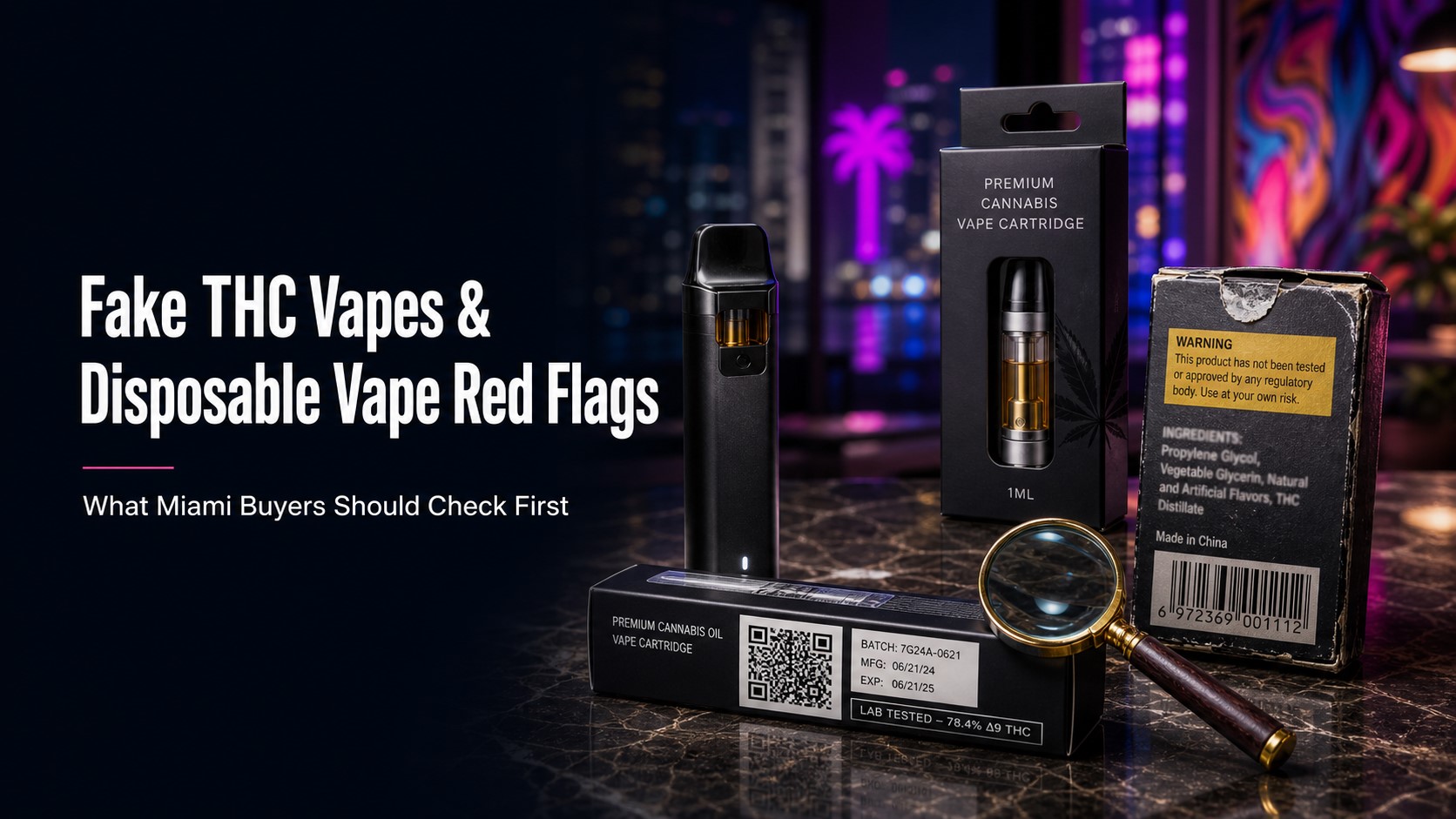
Fake THC Vapes and Disposable Vape Red Flags: What Miami Buyers Should Check First
Fake THC vapes are not always obvious. That is the tricky part. Some look cheap right away, with bad printing or strange packaging. Others look clean enough that a buyer may not notice anything wrong until they scan the QR code, check the label, or ask where the product came from.
If you are buying a disposable vape, THC cart, Delta-8 vape, CBD vape, or hemp-derived vape in Miami, it is worth slowing down for a minute. Check the source. Look for a QR code, COA, batch number, expiration date, clear label, sealed packaging, and a device that does not look damaged. Also pay attention to the seller. If they cannot explain the product at all, that is not a good sign.
This guide is written for adults who want a simple way to check vape products before buying. No scare tactics. No complicated lab talk. Just the basic red flags that are worth knowing before a late-night smoke shop run in Wynwood, a weekend visit to Miami, or a quick stop before heading out.
Quick Answer: How Do You Spot Fake THC Vapes?
A fake or questionable THC vape may have missing product details, a QR code that does not work, no Certificate of Analysis, no batch number, no expiration date, blurry packaging, copied branding, leaking hardware, strange oil appearance, or a price that feels too cheap to trust.
One red flag does not always prove a vape is fake. But it is enough reason to pause. A real-looking box does not mean much if the product cannot be verified. A QR code helps, but only if it opens a real lab report that matches the product and batch in your hand.
Fake THC Vape Red Flags at a Glance
| Red Flag | Why It Matters | What to Do |
|---|---|---|
| No QR code | You may not be able to check lab testing | Ask for COA access or choose something else |
| No COA | No clear lab report is available | Do not rely only on package claims |
| No batch number | The product may not be easy to trace | Look for batch or lot details |
| No expiration date | You do not know the product age | Choose a clearly labeled product |
| Blurry packaging | Can point to poor packaging or copycat design | Check the brand and label details |
| Very cheap price | May be a warning sign when other details are missing | Compare the full product, not only the price |
| Leaking or damaged device | Could be hardware, storage, or quality trouble | Do not use a damaged vape |
| Random seller | The source may be unclear | Buy from a real store with product information |
Real vs Fake THC Vape: A Simple Comparison
This is not a perfect test, but it helps. A questionable vape usually gives you less information, not more. A more trustworthy product makes the basics easier to check.
| What to Check | More Trustworthy Vape | Red Flag Vape |
|---|---|---|
| QR code | Scans to a product-specific COA or lab report | No QR code, broken QR code, or unrelated page |
| COA | Matches the product name and batch number | Missing, outdated, vague, or mismatched |
| Batch number | Printed clearly on the package | Missing or different from the COA |
| Expiration date | Easy to read | Missing, scratched off, or unclear |
| Packaging | Sealed, readable, and adult-focused | Blurry, copied, childish, or full of loud claims |
| Seller | Can explain the product and label | Only says “trust me” or “it’s strong” |
| Price | Makes sense for a tested retail product | Suspiciously cheap with no verification |
Why Fake THC Vapes Are a Real Concern
The main problem with fake or unverified vapes is simple: you may not know what is inside. The package might say THC, Delta-8, hemp-derived THC, or something else, but without a matching lab report and clear label, the buyer is mostly guessing.
The CDC recommends that people avoid THC-containing vaping products from informal sources, including friends, family members, in-person dealers, or online dealers. The CDC also says vitamin E acetate is strongly linked to the EVALI outbreak and should not be added to vaping products.
The FDA has also reported vitamin E acetate findings in THC product samples tested by FDA and state labs, along with patient lung fluid samples tested by CDC. This does not mean every vape is the same. It does mean the source, label, and test information matter.
So the safest habit is not complicated: avoid mystery vapes. If the product source is unclear and the label cannot be checked, walk away.
Red Flag #1: No QR Code or COA
A missing QR code or missing COA is one of the biggest warning signs. This is especially true with hemp-derived THC vapes, Delta-8 vapes, CBD vape cartridges, and disposable vape products.
A COA, or Certificate of Analysis, is a lab report. It can help show product details like cannabinoid levels, batch information, and testing results. A QR code should make that report easy to find.
Florida hemp extract rules say qualifying hemp extract containers must include a scannable barcode or QR code linked to the certificate of analysis. The container should also include batch number, website for batch information, expiration date, and the milligrams of marketed cannabinoids per serving. You can read the rule in Florida Statute 581.217.
When you scan a vape QR code, check the basics:
- Does the QR code actually scan?
- Does it open a real lab report?
- Does the report match the product name?
- Does the batch number match the package?
- Can you see cannabinoid results?
- Is the lab name visible?
- Does the report look product-specific, not random?
A QR code is only a starting point. If it opens a broken page, a vague homepage, an old report, or a report for another product, that is still a red flag.
How to Check a THC Vape COA in About 60 Seconds
You do not need to be a lab expert. Just check whether the information lines up.
- Scan the QR code on the package.
- Make sure it opens a lab report, not just a homepage.
- Compare the product name on the report with the package.
- Compare the batch number or lot number.
- Look at the report date.
- Check whether the cannabinoid results match the label claim.
- Look for contaminant testing if the report lists it.
- Ask staff if anything looks confusing.
If the COA does not match the product name, batch number, or label details, do not brush it off. A lab report only helps when it clearly belongs to the product you are holding.
Can Fake THC Vapes Have Fake QR Codes or Fake Lab Tests?
Yes, they can. A QR code by itself does not prove the vape is real. Some questionable products may use QR codes that lead to a vague page, an unrelated report, an outdated COA, or a document that does not match the product batch.
That is why matching the details matters. Product name, batch number, report date, and cannabinoid results should all make sense together.
Be careful with screenshots too. A random screenshot of a lab report is not the same as a traceable COA connected to the actual package. If someone cannot explain the product and only shows you a picture, that is not enough.
Red Flag #2: No Batch Number, Expiration Date, or Clear Label
A vape product should not make you guess what it is. The label should be clear enough that an adult buyer can understand the product before buying it.
Look for the product name, cannabinoid type, amount, batch or lot number, expiration date, ingredients, and brand or manufacturer information. The batch number helps connect the package to a lab report. The expiration date gives you a basic freshness window.
Be careful with packaging that says things like “premium,” “extra strong,” or “top shelf” but gives no real details. Big claims are easy to print. Traceable information matters more.
Red Flag #3: The Seller or Source Feels Unclear
Where the vape comes from matters. A product from a random seller, party seller, friend of a friend, or unverified online deal usually gives you less protection and less information.
This comes up a lot in Miami because people may be buying before a night out, during a busy weekend, while visiting from out of town, or during a late-night stop. That is when a cheap “deal” can seem tempting.
But if a seller has no label, no QR code, no COA, and no clear explanation, that is not really a deal. It is a risk you cannot check.
A real store should be able to help you understand what the product is, where the QR code is, what the COA shows, and whether the packaging is sealed.
Red Flag #4: Packaging Looks Copied, Blurry, or Too Loud
Packaging is not proof by itself. Still, bad packaging can be a clue.
Watch for:
- Blurry print
- Misspelled words
- Broken seals
- No brand or manufacturer details
- Packaging that copies famous candy or snack brands
- Cartoon-style designs that look aimed at younger people
- Claims that sound unrealistic
- Nice-looking boxes with no real verification details
Some questionable products look polished, so do not judge by design alone. Ask one question: can the product information be verified?
Red Flag #5: The Price Looks Too Cheap
A low price does not automatically mean a vape is fake. Stores run discounts. Products go on sale. That happens.
But if the price is extremely low and the product also has no QR code, no COA, no batch number, no expiration date, and no clear seller source, that is a bigger warning sign.
Real testing, packaging, sourcing, and retail handling cost money. If a vape is being sold like a mystery item with a bargain price, compare more than the price. Compare the label, the test access, the packaging, the source, and whether anyone can answer basic questions.
Red Flag #6: Oil Looks Strange or the Device Looks Damaged
Oil appearance alone does not prove a vape is fake. Different formulas can look different. But if the oil looks strange and the label is also unclear, it is worth stopping.
Be careful with:
- Dark, cloudy, watery, or separated oil
- Oil that looks unusually thin
- Leaking around the mouthpiece or base
- Cracked mouthpiece
- Loose hardware
- Swollen or damaged battery area
- Burnt smell before use
- A device that feels hot, cracked, or poorly built
Some vape problems are regular device issues. Others are signs the product should not be used. If your device is blinking or not pulling, our guide on why your vape is blinking and not hitting may help. If a disposable is leaking, read our guide on disposable vape leaking into your mouth before trying to keep using it.
If a vape is cracked, swollen, badly leaking, or feels unsafe, do not force it. Replace it.
Disposable Vape Red Flags Buyers Should Not Ignore
Disposable vapes need their own check because the battery, mouthpiece, chamber, oil, and label are all part of the product. If something looks off, it is better to stop before using it.
- No sealed mouthpiece or broken seal
- Device feels unusually hot before use
- Battery area looks swollen or damaged
- Mouthpiece is cracked or loose
- Oil leaks from the device
- Label does not show cannabinoid type or amount
- No QR code, batch number, or expiration date
- Seller cannot explain the device or source
A disposable can leak or clog because of heat, sideways storage, or pressure changes. That does not automatically mean it is fake. But a damaged device with unclear product information is not something to ignore.
Red Flag #7: The Seller Cannot Explain the Product
A seller does not need to explain every lab detail. But they should be able to answer basic questions.
Before buying, you should be able to ask:
- What cannabinoid is inside?
- Is this CBD, Delta-8, hemp-derived THC, or another blend?
- Where is the QR code?
- Where is the COA?
- Does the batch number match the report?
- Is the package sealed?
- What does the label say about ingredients?
- How should the device be stored?
If the answer is only “trust me,” that is not enough.
What a Real Vape Product Should Show
| Product Detail | Why It Helps |
|---|---|
| QR code or barcode | Helps access a lab report or COA |
| COA | Shows product testing details |
| Batch number | Helps match the package to the lab report |
| Expiration date | Shows the freshness window |
| Cannabinoid amount | Helps buyers understand label strength and contents |
| Ingredient list | Helps identify what is inside |
| Brand or manufacturer details | Adds traceability |
| Sealed packaging | Helps show the product was not opened |
| Staff explanation | Helps buyers understand what they are buying |
If you are shopping for CBD vape cartridges or hemp-derived vape products, these are the details worth checking before you buy.
What Should You Do If You Think You Bought a Fake Vape?
If something feels wrong after you already bought a vape, stop and check it. Do not keep using a device just because you paid for it.
- Stop using it if the device looks damaged, swollen, leaking, cracked, or unsafe.
- Do not open, refill, modify, or repair a suspicious vape.
- Save the package, receipt, QR code, and photos if you need to ask the store about it.
- Scan the QR code again and compare the batch number to the COA.
- Stop using the product if the COA does not match or the source feels unclear.
- If you feel unwell after using any vape product, seek medical help.
The FDA also advises consumers not to buy vaping products from the street and not to modify or add substances to products bought in stores. If something looks suspicious, it is better to stop than to take chances.
Miami Buyer Checklist Before Buying a Disposable Vape
Before buying a disposable vape or THC cart in Miami, run through this quick check:
- Is the product from a real store?
- Can staff explain the vape clearly?
- Does the package have a QR code?
- Does the QR code open a real COA?
- Does the batch number match the report?
- Is the expiration date readable?
- Is the packaging sealed?
- Does the device look clean and undamaged?
- Is the price realistic?
- Are the claims too loud or unrealistic?
- Would you still trust it if you were not in a rush?
This is useful whether you are shopping before a night out in Wynwood, visiting Miami for the weekend, or making a late-night smoke shop stop.
What About Delta-8 Vapes and Hemp-Derived Vape Products?
Fake vape concerns are not only about traditional THC carts. Buyers should also check labels and testing details on Delta-8 vapes, hemp-derived THC vapes, blended cannabinoid vapes, and CBD vape cartridges.
If you are comparing Delta-8 THC vaporizers in Miami, look for the same basic trust signals: QR code, COA, batch number, expiration date, clear cannabinoid details, sealed packaging, and staff who can explain the product.
The product type may change. The buyer checklist stays mostly the same.
Where to Buy Clearly Labeled Vapes in Miami
Mary Jane’s Bakery Co 24 Hour CBD THC Smoke Shop in Miami carries CBD and hemp-derived THC products for adult shoppers who want clearly labeled options and help understanding what they are buying.
If you are unsure how to read a QR code, COA, batch number, or expiration date, ask us. Our team can walk you through it in a simple way. We also carry product categories like CBD vape cartridges and other hemp products for adult customers.
If your current device seems clogged rather than fake, our guide on how to unclog a disposable vape safely may help. If you are still learning the basics, our THC product safety guide is another helpful place to start.
FAQ: Fake THC Vapes and Disposable Vape Red Flags
How do I know if a THC vape is fake?
You cannot always know by looking at it. But warning signs include no QR code, no COA, no batch number, no expiration date, unclear source, blurry packaging, copied branding, damaged hardware, very cheap pricing, or a seller who cannot explain the product.
Should THC vapes have a QR code?
Hemp extract products sold in Florida should include QR code or barcode access to a certificate of analysis, along with batch number, expiration date, and cannabinoid milligram information. If there is no way to verify the product, that is a red flag.
What does COA mean on a vape?
COA means Certificate of Analysis. It is a lab report that helps verify product and batch testing details. A useful COA should match the product name, batch number, and label.
Can fake carts have fake lab tests?
Yes. Some questionable products may use outdated, unrelated, confusing, or mismatched reports. Always check whether the COA matches the exact product and batch number.
Can fake THC vapes have real-looking QR codes?
Yes. A QR code can look real but still lead to a vague page, unrelated report, outdated document, or mismatched batch. The report needs to match the product.
Is a leaking disposable vape fake?
Not always. Leaking can happen from heat, sideways storage, pressure changes, or device failure. But leaking plus missing product information is a bigger warning sign.
Are cheap THC vapes safe?
A low price alone does not prove a vape is fake. But a very cheap vape with no COA, no QR code, no batch number, and no clear seller source should make you pause.
What should I check before buying a disposable vape?
Check the source, QR code, COA, batch number, expiration date, label clarity, sealed packaging, device condition, price, and whether staff can explain the product clearly.
Should I buy THC vapes from friends or random sellers?
It is better to avoid informal sources. CDC recommends not using THC-containing vaping products from informal sources such as friends, family members, in-person dealers, or online dealers.
What should I do if I think my vape is fake?
Stop using it if the device looks damaged, swollen, leaking, or unsafe. Do not open, refill, or modify it. Save the packaging, check the QR code and COA, and seek medical help if you feel unwell after using any vape product.
Can a vape look real but still be questionable?
Yes. Some packaging can be copied or made to look professional. Always check the QR code, COA, batch number, source, label details, and device condition.
Where can I buy clearly labeled vapes in Miami?
You can visit Mary Jane’s Bakery Co 24 Hour CBD THC Smoke Shop in Miami for clearly labeled CBD and hemp-derived vape options. Our team can help adult shoppers compare products, read labels, and understand QR codes or COAs before buying.