Cannabis Effects & Eye Safety Guide
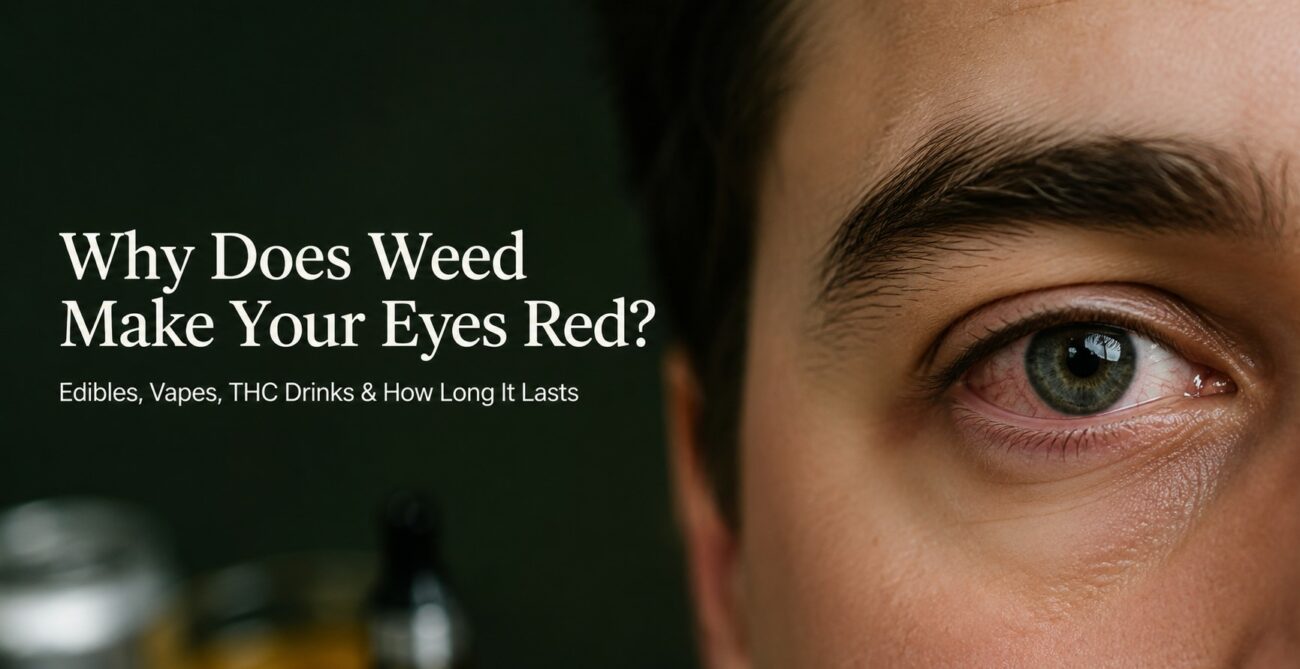
Why Does Weed Make Your Eyes Red? Edibles, Vapes, THC Drinks & How Long It Lasts
Weed can make the eyes look red because THC may affect small blood vessels and make them more visible in the whites of the eyes. The effect can happen after smoking, vaping, eating gummies or drinking THC beverages, which means cannabis smoke is not the only possible cause.
Quick answer
THC-related changes can make small surface blood vessels in the eyes appear more noticeable, creating a red or bloodshot look. Because THC reaches the body through smoked, vaped and swallowed products, edibles, carts, tinctures and THC drinks can all cause red eyes.
Cannabis-related eye redness often improves within approximately one to four hours, although an edible, a high dose or individual sensitivity may produce a different timeline. Pain, discharge, light sensitivity or vision changes should not be dismissed as ordinary cannabis redness.
Main association
THC exposure
Redness can happen without cannabis smoke.
Typical duration
About 1–4 hours
Product, dose and individual response can change this.
Separate symptom
Dryness or irritation
Smoke, vapor, contact lenses or dry air may contribute.
Seek attention for
Pain or blurred vision
Severe or unusual symptoms may have another cause.
Which cannabis products can make your eyes red?
| Product | Can redness happen? | Timing pattern | Other eye consideration |
|---|---|---|---|
| Flower or pre-roll | Yes | May appear relatively quickly | Smoke may also irritate or dry the eye surface. |
| Vape, cart or disposable | Yes | May appear during the fast inhaled-effect timeline | Vapor exposure may contribute to surface irritation or dryness. |
| Gummy or edible | Yes | May appear later | Redness may follow the longer edible timeline. |
| THC drink | Yes | Depends on formulation | Some containers include more than one serving. |
| Tincture | Yes | Depends on whether it is held under the tongue or swallowed | Milligrams per dropper can vary considerably. |
| Dab or concentrate | Yes | Can appear quickly | Concentrated THC can be difficult for beginners to predict. |
| CBD-dominant product | Less closely associated | Depends on THC content and use method | Smoke, vapor, allergies or another ingredient may still irritate. |
Red eyes are not a dependable potency or impairment test.
Visible redness cannot reliably show how strong a product was, how much THC someone consumed or whether that person is safe to drive.
How this article was prepared
This guide combines cannabis-product information with guidance from optometry, ophthalmology and public eye-health sources. It is intended for responsible adult education and does not diagnose an eye condition or replace care from an optometrist or ophthalmologist.
Editorial note: Written by the Mary Jane’s Bakery Co Editorial Team. Published July 17, 2026. Reviewed for responsible-use clarity. This article has not been medically reviewed.
1) Why does THC make your eyes red?
THC can be associated with changes in blood vessels and blood flow that make the small vessels on the surface of the eyes more visible. When those vessels are easier to see, the whites of the eyes can appear pink, red or bloodshot.
The effect is not limited to joints or pre-rolls. THC reaches the bloodstream after it is smoked, vaped, swallowed or used under the tongue, so the same appearance may develop after an edible, tincture or THC beverage.
The Canadian Association of Optometrists provides additional information about
how cannabis can affect vision and the eyes.
Red eyes are also one of several
possible THC side effects
discussed in our comparison of Delta-8, Delta-9 and THCA.
Key distinction: Red eyes may occur alongside intoxication, but the color of someone’s eyes cannot reliably measure their reaction time, judgment, coordination or current level of impairment.
2) Is it THC or cannabis smoke making the eyes red?
THC is the main reason red eyes can appear after both smoked and non-smoked products. Edibles and drinks do not expose the eyes to cannabis smoke, yet they may still cause a bloodshot appearance.
Smoke can nevertheless affect eye comfort. Direct exposure may cause watering, burning, dryness or surface irritation, especially in a small or poorly ventilated room.
Vapor is also separate from THC’s systemic red-eye effect. Broader e-cigarette research has identified possible ocular-surface irritation and dryness from vapor exposure, but that evidence does not prove that every THC cart or formulation affects the eyes in exactly the same way.
Our article about
cannabis smoke and vapor irritation
explains why inhaled products may also feel harsh to the throat and airways.
| Symptom | Possible explanation |
|---|---|
| Visible bloodshot vessels | May be associated with THC-related blood-vessel changes. |
| Burning or watering | Smoke, vapor, allergies or another irritant may contribute. |
| Dry or gritty feeling | Dry eye, reduced blinking, indoor air or contact lenses may be involved. |
3) Red eyes from edibles, vapes, drinks and concentrates
Do edibles and gummies make your eyes red?
Yes. A THC edible or gummy can cause red eyes even though no smoke is involved. The main difference is that redness may appear later because swallowed THC usually takes longer to produce noticeable effects.
If a person takes another gummy before the first serving fully develops, the total THC dose may become larger than expected. That can produce a stronger and potentially longer experience.
Adults new to edibles can compare a
2.5mg vs 5mg THC beginner dose
before choosing a serving.
Do carts, vapes and disposables make your eyes red?
Yes. THC from a cart, disposable or weed pen enters the bloodstream quickly, so eye redness may appear relatively soon after inhalation.
The device name does not determine the reaction. THC concentration, pull size, number of pulls and individual sensitivity matter more.
Beginners should review
how many puffs to take from a vape or pre-roll
before using an inhaled product.
Do THC drinks and tinctures cause red eyes?
They can. A THC drink may cause redness according to its formulation and onset. Some beverages are designed to begin faster, while others follow a more traditional edible pattern.
Learn more about
how long THC drinks take to kick in
and how
nano THC drinks
differ from standard beverages.
A tincture held under the tongue may begin differently from one that is swallowed immediately. Always check the milligrams per serving rather than assuming one complete dropper is appropriate.
Do dabs and concentrates cause red eyes?
Dabs, wax, shatter, rosin and live resin can cause red eyes. Concentrates commonly contain substantial THC levels, making the dose harder for a low-tolerance user to predict.
Beginner caution: Concentrates should not be treated as equivalent to flower simply because both products are inhaled.
4) How long do red eyes from weed last?
Red eyes from cannabis often last approximately one to four hours. Some users notice improvement sooner, while an edible, high THC dose or unusually strong personal response may produce a later or longer timeline.
A physician-reviewed Leafwell guide reports that cannabis-related redness commonly lasts one to two hours and may continue for three to four hours in some cases. That estimate is useful as a general range, not a guaranteed personal timeline.
| Product format | General pattern |
|---|---|
| Smoking or vaping | Redness may appear quickly and improve as inhaled effects fade. |
| Edibles or gummies | Redness may begin later and continue with the longer edible experience. |
| THC drinks | Timing depends on formulation, serving size and total dose. |
| Dabs or concentrates | Redness may appear quickly after a concentrated inhaled dose. |
Redness that becomes painful, affects only one eye, worsens after the cannabis effects fade or appears with vision changes should not automatically be blamed on THC.
5) Why do some people get red eyes while others do not?
Cannabis does not create the same visible reaction in every person. One adult may develop obvious bloodshot eyes, while another experiences only dryness, glossiness or no noticeable change.
Differences may involve:
- Total THC dose
- Individual sensitivity
- Current tolerance
- Natural visibility of surface blood vessels
- Eye dryness and tear-film quality
- Contact-lens use
- Smoke or vapor exposure
- Allergies or environmental irritation
- Lighting, camera flash and photography
Eye appearance cannot reliably reveal how much cannabis a person used.
6) Does potency, sativa, indica or product quality affect red eyes?
| Claim | Better explanation |
|---|---|
| Stronger THC always means redder eyes. | A larger dose may increase redness for some users, but individual reactions vary. |
| Indica causes more redness than sativa. | Broad strain labels do not reliably predict eye redness. |
| Red eyes prove the product was high quality. | Quality should be judged through labeling, ingredients, testing and product integrity. |
| No redness means the THC was weak. | Some users show little visible redness even after noticeable THC effects. |
Our
Delta-8 vs Delta-9 THC comparison
explains why cannabinoid type, dose and tolerance matter more than simple product labels.
7) Bloodshot eyes vs dry eyes vs glossy eyes
Red, dry and glossy eyes can appear together, but they do not describe exactly the same thing.
| Eye change | Appearance or feeling | Possible explanation |
|---|---|---|
| Bloodshot eyes | Visible red vessels in the whites of the eyes | THC-related blood-vessel changes or another red-eye cause |
| Dry or gritty eyes | Burning, scratchiness or a sandy feeling | Dry eye, reduced blinking, contact lenses or environmental exposure |
| Glossy or watery eyes | Shiny or reflective appearance | Tear-film changes, watering, irritation or altered blinking |
| Itchy or swollen eyes | Itching, puffiness or repeated watering | Allergies or another irritant may be involved |
The National Eye Institute lists burning, scratchiness, redness and blurry vision among
possible dry-eye symptoms.
8) Does CBD make your eyes red?
Pure CBD is less closely associated with classic THC-related red eyes. However, the actual product label and laboratory report matter.
A full-spectrum CBD product may contain some THC. Smoked or vaped CBD products may also expose the eyes to smoke, vapor or ingredients that contribute to irritation.
Redness after using CBD may therefore involve:
- Trace or added THC
- Smoke or vapor exposure
- Dry eyes
- Contact lenses
- Allergies
- Another ingredient
- An unrelated eye condition
A current certificate of analysis can help confirm the cannabinoid content.
9) What may help temporary redness or discomfort?
Temporary cannabis-related redness generally improves with time. The priority should be comfort and eye safety rather than urgently hiding the appearance.
General comfort steps
- Stop consuming more THC.
- Move away from smoke or vapor.
- Rest in a comfortable, well-ventilated room.
- Place a clean, cool compress over closed eyes.
- Avoid rubbing the eyes.
- Reduce bright light if the eyes feel sensitive.
- Ask a pharmacist or eye-care professional about suitable lubricating drops for dryness.
Water may help with general comfort and dry mouth, but it does not instantly reverse THC’s effects.
When eye redness occurs with an uncomfortable cannabis experience, read
what to do if THC feels too strong.
10) Are eye drops safe for weed-related red eyes?
Eye drops are not interchangeable. Lubricating artificial tears, allergy drops and medicated redness relievers are designed for different causes.
Some redness-relieving drops temporarily narrow visible blood vessels. The American Academy of Ophthalmology explains that repeated use of certain products can cause
rebound redness
when the effect wears off.
Do not use a medicated drop simply because it promises the fastest cosmetic result. Ask a pharmacist, optometrist or ophthalmologist what type is appropriate, especially when redness happens regularly.
Contact-lens warning: Do not assume an eye drop is safe to use while lenses are in place. Follow the label and professional advice.
11) When red eyes may have another cause
Cannabis is only one possible explanation. Redness may also be related to:
- Dry eye
- Seasonal or environmental allergies
- Pink eye or another infection
- Contact-lens irritation
- Smoke, dust or chemical exposure
- Eye injury
- Extended screen use
- Lack of sleep
- Cosmetics or skin-care products
- Another eye or health condition
When should you contact an eye-care professional?
Seek professional attention when redness involves:
- Severe pain
- Blurred, reduced or changing vision
- Strong light sensitivity
- White, yellow or green discharge
- Eye injury or chemical exposure
- Significant swelling
- Symptoms that continue to worsen
- One-sided redness with unusual symptoms
- Contact-lens use with pain, irritation or blurred vision
The National Eye Institute explains that infection-related red eyes may include itching, burning, watering, discharge, light sensitivity or blurry vision. The American Optometric Association advises contact-lens users to seek prompt care for
redness, pain, irritation or blurred vision.
Emergency note: Sudden vision loss, serious injury, chemical exposure or extreme eye pain requires immediate professional or emergency assessment.
12) Does cannabis treat glaucoma?
Cannabis should not replace prescribed glaucoma treatment. Although cannabis has been studied for temporary changes in eye pressure, the effect does not provide continuous control, and THC can create impairment and other unwanted effects.
Anyone diagnosed with glaucoma should follow the treatment plan provided by a qualified eye-care professional rather than attempting to manage the condition with cannabis.
13) What to check before buying THC products in Miami
Red eyes cannot be completely predicted from a product label, but clear information can help adults understand the likely dose and onset.
- How many milligrams of THC are in one serving?
- How many servings are in the package or container?
- Is the product inhaled, swallowed or used under the tongue?
- Does the beverage use a nano or conventional formulation?
- Is the vape made with distillate, live resin or another extract?
- Which cannabinoids are listed on the package?
- Is a current certificate of analysis available?
- Are allergens or other ingredients clearly identified?
- How should the product be stored away from children and pets?
Adults can visit our
24-hour CBD and THC smoke shop in Miami
to compare product formats, serving sizes and available laboratory information.
You can also
compare THC products by format
where legal and available.
14) Sources
| Source | Used for |
|---|---|
| Canadian Association of Optometrists | Cannabis-related redness, vision effects and glaucoma context |
| Leafwell | Physician-reviewed general duration estimate |
| American Academy of Ophthalmology | Redness-relief drops and rebound-redness caution |
| National Eye Institute: Dry Eye | Dryness, scratchiness, burning, redness and blurry vision |
| National Eye Institute: Pink Eye | Alternative red-eye symptoms, discharge and vision warnings |
| American Optometric Association | Contact-lens redness, irritation, pain and blurry-vision guidance |
| Ocular-surface review of electronic cigarettes | Broader evidence concerning vapor exposure and ocular-surface health |
15) Frequently asked questions
Why does weed make your eyes red?
THC may affect small blood vessels and make them more visible in the whites of the eyes. The result is a temporary red or bloodshot appearance.
Is cannabis smoke the only cause?
No. Edibles, drinks and tinctures can also cause red eyes because THC enters the bloodstream without smoke. Smoke may separately contribute to irritation, watering or dryness.
Do edibles make your eyes red?
Yes. THC edibles and gummies can cause red eyes. The redness may appear later because swallowed cannabis usually takes longer to produce noticeable effects.
Do carts and vapes make your eyes red?
Yes. THC from a cart, disposable or vape enters the bloodstream quickly and may cause red eyes. Vapor exposure may separately contribute to surface irritation or dryness.
Do THC drinks make your eyes red?
They can. The timing depends on the beverage formulation, total THC dose, serving size and individual response.
How long do red eyes from weed last?
Cannabis-related redness often improves within approximately one to four hours. Edibles, high doses and individual sensitivity can produce a different timeline.
Does stronger weed make your eyes redder?
Higher THC exposure may increase redness for some users, but individual reactions vary. Redness is not a reliable measure of product potency or impairment.
Does CBD make your eyes red?
Pure CBD is less closely associated with classic THC-related redness. Full-spectrum products may contain THC, while smoked or vaped CBD may still expose the eyes to irritants.
Why do my eyes look glossy instead of red?
Glossiness may involve watering, tear-film changes, dryness or altered blinking. Glossy eyes and bloodshot eyes are not exactly the same symptom.
Can I use eye drops for weed-related redness?
Eye drops are designed for different causes. Some redness-relieving products may cause rebound redness when repeatedly used. Ask a pharmacist or eye-care professional what type is appropriate.
When should I worry about red eyes?
Seek professional attention for severe pain, blurred vision, light sensitivity, discharge, injury, worsening symptoms or contact-lens-related irritation.
Final takeaway
Weed can make the eyes red because THC may make small surface blood vessels more visible. The effect can occur after flower, vapes, gummies, tinctures, dabs and THC drinks, so smoke is not the only explanation.
Cannabis-related redness often improves within one to four hours, but dose, format and individual response matter. Dry, glossy, itchy or painful eyes may involve a different or additional cause.
Red eyes cannot reliably measure THC potency, product quality or impairment. Allow the effects time to fade, avoid further smoke or THC, use eye products carefully and seek professional attention when symptoms are painful, persistent or connected with vision changes.
Responsible-use note: Cannabis, hemp, CBD and THC products are for adults only. Keep them away from children and pets. Do not drive or operate machinery after using THC.
Medical note: This article provides general education and does not diagnose or treat an eye condition. Contact an optometrist, ophthalmologist or emergency service when symptoms are serious or concerning.