

Last updated: July 20, 2026. Written for adults 21+.
Kava vs kratom at a glance
If you only have thirty seconds, this table covers the split. Everything below it explains why each row matters before you spend money on either one.
| Kava | Kratom | |
|---|---|---|
| Plant | Piper methysticum root (pepper family), South Pacific | Mitragyna speciosa leaf (coffee family), Southeast Asia |
| Active compounds | Kavalactones | Mitragynine and 7-hydroxymitragynine (7-OH) |
| How it works | Acts on calming neurotransmitter systems, not opioid receptors | Alkaloids interact with opioid receptors in the brain |
| Reported feel | Some users describe steady relaxation at social doses | Users often describe a lift at small amounts and a heavier, sedating feel at larger ones |
| Dependence profile | Not associated with opioid-type withdrawal | Regular use can lead to dependence and withdrawal symptoms in some people, per NIDA |
| 2026 legality | Legal to sell in the U.S. and in Florida | Leaf kratom legal in Florida for adults 21+; several states ban it; concentrated 7-OH now restricted |
Two plants from opposite sides of the ocean
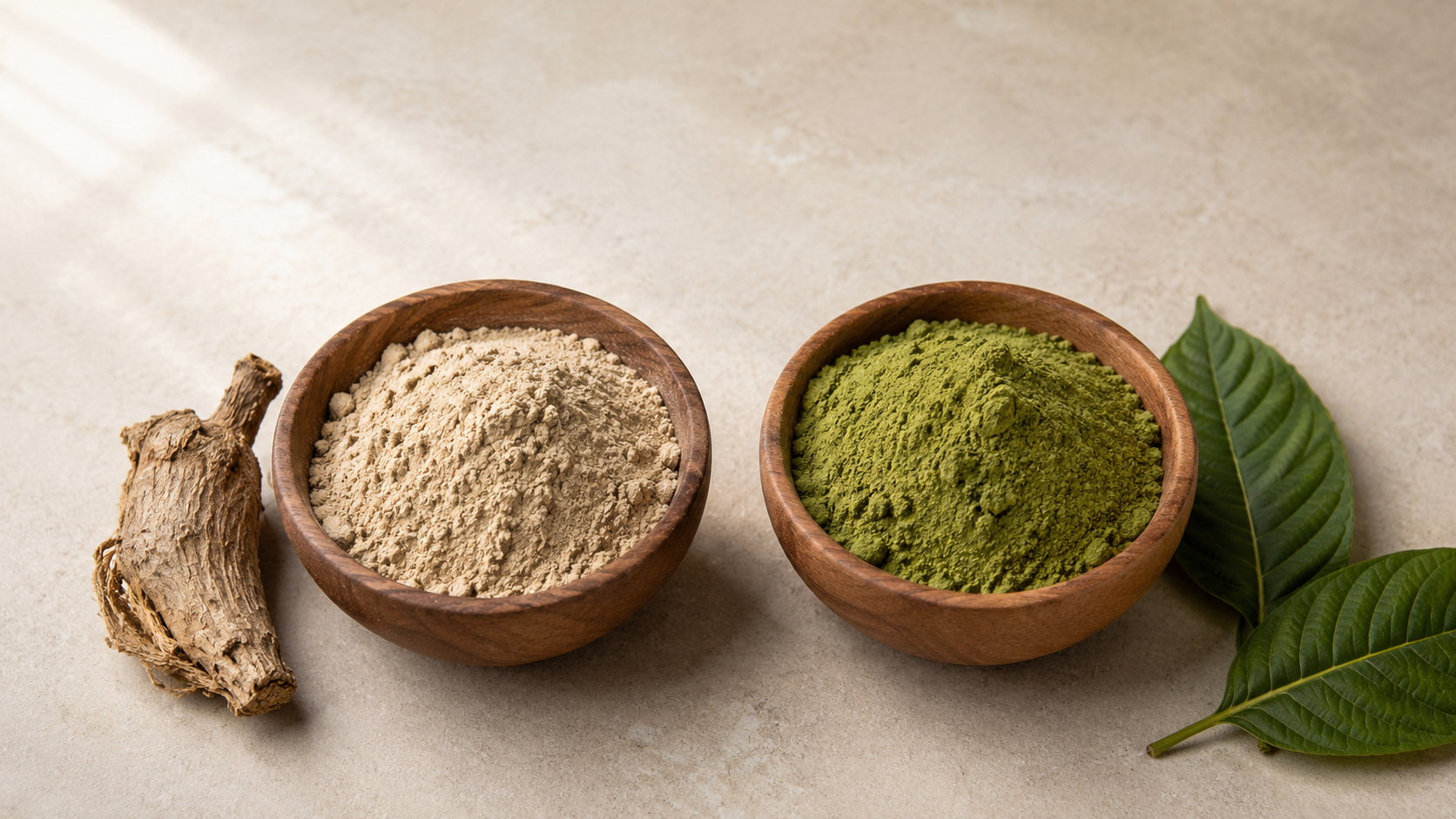
Kava is the root of Piper methysticum, a pepper-family plant grown in Fiji, Vanuatu, Tonga, and nearby islands. Pacific communities have pounded the root into a shared drink for centuries, and that social tradition traveled well: kava bars now operate across Florida, pouring shells of it as an alcohol-free way to wind down. We covered a similar shift in our look at THC drinks versus alcohol, and kava belongs in that same conversation.
Kratom is the leaf of Mitragyna speciosa, a tree in the coffee family native to Thailand, Indonesia, and Malaysia. Field workers there traditionally chewed the leaves or brewed them as tea to push through long days. It’s a working plant with a working history, not a ceremonial one.
In Miami, you’ll often find both under one roof. Our Miami location stocks kava products and kratom powders in the same aisle, which is exactly why so many shoppers ask how they differ.
What’s inside them, and why it matters
Kava’s activity comes from kavalactones, a group of compounds concentrated in the root. The National Center for Complementary and Integrative Health (NCCIH) describes kava as acting on the nervous system without engaging opioid receptors. That mechanism is why kava’s effect is often described as consistent: more kava mostly means more of the same feeling.
Kratom is a different machine. Its main alkaloids, mitragynine and 7-hydroxymitragynine, interact with opioid receptors, according to the National Institute on Drug Abuse. That receptor activity explains kratom’s two-sided reputation. Many users report a stimulating, coffee-like effect from small amounts and a heavier, sedating one from larger amounts.
So the honest one-line comparison isn’t “which is stronger.” It’s that kava stays in one lane while kratom changes lanes depending on how much someone takes.
How the risk profiles split
This is where the two part ways hardest, and it’s the part vendor blogs on both sides tend to soften.
Because kratom’s alkaloids act on opioid receptors, NIDA notes that some people who use it regularly develop dependence and experience withdrawal symptoms when they stop. The NIH’s LiverTox database also documents rare cases of liver injury linked to kratom, along with agency concerns about effects like slowed breathing at high exposures.
Kava doesn’t carry an opioid-type dependence profile, but it isn’t risk-free either. Health agencies have logged rare reports of liver injury connected to kava use, which is why NCCIH advises caution for anyone with liver concerns or anyone combining it with alcohol or medications.
A few ground rules apply to both: they’re for adults 21+ only, they shouldn’t be mixed with each other or with alcohol, and anyone taking medication or managing a health condition should talk with a healthcare professional first. If someone reacts badly to any product, Poison Control is available in the U.S. at 1-800-222-1222.
The 7-OH crackdown: what changed in 2025 and 2026
Here’s the part almost no comparison article has caught up with. Regulators aren’t treating “kratom” as one thing anymore. They’re separating natural leaf kratom from concentrated 7-OH products, the tablets, gummies, and shots spiked with isolated 7-hydroxymitragynine at levels far beyond what the leaf contains.
The timeline moved fast:
- August 2025: Florida’s attorney general issued an emergency rule making concentrated 7-OH a Schedule I substance in the state, and Florida’s agriculture department reported pulling more than 17,000 non-compliant packages from stores, per the Florida Senate’s bill analysis.
- Early 2026: Florida lawmakers filed bills to make that ban permanent and to build a registration system for finished kratom products.
- July 1, 2026: the DEA announced its intent to temporarily place 7-OH above set thresholds, plus three synthetic derivatives, into Schedule I federally.
- July 13, 2026: the FDA updated its 7-OH consumer page confirming the scheduling process and a public comment period on the proposed thresholds.
The key detail for shoppers: federal officials have stated the action targets concentrated and synthetic 7-OH products, not the natural kratom leaf itself. Leaf kratom remains in a separate, still-legal category in Florida. That distinction is now the single most useful thing to understand before buying anything labeled kratom.
Where each one stands legally in 2026
Kava is the simple one. It’s legal to sell and possess across the U.S., including Florida, and kava bars operate openly.
Kratom is patchwork. Natural leaf kratom is legal in Florida for adults 21+, but a handful of states, including Alabama, Arkansas, Indiana, Rhode Island, Vermont, and Wisconsin, ban it outright, and some cities and counties add their own rules. Concentrated 7-OH products are already Schedule I in Florida and are the subject of the pending federal scheduling action described above.
Laws in this space keep moving, so check your own state and local rules before ordering, carrying, or traveling with either product.
Ordering online adds one more step. A responsible seller applies state restrictions at checkout, verifies age, and won’t ship kratom to a state that bans it. If a website will send anything anywhere with no questions asked, treat that as a warning sign rather than a convenience.
How they’re sold, and what to check on the label
Kava shows up as traditional ground root, micronized powder you stir into water, instant mixes, extracts, and ready-to-drink formats. Traditional prep means kneading or steeping the ground root in water, then straining out the fibers, which is why kava bars serve it as an earthy, opaque drink. Kratom is usually sold as raw leaf powder, capsules, or teas. Vein-color names like red, green, and white describe harvest and drying differences; our Bonero white vein powder is a typical example of a plain leaf product.
Before buying either, run this quick label check:
- Ingredient line: plain leaf or root should list one plant, not an extract blend you can’t identify.
- 7-OH red flags: tablets, shots, or gummies advertising “7-OH,” “7-hydroxy,” or extreme potency aren’t leaf kratom, and in Florida they’re now illegal to sell.
- Lab results: a batch-matched COA should verify identity and screen for contaminants.
- Age gate: a seller who doesn’t check for 21+ isn’t following Florida’s rules, which tells you something about the rest of their process.
Which one fits which situation
Skip the marketing framing and think in situations. People reaching for kava usually want a social, alcohol-free way to relax in the evening, the same slot a kava bar fills. People trying kratom are often after that reported small-amount lift during the day, knowing the feel shifts as amounts rise and that regular use carries a dependence risk kava doesn’t.
Neither is a medicine, neither is for anyone under 21, and neither belongs in the same session as alcohol or the other one. Start with less than you think you need, from a seller who shows lab work, and give it time before judging.
If you’re local, stop by our 24-hour Miami shop and ask to compare labels in person, or browse the kava and kratom categories online and read the COAs before you order.
Kava vs kratom FAQ
Is kava the same as kratom?
No. Kava is a South Pacific root in the pepper family whose kavalactones don’t act on opioid receptors. Kratom is a Southeast Asian leaf in the coffee family whose alkaloids do. They differ in plant, chemistry, reported effects, dependence risk, and legal status, so one is never a substitute for the other.
Can you mix kava and kratom?
Combining them isn’t recommended. They act on different systems, both have been linked to rare liver injury reports, and stacking two active botanicals makes any reaction harder to predict and harder to trace. Keep them separate, skip alcohol with either, and talk with a healthcare professional if you take any medication.
Is kratom legal in Florida in 2026?
Natural leaf kratom is legal in Florida for adults 21 and older. Concentrated 7-OH products are not: an August 2025 emergency rule made them Schedule I in the state, and lawmakers moved in 2026 to make that permanent. A federal scheduling action for concentrated 7-OH is also in progress.
Is 7-OH the same as kratom?
No. 7-OH (7-hydroxymitragynine) occurs in trace amounts in kratom leaf, but the products regulators banned are concentrates and synthetics with far higher levels. The FDA and DEA have said the 2026 federal action targets those concentrated products above set thresholds, not the natural leaf in its ordinary form.
Does kava get you high?
Kava isn’t intoxicating the way THC or alcohol is. Some users describe relaxed, social effects with clear thinking, which is why kava bars market it as an alcohol alternative. Effects vary by person, variety, and amount, so treat any first session cautiously and don’t drive until you know how it affects you.
Sources
- NCCIH: Kava
- NIDA: Kratom
- NIH LiverTox: Kratom
- FDA: Hiding in Plain Sight, 7-OH Products (updated July 13, 2026)
- DEA: Temporary scheduling announcement for 7-OH (July 1, 2026)
- Florida Senate: SB 994 bill analysis (kratom regulation)
This article is for general education, not medical or legal advice. These statements have not been evaluated by the Food and Drug Administration. These products are not intended to diagnose, treat, cure, or prevent any disease. For adults 21+. Keep all products away from children and pets, do not drive after use, and follow all federal, state, and local laws.