

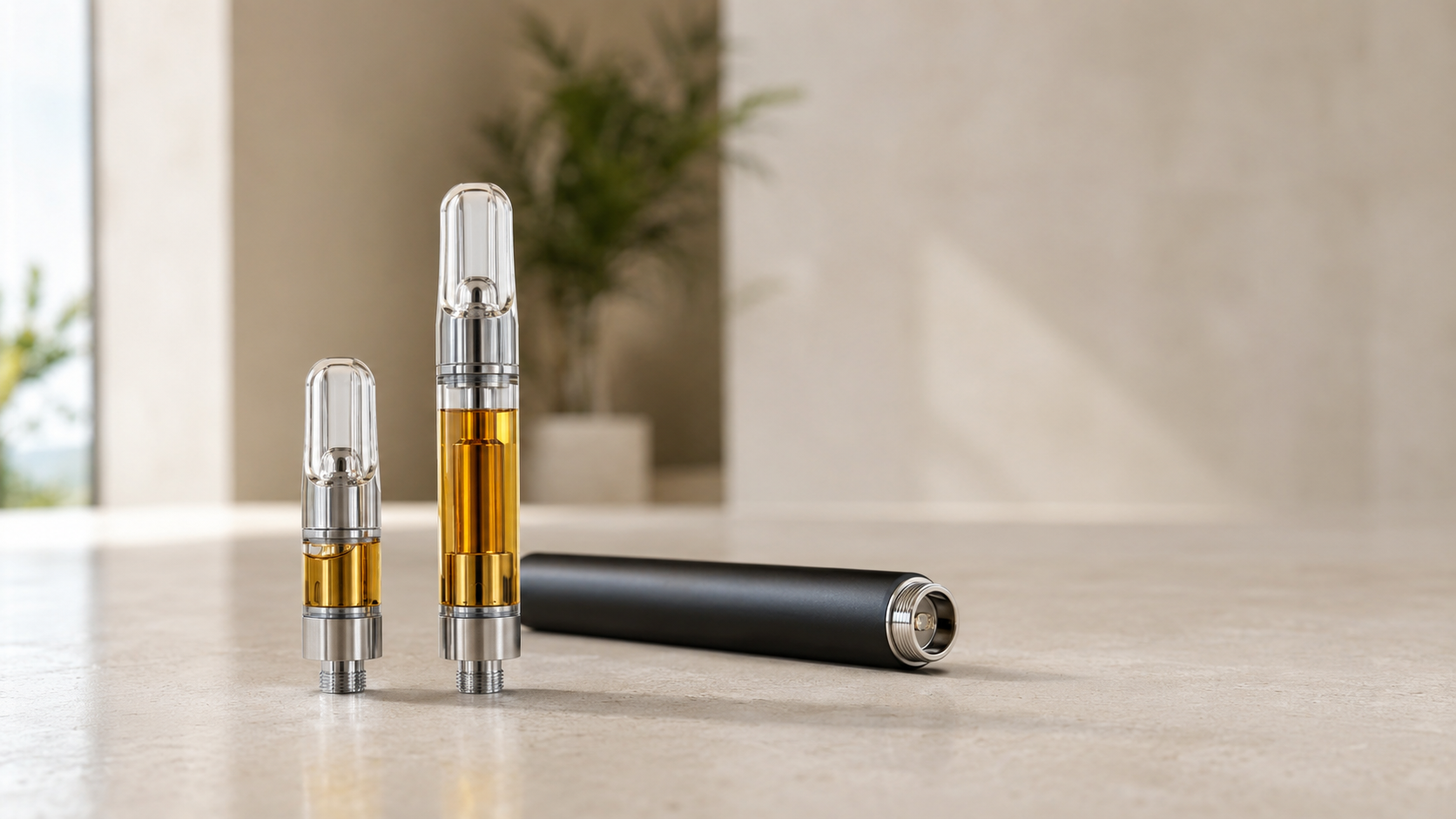
There is another detail worth clearing up immediately: a 1g cart contains about one gram of vape oil. That does not automatically mean it contains 1,000 mg of THC, CBD, or another cannabinoid. Oil fill weight and cannabinoid content are different label numbers. Check the package and matching Certificate of Analysis instead of treating “1g” as a potency claim.
How many puffs are in a 1g cart?
There is no universal puff count. Current vape guides often place a 1g oil cartridge around 160–320 short draws, while some publish narrower or higher estimates. The disagreement is useful: it shows why a puff total should never be printed as if it were guaranteed.
A one-second sip and a long, hard pull do not use the same amount of oil. Two batteries can also heat the same cartridge differently. For that reason, the following table is a planning tool built from the broad 160–320 range—not a specification for every product.
| Short puffs per day | Estimated days | What the estimate means |
|---|---|---|
| 5 | About 32–64 days | Occasional use may stretch a cart beyond a month. |
| 10 | About 16–32 days | A cart may last roughly two to four weeks. |
| 20 | About 8–16 days | Frequent use can finish a cart in one to two weeks. |
| 30 | About 5–11 days | Longer pulls or higher power can shorten this further. |
The math: estimated days = estimated total puffs ÷ your average daily puffs. If your draws are long, the table may overestimate the number of days. If they are very brief and the hardware runs efficiently, it may underestimate them.
Also separate cart life from effect duration. “How long does a cart last?” usually asks how long the oil supply lasts. If you mean how long the effects remain noticeable, use our guide to how long a vape or weed high may last.
How long does a 0.5g cart last compared with a 1g cart?
A 0.5g cartridge contains about half the oil of a 1g cartridge, so it may produce roughly half as many comparable pulls when the hardware, oil, battery setting, and draw style stay similar. Real products are not controlled laboratory copies, though. A leaky 1g cart can deliver fewer usable pulls than a well-made 0.5g cart.
| Cart size | Broad planning range | May suit | Tradeoff |
|---|---|---|---|
| 0.5g | About 80–160 short puffs | Infrequent use or trying a new formula | Runs out sooner with regular use |
| 1g | About 160–320 short puffs | More frequent use or fewer replacements | May sit longer and needs careful storage |
Do not choose only by size. Compare the cannabinoid, oil type, ingredients, batch information, expiration date, compatible battery, and lab report. A bigger cart is not automatically stronger or better.
A better estimate: calculate your personal cart run rate
A generic puff range is helpful before buying. Once you have used a cart for several days, your own oil level gives a better estimate.
- Write down the date you start the cartridge.
- Use the manufacturer-recommended battery range and keep the setting consistent.
- Check the oil window at the same time each day while the cart is upright and at room temperature.
- Estimate the fraction used: one-quarter, one-half, or three-quarters.
- Use the formula below, then leave room for error because cartridge shapes can make the oil level deceptive.
Projected total days = days used ÷ fraction of oil used.
Example: after six days, the cart looks about half empty. Six ÷ 0.5 = approximately 12 total days. That suggests about six days remain if your pattern stays similar.
Seven things that change how long a vape cart lasts
1. Draw length
Longer draws generally heat and vaporize more oil. This is why two people can report very different lifespans for the same cart size.
2. Puffs per day
Frequency is the simplest variable. Repeated sessions use the oil sooner, even if every pull is short.
3. Battery voltage or power
A higher setting can heat the coil more aggressively and use oil faster. It can also produce harsh or burnt pulls when the cartridge is not designed for that setting. Follow the cartridge and battery instructions instead of chasing the largest cloud.
4. Cartridge hardware
Coil resistance, intake size, airflow, and heating design change how much oil becomes aerosol during a draw. “One puff” on one device may not match one puff on another.
5. Oil thickness and formulation
CBD oil, Delta-8 formulations, distillate, live resin, and terpene blends can move and wick differently. Product type alone still cannot predict an exact puff count.
6. Leaks and clogs
Oil lost through a leak never becomes a usable pull. A clogged airway may also lead someone to pull harder, overheat the coil, or flood the mouthpiece. If airflow is the real problem, use the safer checks in our guide to unclogging a disposable vape or cart.
7. Heat and storage
Miami heat matters. Warm oil may thin and move toward the airway or seals, while extreme heat can also stress a battery. The FDA advises protecting vape devices from extreme temperatures, including direct sunlight and hot cars.
How do you know when a vape cart is empty?
A nearly empty cartridge usually gives more than one clue. Do not rely on one symptom, because weak vapor can also come from a low battery, clogged airway, dirty contact, or failed coil.
- Very little oil remains around the intake openings after the upright cart has rested.
- Vapor becomes consistently thin at the same approved battery setting.
- The normal flavor fades or a dry, burnt taste appears.
- The cart warms but produces little or no normal vapor.
- A disposable’s oil meter, if it has one, reaches empty—but the model instructions should explain what the display actually means.
Stop if the taste stays burnt. A burnt pull can mean an empty chamber, dry wick, overheated coil, or failed hardware; it is not a reason to keep increasing the voltage. Our burnt-vape troubleshooting guide explains when cooling or replacement makes more sense.
Is the cart empty, clogged, or connected to a dead battery?
| What you notice | More likely issue | Safer next step |
|---|---|---|
| Little visible oil, normal airflow, dry or burnt pull | Cart may be empty or wick may be dry | Stop repeated pulls and replace it if the taste persists. |
| Oil is visible, but the draw feels blocked or gurgles | Clog, condensation, or flooding | Keep it upright, wipe the mouthpiece, and use low-risk clog checks. |
| Battery blinks and produces no heat | Low battery, connection problem, or protection signal | Check the manual and our guide to a blinking vape that will not hit. |
| 510 cart works on another compatible battery | Original battery or connection is the problem | Clean dry contacts and replace a failed or damaged battery. |
| Device leaks, swells, hisses, cracks, or becomes unusually hot | Hardware or battery failure | Stop using and charging it. Keep it away from heat and flammable material. |
Rechargeable disposables add one more possibility: the oil may remain while the battery is low. Only charge a device that was designed with a factory charging port, and follow its instructions. See our disposable-vape charging safety guide before plugging it in.
How to make a vape cart last without risky tricks
- Store it upright. This helps keep oil near the intended intake area and away from the mouthpiece.
- Keep it cool and shaded. Do not leave a cart or battery on a dashboard, in a parked car, beside a sunny window, or in a hot beach bag.
- Use the approved battery range. More power is not automatically better.
- Pause between draws. Repeated pulls can overheat the coil and make the experience harsher.
- Keep 510 contacts clean and dry. Attach the cartridge gently; overtightening can create connection problems.
- Do not open, refill, or rewire a closed device. Stop using hardware that is damaged, leaking, swollen, or unusually hot.
- Use the older cart first. Check its expiration date and condition rather than leaving multiple opened products in Miami heat.
What to check before buying a 0.5g or 1g vape cart
The puff estimate should come after the product check. For hemp-derived carts sold in Florida, Section 581.217 requires qualifying containers to include items such as a QR code or barcode linked to the batch Certificate of Analysis, a batch number, an expiration date, and marketed cannabinoid milligrams per serving. Review the current Florida hemp statute for the full requirements.
- Is the oil fill listed as 0.5g, 1g, or another size?
- Which cannabinoid is marketed: CBD, Delta-8, or another hemp-derived blend?
- How many cannabinoid milligrams are listed per serving?
- Does the QR code open a product-specific COA?
- Does the COA batch number match the package?
- Is the expiration date readable?
- Does the cartridge fit the battery and approved voltage range?
- Is the package sealed and the hardware clean, uncracked, and free of leaks?
Do not buy only by a claimed puff total. A printed “300 puffs” cannot tell you how long your pulls will be or how the device will perform. If the source, package, or lab report feels questionable, use our checklist for spotting questionable and fake THC vapes.
Adults can compare currently available CBD vape cartridges online or review the Mary Jane’s Bakery Co Miami location for shopping and pickup information. Verify the live product label, availability, and shipping eligibility before ordering.
When to replace a cart—and how to dispose of vape hardware
Replace the cartridge when it is empty, the burnt taste continues, the coil fails, the glass cracks, the seals leak repeatedly, or the label and product condition are no longer trustworthy. Do not try to recover the last film of oil by applying a flame, opening the cartridge, or using an unapproved heat source.
A separate 510 cartridge and a disposable vape are not the same waste item. A disposable contains an embedded lithium-ion battery. The EPA says devices containing lithium-ion batteries should not go into household garbage or curbside recycling; take them to an appropriate battery-recycling or household hazardous-waste collection point. For cartridges without batteries, follow the product maker’s instructions and current local household hazardous-waste rules. Do not pour remaining oil into a sink or drain.
Responsible-use note
Vaping is not risk-free. The CDC advises against THC-containing vape products from informal sources and says substances not intended by the manufacturer should not be added to vaping products. Keep all vape products away from children and pets. Do not drive or operate machinery after using an intoxicating product.
If vaping is followed by chest pain, trouble breathing, fainting, severe vomiting, confusion, or another serious or worsening symptom, stop using the product and seek medical help.
Frequently asked questions
How long should a 1g cart last?
It can last several days, several weeks, or longer. Using a broad estimate of 160–320 short puffs, 10 puffs per day works out to about 16–32 days. Draw length, voltage, hardware, oil, and waste from leaks or clogs can change the result substantially.
How many puffs are in a 1g cart?
Many current consumer guides estimate roughly 160–320 short puffs, but there is no universal number. A puff is not standardized, and different batteries and cartridges vaporize different amounts of oil.
How long does a 0.5g cart last?
A 0.5g cart may provide about half the comparable pulls of a 1g cart. A broad planning range is 80–160 short puffs, but actual use can fall outside it.
Does 1g mean 1,000 mg of THC?
No. One gram refers to the approximate mass of oil in the cartridge. It does not automatically mean the oil contains 1,000 mg of THC, CBD, or another cannabinoid. Check cannabinoid milligrams, percentage, and the matching COA separately.
Can a 1g cart last a month?
Yes, light or occasional use may stretch a cart beyond a month. Frequent use, longer draws, higher battery settings, or oil loss can finish it much sooner.
Why is there oil left but the cart will not hit?
The airway may be clogged, the 510 contact may be dirty or loose, the battery may be low, or the coil may have failed. Visible oil does not prove every other part is working.
Should I keep hitting a cart until no oil is visible?
No. Stop if the pull stays burnt, the hardware overheats, the cartridge leaks, or the device behaves abnormally. Chasing the last residue can overheat a dry wick or failed coil.
Does higher voltage make a cart run out faster?
It can. Higher power often heats more aggressively and may use more oil per pull. Always stay within the range approved for the exact cartridge and battery.
Sources
- U.S. Food and Drug Administration: Tips to Help Avoid Vape Battery Fires or Explosions
- Centers for Disease Control and Prevention: EVALI outbreak findings and product-source guidance
- U.S. Environmental Protection Agency: Used Lithium-Ion Batteries
- Florida Legislature: Section 581.217, State Hemp Program
- Vaping360: consumer-industry puff estimates for 0.5g and 1g cartridges