

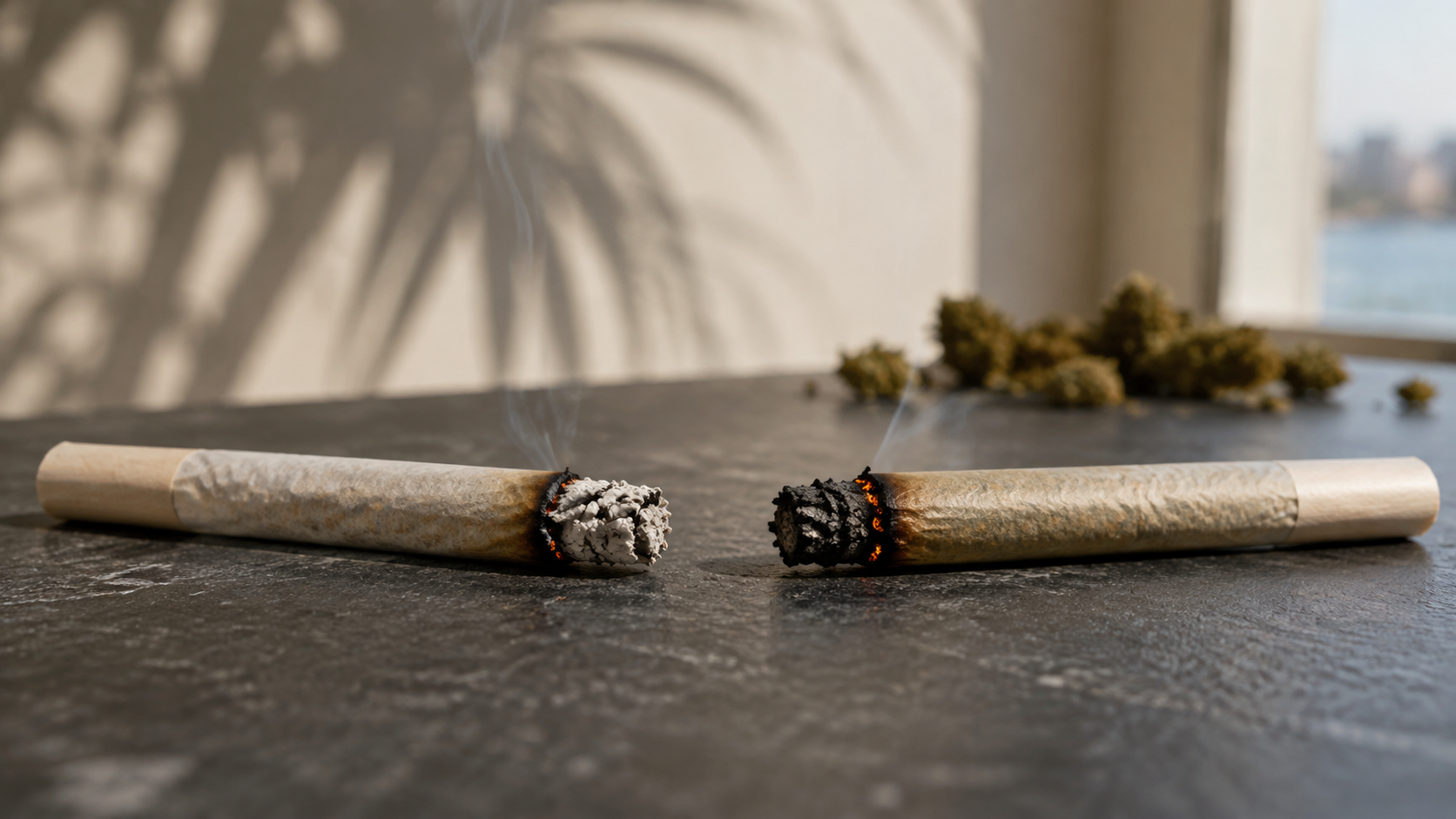
Cannabis flower evidence guide · Adults 21+
White Ash vs Black Ash Weed: Does Ash Color Mean Quality?
White ash versus black ash mainly shows how completely cannabis burned. It does not grade potency, purity, flushing, curing, or contaminant safety. Treat the color as one burn clue, then use the package, batch COA, product condition, and source to judge the flower.
Featured answer
White or light-gray ash usually means more carbon burned away, leaving a larger share of pale mineral residue. Black ash contains more unburned carbon or char. Heat, oxygen, moisture, packing, paper, and plant composition can change the result. Neither color proves the flower is potent, properly flushed, contaminant-free, or high quality.
Less carbon remained in that area.
More carbon-rich char remained.
Color cannot identify contaminants.
Match the label, batch COA, and condition.
The 20-second ash-color decoder
| What you see | What it reasonably suggests | What it cannot prove | Best next check |
|---|---|---|---|
| White or light-gray ash | That portion burned relatively completely | Purity, potency, safety, or flushing | Label and matching batch COA |
| Black or dark-gray ash | More carbonized material remained | Bad flower or contamination | Moisture, pack, airflow, paper, and condition |
| Mixed white and black ash | Different parts burned differently | An inconsistent or unsafe batch | Uneven ember or airflow pattern |
| Any color plus mold, chemical odor, or foreign material | A separate product-condition warning exists | That continued burning will clarify the risk | Stop; retain package and verify source/batch |
Ash color looks like a final verdict. White residue is often praised as proof of clean, carefully grown cannabis. Black residue gets blamed on fertilizer, poor curing, low potency, or contaminants.
The evidence supports a narrower answer. Color mainly describes combustion completeness. Oxygen, ember temperature, moisture, packing, paper, and the point where you inspect the ash can all change it. One joint can therefore show pale, gray, and dark areas without representing three different grades of flower.
Related guide: Ash color and an uneven burn are different questions. If one side advances faster, use Mary Jane’s guide to why a joint canoes and how to diagnose it.
Article note: Prepared by the Mary Jane’s Bakery Co Editorial Team and reviewed August 27, 2026. Review basis: current live U.S. search results, government smoke guidance, a university cannabis thesis, peer-reviewed combustion and pesticide research, and current Mary Jane site pages. Direct consumer research linking cannabis ash color to overall flower quality remains limited. This is not a medical review.
1. What cannabis ash color actually measures
Plant material does not vanish the moment it meets flame. Heating breaks it down, carbonizes part of it, and—when enough heat and oxygen remain—oxidizes more of that carbon into gases. Less complete combustion leaves darker, carbon-rich residue. More complete combustion consumes more carbon and exposes pale mineral-rich ash.
A scientific review indexed by the U.S. Environmental Protection Agency describes this broad pattern in wildland-fire ash: lower combustion completeness tends to produce darker residue, while more complete burning leaves lighter mineral ash. A joint is a smaller and different burn system, so the review does not grade cannabis products. It does explain the underlying color change.
2. White vs black vs gray ash: the real difference
| Ash appearance | Most defensible reading | Possible influences | Confidence |
|---|---|---|---|
| White to light gray | Less residual carbon in that area | Hotter or longer burn, oxygen, paper, minerals | High for burn completeness; low for quality |
| Medium gray | Mineral ash mixed with residual carbon | Normal variation in heat and airflow | Moderate |
| Dark gray to black | More unburned carbon or char remains | Moisture, cooling, tight pack, limited oxygen, resin | High for incomplete burn; low for exact cause |
Gray is normal, not a failed test. Ash can also appear pale on the outside and darker inside. The outer layer may receive more oxygen while less-combusted material remains in the center.
3. Does white ash mean good weed?
No—not on its own. A pale result cannot measure THC, CBD, terpenes, freshness, microbial condition, pesticide residue, smoothness, or label accuracy. It shows that the observed material burned more completely.
Even “white ash proves a perfect cure” is too certain. Moisture affects combustion, but color does not reveal a flower’s measured moisture percentage, water activity, or drying history. A hotter ember, different pack, different paper, or stronger airflow can also produce paler ash.
Bone-dry flower is not automatically better
Water activity is different from room humidity and from a simple moisture percentage. ASTM identifies 0.55–0.65 water activity as the acceptable range for dry cannabis flower. An industry-funded 2025 pre-roll study also reported lighter ash at 0.65 water activity than at 0.45. That study does not establish a universal ash rule, but it challenges the shortcut that drier flower must always burn whiter or better.
Match the evidence to the quality question
Read the matching cannabinoid panel and units.
Confirm the batch and every panel performed.
Check date, seal, odor, texture, and storage.
Check pack, moisture, paper, airflow, and ember.
4. Can black ash reveal pesticides, mold, or other contaminants?
No validated consumer test uses cannabis ash color to identify a pesticide, metal, mold, or other contaminant. Dark residue shows that more carbon remained. It does not identify the reason.
This matters because real contaminants do not need to announce themselves through black ash. In a peer-reviewed laboratory study, some pesticide and plant-growth-regulator residues transferred into cannabis smoke, with recovery varying by compound and device. The researchers did not establish ash color as a detector. Pale ash therefore cannot clear a product.
Use Mary Jane’s 60-second cannabis COA guide to match the product and batch before checking which contaminant panels were actually performed.
5. Does flushing cannabis make the ash white?
The familiar story says plain water before harvest removes nutrients from flower, creating white ash. Available evidence does not support reading a grower’s irrigation schedule from the residue.
A University of Guelph thesis tested late-flower irrigation strategies and reported that flushing was ineffective at removing a significant amount of nutrient from the cannabis bud under the tested conditions. This is useful direct cannabis evidence, but it is one thesis—not a universal trial of every cultivar, medium, climate, and cure. The correct conclusion is that the simple flushing-to-white-ash rule has not been demonstrated.
There is also a chemistry problem with calling pale ash “mineral-free.” Light ash is largely mineral residue after more carbon has burned away. Its color does not prove that nutrients were absent from the plant.
| Claim | Evidence level | Practical reading |
|---|---|---|
| Dark ash contains more residual carbon or char | Strong for combustion generally | The material burned less completely in that area |
| Moisture, oxygen, temperature, packing, and paper can change ash | Moderate | Burn conditions can alter color without changing the batch |
| White ash proves proper flushing | Weak or unsupported | Do not infer a grower’s irrigation schedule from ash |
| White ash proves no contaminants | Unsupported | Use batch-matched testing and product-condition checks |
| Ash color predicts potency or terpene content | Unsupported | Read the correct COA panels and units |
6. Why the same flower can leave different ash
Ash is an outcome of a small combustion system. Change the system and the color can change without changing the batch.
| Variable | How it may change combustion | What the result does not prove |
|---|---|---|
| Moisture and storage | Can cool or destabilize the ember | Original grow quality |
| Grind and packing density | Creates restricted or uneven oxygen paths | Contamination |
| First light and relighting | Changes which areas establish a full ember | Potency |
| Airflow and wind | Changes oxygen supply and cooling | Curing history |
| Paper or wrap | Adds combustible material, minerals, thickness, and a burn rate | Flower purity |
| Resin and plant composition | May change how evenly material burns | That darker ash means lower quality |
If the visible problem is one fast-burning edge, diagnose it separately with the joint-canoeing troubleshooting guide.
7. Use a two-signal rule instead of judging color alone
One ash color is weak evidence. Pair the burn observation with a separate, relevant signal before deciding what it means.
| Signal 1 | Signal 2 | Best interpretation | Action |
|---|---|---|---|
| Dark ash | Joint is tightly packed or keeps going out | Restricted airflow or moisture is plausible | Stop relighting; inspect construction and condition |
| Dark ash | Visible mold or unexpected chemical odor | A product warning exists independent of ash | Stop use; retain package and verify source/batch |
| White ash | COA batch does not match | Testing remains unverified for the item | Do not let color override the mismatch |
| Mixed ash | One side burns faster | Uneven ember or airflow is more useful than color | Diagnose canoeing, paper, pack, and wind |
8. A better cannabis flower buyer checklist
Ash appears after purchase and use. Stronger checks begin before opening the package.
- Verify the source. Use an identifiable seller with clear contact, product, return, and support information.
- Match the batch. The product, matrix, lot or batch, and relevant dates should connect to the COA.
- Read the test scope. A potency result does not prove pesticides, metals, microbes, mycotoxins, or every other analyte were tested.
- Read units correctly. Percentage, mg/g, mg per serving, and package total are not interchangeable.
- Inspect the sealed item. Avoid damaged, relabeled, untraceable, or expired products.
- Check condition after opening. Visible mold, foreign material, or an unexpected chemical odor overrides any ash-color theory.
- Keep ash in its lane. It may help explain the burn. It does not certify the product.
Adults comparing current flower formats can review Mary Jane’s live CBD hemp flower selection. The category showed eight current results when reviewed on August 27, 2026, including flower and a pre-roll. Inventory, reports, and restrictions can change, so verify the exact item at purchase.
9. Miami humidity can change the burn without changing the batch
Miami makes storage part of the diagnosis. Moving flower between strong air conditioning and humid outdoor air, leaving a package open, or storing it in a hot vehicle can change product condition. A later change in ash or burn behavior does not prove the original batch changed in potency or purity.
Keep flower in its original closed package and follow its label. Avoid a parked car, sunny window, bathroom, or kitchen steam area. If the package seal, product condition, or batch identity is questionable, pause before use.
Local adults can inspect current packaging and ask batch questions at Mary Jane’s Miami locations. A useful counter question is: “Can I see the exact label and batch report for this item?” That tells you more than asking whether it will burn white.
10. Authoritative sources and evidence limits
| Source | What it supports | Important limit |
|---|---|---|
| Wildland fire ash scientific review | Darker residue under lower combustion completeness; lighter mineral ash after more complete burning | Explains combustion chemistry; does not grade retail cannabis |
| ASTM cannabis standards overview | D8196 addresses water-activity measurement; D8197 specifies a 0.55–0.65 acceptable range for dry cannabis flower | A storage and handling standard, not an ash-quality test |
| 2025 pre-roll water-activity study report | Reported lighter ash at 0.65 than at 0.45 water activity under the tested conditions | Industry-funded phase-one work; not a universal ash-color rule |
| University of Guelph cannabis irrigation thesis | Flushing did not remove a significant amount of nutrient from buds in tested conditions | One thesis and experiment; not every growing system |
| Pesticide residues in cannabis smoke study | Some residues transferred into smoke; transfer varied by compound and device | Did not validate ash color as a contaminant detector |
| CDC cannabis and lung health | Smoked cannabis can harm lung tissue regardless of smoking method | Not an ash-color study |
| Florida Statute 581.217 | Current Florida requirements for covered hemp-extract COAs, batch-linked QR codes, and container information | Legal requirements vary by product and can change |
11. Frequently asked questions
Does white ash mean clean weed?
No. It means the observed material burned more completely. It does not prove the absence of pesticides, metals, microbes, mold, or other contaminants.
Does black ash mean bad weed?
No. Black ash contains more residual carbon, but color does not reveal the exact cause. Moisture, airflow, packing, temperature, paper, and plant composition can contribute.
Is gray ash normal?
Yes. Gray commonly represents a mixture of pale mineral residue and darker carbon. One ember can contain several shades.
Does white ash mean higher THC?
No. Ash color does not measure cannabinoid potency. Read a matching batch COA and the correct units.
Does white ash mean cannabis smoke is safer?
No. The CDC says smoked cannabis can harm lung tissue. Burn residue color does not remove inhalation risk.
Can rolling paper change ash color?
Yes. Paper adds its own composition, thickness, airflow, and burn rate to the combustion system.
Does white ash mean the weed was flushed?
No reliable ash test can reveal a grower’s pre-harvest irrigation schedule. Available cannabis evidence does not support treating white ash as proof that nutrients were flushed from the flower.
Does very dry weed produce whiter ash?
Not consistently. Moisture and water activity affect combustion, but bone-dry flower is not automatically better. Ember heat, airflow, paper, packing, and plant composition still influence the result.
Why is ash white outside but black inside?
The outside may receive more oxygen and burn more completely while carbon-rich material remains in the center. Mixed color can occur in the same ember.
Should I stop if flower crackles or smells chemical?
Stop and inspect it. An unexpected chemical odor, visible mold, foreign material, damaged packaging, or a batch mismatch deserves attention regardless of ash color.
12. Bottom line: ash grades the burn, not the cannabis
White ash versus black ash is not a clean-versus-dirty test. Pale ash generally means more complete combustion. Dark ash generally means more carbon remained. Neither replaces the label, exact batch match, laboratory report, package condition, or responsible source.
Use ash color to ask why the burn changed. Use evidence built for potency, contaminants, freshness, and identity when deciding whether a product deserves your trust.