

Pre-roll troubleshooting · Updated August 2026
Find out why one side is burning faster, make one careful correction, and learn when an uneven burn points to lighting technique, storage, or the pre-roll itself.
Featured answer
A joint burns unevenly, or “canoes,” when one side advances faster than the other. Common causes include uneven grinding or packing, moisture differences, a one-sided first light, wind, damaged paper, or hard repeated pulls. Pause, inspect the slower edge, make one small correction, and stop relighting if the same run immediately returns.
Uneven airflow through the roll
Pause before adding more heat
Even pack and even first light
One careful correction does not hold
Which pre-roll problem are you seeing?
| Symptom | What it may mean | Best next check |
|---|---|---|
| One side burns faster | Canoeing or running | Check the first light, pack, moisture, seam, and wind |
| The center advances while the outside lags | A tunneling-style burn or uneven construction | Extinguish it and inspect the paper and fill before relighting |
| The pre-roll keeps going out | Restricted airflow, damp material, or a weak ember | Check draw resistance, storage condition, and lighting |
| The unlit draw feels unusually tight | Overpacking, compression, or a blocked tip | Treat a sealed retail item as a product problem rather than puncturing it |
A joint that burns on one side is frustrating, but the uneven edge is only a symptom. The real cause may have started before lighting, during the first few seconds of ignition, halfway through the roll, or while the product was stored. Identifying that moment is more useful than repeatedly applying flame.
This guide covers hand-rolled joints and ready-made pre-rolls. The same basic factors matter in both: particle size, density, moisture, paper, airflow, heat, and handling. A retail pre-roll also adds a product-quality question because the buyer did not prepare the material or control the original pack.
Related guide: Start with what a pre-roll contains and what to check before buying if you need the product basics first.
Article note: Prepared by the Mary Jane’s Bakery Co Editorial Team and updated August 2026. Reviewed against current consumer questions, specialist pre-roll guidance, cannabis storage research, CDC smoke guidance, and current Florida hemp information. This is not a medical review.
1. What does it mean when a joint canoes?
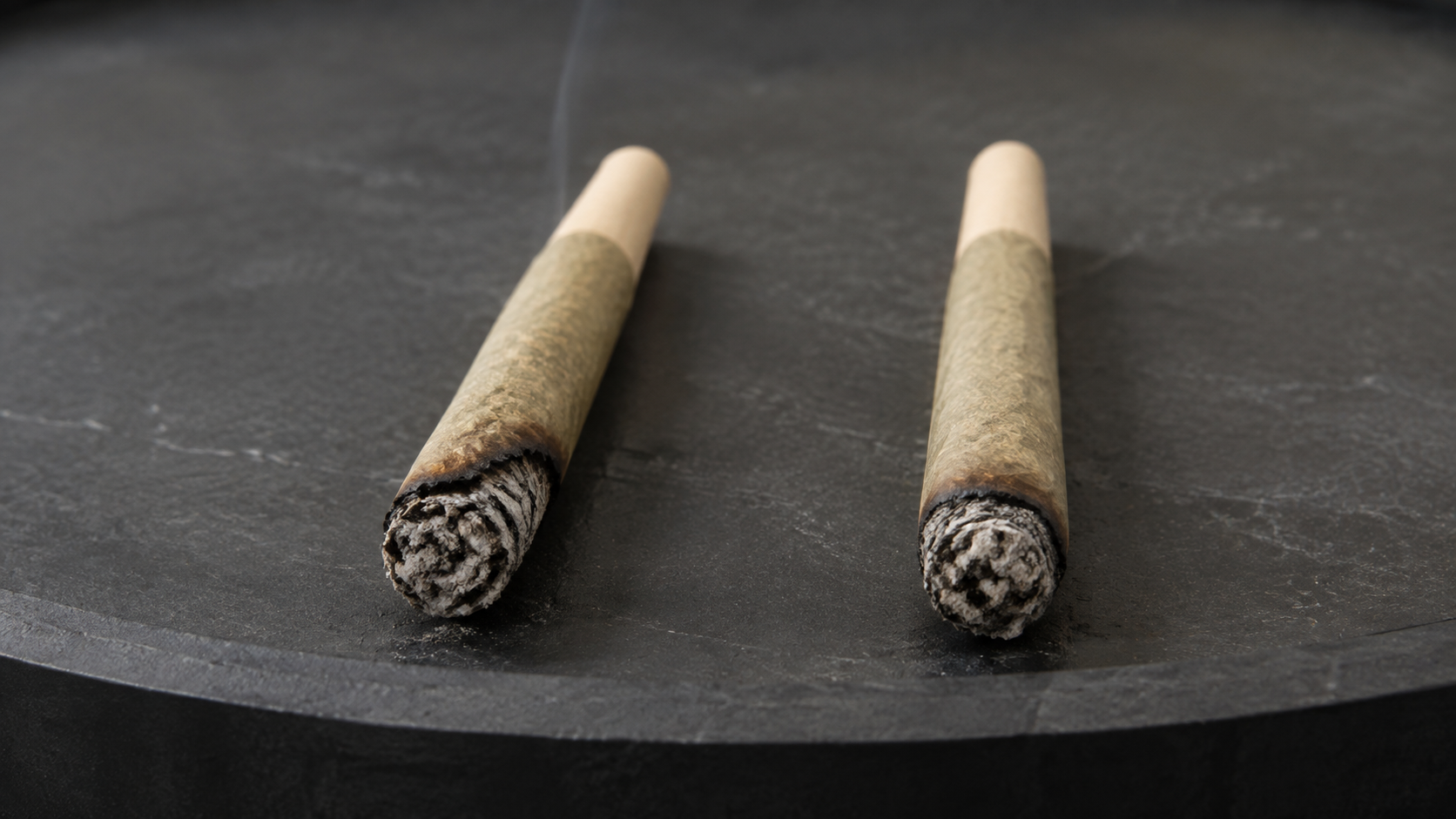
Canoeing, running, or a side burn happens when the ember travels farther down one side of the paper than the other. The remaining edge rises above the burned side and can resemble the open shape of a canoe.
A shallow uneven line may settle without intervention. A deep run continues moving along one edge, wastes material, and can become harder to correct. The shape does not identify one cause by itself. Lighting, airflow, construction, moisture, and wind can produce a similar result.
2. Why does a joint burn unevenly?
Quick diagnosis: when did the run begin?
| What you notice | More likely cause | What to check |
|---|---|---|
| It runs from the first light | Only part of the tip formed an ember | Light the circumference evenly before the first pull |
| It starts halfway through | A hard spot, gap, moisture difference, wind, or pull pattern | Inspect the area without crushing the roll |
| The run follows the seam | Paper overlap, gum line, crease, or tear | Check whether the paper is damaged or folded unevenly |
| Several items in one pack do it | Batch construction, handling, or storage | Keep the package, batch details, receipt, and a clear photo |
Uneven grind or packing
Large pieces, fine dust, hollow pockets, and hard plugs do not burn or draw at the same rate. The looser side may receive more airflow and advance faster, while a dense area falls behind. Packing tighter is not always the answer. Consistency matters more than maximum pressure.
Moisture and storage differences
Very dry material may burn quickly. A damp or sticky section may struggle to stay lit. Keep ready-made products sealed in their original labeled packaging and away from direct heat, sunlight, and moisture. Use the cannabis freshness and storage guide to check musty odor, visible moisture, mold-like growth, and other warning signs.
Lighting, wind, and repeated hard pulls
If one edge ignites first, the burn begins with an imbalance. Wind can feed the exposed side. Fast or forceful repeated pulls can enlarge an existing airflow channel and make the faster edge move farther ahead.
Paper, seam, or uneven infusion
A tear, heavy overlap, crooked seam, crushed section, or unevenly distributed infusion may change the burn. Paper thickness alone is not a reliable diagnosis because material, construction, storage, and lighting all interact.
3. How to fix a canoeing joint right now
- Pause the pull. Let the ember settle before adding more heat.
- Rotate and inspect. Find the slower, higher edge. Check for wind, a visible tear, a crushed area, or an open pocket.
- Make one small correction. Bring a normal lighter briefly near the slower edge while rotating. Avoid heating the entire side.
- Recheck once. Continue gently only if the burn line becomes more even.
- Stop if it returns. If the same run immediately grows again, extinguish the pre-roll instead of repeatedly chasing it with flame.
How to fix canoeing without saliva
You do not need to wet the paper. Pause, rotate the roll, and apply one brief correction near the lagging edge. If the run is already deep, extinguish it on a heat-safe surface, allow it to cool, and relight the full tip once. This avoids a hygiene problem when products are shared and prevents the paper from becoming oversaturated.
4. Why does my pre-roll keep going out?
A pre-roll that repeatedly goes out may have restricted airflow, material that is too damp, a compressed filter, an inconsistent pack, or an ember that never formed evenly. It is not always the same problem as canoeing, although both can come from density and moisture differences.
- Very tight draw before lighting: The fill or tip may be compressed.
- Normal draw but weak first ember: The circumference may not have been lit evenly.
- Damp feel, visible moisture, or musty odor: Do not use the product.
- Several new items fail the same way: Keep the package and contact the retailer.
Do not puncture a sealed retail pre-roll with a needle, toothpick, or paperclip. That can tear the paper, disturb the fill, and make the product harder to evaluate or return. If one careful relight fails, replacement is the cleaner decision.
5. How to prevent a joint from canoeing
- Use a reasonably even grind and remove hard stem pieces when preparing your own roll.
- Distribute material consistently without creating hills, gaps, or rigid plugs.
- Pack firmly enough to hold its shape, but not so tightly that airflow is restricted.
- Inspect a ready-made pre-roll for tears, crushed zones, a crooked tip, or an open seam.
- Keep it sealed and labeled until use, away from direct heat and moisture.
- Use slower pulls and allow the ember time to settle between them.
How to light a pre-roll evenly
- Inspect the tip and paper before applying heat.
- Hold the flame near the outer edge without drawing immediately.
- Rotate slowly until the tip has an even ember around its circumference.
- Take a gentle first pull only after the ember looks balanced.
Lighting the complete tip first is easier than correcting a run later. For a slower approach to inhaled products, read the beginner pre-roll pacing guide.
6. Is it your technique or the pre-roll?
| Pattern | More likely explanation | Next step |
|---|---|---|
| One pre-roll runs after a one-sided light | Ignition or wind | Use the four-step lighting method next time |
| A hard ridge, tear, or empty pocket is visible | Construction or handling | Stop modifying it and ask about replacement |
| Every item in one package behaves similarly | Batch, packing, or storage issue | Keep the tube, batch details, and receipt |
| Musty odor, failed seal, moisture, or foreign material | Product warning sign | Do not use it |
7. What to check when a new pre-roll burns unevenly
A brand-new pre-roll may canoe because the first light was uneven. Try one reset only if the seal, paper, smell, and visible contents appear normal. If the problem returns, document the product instead of repeatedly relighting it.
It preserves the product name and warnings.
Photograph the lot or batch information.
Keep the order or purchase record.
Match available laboratory information to the package.
Mary Jane shoppers can review available Certificate of Analysis records. A COA helps verify the tested batch and cannabinoid information. It does not prove that every individual pre-roll will burn evenly.
8. Miami heat, humidity, and wind
Miami conditions can expose a pre-roll to quick changes. A hot car, direct sun, a damp bag, an open tube, or outdoor wind may affect the paper, material, or first light. Keep the product sealed, labeled, shaded, and dry. Do not leave it loose on a dashboard or in a beach bag.
Adults who want to compare current packaging, labels, and available batch information can visit the Mary Jane’s Bakery Co Miami location. Product availability and batches can change, so check the current item rather than relying on an older photograph or review.
9. When should you stop or replace the pre-roll?
Stop if the paper is badly torn, the seal has failed, foreign material is visible, the product smells musty or unusual, or one careful correction does not hold. A repeated defect across one package is another reason to keep the labeled container and contact the retailer.
Canoeing is a performance symptom, not a safety test. Product identity, packaging, smell, appearance, storage history, and matching batch information still need separate checks.
10. Sources and review basis
| Source | What it supports |
|---|---|
| CDC: Cannabis and Lung Health | Smoke and lung-health caution |
| CDC: Cannabis and Secondhand Smoke | Secondhand-smoke caution |
| Florida Statute 581.217 | Current Florida hemp definitions, packaging, and certificate context for applicable products |
| Peer-reviewed cannabis postharvest review | Moisture and postharvest quality context, not a universal canoeing threshold |
11. Frequently asked questions
Why does my joint burn on one side?
One side may have more airflow, finer material, less moisture, or an earlier light. Wind, a paper seam, and hard pulls can make the difference grow.
Should I pack a joint tighter or looser?
Neither extreme. Aim for consistent density without hard plugs or hollow pockets. A roll should hold its shape without creating a severely restricted draw.
Can I fix a canoe after it starts?
Often, if the run is shallow. Pause, rotate, correct the lagging edge once, and extinguish the joint if the same run immediately returns.
How do I stop canoeing without licking the paper?
Pause, rotate the roll, and briefly apply heat near the slower edge. For a deep run, extinguish it safely, let it cool, and relight the full tip once.
Why does a new pre-roll canoe immediately?
It may have been lit unevenly, crushed, packed inconsistently, stored poorly, or made with a damaged seam. Keep the package if one careful reset fails.
Why does my pre-roll keep going out?
Restricted airflow, damp material, a compressed tip, or a weak initial ember can make a pre-roll go out repeatedly. Do not keep forcing a damaged or suspicious product.
Does canoeing mean the flower is bad?
Not by itself. Treat musty odor, foreign material, visible moisture, mold-like growth, a failed seal, or damaged packaging as separate warning signs.
Can wind make a joint canoe?
Yes. Uneven flame and oxygen exposure can make one edge advance faster. Avoid exposing other people to smoke and follow local property rules.
12. Bottom line: pause, diagnose, and correct once
A joint can burn unevenly when fuel, moisture, heat, or airflow differs from one side to the other. First identify when the problem started. Then make one small correction. If the run immediately returns, the paper is damaged, or several products from the same package behave the same way, stop forcing it and ask about replacement.
Adults can compare Mary Jane’s current CBD pre-roll information or browse CBD hemp flower options while checking the current label, package condition, and matching batch information.