

Equipment care · Adults 21+
A practical guide to alcohol-free bong cleaning
Choose a method for the material, deal with residue, and protect the parts that need different care.
Start with a permitted soap-and-warm-water wash.
Choose a labeled alcohol-free cleaner for the material.
Possible mineral marks need a different decision.
Separate glass inserts and check the exact model.
| Your piece or deposit | Useful starting route | Important limit |
|---|---|---|
| Plain glass with loose debris or light film | Mild-soap and warm-water steps. | Check formula and material compatibility; old resin may remain. |
| Glass with pale or chalky-looking marks | Check the possible mineral-deposit route. | Appearance alone cannot identify the deposit. |
| Glass with thick, sticky residue | See the alcohol-free glass-cleaner example. | Use the exact label procedure; do not add stronger DIY mixtures. |
| Silicone body with glass insert | Separate components and follow the model’s care. | The glass route does not authorize cleaning the silicone body. |
| Acrylic, coated, damaged, or unknown piece | Identify the model and inspect first. | Stop for damage or uncertain compatibility. |
Some readers have run out of rubbing alcohol. Others want a formula without an alcohol ingredient. Both need a compatible cleaning method, but the second group also needs an exact product-label check.
This guide covers manual water pipes and separates light film, sticky resin, possible mineral marks, and silicone components. Follow the route for the piece in your hand.
Related guide: Cannabis accessories for beginners explains how to choose a simpler setup and storage essentials.
Prepared for the Mary Jane’s Bakery Co Editorial Team · Sources checked October 14, 2026 · Manufacturer and public-health desk research; no physical cleaning test or medical review.
1. Clean plain glass with soap and warm water
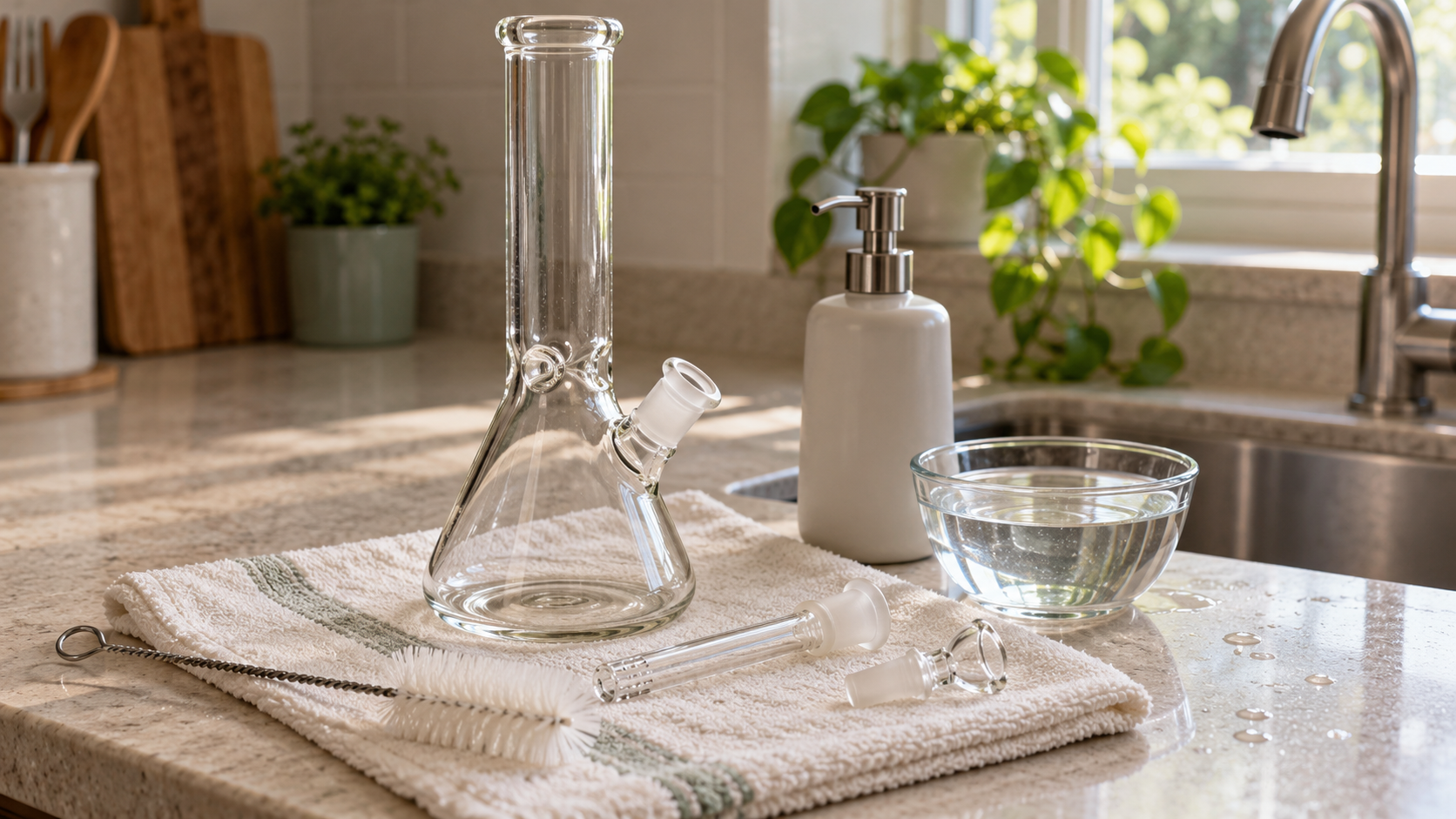
Use this route for sound, washable plain glass where mild dish soap is permitted. Keep decorated surfaces, seals, and excluded components out of the wash. Have a folded towel, clean water, mild hand dish soap, and a suitably sized soft brush ready.
- Let the piece reach a comfortable temperature. Use warm, not boiling, water.
- Empty the old water. Remove the bowl and downstem only if they are designed to detach, and place them apart on a towel.
- Rinse loose debris from the main chamber and removable parts.
- Add a few drops of a compatible mild dish soap and enough warm water for a gentle wash. If you need a strictly alcohol-free formula, verify its ingredient listing first. Swirl carefully and brush reachable deposits without forcing the tool.
- Empty the wash and rinse the chamber, bowl, stem, and joints repeatedly with clean water until no visible soap or loose residue remains.
- Dry the parts separately in a stable position, then inspect and reassemble without forcing a joint.
Vessel’s published soap method includes a few drops of soap, gentle agitation, brushing, rinsing, and drying. This is a useful starting route for light deposits, not evidence that soap removes every thick resin layer.
Check the exact soap, not just the brand
Dish soap is not automatically alcohol-free. The current P&G label for a Dawn Powerwash Free & Clear starter kit lists Alcohol, Denat. as a solvent. Its rendered label was updated October 9, 2026. That is one specified variant, not a statement about every Dawn product.
If avoiding alcohol-containing cleaners matters to you, check the formula on your current bottle or its ingredient page before substituting a dish spray. A “Free & Clear” name does not itself establish alcohol-free status. Ingredient disclosure also does not establish compatibility with a water pipe.
2. Check materials, finishes, and damage
Identify glass, silicone, seals, coatings, and removable parts before choosing a cleaner. Remove only parts designed to detach. Stop for cracks, sharp chips, loose components, or peeling finishes.
Extended soaking can affect decorations: Session Goods warns that its cleaner may wear a glass decal over time. That caution does not establish alcohol-free status or permission for another model.
3. Separate mineral marks from sticky resin
Pale cloudiness may indicate mineral deposits; a sticky brown film may be resin. Appearance alone cannot identify either. VITAE Glass discusses vinegar for mineral cloudiness, while NWTN notes its limits on heavy resin.
Use a vinegar treatment only where the piece’s maker permits it, at the specified concentration and contact time, followed by complete rinsing. Do not choose an overnight soak by default.
Use salt only on surfaces that permit an abrasive. Skip grains in narrow percolators if removal is uncertain. A reachable surface is easier to clean with a soft brush. None of these household routes establishes sterilization.
4. Remove stubborn resin without alcohol
If a permitted soap wash leaves thick, sticky deposits, choose a cleaner explicitly labeled alcohol-free and approved for the material. “Natural” alone does not establish alcohol-free status.
A verified glass-only example
Grunge Off Super Soaker’s manufacturer page labels it alcohol-free and formulated exclusively for glass. It is an example of the right product category, not a claim that Mary Jane carries it or that we have tested its performance.
Its published directions specify:
- Apply to the glass piece; use a glass container for small glass components.
- Use the product without adding water during the cleaning soak.
- Soak until the deposits clear; the published directions give no universal number of minutes.
- Rinse thoroughly with warm water afterward and wash your hands.
Follow the label for handling, protective equipment, waste, and any reuse. Keep the cleaner in its labeled container. If deposits remain after its permitted procedure, contact the maker rather than improvising stronger mixtures.
| Route | Scope and formula check | Dilution or contact time | Finish |
|---|---|---|---|
| Compatible mild-soap wash | Suitable washable plain glass; verify the actual formula for an alcohol-free requirement. | A few drops in warm water; no universal time for removing thick resin is established here. | Brush reachable areas, rinse, dry, and inspect. |
| Grunge Off manufacturer example | Manufacturer labels it alcohol-free and glass-only. | No water added during the soak; the directions give a condition-based endpoint, not a fixed number of minutes. | Warm-water rinse afterward; wash hands. |
| Eyce silicone-care example | Its specified silicone route uses a plant-based alcohol-free cleaner; separate glass parts. | Up to five minutes for that procedure. Dilution is not stated; follow the current cleaner label. | Scrub, rinse, and air-dry as directed. |
This compares published instructions from Grunge Off and Eyce. It does not rank cleaning performance or extend either procedure to another material.
5. Clean silicone and other materials separately
Remove a glass insert only when the design permits it. Eyce’s current silicone-bong guide supports a soap route for light cleaning and a plant-based alcohol-free cleaner for deeper residue. Its cleaner procedure allows up to five minutes, followed by brushing, rinsing, and drying.
That is a specific manufacturer example, not a universal soak time. Eyce’s silicone FAQ permits top-rack dishwasher cleaning of its specified products with glass removed and no heated dry. This does not authorize dishwashing every silicone bong.
Eyce’s current retrieved guide and FAQ advise against isopropyl alcohol. Other retailers publish different advice, so identify the exact model and use its current instructions. This article’s route stays alcohol-free.
For acrylic, unidentified plastic, metal finishes, or decorative coatings, obtain the model’s care instructions before vinegar, heat, abrasives, a freezer, or a dishwasher. These components are outside the plain-glass method.
6. Clean bowls, downstems, and percolators
Clean removable bowls and stems separately using their approved method. A clear main chamber does not establish that the smaller parts are clean. Use a soft brush that fits; do not force a rigid tool through a narrow opening.
For fixed percolators, tilt the piece gently to distribute the compatible liquid. Avoid aggressive shaking or pressure against fragile internals. A blocked passage needs model-specific support. If a downstem will not release normally, stop pulling and ask the maker.
7. Avoid heat and cleaner mixtures
- Avoid boiling water and abrupt hot-to-cold changes. My Bud Vase cautions against hot or boiling rinses for its glassware.
- Do not use bleach, drain cleaner, oven cleaner, paint thinner, or nail-polish remover as improvised equipment cleaners.
- Do not mix cleaning products. Poison Control advises against household-cleaner mixtures; vinegar and bleach can release chlorine gas.
- Do not cap a vessel containing a reacting vinegar-and-baking-soda mixture. ACS identifies carbon dioxide as a reaction product; gas can build pressure in a closed container.
- Do not consume cleaning liquid or cleaner-soaked residue. Discard cleaning waste according to the label and local guidance.
Fizzing is evidence of a reaction, not proof of better cleaning. This guide does not recommend a vinegar-and-baking-soda mixture as the default deep-clean method.
8. Repeat, ask for help, or replace
| What remains | Next step | Keep it out of use when |
|---|---|---|
| White or cloudy-looking glass | Check the maker’s mineral-deposit guidance. | Cloudiness remains unexplained or the surface seems damaged. |
| Sticky film after a soap wash | Use the compatible cleaner route for the material; soap is a light-maintenance starting point. | You need extra heat, force, or an unapproved chemical. |
| Soap, cleaner, or vinegar odor | Complete the label’s rinse; inspect the bowl, stem, joints, and removable seals for retained film or liquid. | Film, foam, odor, or trapped liquid persists. |
| Possible mold or unknown contamination | Take the piece out of use and ask about approved remediation or replacement. | Routine cleaning cannot confidently address the contamination. |
| Crack, chip, loose insert, or peeling finish | Request a replacement part or replace the piece. | Cleaning would leave the damage in place. |
These are maintenance decisions, not a safety or disinfection certificate. Cleaning cannot repair damage or identify an unknown deposit.
Examples: Light film on washable plain glass can start with soap. A silicone body and glass insert need separate checks. Thick residue after washing needs a compatible cleaner, not more heat or force.
When soap does not clear the resin
Do not assume you used too little soap. A thick residue layer can require a different permitted method. Choose the labeled cleaner route above, and follow its material scope, dilution, contact time, and rinse. Do not raise the temperature or combine cleaners to compensate.
When the piece still smells after cleaning
Recheck the small components and finish the prescribed rinse and drying process. Odor alone cannot identify the remaining material or certify a completed clean. Do not add fragrance to mask the problem. Keep the piece out of use if the odor, film, or uncertain deposit persists and ask the maker about further care or replacement.
9. Maintain the piece and ask accessory questions
Empty used water and rinse where permitted. Clean before deposits become difficult to remove and before storage; follow the model’s maintenance guidance. Store fully dry in a secure place, with cleaners in their labeled containers.
Mary Jane’s Miami smoke shop location lists 175 NW 14th St and 24-hour service. Ask about current accessory availability, the exact model, removable parts, and its cleaning instructions before visiting. The cleaner examples here are not inventory claims.
For other equipment, use the separate weed-grinder cleaning guide. Its screens, teeth, and coatings need their own care.
10. Sources and manufacturer instructions
Sources checked October 14, 2026. Manufacturer advice applies to the specified product; public-health sources support the safety cautions, not cleaning-performance claims.
| Source | What it supports |
|---|---|
| Vessel: alcohol-free cleaning | Dish-soap cleaning, removable parts, brushing, rinsing, and drying. |
| VITAE Glass: alcohol-free cleaning | Separate components, warm-water preparation, and possible mineral cloudiness. |
| NWTN Home: alcohol-free methods | Limits of household methods and caution about temperature changes. |
| My Bud Vase: glass-care guidance | Lukewarm rinsing and avoiding hot or boiling water on its glassware. |
| Eyce: silicone FAQ | Model-specific dishwasher permission and component separation. |
| American Chemical Society: vinegar reaction | Vinegar plus baking soda produces carbon dioxide, water, and sodium acetate. |
| Poison Control: dish soap | Avoid mixing household cleaning products. |
| Poison Control: vinegar | Vinegar and bleach can release irritating chlorine gas. |
| CDC: cannabis and lung health | Equipment cleaning does not remove the risks of smoking cannabis. |
| Grunge Off: product specification | Published alcohol-free claim and glass-only material scope. |
| Grunge Off: directions | Undiluted glass-cleaning soak, condition-based endpoint, and warm-water rinse. |
| Eyce: current silicone-bong guide | Its light-cleaning route and specified alcohol-free cleaner procedure. |
| Session Goods: cleaning-kit caution | Possible decal wear during extended soaking; not an alcohol-free certification. |
| P&G SmartLabel: specified dish spray | Product-specific Alcohol, Denat. disclosure; live rendered label updated October 9, 2026. |
11. Frequently asked questions
Can I clean a bong without alcohol or salt?
Yes, for light buildup where permitted: warm water, mild dish soap, and a soft brush are a useful starting route. Thick resin may need an approved alcohol-free cleaner.
Can I use Dawn or another dish soap?
Check the exact formula and the piece’s instructions. Some dish sprays list an alcohol ingredient. A brand name or “Free & Clear” label does not establish an alcohol-free formula. Use a compatible product and rinse as directed.
Is vinegar better than soap?
They address different cleaning needs. A permitted vinegar treatment may help mineral marks; soap is a maintenance option for light residue. Neither is a universal answer to old resin.
Can a silicone bong go in the dishwasher?
Only when the exact manufacturer and model permit it. Remove excluded glass and other parts, and follow its rack and drying instructions.
How long should I soak the piece?
Use the cleaner label and model’s limit. There is no verified universal soak time for every bong, coating, or alcohol-free formula.
Will this remove mold and sterilize the bong?
This is a maintenance guide, not a validated disinfection method. For suspected mold or unknown contamination, stop using the piece and ask the maker about remediation or replacement.
Can I clean a bong without alcohol or vinegar?
For light deposits on suitable plain glass, a compatible mild-soap wash is an option; verify the soap if strict alcohol-free status matters. Stubborn resin may need a labeled alcohol-free cleaner approved for the material.
Why did dish soap leave sticky resin behind?
The soap route is a starting point for light deposits, not guaranteed heavy-resin removal. Switch to a compatible labeled cleaner rather than adding more heat, abrasion, or mixed chemicals.
Does no smell mean every cleaner residue is gone?
No smell alone is not a completion test. Follow the complete rinse and drying directions, inspect recesses and removable parts, and stop if film, foam, liquid, or unexplained deposits remain.
12. Finish with clean, dry, intact parts
Identify the material, start with an approved gentle wash, and use a compatible alcohol-free cleaner when deposits remain. Complete the rinse and drying directions, inspect every component, and stop when the remaining problem is damage or uncertainty.