

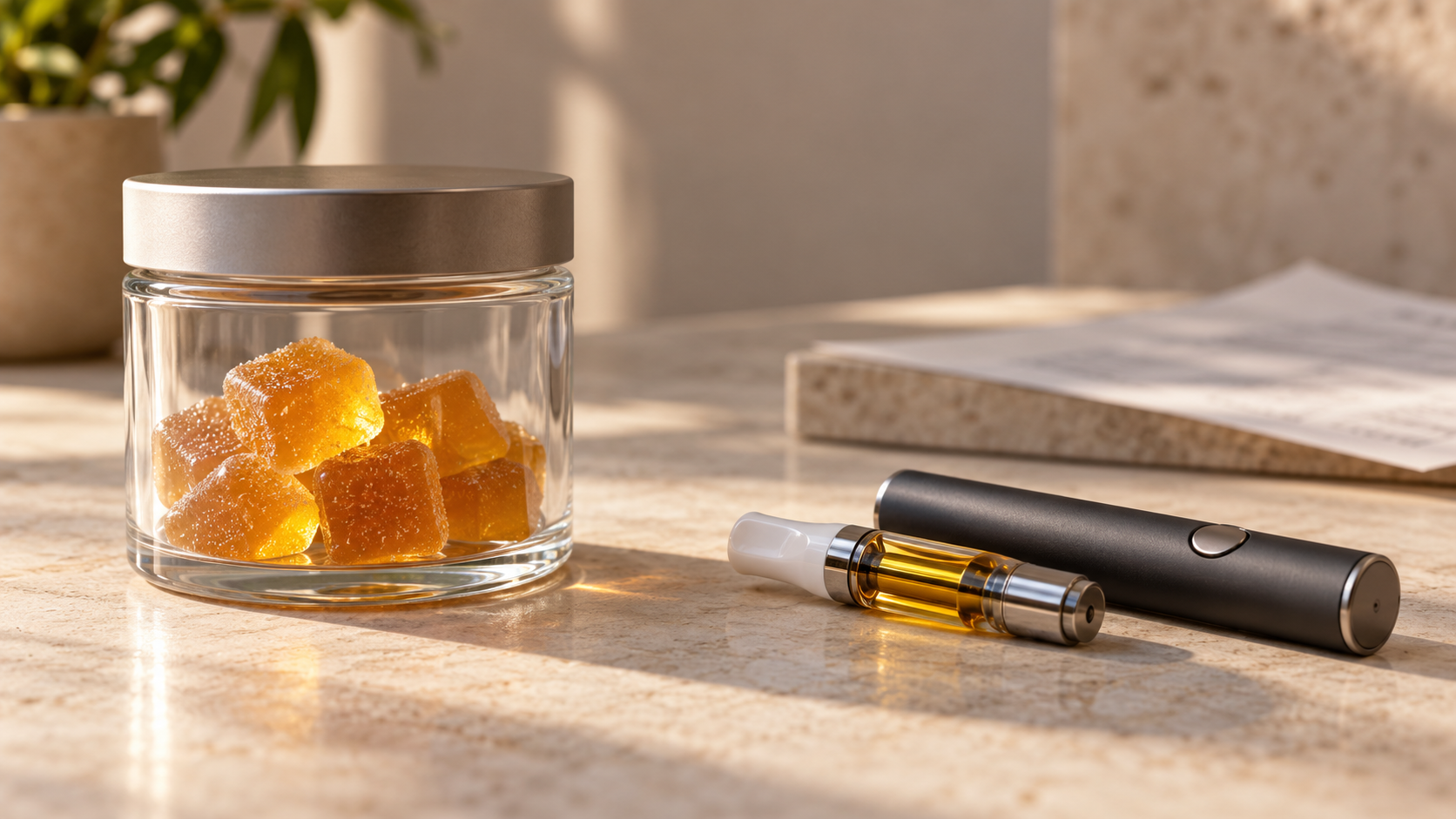
Independent-format comparison for adults 21+ · Research checked October 21, 2026
CBD vape vs. gummies: CBD cartridges deliver an inhaled aerosol; CBD gummies are swallowed and digested. In controlled research, inhaled and oral CBD produce different blood-concentration patterns, but that does not prove one produces better or faster medical relief. Gummies avoid inhalation exposure, while vapes introduce device and aerosol considerations. With either format, check the CBD/THC amounts, the actual batch lab report and possible medication interactions before making a decision.
CBD vape vs. gummies: the side-by-side comparison
On smaller screens, swipe the table horizontally.
| Question | CBD vape cartridge | CBD gummy |
|---|---|---|
| How does it enter the body? | Inhaled aerosol reaches the lungs. | Swallowed; CBD goes through digestion. |
| Blood concentration pattern | Earlier peaks are possible under controlled conditions. | Often later and more variable; food and formulation matter. |
| Portion clarity | Cartridge totals are not a reliable CBD amount per puff. | Per-piece amounts can be stated, but should be verified. |
| Other things needed | Compatible hardware, charging and manufacturer instructions. | No vape hardware; check ingredients and allergens. |
| Distinct exposure | Heated aerosol, inhaled ingredients and possible device contaminants. | Food ingredients, delayed absorption and accidental ingestion risks. |
| Shared concerns | Potential THC exposure, CBD drug interactions, inconsistent labels and incomplete third-party testing. | |
Bottom line: The better format fit depends on your priorities, while the better product decision requires evidence about an actual package and its batch. Those are two different judgments.
Which absorbs faster: a CBD vape or gummies?
Vaporized CBD can reach peak blood concentrations earlier than orally consumed CBD in controlled studies. Oral CBD must move through the gastrointestinal tract, where food, formulation and individual differences can greatly alter absorption. A controlled human study comparing oral and vaporized CBD products reports differences in how CBD and metabolites appear in blood; a broader pharmacokinetic review also finds large variability between products and routes. See the human pharmacokinetics study and systematic review.
That is a finding about measured exposure, not a promise that vaping reliably treats stress, pain, sleep problems or any other condition faster. A marketing phrase such as “fast-acting relief” should not be accepted as clinical proof. Similarly, a “nano” gummy claim needs formulation-specific evidence rather than a universal promise.
Look for evidence about the precise product and formulation. A general inhaled-versus-oral average cannot predict exactly what you will experience.
Speak with a qualified clinician. Nonprescription CBD products are not established as treatments for conditions just because CBD may reach the bloodstream.
Are CBD gummies safer than vaping CBD?
Gummies avoid inhaling an aerosol, but neither route is risk-free. Vaping raises separate respiratory and ingredient-exposure questions. The 2019–2020 EVALI outbreak was strongly associated with certain THC vaping products, especially those from informal sources, and vitamin E acetate; that history should not be falsely presented as proof that every CBD vape causes the same injury. The CDC clinical report explains the outbreak context.
CBD itself also warrants caution. The FDA’s consumer guidance identifies possible drug interactions, liver-related risks and other safety uncertainties. Gummies may introduce allergens, sweeteners and accidental-consumption risks, especially around children and pets. If you take prescription medication, are pregnant or breastfeeding, or have a respiratory condition, discuss the risks with a qualified healthcare professional rather than relying on a store recommendation.
Do not interpret a COA labeled “tested” as proof that an entire product is safe. Ask which analytes and contaminants were actually included and whether the report matches the package in hand.
How to read CBD and THC labels without mixing up units
The most common comparison mistake is treating all milligram figures as interchangeable. Check the compound (CBD versus delta-9 THC or another cannabinoid), the unit (per piece, per package, per cartridge, per gram) and the sample identity.
| Label or report says | What it means | What it does not establish |
|---|---|---|
| 1,000 mg CBD per package | A claimed package total of CBD. | CBD per gummy, or the amount absorbed by the body. |
| 100 mg THC per piece | A claimed per-piece THC amount—very different from CBD. | That the product is non-intoxicating or appropriately labeled. |
| 84% total CBD by weight | A percentage concentration in a tested sample. | Milligrams inhaled per puff or current-stock contents. |
| 136 mg/unit on a COA | The lab-defined unit of the submitted sample. | Automatically 136 mg in each individual gummy. |
Stop and clarify when a listing contradicts itself. The publicly visible CBD Hybrid Canna Gummies product page has described CBD in its body copy but THC amounts in its purchase details. Until those labels are reconciled with current packaging and a matching COA, the figures should not be used to recommend or compare that SKU.
A real example: what Mary Jane’s historical lab reports do—and do not—verify
Two public 2024 laboratory records demonstrate why careful document reading matters. They are useful historical examples, not certificates for products stocked in October 2026.
| Document | Reported cannabinoid result | Crucial limitation |
|---|---|---|
| GSC CBD vape cartridge, May 2024 | Total CBD: 84.5302% by weight; total THC: 0.2344% by weight. | Microbials, heavy metals, residual solvents and several other panels marked “not tested.” |
| Hybrid Canna Gummies CBD, September 2024 | Total CBD: 136 mg/unit; total THC: 78.1 mg/unit. | “Unit” is defined by the submitted lab sample, not verified as one gummy. Most listed contaminant panels were not tested. |
Read the original May 2024 cartridge report and September 2024 gummy report. The reports use different measurement units and samples, so the numbers must not be compared as if they represent equivalent doses. Neither report shows that the same products, formulations or batches are for sale now, and neither is a comprehensive safety certification.
Six checks that make a CBD certificate of analysis useful
- Match the product and batch. The COA identifier should correspond to the exact packaging being purchased.
- Check the test date. An older document may describe a prior batch or formulation.
- Separate CBD from THC. Check measured cannabinoids and confirm each unit.
- Look for relevant contaminant panels. Depending on product and testing protocol, these may include pesticides, heavy metals, microbes, mycotoxins and residual solvents. A “not tested” field is not a pass.
- Inspect vape-specific information. Consider ingredients, hardware and whether the lab assessment meaningfully covers a cartridge’s risks.
- Resolve contradictions before buying. The listing, label and COA should agree; ask the store if they do not.
Consumers who want a second guide can read Mary Jane's CBD edibles guide or CBD cartridge explainer. These supporting articles should link back to this comparison using descriptive, natural anchors.
Which offers better value: CBD vapes or gummies?
Compare verified package pricing and labeled CBD amounts first. For a product with a trustworthy declared total, the basic arithmetic is package price ÷ labeled total CBD milligrams. For example, a hypothetical $30 product labeled 600 mg CBD equals five cents per labeled mg. This is an arithmetic illustration, not a Mary Jane's store price.
For gummies, also compare piece count and the CBD/THC amount per piece. For cartridges, count any battery or hardware required, and do not turn milligrams per cartridge into an invented milligram amount per puff. Price per labeled mg is a limited purchasing metric: it is not a measure of actual absorption, effects or clinical value.
What is the total cost, number of pieces, reported cannabinoid content per piece, and full ingredient list?
Does the listed price include a battery? What is the cartridge size, ingredient declaration and batch testing scope?
Can CBD gummies or vapes lead to a positive drug test?
Yes, either format may present a risk if it contains THC. Many workplace marijuana screens look for THC metabolites, not CBD itself. However, imperfect labeling, THC-containing CBD products and different test programs make a guaranteed negative result impossible. The U.S. Department of Transportation CBD notice specifically warns safety-sensitive workers about these risks.
If avoiding THC is essential for work, medical or other reasons, do not rely on “CBD,” “hemp” or “full spectrum” wording alone. Consider avoiding products that might contain THC and consult the applicable testing policy.
Buying CBD vapes or gummies in Miami: what to ask locally
In warm Miami weather, protect products from unnecessary heat, follow the original packaging instructions and never leave cannabinoid products where children or pets can access them. Do not assume a hot-car exposure or a damaged cartridge leaves a product unchanged.
Mary Jane's Bakery Co. has category pages for CBD edibles and gummies and CBD vape cartridges. These are places to check listed formats—not endorsements of individual products. If a label, lab report, battery compatibility detail or ingredient list is unclear, contact the Wynwood store to request clarification before making a purchasing decision.
Start with a current label and batch identifier; examine the available report; ask what was not tested; and make sure CBD, THC and unit quantities are consistent. When the available evidence is incomplete, it is reasonable not to choose either option.
CBD vape vs. gummies: frequently asked questions
Are CBD gummies stronger than CBD vapes?
Not necessarily. Labeled cannabinoid quantity, absorbed quantity and perceived effects are different measures. You cannot reliably compare them from package totals alone.
Do CBD gummies last longer than a vape?
Oral and inhaled CBD have different blood-concentration patterns, but there is no reliable fixed duration that applies to all gummies and cartridges. Formulation, food, exposure and individual differences matter.
Is a CBD gummy always safer than a vape?
No. Avoiding inhaled aerosol removes a particular type of exposure, but gummies still have CBD-related risks, potential THC exposure, ingredient concerns and drug interactions.
Does full-spectrum CBD always contain zero THC?
No. Full-spectrum extracts can contain THC. Check the actual product and current COA, not the label category alone.
Can a COA prove a product is safe?
No. It documents findings for specified samples and tests. It cannot certify untested hazards, a different batch or the product's effect on a particular person.
What if I take prescription medication?
Talk to a qualified healthcare professional before using CBD. The FDA identifies potentially significant drug interactions and other risks.
How this guide was researched
This article compares delivery formats using published human pharmacokinetic research, FDA and CDC guidance, U.S. DOT drug-testing information and two publicly posted 2024 Mary Jane's COAs. It is a source review and label-reading guide; no product was purchased, independently tested, photographed or clinically evaluated for this article. The historical reports do not represent today's retail inventory. Illustrative editorial media, if used, is not evidence of current stock. Research reviewed October 21, 2026. The date should be updated only after substantive review.
- Human study: inhaled versus oral CBD pharmacokinetics.
- Systematic review of CBD pharmacokinetics.
- FDA: CBD safety and regulatory questions.
- CDC: historical EVALI outbreak guidance.
- DOT: CBD and marijuana testing notice.
- May 2024 vape COA and September 2024 gummies COA.
For adults 21+. Educational only, not individual medical or legal advice. This page is not a claim that CBD products treat or cure medical conditions. Readers should follow applicable laws and consult qualified professionals for personal risks.