

Last updated: October 16, 2026
When comparing CBD oils, start with the amount of CBD per milliliter and the serving information on the label—not just the largest number printed on the bottle. Then check the extract type, ingredients, THC details, and whether a lab report matches the exact product and batch. This guide explains those checks and how to compare other CBD formats.
About this guide: Mary Jane’s Bakery Co. sells products linked from this page. This is shopping information, not medical advice, independent product testing, or a claim that any product will produce a particular effect. Product labels, stock, and available reports can change; verify the current item before ordering.
Mary Jane lists products for adults 21+. Product eligibility and shipping depend on the product and destination.
Quick answer: what to compare before buying CBD
- Choose a format that fits your preferences and read that product’s label directions.
- Compare like with like: for oil, check CBD per mL and the label-defined serving; for gummies, check CBD per piece; for topicals, review the amount per container and ingredients.
- Check the cannabinoid details, including THC, if that matters to you.
- Match the COA (Certificate of Analysis) to the product and lot or batch you are considering. A report for a different batch does not verify the current item.
- Check applicable rules and safety information. A label or COA is not medical advice, legal clearance, or a guarantee about drug-test results.
How to choose CBD oil
CBD oil and tincture labels can display a total amount for the whole bottle, while the bottle itself can vary in size. To compare products fairly, put the amount and volume into the same units.
- Find the total CBD amount on the label, in milligrams (mg).
- Find the bottle volume, in milliliters (mL).
- Calculate CBD per mL: total labeled CBD in mg ÷ bottle volume in mL.
- Read the serving information: note how many mL the label defines as a serving and the CBD amount stated for that serving.
- Review the ingredients and extract type. Check carrier oils, flavors, allergens, and any other listed cannabinoids.
- Check THC information and the COA. Match the report’s product identity, lot, units, and date to the item being sold.
- Compare price only after the units match. Price per 100 mg is a basic arithmetic comparison; it does not measure quality, safety, or suitability.
Illustrative calculation: A hypothetical bottle labeled with 1,000 mg CBD in 30 mL contains about 33.3 mg CBD per mL by label math (1,000 ÷ 30). If its hypothetical price is $45, the labeled amount works out to $4.50 per 100 mg ($45 ÷ 1,000 × 100). These numbers are examples only, not a Mary Jane product claim or a suggested serving.
COA-to-label difference: when the report and label use the same units and package basis, you can calculate the percentage difference as ((COA result − label amount) ÷ label amount) × 100. Do not compare results expressed on different bases, such as mg per gram versus mg per bottle.
For product-specific availability and label details, see the current CBD oil tincture listings and the CBD tincture strength guide.
CBD oil label calculator
Enter the values printed on a product label to compare concentration and package price. The calculator performs unit arithmetic only; it does not recommend a serving, predict an effect, or verify a lab result.
Use the serving volume shown on the product label. A calculated amount is not a serving recommendation. Follow the product label and consult a healthcare professional for medical questions.
How to compare CBD product formats
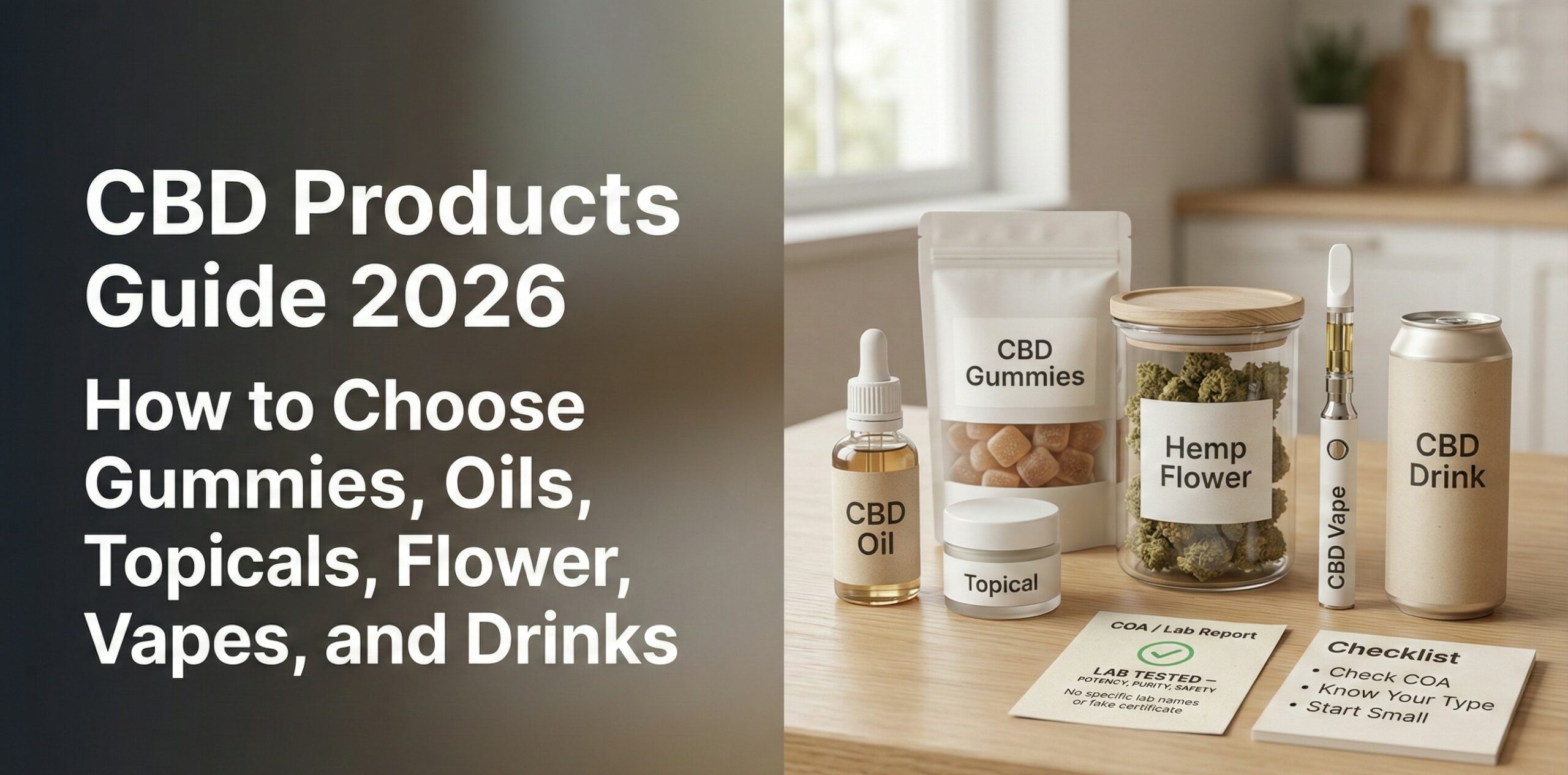
Formats use different label units, so the comparison that helps for an oil may not work for an edible or topical. Check the exact product’s ingredients, directions, cannabinoid details, and current availability.
| Format | Useful label checks | Keep in mind |
|---|---|---|
| Oils and tinctures | Total CBD, bottle volume, CBD per mL, label-defined serving, ingredients, THC details. | Compare concentration and serving units; do not choose by the front-label total alone. |
| Gummies and other edibles | CBD and THC per piece and per package, number of pieces, ingredients, allergens, label directions. | Check product-specific rules. FDA’s current position on CBD added to food is summarized in the legal section below. |
| Topicals | Total CBD per container, full ingredient list, product directions, and available cannabinoid information. | Do not assume a topical has the same absorption or effects as an edible or tincture. |
| Hemp flower and vapes | Product identity, cannabinoid information, ingredients or hardware details, and current batch documentation. | These are inhaled formats with separate health and legal considerations. Check local rules and the product’s exact details. |
| Drinks | CBD and THC per serving and container, total servings, ingredients, and product-specific documentation. | Do not assume a CBD drink is THC-free or that a category label establishes its legal status. |
For a side-by-side format discussion, read CBD gummies vs. CBD oil and the CBD edibles guide.
CBD isolate vs. broad spectrum vs. full spectrum
These terms describe an extract profile, but naming conventions and formulations can vary. Use the product label and the matching COA to check the actual reported cannabinoids.
- CBD isolate: a formulation intended to contain CBD as the isolated cannabinoid. Check the report for other cannabinoids and the lab’s stated detection limits.
- Broad spectrum: generally describes CBD with other hemp compounds after processing intended to remove THC. The term alone does not establish that a product or batch contains zero THC.
- Full spectrum: generally describes an extract with multiple hemp compounds and may include THC. Review the exact label and report if THC content matters to you.
No spectrum term proves the contents of every product. For more detail, see the CBD spectrum comparison guide.
How to check a CBD COA
A Certificate of Analysis is a laboratory report for a tested sample. It can help you review the reported cannabinoid profile and the panels listed on that report. It is not FDA approval. It does not by itself establish that the sample represents the product currently in stock, that every possible contaminant was tested, that the product is legal in every location, or that it is safe or effective for a particular person.
- Match product identity: compare the report’s product name or code and product type with the package and product listing.
- Match the lot or batch: the report should identify the same lot as the product you are considering. If the online listing does not identify the shipped lot, ask the seller which report applies.
- Check report dates: note sample, test, and report dates. A report for an older sample may not describe current stock.
- Compare units: identify whether results are reported per gram, milliliter, serving, or container before comparing them with a label claim.
- Read the cannabinoid panel: check CBD, delta-9 THC, THCA, and any total-THC calculation shown when those details are relevant.
- Read detection limits: “ND” means not detected under the lab’s method and stated limit; it does not mean absolute zero. Review LOD or LOQ information if shown.
- Review the test scope: identify which pesticides, heavy metals, microbes, residual solvents, or other panels were tested. “Not tested” means that report does not provide a result for that panel.
- Identify the laboratory: look for its name, methods, and any stated accreditation. A lab name or accreditation alone does not prove that the report matches the item in your cart.
Quick COA worksheet
| Write down | Where to find it |
|---|---|
| Product and lot | Retail label and COA product/sample information |
| Label amount and unit | Product label; note per serving or per package |
| COA result and unit | Report cannabinoid table; compare on the same basis |
| Report date and lab | COA header or sample information |
| Panels tested / not tested | COA results and test-scope sections |
For another explanation of THC results and testing, see the CBD and drug-testing guide.
CBD and drug testing
No CBD product can guarantee a negative drug-test result. Some products contain THC, and a label or COA cannot guarantee how a separate test will classify an individual’s exposure.
- Full-spectrum products may contain THC.
- “Broad spectrum” and “isolate” do not guarantee that every product or batch contains zero THC.
- A COA applies to the sample and test methods described in that report. It cannot guarantee a result under a separate workplace or testing program.
If a workplace, legal, or athletic testing policy applies, review that policy and seek qualified guidance before using cannabinoid products. See the CBD drug-testing guide.
CBD safety and legal information
Health and medication questions
The FDA identifies potential CBD safety concerns, including liver injury and interactions with other medicines. The agency also says that unapproved CBD products have not been evaluated for claimed effectiveness, appropriate dosage, or how they may interact with other drugs. If you take medication, are pregnant or breastfeeding, or have a health question, speak with a qualified healthcare professional. This guide does not recommend CBD for pain, sleep, anxiety, or any other medical condition.
See the FDA consumer update on cannabis-derived products and the FDA’s CBD regulatory questions and answers.
Federal hemp-law changes scheduled for 2026
Checked October 16, 2026. Section 781 of Public Law 119-37 is scheduled to amend the federal hemp definition 365 days after the law’s November 12, 2025 enactment. Public Law 119-103, section 2019, sets a temporary applicability rule through December 11, 2026 for specified products containing cannabinoids that cannot be naturally produced by a Cannabis sativa L. plant.
This is a narrow statutory transition, not a decision that a particular CBD or THC product may be sold or shipped. It also does not replace FDA requirements for foods, drugs, or other product categories. The FDA states that CBD added to food or marketed as a dietary supplement is subject to federal restrictions. State and local rules may add further requirements. Sellers should have qualified counsel review each product and destination; shoppers should check current product details and local rules.
Browse CBD product categories
Use the label and COA checklist on the exact item you are considering. Product availability, package sizes, prices, and reports may change. Check the current listing and checkout eligibility for your location before ordering.
| Category | Details to compare | Browse |
|---|---|---|
| CBD oils and tinctures | CBD per mL, label serving, extract type, ingredients, THC details, matching COA. | Current tincture listings |
| CBD edibles | CBD and THC per piece and package, ingredients, allergens, current rules. | Current edible listings |
| CBD topicals | CBD amount per container, full ingredient list, label directions. | Current topical listings |
| CBD hemp flower | Product identity, cannabinoid details, available lot documentation, local rules. | Current hemp-flower listings |
| CBD vapes | Cannabinoid profile, ingredients, hardware information, batch documentation, local rules. | Current vape listings |
| CBD drinks | CBD and THC per serving and container, ingredients, report, and product-specific legal status. | Current drink listings |
For delivery, returns, and current order terms, review the returns policy or contact Mary Jane’s support.
Frequently asked questions
How do I choose a CBD oil?
Compare CBD per mL, the serving information printed on the label, extract type, ingredients, and THC details. Match any COA to the exact product and lot. The CBD tincture listings show the current products available from Mary Jane.
Is a higher milligram number always better?
No. The total milligrams describe a labeled package amount, not product quality or suitability. Compare the package volume, amount per serving, ingredients, extract type, and available batch documentation.
What does CBD per mL mean?
It is the labeled total CBD in a liquid package divided by the package volume in milliliters. It helps compare concentration when two bottles have different volumes; it is not a serving recommendation.
What should I look for on a CBD COA?
Check that the product and lot match, note the report date and lab, compare results using the same units as the label, and review which panels were tested. “ND” means not detected at the report’s stated limit, not absolute zero.
Can CBD make me fail a drug test?
No CBD label or COA can guarantee a negative result. THC-containing products may create risk, and testing policies vary. Review the applicable policy and get qualified guidance if a result matters to you.
Can CBD interact with medication?
The FDA warns that CBD may interact with other medicines. Ask a healthcare professional about potential interactions before using CBD if you take medication or have safety questions. Read the FDA consumer update.
Are CBD gummies and drinks legal everywhere?
No. Product rules depend on the formulation, how the product is marketed, federal requirements, and state or local law. The FDA states that CBD added to food is subject to federal restrictions. Check the current rules for the specific product and destination; this guide is not legal advice.
Does Mary Jane ship every CBD product to every state?
No. Product and shipping eligibility can vary by destination. Check the current product page and checkout options, and contact support if a listing or lab report is unclear.