

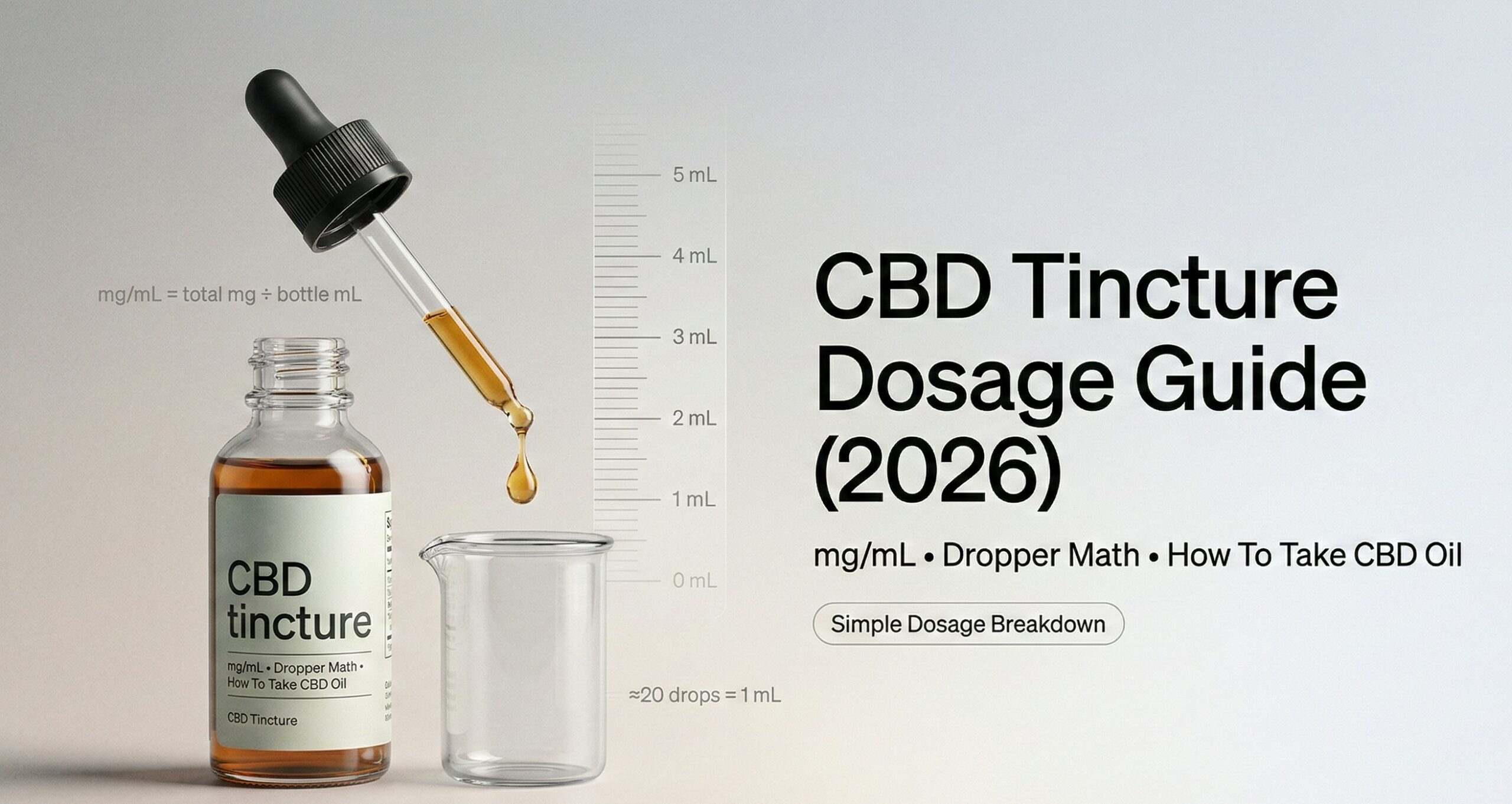
If you have ever stared at a CBD tincture label and wondered, “How many mg is one dropper?” or “How many drops should I take?”
you are not alone. This guide keeps it simple: we will show you the label math (mg/mL), a realistic way to think
about dropper servings, and a repeatable routine you can actually follow.
If you want to shop while you read, you can browse our
CBD Oil Tinctures
here.
Table Of Contents
Quick Answer: The Dosage Math In 60 Seconds
1) mg/mL = Total CBD (mg) ÷ Bottle Size (mL)
Example: 1,000 mg ÷ 30 mL = 33.3 mg/mL
2) mg in a dropper depends on how much liquid the dropper holds.
Many droppers are marked at 1 mL, but not all are identical. Always check your dropper markings and product label.
3) “Drops” are an estimate, not a perfect measurement.
A common estimate is ~20 drops per 1 mL, but drop size changes with oil thickness, dropper tip, angle, and squeezing pressure.
Want a simple way to shop by strength after you do the math? Visit our
CBD Oil Tinctures
category page.
Step 1: Calculate mg/mL (The Label Formula)
Most tinctures list a total CBD amount (like 1,000 mg) and a bottle size (often 30 mL).
To understand what you are taking, you want the concentration:
mg/mL = Total CBD (mg) ÷ Bottle Size (mL)
Why mg/mL Matters
mg/mL helps you compare tinctures fairly. Two bottles can both say “CBD Oil,” but the concentration can be completely different.
Once you know mg/mL, you can estimate how many mg you get from common measured amounts:
- 0.25 mL (quarter dropper on a 1 mL dropper)
- 0.5 mL (half dropper)
- 1 mL (full dropper)
If you want a quick strength overview before you buy, this internal guide helps:
CBD Tincture Strength Guide.
Step 2: Dropper Math (And Why Drops Vary)
Dropper Markings Beat “Drops”
The most reliable way to measure a tincture is by mL markings on the dropper (0.25 mL, 0.5 mL, 1 mL).
“Drops” are helpful for a rough estimate, but they are not consistent from one dropper (or oil) to another.
If You Still Want A Drop Estimate
Many people use the common estimate of ~20 drops per 1 mL. That lets you approximate:
Estimated mg per drop ≈ (mg/mL) ÷ 20
Important: This is only an estimate. Drop size varies with the dropper, oil thickness, and technique.
If precision matters, measure by mL.
If you are comparing CBD oil to gummies (which are pre-measured), this article helps:
CBD Gummies vs CBD Oil.
Worked Examples: 1,000 vs 5,000 vs 10,000 mg (30 mL Bottles)
Below are clean examples using common 30 mL tincture strengths. These examples are here to help you understand the math.
Always follow the serving information on your specific product label.
| Bottle | Total CBD | Bottle Size | mg/mL | mg per 0.5 mL | mg per 1 mL | Estimated mg per Drop* |
|---|---|---|---|---|---|---|
| 1,000 mg Tincture | 1,000 mg | 30 mL | 33.3 mg/mL | 16.7 mg | 33.3 mg | ~1.7 mg |
| 5,000 mg Tincture | 5,000 mg | 30 mL | 166.7 mg/mL | 83.3 mg | 166.7 mg | ~8.3 mg |
| 10,000 mg Tincture | 10,000 mg | 30 mL | 333.3 mg/mL | 166.7 mg | 333.3 mg | ~16.7 mg |
*Estimated mg per drop uses the common “~20 drops per 1 mL” rule. This varies by dropper and oil consistency. For more accuracy, measure in mL.
Want the easiest way to buy? If you already know your preferred strength range, shop here:
CBD Oil Tinctures.
How To Take CBD Oil Under The Tongue
Many people use tinctures sublingually (under the tongue) because it fits easily into a routine and makes measuring straightforward.
Always follow the directions on your product label.
Simple Steps
- Shake (If Needed): Some oils recommend a quick shake for consistency.
- Measure Your Serving: Use the dropper markings (0.25 mL, 0.5 mL, 1 mL) rather than counting drops.
- Place Under Tongue: Hold it under your tongue for 30–60 seconds (or as your label suggests), then swallow.
- Be Consistent: Choose a time that you can repeat daily (morning, evening, or both).
If you want a calm, routine-focused explanation of tinctures (without overcomplicating it), read:
CBD Oil Tinctures: A Calm, Steady Way To Feel More Balanced.
A Simple “Start Low, Go Slow” Routine
CBD routines work best when they are consistent. Instead of changing multiple things at once, use a basic plan:
The 7–14 Day Routine
- Days 1–3: Start with a small measured amount at the same time each day.
- Days 4–7: Keep it consistent. Track how the routine feels (timing, serving size, and consistency).
- Days 8–14: If you adjust, do it gradually and keep notes. Avoid “jumping” too fast.
If you are choosing between strength levels, this guide is your shortcut:
CBD Tincture Strength Guide.
If you prefer a ready-to-shop list of quality-first options, you can also check:
Best CBD Oils (Lab-Tested Picks).
Safety Notes: Interactions, Side Effects, And Common Sense Checks
CBD is widely used, but it is still smart to be cautious. If you are pregnant or nursing, have a medical condition,
or take prescription medication, talk with a qualified healthcare professional before starting.
Common Things People Ask About
- Medication interactions: Some medications can interact with cannabinoids. If you take meds, check with a professional.
- Side effects: Some people report mild effects like drowsiness or digestive discomfort, especially when changing serving size quickly.
- Drug testing: If you are subject to drug tests, learn the difference between product types and the real-world risks.
For a clear safety overview, read:
CBD Side Effects, Safety & Drug Interactions.
For drug test concerns, read:
CBD Tincture Drug Test Guide.
Shipping note: We ship across the U.S. where permitted. Product availability can vary by local rules.
Browse options here:
CBD Oil Tinctures.
FAQ
How Do I Calculate mg/mL For My Tincture?
Is One Full Dropper Always 1 mL?
How Many Drops Are In 1 mL?
How Long Should I Hold CBD Oil Under My Tongue?
What Strength Should Beginners Choose?
CBD Tincture Strength Guide.
Can CBD Tinctures Affect Drug Tests?
CBD Tincture Drug Test Guide.
Can CBD Interact With Medications?
For a safety overview, see:
CBD Side Effects, Safety & Drug Interactions.
Where Can I Shop CBD Oil Tinctures By Strength?
CBD Oil Tinctures.
These statements have not been evaluated by the Food and Drug Administration. This content is for general education only.
Products are not intended to diagnose, treat, cure, or prevent any disease.