

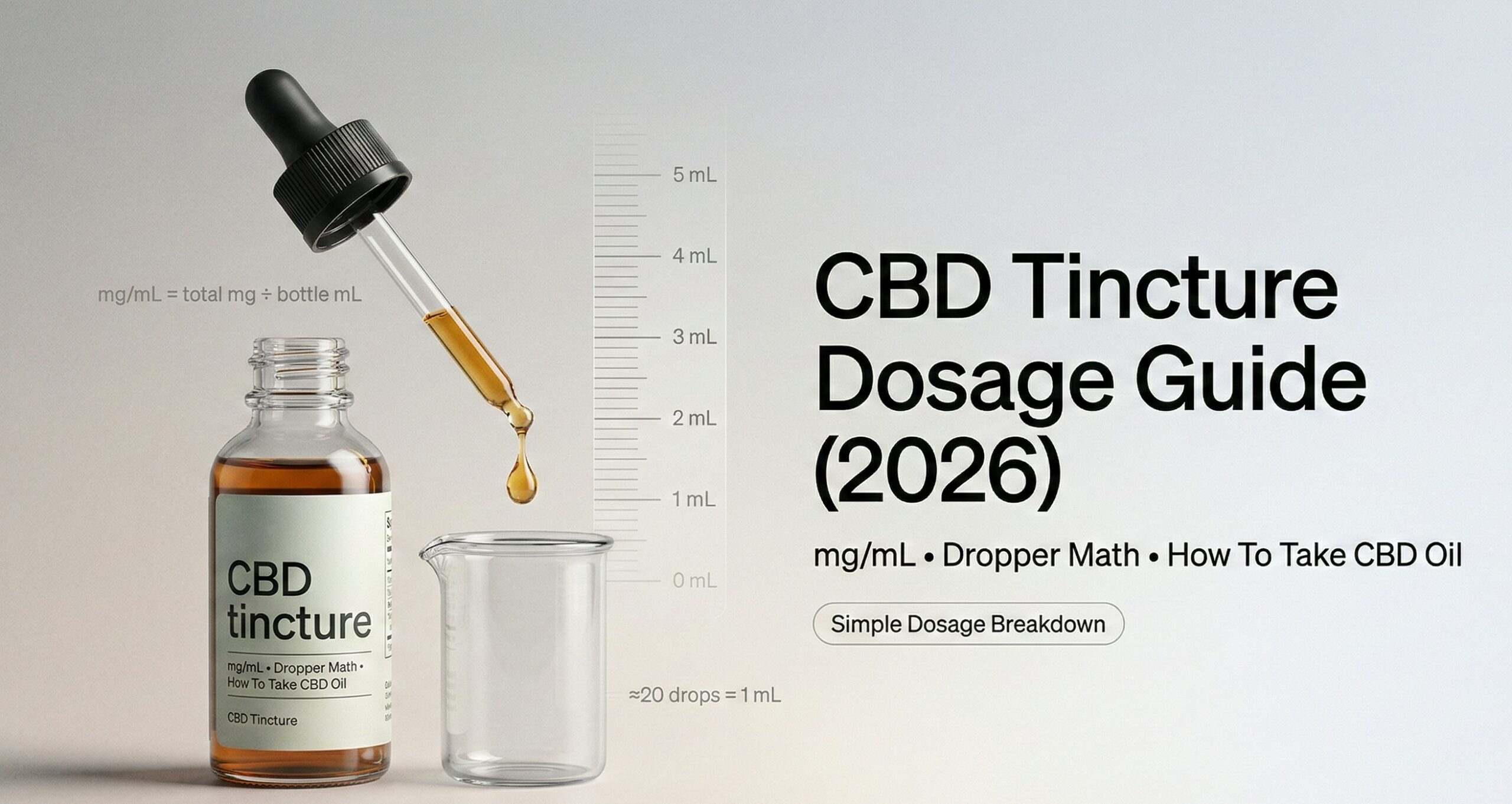
Quick answer: A CBD tincture label tells you the total CBD in the bottle, but the useful number for a marked dropper is mg per mL. Divide total label CBD by bottle size, then multiply by the volume you measured. This is label math, not a personal dose recommendation. Use mL markings whenever possible because individual drops vary.
If a bottle says 1,000 mg, that does not mean every dropper contains 1,000 mg. The amount in a measured portion depends on the bottle volume and its concentration. This guide shows the calculation for 0.25 mL, 0.5 mL, 0.75 mL and 1 mL without pretending that one amount fits everyone.
CBD Label Calculator: The Two Formulas You Need
You only need three values: the total CBD stated on the label, the bottle size in milliliters and the amount of liquid measured in the dropper.
1
Find mg per mL
Total label CBD ÷ bottle size = mg/mL
Example: 1,000 mg ÷ 30 mL = 33.3 mg/mL.
2
Find mg in a marked amount
mg/mL × measured mL = label-based mg
Example: 33.3 mg/mL × 0.25 mL = about 8.3 mg.
3
Check the inputs
Confirm that the label, bottle volume and dropper markings belong to the same product.
Do not assume every full dropper is exactly 1 mL.
Manual calculator worksheet
- Write the total label amount: ______ mg CBD.
- Write the bottle size: ______ mL.
- Divide those numbers: ______ mg/mL.
- Write the marked volume you measured: ______ mL.
- Multiply mg/mL by measured mL: ______ label-based mg.
Important: This calculation converts label information. It does not confirm laboratory potency and does not determine an appropriate personal amount.
CBD Tincture Chart for 0.25, 0.5, 0.75 and 1 mL
The following examples use hypothetical 30 mL bottles. They show how the formula changes as label strength increases. They are not serving recommendations and should not replace the directions on a product label.
| Example label | Calculated mg/mL | 0.25 mL | 0.5 mL | 0.75 mL | 1 mL |
|---|---|---|---|---|---|
| 1,000 mg in 30 mL | 33.3 mg/mL | 8.3 mg | 16.7 mg | 25 mg | 33.3 mg |
| 5,000 mg in 30 mL | 166.7 mg/mL | 41.7 mg | 83.3 mg | 125 mg | 166.7 mg |
| 10,000 mg in 30 mL | 333.3 mg/mL | 83.3 mg | 166.7 mg | 250 mg | 333.3 mg |
Rounded figures can differ by 0.1 mg. If your bottle is 15, 60 or another number of milliliters, recalculate with the actual volume instead of copying this table.
For a separate shopping-focused comparison of concentration, spectrum type and label strength, use the CBD tincture strength guide.
How Many Milligrams Are in a CBD Dropper?
A full dropper does not have one universal CBD amount. It depends on two things: how many milliliters the dropper actually holds and the product concentration in mg/mL.
Example: If a product contains 33.3 mg/mL and its marked dropper holds 1 mL, the label-based estimate for that full marked volume is 33.3 mg. If the dropper only holds 0.75 mL, the estimate is about 25 mg.
How many drops are in 0.25 or 0.5 mL?
You may see a rough convention of about 20 individual drops per 1 mL. Under that assumption, 0.25 mL would be about five drops and 0.5 mL would be about ten drops. However, the actual number can change with the dropper tip, oil thickness, angle and squeezing pressure.
That is why the marked mL line is more useful than counting drops. If a product does not provide a marked dropper, follow the manufacturer’s directions or ask the seller how the supplied dropper was calibrated.
If you still need a rough per-drop estimate
mg per mL ÷ estimated drops per mL = estimated mg per individual drop
Only use the drops-per-mL figure supplied by the manufacturer. Treat a generic 20-drop assumption as an approximation, not a precise measurement.
How to Take CBD Oil With a Marked Dropper
- Read the product directions first. Confirm whether the label directs sublingual use, swallowing with food or another method.
- Check the bottle and dropper. Look for the bottle volume and marked lines such as 0.25, 0.5, 0.75 or 1 mL.
- Shake only when directed. Some formulas need mixing; others may not.
- Measure by the marked line. Keep the dropper level enough to read the marking clearly.
- Follow the label’s sublingual directions. When directed, place the measured liquid under the tongue, hold it for the time shown on the label and then swallow.
- Avoid contaminating the bottle. Try not to touch the glass dropper to the mouth, tongue or another surface before returning it to the bottle.
- Record what you measured. Write the mL amount and the product used. This prevents confusing two bottles with different concentrations.
If you prefer a format with a fixed amount per piece, compare CBD gummies versus CBD oil. A gummy can be simpler to count, while a marked oil dropper allows smaller volume changes.
CBD Oil Versus a Traditional CBD Tincture
The words “CBD oil” and “CBD tincture” are often used interchangeably in online shopping, but the traditional definitions are different. A tincture normally refers to an alcohol-based extract. A CBD oil generally combines hemp extract with a carrier oil such as MCT oil.
The distinction matters if someone has an alcohol sensitivity, a carrier-oil allergy or needs to understand exactly what is on the ingredient list. The same label-math formula can still be used when the package clearly states total CBD and total liquid volume. For more background, see the medically reviewed overview of CBD tinctures and CBD oil.
Before Using the Math, Check the Label Against the COA
A calculation can be mathematically correct and still rely on outdated or incomplete product information. A certificate of analysis, or COA, should help connect a laboratory result to the product and batch being sold.
Batch match
Confirm that the batch or lot number on the report matches the product package.
Potency result
Compare tested CBD and THC values with the amounts shown on the label.
Contaminant panels
Check whether pesticides, heavy metals, solvents and microbials were tested. “Not tested” is not the same as “passed.”
Date and product
Confirm the report is for the same product type and is relevant to the inventory currently being sold.
If the label and batch report do not align, ask the seller for clarification before relying on the front-label number for a purchase decision. For help reading product strength and laboratory information, see the CBD tincture strength guide and the full-spectrum CBD tincture drug-test guide.
Related Mary Jane CBD Tinctures and Other CBD Formats
Once you understand the label math, compare the current product label, bottle volume, ingredients and batch COA before choosing. Product names below reflect the strength shown on the product page; availability and batch information can change.
1,000 mg tincture
Review the current label, ingredients and supplied dropper before calculating a marked amount.
5,000 mg tincture
A higher label concentration makes accurate mL measurement especially important.
10,000 mg tincture
Check the current package and matching batch report rather than relying only on the product name.
Compare the full tincture collection
Use the CBD oil tincture collection to compare available options. If tinctures are not the format you want, browse the CBD products collection for other current formats.
CBD Safety, Medication Interactions and Older Adults
There is no universal nonprescription CBD dose. The FDA says that, apart from an approved prescription CBD medicine, marketed CBD products have not been evaluated to establish proper dosage, effectiveness, drug interactions or all possible safety concerns.
- Medication interactions: CBD can affect how some medicines work. Ask a doctor or pharmacist before use if you take prescription medicines.
- Drowsiness and alertness: CBD may cause sleepiness or reduced alertness. Do not drive or operate machinery if you feel impaired.
- Liver and digestive concerns: Reported risks include liver injury, diarrhea, appetite changes and other gastrointestinal effects.
- Older adults: People taking several medicines may have more opportunities for interactions. A pharmacist can review the complete medication and supplement list.
- Pregnancy and breastfeeding: The FDA advises avoiding CBD during pregnancy and while breastfeeding.
- Children: Keep all CBD and THC products in child-resistant packaging and out of reach.
- Drug testing: Full-spectrum products may contain THC. No CBD product should be treated as a guarantee of passing a drug test.
Read current guidance from the U.S. Food and Drug Administration, the Centers for Disease Control and Prevention and the National Center for Complementary and Integrative Health.
If a child accidentally consumes a cannabinoid product, or anyone develops concerning symptoms, contact Poison Control at 1-800-222-1222. Call 911 for a medical emergency.
For a longer site resource without shopping links inside the safety discussion, read CBD side effects, safety and drug interactions.
Common CBD Dropper-Math Mistakes
| Mistake | Why it causes confusion | Better check |
|---|---|---|
| Treating total bottle CBD as one serving | The front-label number usually refers to the full bottle. | Divide total mg by total mL first. |
| Assuming every dropper holds 1 mL | Dropper capacity and markings can differ. | Read the supplied dropper and product directions. |
| Counting individual drops as an exact measure | Drop size changes with equipment, liquid and technique. | Use a marked mL volume whenever possible. |
| Copying a chart for the wrong bottle size | The same total CBD in 30 and 60 mL produces different concentrations. | Calculate with the actual bottle volume. |
| Ignoring the batch COA | A label alone does not show whether the batch was tested or matched. | Check batch identity, potency and tested panels. |