

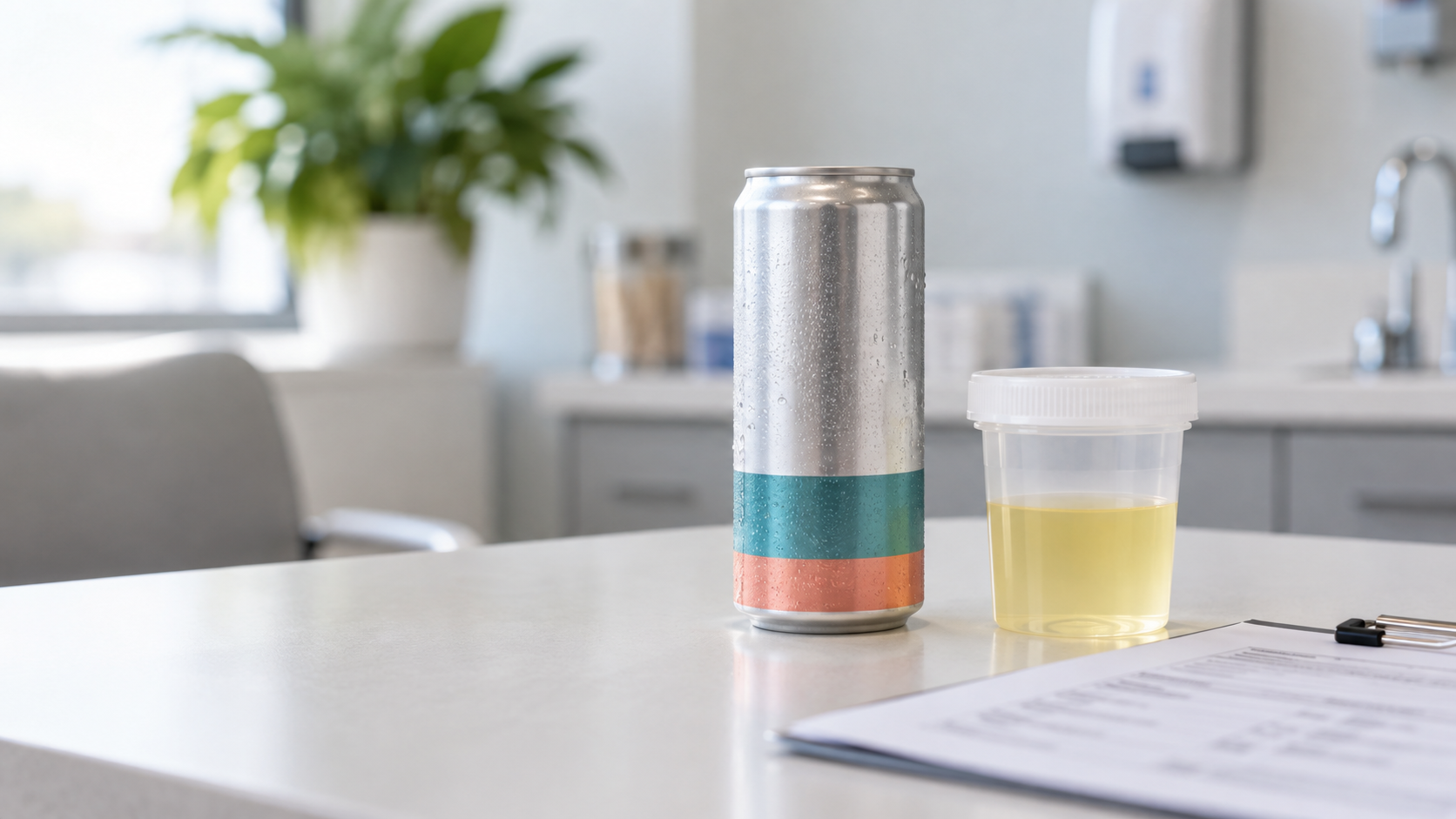
THC beverage drug-test guide | Adults 21+
A THC seltzer, lemonade, mocktail, or nano beverage can create the same basic testing concern as another THC product. The label may describe a drink, but a test looks for THC or related metabolites.
Featured answer
Yes. THC drinks can show up on a drug test. A urine, oral-fluid, blood, or hair test does not give a special exemption because THC came from a beverage or from hemp. Even one drink may create a positive-result risk. No online timeline can guarantee when a specific person will test negative.
Short answer
A drink containing THC can create testing risk.
Hemp label
Hemp-derived THC is still THC exposure.
One can
A single serving can matter, but the result is not predictable.
Safest rule
If passing matters, avoid THC products.
What the test sees, not what the package calls it
| Product | Main testing concern | Practical answer |
|---|---|---|
| Delta-9 THC drink | THC exposure and metabolites | Treat as a real positive-test risk |
| Delta-8 THC drink | THC-related testing risk | Do not assume the variant protects you |
| Full-spectrum CBD drink | Possible THC exposure | Lower THC does not mean zero risk |
| CBD isolate drink | CBD is not the usual cannabis target, but labels and contamination matter | Do not rely on it when a test has serious consequences |
You may be asking this after seeing THC seltzers, cannabis-infused lemonades, or alcohol-free THC mocktails in a store. The package can look familiar and the serving can look small, but that does not make the testing question simple.
This guide explains what common tests look for, why one drink can matter, why a fixed detection chart cannot promise a pass, and what to do when your job, license, sport, or legal status depends on the result.
Related guide: For onset, serving, and drinks-versus-gummies questions, read the THC drink onset and dosing guide.
Article note: Written by the Mary Jane’s Bakery Co Editorial Team. Updated September 17, 2026. Reviewed against NIDA, the U.S. Department of Transportation, MedlinePlus, FDA guidance, and a medical-toxicology position statement. This is not a medical, legal, employment, or laboratory review.
1. Do THC drinks show up on a drug test?
Yes. A beverage containing Delta-9 THC, Delta-8 THC, or another intoxicating THC form can create a positive-result risk. NIDA explains that drug tests may look for a drug or the metabolites the body makes while processing it. The can, flavor, carbonation, and hemp-derived marketing do not create a separate testing category.
The most important distinction is between what you consumed and what the test measures. You consumed a drink. The test may measure a THC-related analyte or metabolite in a biological sample.
2. Can one THC drink make you fail a drug test?
It is possible. A single drink does not guarantee a positive result, and nobody can honestly guarantee a negative result either. Risk depends on the labeled THC amount, whether the entire container was one serving, prior THC use, the time between use and collection, the specimen type, and the testing cutoff.
3. How THC drug testing works
Many programs use an initial screen and a more specific confirmation test. NIDA describes the initial urine screen as commonly using an immunoassay. A positive initial screen can then be checked with a more specific laboratory method.
For DOT-regulated urine testing, 49 CFR 40.85 lists an initial cutoff of 50 ng/mL for marijuana metabolites and a confirmatory cutoff of 15 ng/mL for the confirmatory analyte. Those numbers are reporting thresholds. They are not a safe dose, a drinking limit, or a promise that a person will pass after a certain number of days.
4. Urine, saliva, blood, and hair tests are not interchangeable
| Specimen | General use | Important limit |
|---|---|---|
| Urine | Most common screening specimen | Does not show exact time of use or current intoxication |
| Oral fluid | Often used for more recent exposure questions | Program methods and cutoffs differ |
| Blood | Clinical, legal, or recent-exposure contexts | A result still needs expert interpretation |
| Hair | Longer-pattern testing in some programs | Not the standard method for every workplace |
5. How long do THC drinks stay detectable?
There is no reliable personal countdown. MedlinePlus notes that detectability depends on the drug, amount, duration of use, and the way a person’s body responds. NIDA adds that urine testing does not identify the exact time since last use.
Factors that can change the result include:
- total THC in the portion and container;
- whether you used THC once or repeatedly;
- other recent THC exposure;
- time between use and specimen collection;
- urine, oral fluid, blood, hair, or another specimen;
- the program’s screen and confirmation cutoffs;
- individual metabolism and physiology.
A chart can describe general patterns, but it cannot clear you for a real test. Do not use a home-test result as a guarantee for a workplace or legal program. FDA guidance says positive home results should be confirmed through a laboratory process.
6. Do hemp-derived THC drinks count?
Yes, they can. “Hemp-derived” describes the product’s source and regulatory category. It does not make the THC invisible after the body processes it. The DOT CBD notice also warns safety-sensitive employees that cannabinoid product labels can be misleading and that CBD use is not accepted as an explanation for a confirmed marijuana positive under DOT rules.
What about a CBD drink?
CBD itself is not the main target in standard cannabis screening, but a full-spectrum CBD drink may contain THC. Broad-spectrum and isolate products may reduce THC exposure, yet label accuracy and cross-contamination still matter. If a test carries serious consequences, avoiding cannabinoid products is more reliable than trying to find a label loophole.
For format-specific detail, read the CBD gummy drug-test guide and the CBD tincture testing guide.
7. What to do when the test has serious consequences
- Do not consume more THC or rely on a low-dose claim.
- Keep the original package and identify the labeled cannabinoids and amount.
- Read the written policy for the employer, DOT program, court, probation office, school, or sport.
- Ask the testing program or a qualified professional about the specimen and process.
- Do not rely on detox products, dilution tricks, or substitution. No product can guarantee a passed test.
- If an initial home screen is positive, follow the instructions and seek proper laboratory confirmation where appropriate.
If you are comparing another THC format, Mary Jane’s THCA drug-test guide explains why product wording does not remove testing risk.
8. Does buying a legal THC drink in Miami change the test risk?
No. Retail availability and testing policy are separate questions. Buying a product from a Miami store does not override an employer, DOT, court, probation, school, or sports rule. Adults can review Wynwood, Miami location information, but anyone who must pass a test should avoid treating store availability as permission under a testing program.
9. A responsible shopping note
If you are not subject to testing, are 21 or older, and choose to shop where lawful, read the full label, milligrams per serving, milligrams per container, batch details, restrictions, and available lab information. Mary Jane’s currently displays Delta-9 THC drinks. Do not buy or use a THC product when a positive test would put your work, license, legal status, or safety at risk.
10. Authoritative sources
| Source | What it supports |
|---|---|
| NIDA: Drug Testing | Metabolites, specimen types, screens, confirmation, and urine-test limits |
| DOT 49 CFR 40.85 | Federal urine cutoffs for marijuana metabolites |
| DOT CBD Notice | Safety-sensitive employee and product-label cautions |
| MedlinePlus: Drug Testing | Specimens, detection factors, and confirmatory testing |
| ACMT position statement | Interpretation limits for urine THC metabolites |
| FDA: Home Drug Tests | Home-test limits and laboratory confirmation |
11. Frequently asked questions
Will one 5 mg THC drink show up on a drug test?
It can. Five milligrams does not guarantee a positive result, but it also does not guarantee a pass. Testing method, timing, previous use, cutoff, and individual response matter.
Can a test tell that the THC came from a drink?
A routine cannabis test generally focuses on THC-related analytes or metabolites, not whether the source was a seltzer, gummy, vape, or flower.
Does hemp-derived Delta-9 show up?
It can. Hemp-derived wording does not make THC or its metabolites invisible to testing.
Does a positive urine result prove that I am currently high?
No. NIDA states that urine testing does not provide the exact time since ingestion or the state of intoxication.
Can a home test guarantee that I will pass a workplace test?
No. Home tests have limitations, and workplace programs can use different collection, screening, confirmation, and review procedures.
Conclusion: treat a THC drink as real THC exposure
A THC beverage can create a positive drug-test risk, even when it is low-dose, alcohol-free, hemp-derived, or legally sold. The most responsible answer is not a countdown. It is to understand the test, the policy, the consequences, and the uncertainty. If passing matters, avoid THC products and get guidance from the responsible program or qualified professional.
Adults 21+ only where lawful. Do not drive or operate machinery after THC. Do not mix THC with alcohol. Keep cannabinoid products locked away from children and pets. No article, product label, home test, detox product, or retailer can guarantee a passed drug test.