

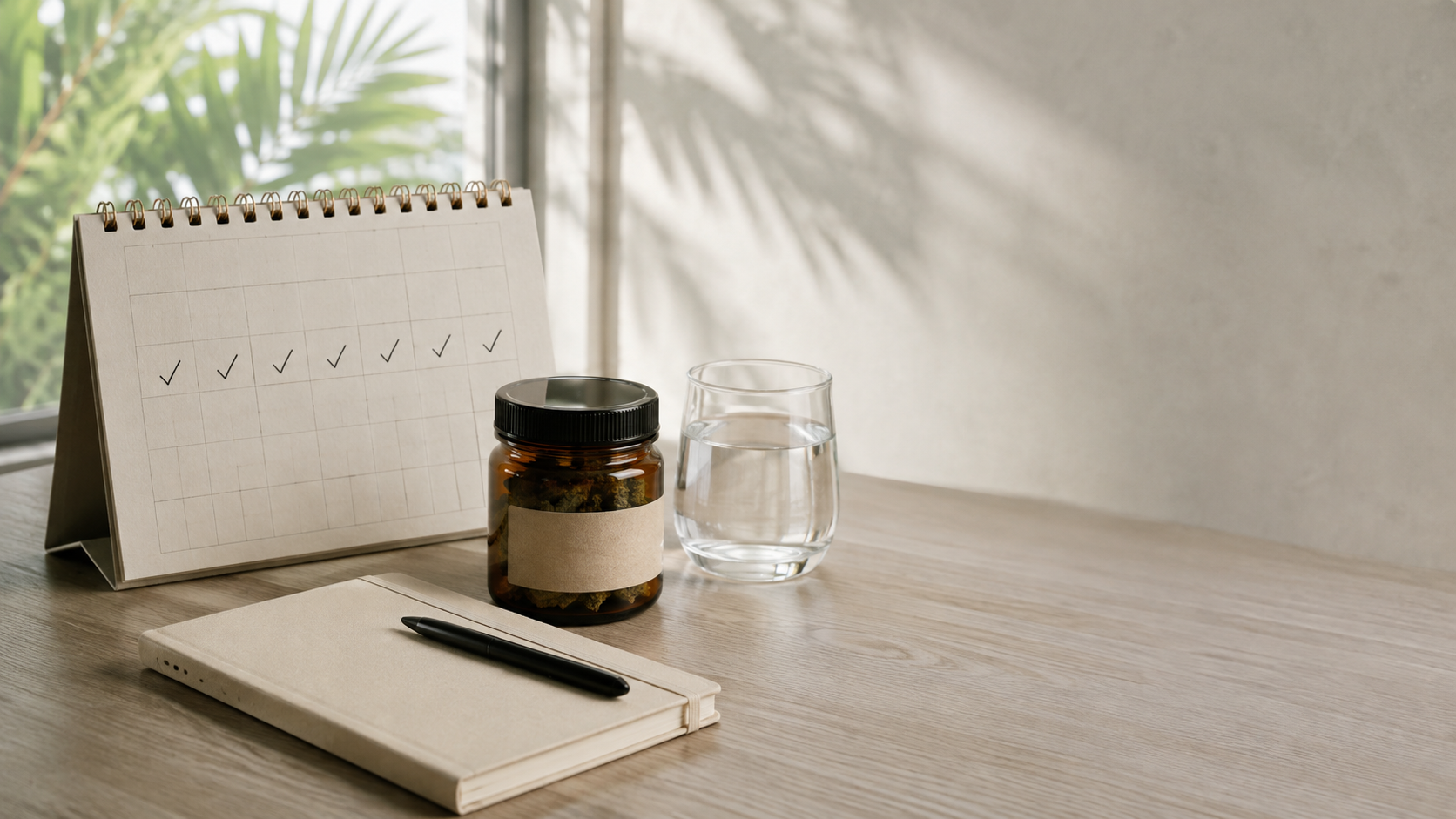
Cannabis tolerance break guide
How Long Should a Cannabis Tolerance Break Be? Evidence by Timeline
Compare 2-day, 3-day, 7-day, 21-day, and 4-week breaks without treating any one timeline as a guaranteed THC “reset.”
Featured answer
No single break length fully resets cannabis tolerance for everyone. Receptor recovery can begin within about two days, but research has not established a personal “reset percentage” for 48 hours, 21 days, or 30 days. A 7-day break can reveal early changes; 14–21 days offers a useful review window; four weeks is a longer reassessment—not a guaranteed reset.
2 days
Biological recovery may begin. That is not the same as a full tolerance reset.
7 days
A practical first checkpoint, although sleep and mood changes may still be active.
21 days
A structured review period—not a scientifically required number for every person.
4 weeks
A longer reassessment window. Research still does not promise a complete reset.
Tolerance-break timelines at a glance
| Time away from THC | Useful goal | What evidence can support | What it cannot promise |
|---|---|---|---|
| 48 hours | Interrupt a routine and start observing | CB1 receptor recovery can begin quickly | A full reset or a known percentage |
| 3 days | Notice early sleep, appetite, mood, or craving changes | Withdrawal may be most noticeable around this period | A validated three-day reset threshold |
| 7 days | Complete a practical first evaluation | More time to observe routine and withdrawal changes | The same result for every person |
| 14–21 days | Review tolerance, habits, sleep, spending, and goals | A structured, behaviorally useful window | That 21 days is biologically required |
| 4 weeks | Make a longer reassessment | Human imaging research has measured continued recovery over this span | A guaranteed complete or permanent reset |
How to use this table: choose the shortest window that can answer your goal, then extend it if the information you want is still unclear and the break remains manageable.
A cannabis tolerance break—often called a t-break—is a planned period without THC. People take one because the same amount feels less noticeable, their routine has become more frequent than intended, they want to reassess side effects or spending, or they simply want to learn how they feel without THC.
The useful question is not “What number erases tolerance?” Science has not established that number. A better question is: What length gives you enough time to evaluate your specific goal? This guide separates research findings from internet rules so you can make a practical plan without mistaking a receptor study, a drug-test timeline, or someone else’s experience for a personal guarantee.
Related guide: If repeated servings are part of the problem, read why edibles may not seem to work as expected.
Article note: Prepared by the Mary Jane’s Bakery Co Editorial Team in August 2026 using peer-reviewed human research and U.S. public-health guidance. This is an editorial evidence review, not a medical review, and it does not replace individualized care.
1. What is a cannabis tolerance break?
A tolerance break is an intentional pause from THC-containing cannabis. Its purpose is usually to interrupt repeated exposure and evaluate whether sensitivity, habits, side effects, or goals change. It is not a “detox” product, a treatment, or a reliable way to pass a drug test.
Tolerance means repeated exposure produces less of an effect, or more is needed to produce an effect that previously occurred at a lower amount. Cannabis tolerance is not one single switch. It can differ by effect, pattern of use, potency, frequency, individual biology, and context.
Important distinction: lower felt intoxication does not prove that attention, coordination, reaction time, or driving ability is unaffected.
2. Do cannabis tolerance breaks work?
They can change tolerance and interrupt a routine, but the size and timing of the change cannot be predicted precisely for one person. Human brain-imaging research shows that cannabis-associated changes in CB1 receptor availability can begin reversing soon after abstinence and continue over weeks. That supports the basic idea that a break can matter. It does not support online claims such as “48 hours resets 50%” or “30 days guarantees 100%.”
A study of cannabis-use breaks in young adults also found that break duration was not associated with better cannabis outcomes after the break. The authors noted that popular online duration recommendations—ranging from days to weeks—often have little scientific basis. That makes the person’s goal and what happens after the break at least as important as the countdown itself.
Evidence-confidence check
| Common claim | Best answer | Confidence |
|---|---|---|
| Can recovery begin within 48 hours? | Yes, receptor-level changes can begin quickly. | Moderate |
| Does 48 hours fully reset tolerance? | Not established. | High confidence that no guarantee is supported |
| Is 21 days required? | No universal requirement has been established. | High |
| Does 30 days completely reset everyone? | No. | High |
| Is a longer break always better? | Not shown; “better” depends on the goal and follow-through. | Moderate |
| Do edibles require a longer break than inhaled THC? | No validated format-specific schedule exists. | Moderate |
| Can a t-break guarantee a negative drug test? | No. | High |
3. How long should a tolerance break be?
For many adults, 7 days is a reasonable first checkpoint, while 14–21 days is a more useful all-purpose evaluation window. Those are practical planning choices, not medical rules. Choose based on what you want to learn and whether withdrawal, health conditions, or clinician-directed use call for support.
Will a 2-day tolerance break do anything?
Possibly. Forty-eight hours can interrupt the pattern of use, and human imaging data indicate that receptor-level recovery can start in this period. You might notice a change when you return, especially after frequent use, but a two-day pause is too short to call a full reset. It may also overlap with the beginning of withdrawal symptoms.
Is a 3-day tolerance break worth it?
It can be worth it when your goal is a short routine check or you are testing whether you can skip a usual consumption window. It is also around the time irritability, sleep disruption, appetite changes, or cravings may be noticeable for some frequent users. Treat day three as information, not proof that your tolerance has reached a specific level.
Does a 7-day tolerance break work?
A week creates enough separation to observe more than a missed session or weekend. It can reveal how strongly your routine is tied to sleep, meals, stress, or social cues. Some early withdrawal symptoms may have eased by then, while sleep changes or vivid dreams can persist. A seven-day result still cannot be converted into a reliable “percent reset.”
Is 21 days enough for a tolerance break?
Twenty-one days is a useful structured window because it allows repeated observations across weekdays and weekends. The University of Vermont’s public t-break guide uses 21 days as a practical program, and a young-adult study found that some people used that structure to complete a break. That does not establish 21 days as a biological requirement or universal endpoint.
Does a 30-day tolerance break fully reset tolerance?
Four weeks is long enough for a deeper reassessment and overlaps with the period measured in CB1 receptor imaging research. But “fully reset” is stronger than the evidence allows. The studies measure group-level biological changes under research conditions; they do not provide a personal reset meter, and tolerance to different effects may not change at the same rate.
4. What cannabis-tolerance research actually shows
A systematic review of human studies found evidence of tolerance to several acute cannabis effects, but the pattern was uneven. Cognitive effects showed stronger evidence of tolerance, while intoxicating, cardiac, and psychosis-like effects showed only partial tolerance. That matters because “I barely feel high” is not a reliable safety test.
| Effect or question | What tolerance may change | What not to assume |
|---|---|---|
| Felt intoxication | The same THC exposure may feel less noticeable with repeated use. | Feeling normal means you are unimpaired. |
| Attention and memory | Some regular users show blunted acute effects. | Performance is fully restored while using THC. |
| Heart rate or anxiety | Tolerance can be partial and inconsistent. | A previous comfortable amount will always feel comfortable. |
| After a break | Sensitivity may increase, so an old serving may feel stronger. | The exact change can be predicted from days alone. |
The cleanest evidence-based statement is simple: tolerance is real, abstinence can reverse some adaptations, and the response is effect-specific and individual. Anything more precise needs better data than current research provides.
5. Why a longer break is not automatically a better break
A longer break gives you more observation time, but duration alone does not decide the outcome. In the young-adult t-break study, break length was not associated with subsequent cannabis-use outcomes. A person can complete 30 days and return immediately to the same pattern, while another can use a shorter break to set a lower limit, change a cue-driven routine, or decide not to resume.
Define success before day one. Useful goals include:
- finding out whether the same THC amount has become less noticeable;
- separating cannabis use from a bedtime, meal, stress, or social cue;
- checking whether use is more frequent than intended;
- comparing sleep, appetite, mood, spending, or concentration with and without THC; and
- deciding what a lower-frequency return—or continued abstinence—would look like.
If the break becomes a contest to reach a magic number, it can obscure the decision you were trying to make.
6. Do edibles, flower, vapes, or drinks need different t-break lengths?
No validated research assigns a separate tolerance-break schedule to each format. THC exposure, frequency, potency, serving pattern, and individual response matter more than a rule such as “edibles need 30 days” or “vapes need seven.” Product format still affects how quickly effects begin, how long they last, and how easy the amount is to judge.
Edibles and drinks
Delayed effects can lead to unplanned repeat servings. Review both the labeled amount and the wait between servings.
Flower and vapes
Fast onset can make frequent small sessions easy to overlook. Track sessions, not only the amount in one session.
Topicals
Intoxicating potential depends on formulation and ingredients. Read the product label rather than assuming every topical is non-intoxicating.
If you are unsure how formats differ, compare gummies, tinctures, flower, and vapes for beginners. For timing context, see how long a cannabis high can last.
7. What happens during a tolerance break?
Not everyone experiences cannabis withdrawal. When it occurs, common symptoms include irritability, anxiety, sleep difficulty or vivid dreams, lower appetite, restlessness, and depressed mood. Headache, sweating, chills, or stomach discomfort can occur less often. Symptoms are more likely after frequent or dependent use.
A clinical review reports that symptoms commonly begin 24–48 hours after stopping and often peak around days 2–6. In heavy users, some symptoms—especially sleep disturbance—can last two to three weeks or longer. This pattern explains why a short break can feel hardest before it feels informative.
| Approximate period | What may happen | Useful response |
|---|---|---|
| Days 1–2 | Craving, irritability, appetite or sleep changes may begin. | Keep the schedule simple; eat and hydrate regularly. |
| Days 2–6 | Symptoms may peak for some frequent users. | Reduce avoidable stress and ask for support if needed. |
| Week 1–2 | Many early symptoms may ease; dreams or sleep disruption can continue. | Look for trends rather than judging one night. |
| Weeks 2–3+ | Persistent symptoms are possible after heavy use. | Seek clinical guidance if symptoms are severe, worsening, or disruptive. |
One meta-analysis estimated withdrawal in 47% of pooled regular or dependent cannabis-user samples, but the result varied sharply by setting: about 17% in population-based samples, 54% in outpatient samples, and 87% in inpatient samples. It would be misleading to say that half of all people who use cannabis will experience withdrawal.
8. How to plan and measure a useful t-break
- Write one primary goal. Examples: “I want to see whether seven THC-free days change my sleep” or “I want to decide whether weekend-only use fits me better.”
- Choose an initial window. Use 48–72 hours for a brief pattern interruption, seven days for a first checkpoint, 14–21 days for a fuller review, or four weeks for a longer reassessment.
- Choose a realistic start. Avoid beginning immediately before a demanding work stretch, major exam, long drive, or other period when possible sleep disruption would create a safety problem.
- Change the cue, not just the product. Replace the usual consumption time with a walk, shower, meal, non-intoxicating drink, music, or another specific activity.
- Decide the end rule in advance. At the checkpoint, review your notes before choosing to resume, extend, reduce frequency, or continue abstaining.
Simple daily t-break tracker
Complete this once at roughly the same time each day. A trend across several days is more useful than one unusually good or bad day.
| Day | Sleep hours / quality | Craving 0–10 | Irritability 0–10 | Appetite | Trigger and response |
|---|---|---|---|---|---|
| ___ | ___ | ___ | ___ | ___ | ___ |
| ___ | ___ | ___ | ___ | ___ | ___ |
| ___ | ___ | ___ | ___ | ___ | ___ |
Difficulty meeting your plan is not a character flaw; it is useful information. If repeated attempts fail, cravings dominate the day, or use is interfering with responsibilities, consider support from a clinician or substance-use professional.
9. Can you use CBD during a tolerance break?
If your definition is “no THC,” a reliably THC-free CBD product may fit that rule—but retail CBD is not proven to treat cannabis withdrawal. If your goal is to pause every cannabis-related product or break a consumption ritual, CBD may not fit your plan even when it contains no detectable THC.
CBD research needs careful translation. A clinical cannabis-use-disorder trial evaluated pharmaceutical oral CBD at 400 mg and 800 mg per day under research supervision. Those findings should not be generalized to a typical retail gummy, tincture, or beverage. A 2025 umbrella review did not find clear evidence that CBD monotherapy is effective for substance-use disorders; some positive withdrawal findings involved nabiximols, which contains both THC and CBD and therefore is not a THC-free t-break substitute.
The FDA also warns that nonprescription CBD products can have labeling and quality problems, can interact with medications, and can pose risks including liver injury. Check the certificate of analysis when available, but understand that a label or lab report cannot turn CBD into an established withdrawal treatment. Ask a clinician or pharmacist about interactions, pregnancy or breastfeeding, liver conditions, or concurrent medications.
10. Tolerance is not the same as impairment—or a drug-test timeline
A person with tolerance may report less intoxication from a familiar amount, yet still experience changes in reaction time, coordination, judgment, attention, or memory. The CDC advises that cannabis can impair skills needed for driving. Do not drive, cycle in traffic, operate machinery, or perform safety-sensitive work after using THC simply because you “feel used to it.”
A tolerance break also cannot guarantee when a drug test will be negative. Test type, cutoff, use pattern, body factors, and time all matter, and feeling sober does not mean metabolites are absent. Avoid detox promises, home calculations, or a fixed number of break days when employment, court, medical, or athletic testing has real consequences.
11. How to return to THC more cautiously after a break
After a break, an amount that previously felt routine may feel stronger. There is no validated formula that converts break length into a new serving. If an adult legally chooses to resume, use a cautious plan:
- Use less than the old amount. Do not assume your pre-break serving is still appropriate.
- Choose one clearly labeled product. Avoid combining multiple THC formats when you are trying to assess sensitivity.
- Allow time before considering more. This is especially important for swallowed products, whose effects can be delayed and long-lasting.
- Avoid alcohol and other intoxicants. Combining substances makes effects less predictable.
- Choose a safe setting. Do not drive, and do not schedule safety-sensitive tasks.
- Record the result. Note the product, labeled THC amount, time, effects, and whether it matched your goal.
- Stop if the result is uncomfortable. More THC is not a fix for anxiety, dizziness, racing heart, or excessive intoxication.
For a lower-serving comparison, see 2.5 mg versus 5 mg THC for beginners. If unwanted effects are part of your decision, review the guide to possible side effects of Delta-8, Delta-9, and THCA products.
12. A practical Miami tolerance-break checklist
Miami’s nightlife, social calendar, heat, and driving demands can shape the plan even though they do not change the biology. A few local, practical choices can make the break and any return easier to evaluate:
- Start before a calm stretch rather than during a festival weekend, party, or heavy work deadline.
- Plan a non-intoxicating replacement for the social cue—not only an empty promise to skip THC.
- Hydrate and protect sleep routines, especially when hot weather or late nights already affect both.
- Do not leave cannabis products where heat, children, pets, or other people can access them.
- Arrange transportation before any return to THC; tolerance does not make impaired driving safe.
If you decide to resume after reviewing your notes, you can compare clearly labeled options in the Mary Jane’s Bakery Co shop or review information about the Miami location. Availability changes, and a product page is not a substitute for medical guidance.
13. Authoritative sources and what they support
| Source | Used for |
|---|---|
| Rapid changes in CB1 receptor availability after abstinence | Why biological recovery can begin quickly without proving a personal reset percentage |
| Cannabis Use Breaks in Young Adults: The Highs and Lows | Limited evidence for exact break lengths and the importance of goals and structure |
| Systematic review of human cannabis-tolerance studies | Why tolerance differs across cognitive, intoxicating, cardiac, and other effects |
| Clinical management of cannabis withdrawal | Typical symptoms, onset, peak, duration, and clinical considerations |
| Cannabis-withdrawal prevalence meta-analysis | Why prevalence varies greatly by population and care setting |
| 2025 umbrella review of CBD for substance-use disorders | Limits of evidence for CBD monotherapy and withdrawal claims |
| Clinical trial of CBD for cannabis-use disorder | Why pharmaceutical 400–800 mg research should not be generalized to retail CBD |
| FDA consumer guidance on cannabis and CBD products | CBD quality, interaction, and safety cautions |
| CDC: cannabis and driving | Why tolerance and lower felt intoxication do not establish driving safety |
| University of Vermont 21-day t-break guide | An example of a structured break plan, not proof that 21 days is mandatory |
14. Cannabis tolerance-break FAQs
What is the best tolerance-break length?
There is no universal best length. Seven days is a practical first checkpoint; 14–21 days gives a fuller view across multiple routines; four weeks is a longer reassessment. Choose by goal, not by a promised reset percentage.
Will a 48-hour t-break lower tolerance?
It may. Receptor-level recovery can begin within roughly two days, but research cannot tell you how much your felt tolerance will change or promise a full reset.
Is a 3-day t-break worth doing?
Yes, if your goal is to interrupt a routine or observe early changes. Three days is not a scientifically validated full-reset point, and it may coincide with peak withdrawal symptoms for some frequent users.
Is one week enough for a tolerance break?
One week can be enough to notice a meaningful difference and evaluate cues, sleep, appetite, or cravings. It does not guarantee that every form of tolerance has resolved.
Why do people recommend 21 days?
Twenty-one days provides a structured multiweek plan and is used by the University of Vermont’s public guide. It is a practical framework, not a proven biological requirement.
Does 30 days completely reset THC tolerance?
No study can guarantee a complete reset for every person. Four weeks provides a substantial observation period and overlaps with receptor-imaging research, but individual and effect-specific responses vary.
How often should you take a tolerance break?
No evidence-based calendar applies to everyone. Consider a break when you need more THC for the same effect, use more often than planned, find it difficult to skip, or want to reassess benefits, side effects, costs, or goals.
Why are dreams vivid during a t-break?
Sleep disturbance and vivid dreams are recognized cannabis-withdrawal symptoms. They often improve with time, but persistent or severe sleep problems warrant clinical guidance.
Can CBD help during a tolerance break?
Retail CBD is not an established treatment for cannabis withdrawal. A reliably THC-free product may fit a THC-only break, but it may not fit a goal of pausing all cannabis products or consumption rituals, and CBD can interact with medications.
Do edibles build tolerance faster than flower or vapes?
Research does not provide a simple format ranking or a separate break schedule. Total THC exposure, potency, frequency, repeated servings, and individual response matter more than the product label alone.
15. The bottom line: choose an evaluation period, not a magic reset date
There is no scientifically proven number of days that completely resets cannabis tolerance for everyone. Two or three days can interrupt a routine and begin biological recovery. Seven days is a practical first checkpoint. Fourteen to 21 days offers a stronger behavior-and-symptom review. Four weeks is a longer reassessment—not a guarantee.
The best break is the one that answers a clearly stated question and leads to a safer next decision. Track what changes, take withdrawal seriously without assuming it will happen, and remember that feeling less high is not evidence that you can drive safely.