

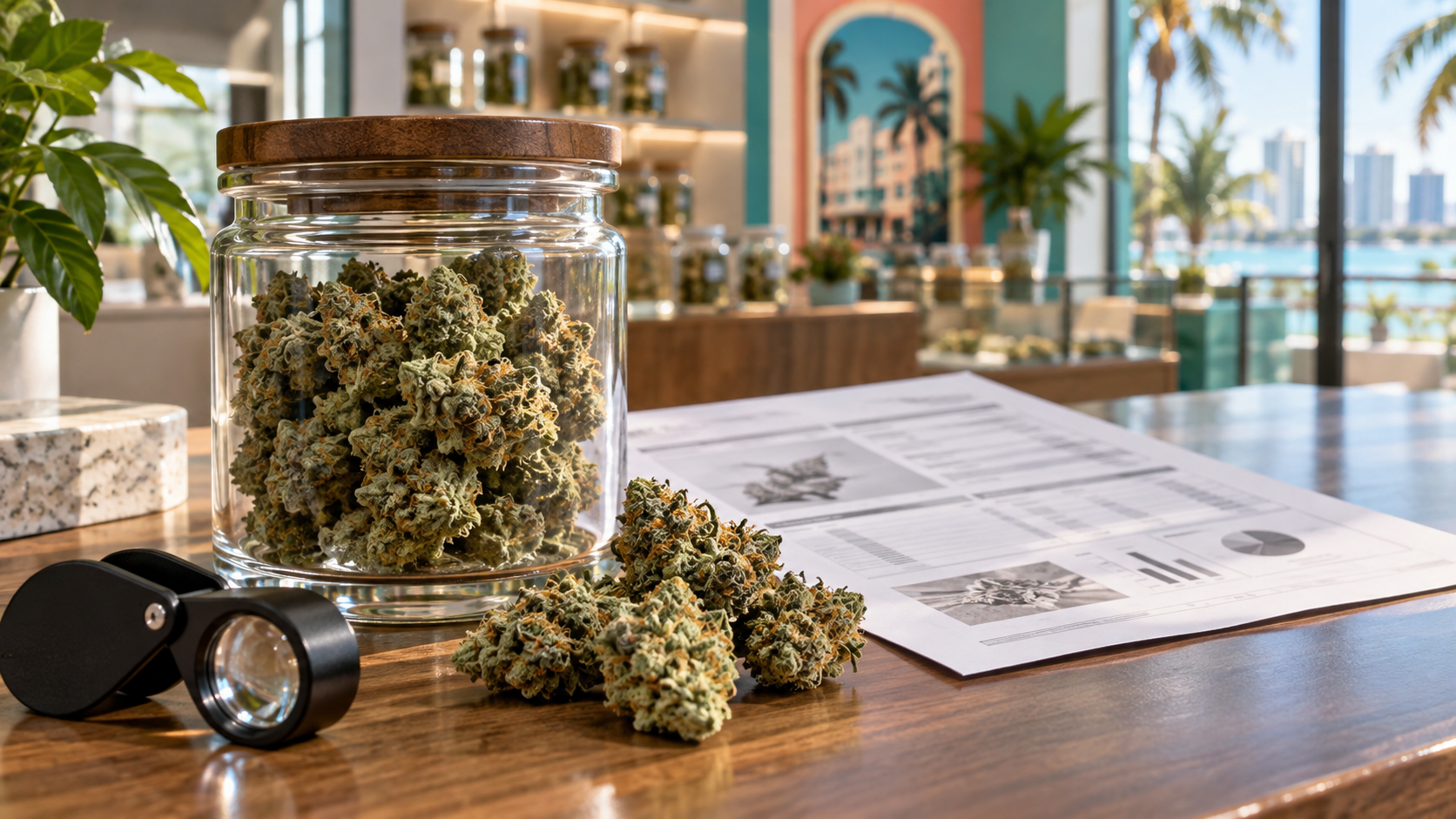
Cannabis label guide
A 20% label describes substantial flower potency and can be strong, especially for a newer or lower-tolerance adult. It is not an official universal threshold. Use this guide to translate the percentage, check Total THC and the exact batch, and understand what the number cannot predict.
Featured answer
Yes, 20% THC can be strong, but “high THC” has no single official cutoff. The label implies about 200 milligrams of THC-equivalent material per gram before real-world losses. It does not state a personal dose, amount absorbed, or guaranteed effect. Compare the same potency metric and verify the exact batch COA.
20% can be strong without being a scientific category boundary.
A theoretical content figure before heating, transfer, and absorption losses.
Higher reported concentration does not automatically mean better flower.
Match the package, lot, units, dates, and current COA.
| Flower label | In 0.25 g | In 1 g | Plain-language context |
|---|---|---|---|
| 10% | 25 mg | 100 mg | Lower than many current-market examples, but not guaranteed to feel mild |
| 15% | 37.5 mg | 150 mg | Within a commonly cited modern-flower range |
| 20% | 50 mg | 200 mg | Substantial and potentially strong |
| 25% | 62.5 mg | 250 mg | A higher-concentration comparison point |
| 30% | 75 mg | 300 mg | High-potency territory by many retail conventions |
Calculation: percentage by weight multiplied by the flower weight. These values describe theoretical material content, not a recommended dose or absorbed amount.
A THC percentage answers one narrow question: how much reported cannabinoid concentration exists by weight. It does not tell you how much material an individual will use, how efficiently the route transfers it, or how that person will respond.
For the full verification process, use our related guide on how to read the batch COA. This article is for adults 21+ and general education. Cannabis can impair judgment, coordination, perception, and reaction time. Do not drive or operate machinery while impaired.
1. Is 20% THC strong?
For cannabis flower, 20% is a substantial concentration and can be strong. An adult with little experience, low tolerance, or a long break from cannabis should not assume that a common retail number will feel mild. At the same time, 20.0% is not a scientific switch that turns a product from moderate to high.
The Washington State Liquor and Cannabis Board says modern flower commonly averages about 15%-20% and reports a 21% average in its 2022 Washington data. Many retailer guides use 20% as the start of a “high” band. Those are different types of reference points, not a universal rule. The most accurate answer is that 20% is current-market familiar and still potentially strong.
2. The five-step potency ladder
The reported percentage by weight.
The theoretical cannabinoid amount in the flower considered.
A percentage alone does not state quantity.
Heating and inhalation do not transfer every labeled milligram.
Tolerance, composition, method, and setting can change the experience.
Search results often collapse these steps into one word: strength. Keeping them separate explains why a percentage is useful without pretending that it predicts an exact outcome.
3. THC percentage versus the amount in the flower
A percentage is a weight ratio. One gram equals 1,000 milligrams, so 20% of one gram is 200 milligrams of theoretical THC-equivalent material. One quarter gram at the same concentration contains about 50 milligrams in the material.
That math is useful for comparing concentration, but it is not an inhaled-dose calculation. It does not account for incomplete chemical conversion, material left unused, smoke or vapor loss, device differences, or absorption.
4. THCA, delta-9 THC, and Total THC
Flower reports commonly list THCA and delta-9 THC separately. THCA can convert to THC with heat, so a report or label may calculate Total THC:
Total THC = delta-9 THC + (THCA x 0.877)
The factor reflects the molecular-weight change associated with conversion. It is still a theoretical measure, and reporting conventions can differ. Compare Total THC with Total THC across products rather than switching between headline THCA, delta-9 THC, and Total THC numbers. Use the Total THC calculation guide for worked examples and the THCA flower comparison for the broader product question.
5. Why two 20% flowers may not feel the same
The exact cannabinoid profile, aromatic compounds, moisture and storage, product age, amount used, method, prior exposure, and personal context can all matter. A percentage cannot guarantee intensity, mood, duration, or impairment for one person.
Terpene profiles may help describe aroma and product composition, but a terpene name should not be presented as a guaranteed mood selector. Readers comparing timing can use the separate guide to how long effects may last.
6. Does higher THC mean better flower?
No. A higher number means more reported concentration. It does not automatically mean better cultivation, fresher flower, stronger aroma, cleaner documentation, or a more suitable experience.
New or returning adult
Treat 20% as potentially strong. Choose conservatively, avoid mixing intoxicants, and allow time before considering more.
Comparing close labels
A small percentage gap may be less useful than a matching COA, fresh batch information, and product condition.
Prioritizing documentation
Compare batch, laboratory, dates, units, and the broader cannabinoid panel before chasing the largest headline.
Managing health uncertainty
Higher-potency products deserve more caution. Individual medical questions belong with a qualified clinician.
A 2025 systematic review found suggestive associations between higher-potency cannabis and some adverse outcomes, particularly problem cannabis use, while results for several other outcomes were inconsistent and the overall certainty was very low. That supports caution, not a precise “safe” threshold.
7. How accurate is the THC number?
Use the label as batch information, not perfect truth. Two recent Colorado studies help show why, but their findings should not be generalized into a claim that every label everywhere is inaccurate.
| Study | Sample | Relevant finding | How to use it |
|---|---|---|---|
| PLOS ONE, 2023 | 23 flower samples from 10 Colorado dispensaries | About 70% measured more than 15% below the reported value | Evidence of uncertainty, not a national error rate |
| Scientific Reports, 2025 | 277 products from 52 Colorado dispensaries | 56.7% of flower products were within plus or minus 15% of the label | A larger warning against false decimal precision |
Testing method, sampling, product variation, storage, and reporting practices can contribute to differences. The practical conclusion is modest: verify the batch, compare like with like, and treat small percentage differences as uncertain rather than absolute.
8. How to compare cannabis flower without chasing the highest number
- Match the batch. Confirm that the package lot or batch corresponds to the COA.
- Use the same metric. Compare Total THC with Total THC, not THCA on one item with delta-9 THC on another.
- Confirm the units. Flower commonly uses percentages; other formats may use milligrams per package or serving.
- Review the dates and source. Find the sample date, report date, laboratory identity, and current product information.
- Look beyond the headline. Review the broader cannabinoid panel, documentation, product condition, and your reason for comparing.
- Avoid false precision. Do not assume a tiny label difference guarantees a different experience.
- Choose conservatively. More reported THC is not automatically a better or more appropriate match.
9. What Miami shoppers should check
For a covered hemp product in Florida, use the package QR code or other supplied access point to review available documentation. Match the batch identifiers, product name, units, and dates. Rules change, and this article is not a legal determination about a specific product.
Adults can review the current Mary Jane shop or check Wynwood location details. Ask to see the exact label and batch documentation. Online categories, filters, inventory, and local availability can change or display differently by location, so verify the specific item at purchase time.
10. Authoritative sources used
| Source | What it supports | Limit |
|---|---|---|
| Washington State LCB | Concentration, typical-market context, and caution | Washington data, not a universal cutoff |
| PLOS ONE, 2023 | Total THC formula and label comparison | Small Colorado sample |
| Scientific Reports, 2025 | Larger contemporary label study | Colorado products |
| Systematic review, 2025 | Higher-potency risk evidence | Mixed findings and very low overall certainty |
| CDC | Impairment and driving | Not a potency calculator |
| Florida Statute 581.217 | Florida hemp context | Law changes; not legal advice |
11. Frequently asked questions
Is 20% THC a lot for a beginner?
It can be. A common retail percentage is not necessarily mild, and tolerance varies. A newer or returning adult should take a conservative approach, avoid combining intoxicants, and never drive while impaired.
Is 25% much stronger than 20%?
By label concentration, 25% is one-quarter more than 20%. That does not guarantee a one-quarter increase in felt intensity because amount used, label uncertainty, composition, method, and individual response matter.
How many milligrams are in one gram of 20% flower?
The theoretical content is about 200 milligrams in the plant material before conversion, delivery, and absorption losses. It is not a recommended dose or the amount a person absorbs.
Should I compare THC, THCA, or Total THC?
Use the same measure across products. When available, Total THC combines reported delta-9 THC with potential THC from THCA and often supports the cleanest like-for-like comparison.
Can a 15% flower feel stronger than a 20% flower?
Yes, it may for a particular person or situation. Percentage is only one input, and labels have uncertainty. Product composition, amount, method, tolerance, and context can all affect the experience.
Does higher THC mean higher quality?
No. It means higher reported concentration. Quality and suitability require a broader review of the batch, product condition, documentation, and the adult shopper’s priorities.
12. The clearest way to interpret a 20% label
A 20% THC label describes substantial concentration in cannabis flower. It can be strong, but it is not a universal category, a quality score, a personal dose, or a prediction of one person’s experience. Translate the percentage into theoretical material content, keep that separate from amount delivered, compare the same metric, and verify the exact batch.
The most useful label is not automatically the one with the largest number. It is the one supported by current, matching documentation and understood well enough for a careful adult decision.