

Last updated: March 2026
Important: Adults 21+ only. Follow local laws. This guide is for general shopper education and is not medical advice or legal advice.
Kava is one of those products that can look simple at first and confusing the second you actually try to buy it. You see powder, extracts, capsules, percentages, earthy drink recipes, and a lot of vague claims that do not really explain what changes from one format to the next.
That is where most beginners get stuck.
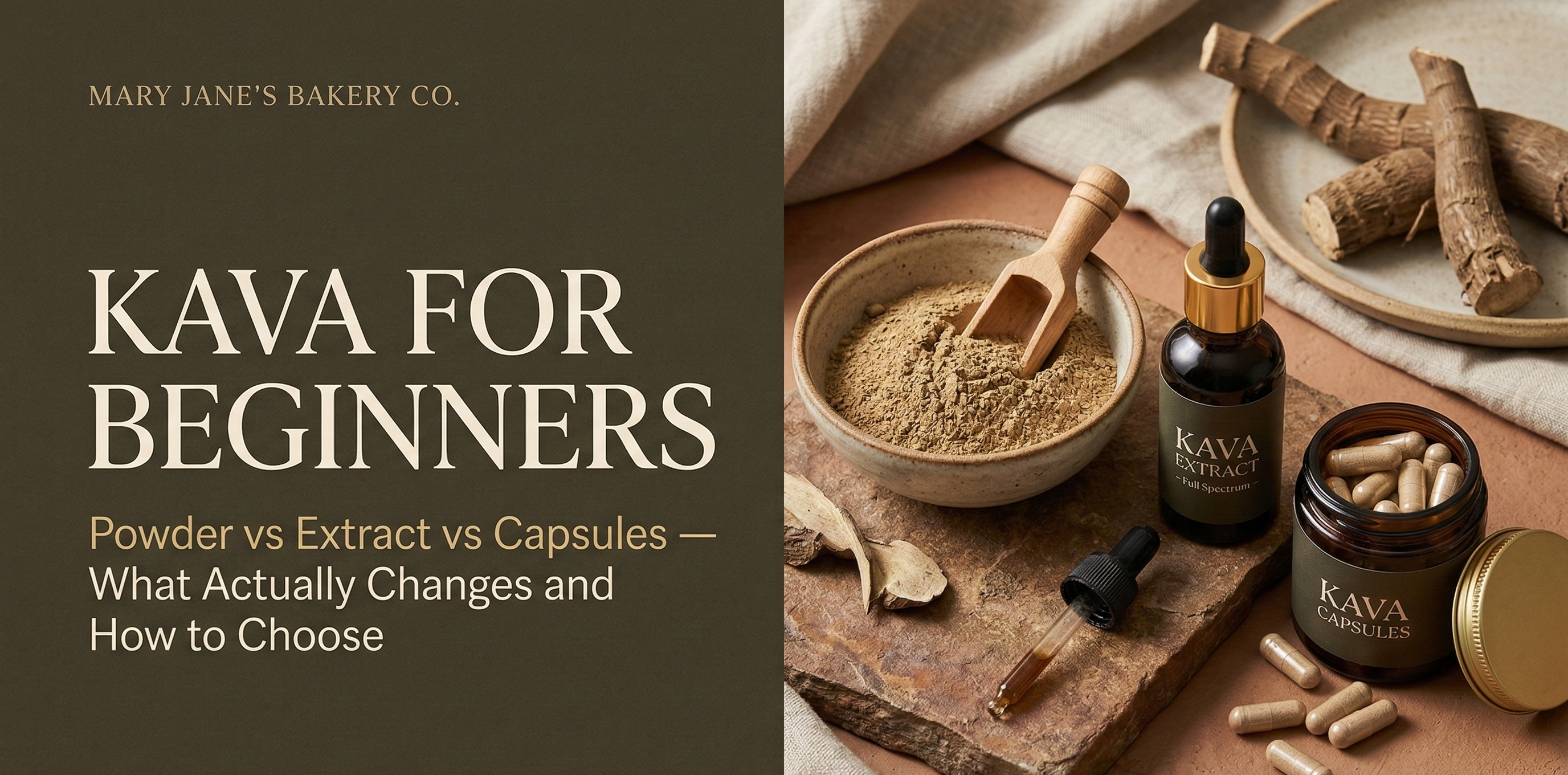
The good news is that the first choice is not as complicated as it seems. In plain terms, powder, extract, and capsules all start from the same plant idea, but they feel very different in real life because prep time, taste, label clarity, portability, and concentration can all change. One option may fit a laid-back home routine. Another may make more sense for someone who just wants something easier to measure and carry.
If you are brand new to kava, this guide will help you understand what actually changes, what to check before you buy, and how to choose a format without overthinking it.
Quick table of contents
- What kava is in simple terms
- The fast answer: powder vs extract vs capsules
- Kava powder
- Kava extract
- Kava capsules
- How to choose your first kava format
- What to check before buying
- Safety, interactions, and who should skip it
- FAQ
What kava is in simple terms
Kava is a plant traditionally used in parts of the South Pacific. The part shoppers usually care about is the root, and the main compounds people talk about are called kavalactones. Those are the plant compounds most often discussed when brands talk about strength, character, or traditional kava effects.
For beginners, the most useful thing to know is this: not every kava product is built the same way. Some are closer to the traditional drink style. Some are more processed. Some are designed mostly for convenience. That is why two products can both say “kava” on the label and still feel like very different purchases.
That is also why format matters more than people expect.
The fast answer: powder vs extract vs capsules
| Format | Best for | Main tradeoff | What beginners usually notice first |
|---|---|---|---|
| Powder | People who want the more traditional route | More prep, more taste, more mess | Earthy flavor and hands-on preparation |
| Extract | People comparing concentration and label details | Quality depends heavily on how it is made | Not all extracts are equal, so label reading matters more |
| Capsules | People who want convenience and portability | Less of the traditional ritual | Easier routine, easier travel, less taste to deal with |
If you want the shortest possible answer, it is this:
- Choose powder if you want the traditional feel and do not mind prep.
- Choose capsules if you want the easiest entry point and less mess.
- Choose extract carefully if you are comfortable reading labels and comparing product details.
Kava powder: the traditional, hands-on option
Kava powder is usually the format that feels closest to what many people picture when they think about traditional kava prep. It has more of a ritual to it. You measure it, mix it, sometimes strain it, and deal with the natural earthy taste instead of hiding from it.
For some people, that is exactly the point.
Powder tends to appeal to shoppers who like being involved in the process instead of just swallowing a capsule and moving on. It can feel slower and more intentional. It also gives you a better sense of the raw material itself. You are seeing the powder, smelling it, mixing it, and noticing its texture.
At Mary Jane’s, the clearest direct fit for this section is Mega Kava, which is presented as a fine-milled kava root powder with a traditional prep style in mind. That makes it a useful example for beginners who want to understand what the powder route actually looks like before they buy.
Why beginners sometimes like powder:
- It feels more traditional and less processed
- You can build a routine around it at home
- You get a clearer sense of the product itself
- Some shoppers prefer starting with the most straightforward form
Why beginners sometimes do not:
- The taste is earthy and not for everyone
- Prep takes more effort than a capsule
- It is less convenient for travel or quick use
- Some people simply do not want to strain or mix anything
If you already know you enjoy the ritual side of botanical products, powder may feel natural. If you know you are the type of person who gets annoyed by measuring, cleanup, or texture, be honest with yourself. That matters more than people admit.
Kava extract: more processed, more label-dependent
Extract is where things start to get a little less simple.
When people hear “extract,” they often assume it automatically means better, stronger, or more advanced. That is not a good assumption. Extract only tells you that the product has gone through more processing to concentrate or isolate certain parts of the plant. It does not tell you whether the product is transparent, well-made, root-focused, clearly labeled, or worth your money.
That is why extract buyers need to pay more attention to the fine print.
With extract products, the method matters, the ingredient list matters, and the testing matters. You want to know what exactly you are getting and whether the brand makes that easy to verify. If a product leans heavily on hype but stays vague about the basics, that is not a great sign.
Extract may suit you if:
- You want a more concentrated product style
- You are comfortable comparing labels and product details
- You prefer a more compact or modern supplement-style format
Extract may not suit you if:
- You want the most traditional route
- You do not want to decode labels
- You tend to trust marketing language too easily
This is one reason beginner shoppers should get comfortable with quality checks, not just product names. If you want a simple guide to reading batch testing and lab transparency, Mary Jane’s CBD Products Guide 2026 and CBD Tincture Strength Guide are both useful because the same basic shopping habits apply here too: readable labels, batch match, clear ingredient lists, and testing you can actually review.
Kava capsules: the easy-entry option
If powder is the ritual route, capsules are the “just make this simple” route.
That is why many beginners start here.
Capsules remove a lot of friction. There is no earthy drink to deal with, no straining, and no scoop on the counter. They are also easier to carry, easier to store, and easier to fit into a routine if you already take supplements in capsule form.
The tradeoff is that capsules can hide some of the product experience from you. That is not automatically bad, but it does mean you rely more on the label and the brand. You are not seeing the powder the same way. You are not preparing it the same way. You are trusting the manufacturer more, which brings you right back to transparency and testing.
Capsules usually make sense for beginners who:
- Want the lowest-prep option
- Do not want to deal with taste
- Need something travel-friendly
- Prefer measured servings over DIY preparation
Capsules may be less appealing if you:
- Want the more traditional feel of kava use
- Like controlling the preparation process yourself
- Prefer simple root powder over a more supplement-style experience
A good comparison mindset is the same one shoppers already use when comparing gummies, oils, tinctures, and other botanical formats: convenience changes the experience. That is one reason Mary Jane’s CBD Gummies vs CBD Oil guide is still worth reading even though it is a different category. The lesson carries over well: the best format is not always the one that sounds strongest. It is usually the one you will actually use properly and consistently.
How to choose your first kava format
Here is the practical version.
Choose powder if you want:
- A more traditional approach
- A home-based routine
- More connection to the raw product
- The kind of experience where preparation is part of the appeal
Choose extract if you want:
- A more concentrated product style
- A modern supplement format
- Something compact, but only if the label is clear and transparent
Choose capsules if you want:
- The easiest beginner entry point
- Less taste and less cleanup
- Portable, measured servings
- A routine that feels simple and low-effort
If you are still unsure, ask yourself these three questions:
- Do I want convenience, or do I want the traditional ritual?
- Am I comfortable reading labels and checking testing details?
- Do I want something for home, or something easier to carry around?
That usually gets people to the right starting point faster than chasing percentages alone.
What to check before buying any kava product
This is the part a lot of shoppers skip. Then later they wonder why one product feels trustworthy and another feels vague.
Start with the product type.
Is it root powder, extract, or capsules? That should be easy to understand in a few seconds. If a product page makes that unclear, that is already a small warning sign.
Look for clear ingredient details.
You want to know what is in it without digging through confusing language or oversized claims.
Check for batch-level transparency.
A product should not feel like a mystery bag. Batch numbers, lot details, or other traceable info matter.
Look for lab testing when available.
This is where a lot of good shopping decisions start. If you want a straightforward breakdown of what to look for on a lab report, the CBD Products Guide 2026 has a practical COA checklist, and the CBD Tincture Strength Guide also explains what makes a readable, credible lab report useful.
Be careful with miracle-style claims.
If a product sounds like it is trying to do everything, fix everything, and promise everything, slow down. Calm language is usually a better sign than dramatic language.
Check whether the brand writes like a real company.
That sounds basic, but it matters. Real contact info, readable policies, clear labeling, and consistent product details all help.
Watch for the same red flags you would avoid in other fast-moving botanical categories.
Mary Jane’s Amanita Gummies Safety Guide is a good example of that mindset. Different category, same common-sense rule: if the packaging, claims, or transparency look off, you do not need to talk yourself into it.
Safety, interactions, and who should skip it
This section matters.
Kava is not something to treat casually just because it is plant-based. If you are pregnant, breastfeeding, taking medications, dealing with liver concerns, or combining substances that can make you drowsy, this is a category where caution makes sense.
It is also a bad idea to mix kava with alcohol or other sedating substances. If you take medicines of any kind, it is smart to speak with a qualified healthcare professional before trying kava. That is not fear talk. It is just the practical route.
Some shoppers also confuse kava with other botanical categories and assume they all belong in one big bucket. They do not. For example, Kratom is a separate category with its own profiles, use patterns, and things to consider. If you are shopping across multiple plant-based categories, it is worth slowing down instead of treating them like interchangeable products.
A few simple rules go a long way:
- Do not combine kava with alcohol
- Do not treat it like a casual mix-and-match product with everything else in your cabinet
- Do not rely on exaggerated health claims
- Do not guess if you have medication, pregnancy, breastfeeding, or liver-related concerns
When in doubt, keep it simple and cautious.
Best beginner path if you want the least confusion
If you want the most straightforward beginner path, start with the format question first, not the hype question.
Ask yourself:
- Do I want a traditional powder experience?
- Do I want a simple capsule routine?
- Am I comfortable comparing extracts and reading details carefully?
If you already know you like more natural, hands-on product formats, a powder option such as Mega Kava will probably make the most sense. If you know you want convenience above everything else, capsules are usually the more beginner-friendly place to start. If you are drawn to extract products, just be stricter about transparency before you buy.
That is the whole idea. Keep the first decision honest and practical.
FAQ
Is kava powder the same as kava extract?
No. Powder is usually the more traditional, less processed route, while extract is a more concentrated, more processed product style. They may both come from kava, but they are not the same shopping experience.
Are kava capsules better for beginners?
For many people, yes. Capsules are often easier because they remove taste, prep, and cleanup. That said, some beginners prefer powder because it feels more direct and traditional.
Is stronger always better with kava?
Not really. The better question is whether the product is transparent, suitable for your routine, and easy for you to use responsibly. A product that sounds stronger on paper is not automatically the better beginner choice.
What is the easiest kava format to fit into a daily routine?
Usually capsules. Powder takes more involvement. That can be a plus or a minus depending on the person.
What should I check before ordering kava online?
Start with product type, ingredient clarity, batch information, available lab testing, and whether the brand avoids vague miracle claims. If you need help with lab-reading habits, Mary Jane’s COA-focused buyer guides are worth reviewing before you shop.
Can I mix kava with alcohol?
That is not a good idea. It is smarter to avoid combining kava with alcohol or other sedating substances.
Where can I browse a kava powder option at Mary Jane’s?
You can start with Mega Kava if you want to see a powder-style product page and get a feel for the more traditional route.
Final thoughts
The biggest mistake beginners make with kava is assuming every format is basically the same. It is not.
Powder is more traditional and more hands-on. Extract is more label-dependent and needs more careful comparison. Capsules are usually the easiest place to start if convenience matters most.
That is really what this comes down to: not “Which one sounds the most impressive?” but “Which one actually fits the way I shop and the way I will use it?”
If you want to explore the traditional powder route first, take a look at Mega Kava. If you want to sharpen your buyer checklist before ordering anything, the CBD Products Guide 2026, CBD Gummies vs CBD Oil, and CBD Tincture Strength Guide are also worth reading for label and transparency basics.