

Adults 21+ • Education only
No legal advice • Rules vary by state
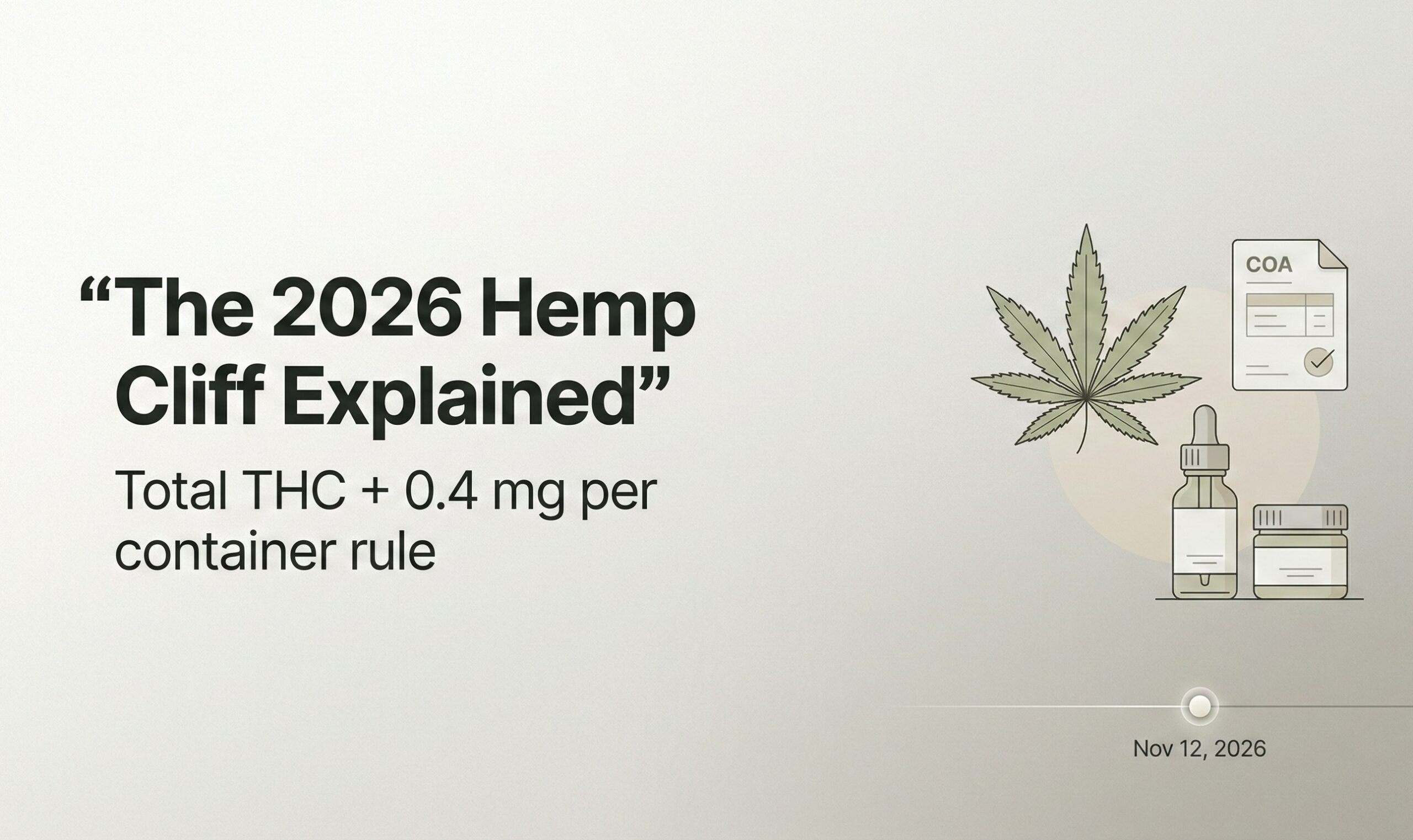
“Hemp cliff” is an informal nickname for a federal definition change scheduled to take effect on November 12, 2026.
The big shift: hemp is no longer judged by delta-9 THC only—it moves to Total THC (including THCA),
and it excludes many final consumer products that contain more than 0.4 mg combined total per container.
Quick Answer (Snippet-Friendly)
The 2026 hemp cliff is a federal update to the hemp definition that (1) uses Total THC (including THCA) rather than delta-9 THC alone,
and (2) excludes many final hemp-derived cannabinoid products that contain more than 0.4 mg combined total per container.
If you are a business operator or you rely on a product for a specific need, consult qualified counsel or a licensed professional.
1) What Is Changing in 2026?
The main federal change is a revised hemp definition in 7 U.S.C. § 1639o.
The Congressional Research Service (CRS) explains that the definition moves from “delta-9 THC only” to a
Total THC approach (including THCA), and it adds restrictions aimed at potentially intoxicating hemp-derived consumer products.
| Topic | What Most People Were Used To | What The New Definition Adds |
|---|---|---|
| THC measurement | Mostly focused on 0.3% delta-9 THC on a dry-weight basis. | Uses 0.3% Total THC (including THCA) on a dry-weight basis, acknowledging delta-9 is not the only THC-related compound. |
| Finished consumer products | Many products marketed as “hemp” were sold in gummies, drinks, vapes, etc. | Excludes final hemp-derived cannabinoid products that contain > 0.4 mg combined total per container. |
| Timing | Rules varied, and enforcement was uneven. | Effective date stated by CRS: November 12, 2026. |
is more likely to fall outside the hemp definition after the effective date.
2) Key Definitions: Total THC, Final Product, Container
Total THC (Including THCA)
“Total THC” is a reporting approach that accounts for THC-related content beyond delta-9 alone.
In many lab reports and compliance discussions, THCA is included because it can convert to delta-9 THC when heated.
A common label-reading formula is:
Total THC = (THCA × 0.877) + Δ9-THC
If you want a step-by-step guide with examples written for everyday shoppers, read:
Total THC vs Delta-9 THC (THCA × 0.877 explained).
Final vs Intermediate Hemp-Derived Cannabinoid Products
CRS distinguishes between intermediate products (not in final form, or marketed to be mixed into something else before use)
and final products (retail-ready consumer items).
This matters because the rules treat these categories differently.
What “Container” Means (This Is The Biggest Confusion)
CRS explains that “per container” means the innermost packaging directly holding the product for retail sale—think
the bottle/jar/bag/cart that physically contains the item.
Why this matters: people often assume THC limits apply “per serving.” The 2026 change focuses on what is in the whole package.
3) The 0.4 mg Per Container Rule (Per Container vs Per Serving)
The “0.4 mg rule” is one reason people call this a cliff. 0.4 mg is a tiny amount of THC across an entire package.
Under the CRS explanation, final products that contain greater than 0.4 mg combined total per container
fall outside the hemp definition after the effective date.
“Per serving” is what one gummy or one dropper contains. “Per container” is the total across the whole bottle/jar/bag/cart.
The 2026 discussion is centered on per container.
Want the Mary Jane’s deep dive that stays calm and practical?
The 0.4 mg THC per container rule explained.
4) What Is Excluded From “Hemp” Under the New Definition?
CRS lists specific exclusions designed to restrict distribution of certain hemp-derived cannabinoid products.
If a product falls into these buckets after the effective date, it is not treated as hemp under the revised definition.
High-level list (shopper-friendly):
- Viable seeds that exceed the 0.3% Total THC (including THCA) threshold.
- Cannabinoids not naturally produced by the cannabis plant.
- Naturally occurring cannabinoids that were synthesized or manufactured outside the plant.
- Intermediate products with more than 0.3% combined Total THC and other THC-like cannabinoids.
- Final consumer products with > 0.4 mg combined total per container of Total THC and other THC-like cannabinoids.
This is a plain-language summary. The official wording and categories are in CRS and the bill text (see “Official Sources” below).
This is also where a lot of public confusion comes from: some items sold today as “hemp”
may be treated differently under the new definition after November 12, 2026.
5) Who Is Most Impacted (Shoppers + Categories)?
Products that tend to be most sensitive
- Hemp-derived THC edibles (gummies, candies, drinks)
- THCA-heavy products (because THCA is included in Total THC reporting approaches)
- Full-spectrum wellness products where “trace THC” can add up across the entire container
If you want category-specific reading (Mary Jane’s internal guides):
- Are hemp THC gummies banned in 2026? What changes
- Is THCA getting banned? What changes in 2025–2026
- CBD Products Guide 2026 (COA checklist + shopping clarity)
- Florida hemp law update 2026 (Miami context)
Always use COAs and choose products conservatively.
6) How To Read a COA for 2026 (With Simple Examples)
COA (Certificate of Analysis) reading is the most practical skill you can build before 2026.
Instead of relying on buzzwords like “compliant,” confirm what the lab report actually shows.
COA checklist (fast)
- Match the COA to the product: name, batch/lot number, and date.
- Find the cannabinoid panel: look for Δ9-THC, THCA, and any “Total THC” line.
- Notice the units: mg/g, %, or mg per serving. (Do not mix units without converting.)
- Ask the “whole package” question: what is the total across the full container?
Want the full Mary Jane’s walkthrough?
CBD Products Guide 2026 (COA checklist).
Example (Illustration Only): Per Serving Can Look Small, But The Container Total Adds Up
Imagine a product with 0.15 mg Δ9-THC per serving and the bottle contains 30 servings.
The bottle total would be roughly:
0.15 mg × 30 = 4.5 mg Δ9-THC per container
This example is not a compliance ruling. It simply shows why “per container” language changes how people think about labels.
Example (Illustration Only): Why THCA Changes The “Total THC” Conversation
If a COA shows THCA, some calculations convert it using a common factor:
Total THC = (THCA × 0.877) + Δ9-THC
See a full explanation with plain examples here:
Total THC vs Delta-9 THC.
7) What Is Still Unclear (And What To Watch)
Even with a law on the books, real-world outcomes depend on implementation and enforcement.
CRS notes that it remains unclear how broadly the new prohibitions will be enforced once the definition takes effect,
and that agencies may face practical resource limits.
What to watch in 2026:
- FDA lists and guidance: CRS explains the law requires FDA to publish lists of cannabinoids and provide additional info about the term “container.”
- State rules: Some states may move faster or set stricter limits than the federal baseline.
- Packaging + labeling shifts: Expect changes to serving language, container language, and how brands present testing.
FAQ
When does the 2026 hemp cliff start?
CRS states the new definition takes effect on November 12, 2026. States may change rules earlier.
Is the 0.4 mg THC limit “per serving” or “per container”?
The CRS discussion is centered on per container—the “container” is the innermost retail packaging that directly holds the product.
That is why “per serving” labels can be misleading when you are trying to understand total package amounts.
Does “Total THC” include THCA?
Yes. CRS describes “Total THC” as including THCA, and many COA calculations estimate total THC as
(THCA × 0.877) + Δ9-THC.
For a plain guide, see:
Total THC vs Delta-9 THC.
Will hemp-derived THC gummies still be around in 2026?
The policy direction is clearly tighter, but the market outcome depends on implementation, packaging, testing, and enforcement.
We keep this guide updated here:
Hemp-derived THC gummies in 2026.
What should shoppers do right now?
Build a simple habit: choose transparent brands, check COAs, and think in “whole container” totals (not just per serving).
Use our COA checklist:
CBD Products Guide 2026.
Is this post legal advice?
No. It is educational. If you need advice for a specific product, business, or state, consult qualified counsel.
Official Sources (Primary References)
If you want the exact language and definitions, start with CRS and Congress.gov:
- CRS (PDF): Changes to the Statutory Definition of Hemp and Issues for Congress (IF13136):
congress.gov - CRS (PDF): Change to Federal Definition of Hemp and Implications for Hemp Regulation (IN12620):
congress.gov - Congress bill text (H.R. 5371, 119th Congress – text):
congress.gov - CRS Legal Sidebar (PDF): Legal considerations under the Controlled Substances Act (LSB11381):
congress.gov - U.S. Code reference (reader-friendly): 7 U.S.C. § 1639o:
law.cornell.edu - FDA overview: Cannabis and cannabis-derived products (including CBD):
fda.gov - USDA hemp FAQs (program background):
usda.gov
Related Reading on Mary Jane’s Bakery Co
- The 0.4 mg THC per container rule explained
- Total THC vs Delta-9 THC (THCA × 0.877 + Δ9)
- Are hemp THC gummies banned in 2026? What changes
- Is THCA getting banned?
- Florida hemp law update 2026 (Miami context)
- CBD Products Guide 2026 (COA checklist)
- CBD edibles and CBD gummies: how to choose in 2026
Reminder: Follow local laws. If you are pregnant, nursing, on medications, or subject to drug testing, consult a licensed professional and avoid guessing.