

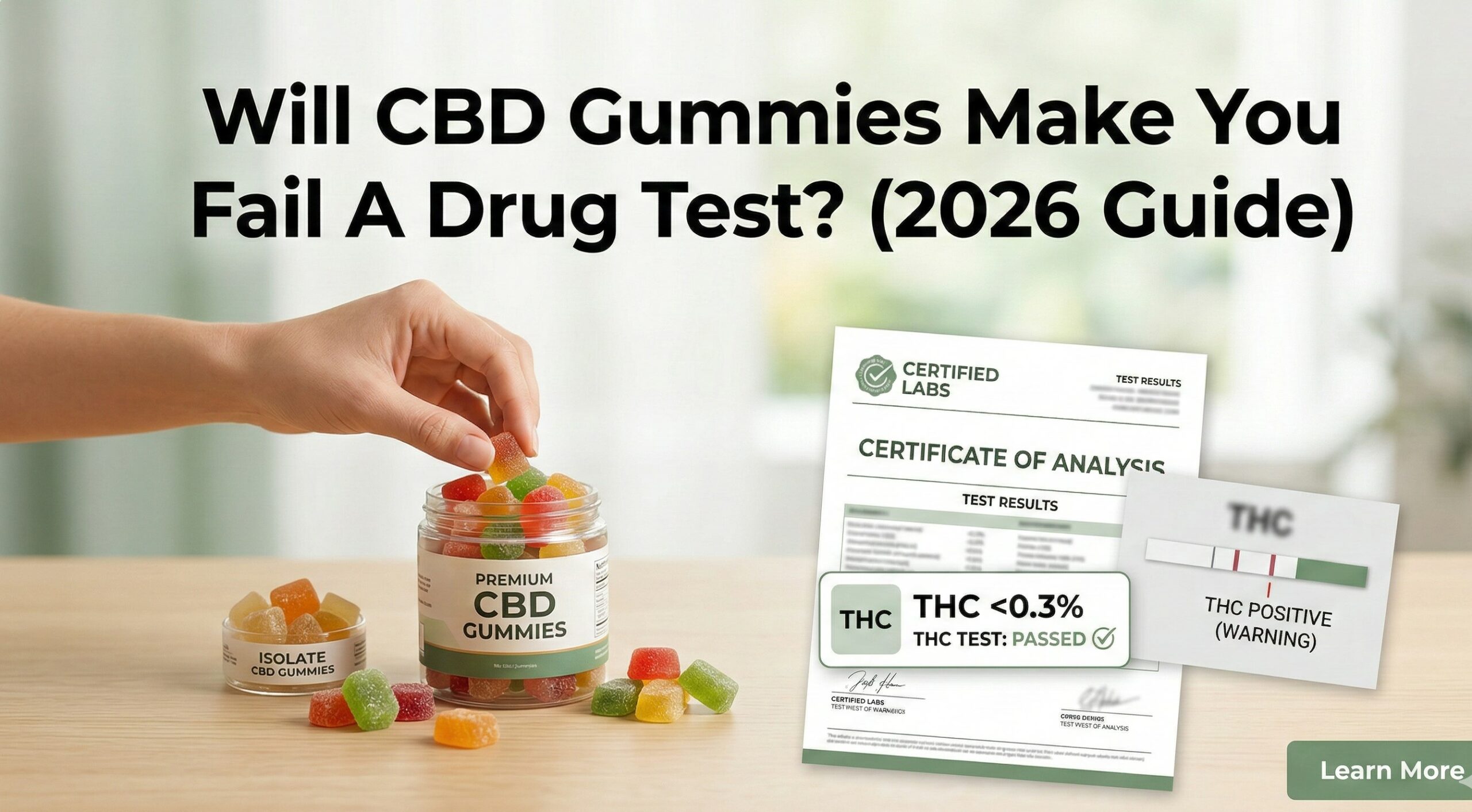
Quick Answer
CBD itself is not what most drug tests look for. The issue is THC. Some CBD gummies contain trace THC (especially full-spectrum products), and repeated use can sometimes lead to a positive test for THC metabolites. If passing a test is your top priority, your lowest-risk option is typically THC-free CBD isolate gummies with a recent third-party lab report (COA). Even then, no CBD product can be promised as “zero risk” in every real-world scenario.
If you want a deeper breakdown of CBD product types (isolate vs broad vs full spectrum), you can also read:
CBD Isolate vs Full Spectrum vs Broad Spectrum: What Is The Difference?
Why This Question Matters So Much In 2026
People do not search “drug test + CBD gummies” because they are curious. They search it because they are stressed. It is usually one of these situations:
- A pre-employment urine test is coming up.
- They are in a job with random testing.
- They used CBD gummies for a while and suddenly realized the label says “full spectrum.”
- They felt “something” from a product that was supposed to be CBD only.
So the goal of this guide is simple: help you understand the real risk, how drug tests work, and how to choose products more safely if you still want to use CBD gummies.
What Most Drug Tests Actually Detect (It Is Not CBD)
Most workplace tests are designed to detect THC metabolites (what your body creates after THC is processed), not CBD. In federal workplace drug testing standards and DOT-regulated testing, the primary target is THC metabolite (commonly listed as THCA on lab panels and guidance tables). Federal guideline tables commonly reference cutoffs like 50 ng/mL (initial screen) and 15 ng/mL (confirmatory test) for marijuana metabolite testing in urine-based programs.
Trusted references you can check:
- DOT 49 CFR § 40.85: Cutoff concentrations for urine drug tests
- Federal Register: Mandatory Guidelines for Federal Workplace Drug Testing Programs (Urine)
Screening vs Confirmation (Why “False Positives” Get Discussed)
Many workplace drug tests follow a two-step process:
- Initial screen (often immunoassay): fast, cost-effective, but not the final word.
- Confirmatory test (more specific lab confirmation): used to verify results when a screen is positive.
So when people say “CBD caused a false positive,” what is usually happening is this: THC exposure occurred somehow (trace THC, mislabeled product, cross-contamination, or combined use), and the test detected THC metabolites. It is not typically “CBD showing up” as CBD.
Can CBD Gummies Cause a Positive Drug Test?
They can, depending on the product and your usage. CBD gummies can increase your risk of a positive THC test when they contain THC (even small amounts) and you take them regularly.
The Three Main Ways CBD Gummies Become a Drug-Test Risk
- The gummy is full spectrum (contains THC by design).
Full-spectrum products usually include a range of cannabinoids from hemp, including small amounts of THC. Over time, that THC can add up. - The label says “THC-free,” but the batch is not actually THC-free.
The hemp market has improved a lot, but it is still possible to see inconsistencies between labels and what a specific batch contains. That is why batch-specific COAs matter. - You are unknowingly stacking THC from multiple sources.
For example: gummies + a “full spectrum” tincture + a vape + a product you did not realize contains THC. When stacked, the risk rises.
For an edibles-focused shopping guide, see:
CBD Edibles And CBD Gummies (2026)
Which CBD Gummies Are Most Likely To Trigger A Positive Test?
| Product Type | Typical THC Situation | Drug-Test Risk | Best For |
|---|---|---|---|
| Full Spectrum CBD Gummies | Contains THC (trace or measurable) by design | Highest (especially daily use) | People not subject to testing who prefer “whole-plant” profiles |
| Broad Spectrum CBD Gummies | THC removed, but trace amounts may still occur depending on processing/batch | Medium (depends on COA + frequency) | People avoiding THC effects but not under strict testing |
| CBD Isolate Gummies | CBD only (should be THC-free), but quality control matters | Lowest (not zero-risk in the real world) | People who want the simplest option and lowest testing risk |
Want a deeper explanation of how isolate vs broad vs full spectrum differs? Read:
CBD Isolate Gummies vs Full Spectrum vs Broad Spectrum
How To Read A COA For CBD Gummies (The Part Most People Skip)
A COA (Certificate of Analysis) is the third-party lab report for a specific product batch. If you care about drug testing, COAs are not “nice to have.” They are your safety checklist.
Check These COA Sections First
- Cannabinoid profile: look for Delta-9 THC, THCA, and any “Total THC” line or calculation.
- “ND” vs “0.00”: ND usually means “not detected” above the lab’s detection limit. It is different than “absolute zero.”
- Batch match: confirm the batch/lot number on the COA matches your product.
- Date: prefer recent lab reports, especially if you are buying online.
For a plain-English explanation of “Total THC” and why it shows up in lab conversations, see:
Total THC vs Delta-9 THC (Including THCA Math)
Factors That Increase Your Risk Of A Positive Result
Two people can take the “same” CBD gummies and have different outcomes. That is because drug test risk is influenced by:
- Product type: full spectrum generally adds more risk than isolate.
- Dose size: higher mg per gummy, multiple gummies per day, or high-strength products.
- Frequency: occasional use is not the same as daily use for weeks.
- Body composition and metabolism: THC metabolites may stay longer for some people.
- Test sensitivity and policy: some employers use strict standards.
Important Note For DOT / Safety-Sensitive Roles
If you are DOT-regulated (or in any safety-sensitive position), the safest path is often to avoid CBD products entirely if you are concerned about testing outcomes. DOT has specifically warned that CBD products could lead to a positive result.
How To Lower Your Risk If You Still Want CBD Gummies
If you are not in a zero-tolerance environment and you still want to use gummies, here are the most practical ways to reduce risk. This is not a guarantee, but it is a realistic checklist.
1) Prefer CBD Isolate Gummies (With Real Batch Testing)
CBD isolate gummies are typically the lowest-risk choice because they are designed to contain CBD only. Still, the COA matters because it shows what is in the batch you are actually taking.
2) Avoid “Full Spectrum” If Passing A Test Is Your Priority
Full spectrum often contains THC by design. Even if it is legally “hemp-derived,” the testing risk can still be real, especially with repeated use.
3) Do Not Overdose “Just To See If It Works”
A common mistake is increasing gummy intake rapidly because effects feel subtle. If your goal is safety, take a consistent, reasonable amount and avoid stacking multiple products. If you want a comparison between gummies and oils for dosing control, read:
CBD Gummies vs CBD Oil
4) Keep A Simple “Testing Window” Rule For Yourself
If you know you have a scheduled test coming up, be cautious with any product that could contain THC. There is no universal “safe number of days,” because frequency, dose, and personal metabolism vary widely. But in general: the closer the test date, the less risk you want to take.
If You Already Took CBD Gummies And Have A Test Soon
If you are anxious right now, keep it simple:
- Stop use immediately if passing the test is your priority.
- Do not rely on “detox” gimmicks or extreme methods. They can create other problems and still do not guarantee outcomes.
- Consider an at-home THC test as a personal check (not a replacement for workplace testing, but it can reduce guessing).
- If you are DOT-regulated or high-risk employment: consider speaking with your employer or HR about policy. DOT guidance is clear that CBD use is not a defense for a confirmed THC positive.
For more detailed context on testing risk across CBD formats, you can also read:
CBD Tincture Drug Test Guide
Shop CBD Gummies With Clear Product Context
If you are looking for CBD gummies and want to browse options, you can start here:
CBD Edibles (Gummies & More).
Mary Jane’s Bakery Co serves customers nationwide and ships across the U.S. where allowed by law.
Trusted References (Government & Public Health)
If you want to verify information from primary sources, these are solid starting points:
- U.S. Department of Transportation (DOT): “CBD” Notice
- DOT 49 CFR § 40.85: Urine drug test cutoff concentrations
- Federal Register: Mandatory Guidelines for Federal Workplace Drug Testing Programs
- SAMHSA: Medical Review Officer (MRO) Guidance Manual (2024)
- CDC: About CBD (Cannabis and Public Health)
- FDA: What You Need To Know About Products Containing Cannabis or CBD
Bottom line: If you must pass a drug test, treat CBD gummies with caution. The safest approach is to avoid THC exposure as much as possible, prefer isolate-based products with batch testing, and understand that workplace policies (especially DOT) may not accept CBD use as an explanation for a THC positive.