

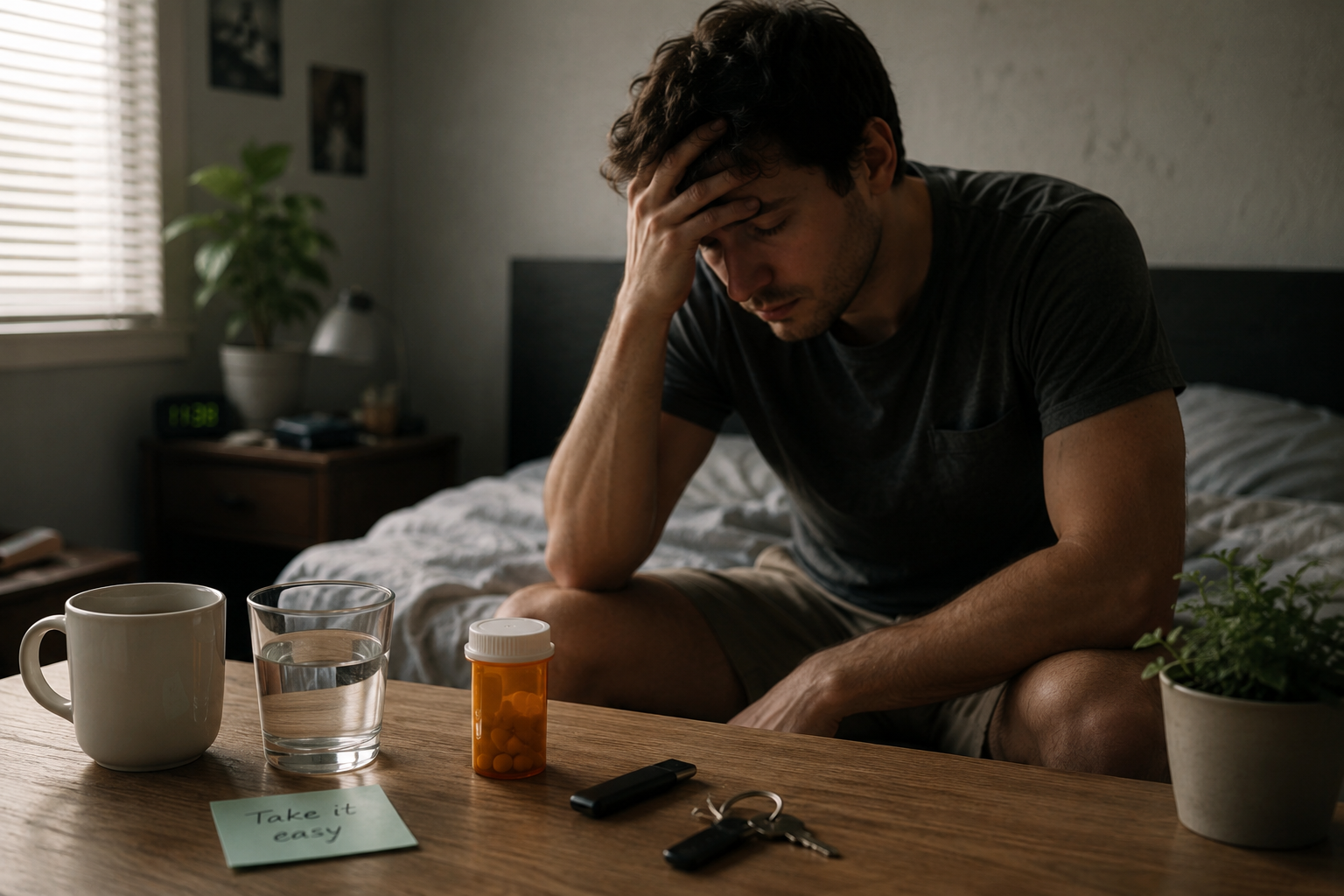
THC next-day safety guide
Weed hangover symptoms can include tiredness, brain fog, headache, dry mouth, and dizziness. If you wake up still feeling high, THC effects may still be active—especially after a late or repeatedly dosed edible. These experiences can overlap, and neither a clock nor a cup of coffee can confirm sobriety. Do not drive or do safety-sensitive work while you feel impaired.
Most important distinction
Still high or just groggy?
Altered perception, slowed reactions, or poor coordination may mean intoxication is ongoing.
Common timing problem
Late edible or redose
Swallowed THC can take hours to reach full effect and may carry into the next day.
No instant fix
Time and support
Rest and normal hydration may ease discomfort; coffee and showers do not end impairment.
Why do I still feel high the next day?
Why do I still feel high the next day? One possibility is that intoxicating THC effects have not completely worn off. This is more likely after a late edible, higher exposure, several servings taken close together, or mixing cannabis with alcohol or other impairing substances. However, grogginess, dizziness, and poor concentration can also have other causes. Treat ongoing altered perception, slow reactions, or poor balance as potential impairment rather than relying on how many hours have passed.
There is another possibility: you may no longer feel intoxicated but still feel tired, unfocused, or off after a poor night’s sleep. A third possibility is an unrelated medical issue. You cannot reliably distinguish these from a clock, product label, or single symptom alone.
A practical morning check (not a sobriety test)
- Feeling altered, slow, confused, or unsteady? Treat this as possible continuing impairment. Avoid driving and other safety-sensitive activities.
- Mainly sleepy or dry-mouthed? Rest and monitor, but do not assume you are safe to drive if your attention or coordination is not normal.
- Severe, unusual, or worsening symptoms? Get medical help rather than labeling them a routine hangover.
This checklist cannot certify that a person is unimpaired. When in doubt, arrange another ride.
Can vaping weed at night leave you high in the morning?
It can happen, especially after repeated inhalations, high-potency products, or late use. However, inhaled cannabis usually starts working much sooner than a swallowed edible and typically has a shorter period of noticeable effects. Waking up foggy after vaping is not proof that you are still intoxicated—nor proof that you are safe to drive. Review the timelines for smoking, vaping, and edibles for more detail.
If you are feeling actively too high right now, our separate guide to what to do when you feel too high focuses on the immediate experience.
What is a weed hangover?
“Weed hangover” is an everyday term for feeling unwell or not quite yourself after cannabis use, often the following morning. People commonly describe grogginess, fatigue, brain fog, dry mouth, dry eyes, headache, or mild nausea. It is not a formally defined diagnosis, and researchers have not established one uniform syndrome or a proven quick cure.
In a 2023 systematic review of studies measuring next-day THC performance, most measured outcomes did not show clear next-day impairment, although study quality and findings varied. That evidence is not a guarantee about any individual, every product, or every dose. Reported symptoms and measured driving performance are also different questions.
A 2026 randomized edible-THC driving-simulator trial found dose-related driving impairment at 2 and 5 hours; most tested measures did not show a residual difference at 24 hours, although one measure did. The study did not establish when everyone becomes safe to drive between those times, and its regular-use adult participants do not represent every consumer.
What the research shows—and what it does not
| Evidence | Finding | Important limit |
|---|---|---|
| 2023 systematic review 20 studies | Most recorded performance tests did not demonstrate measurable next-day impairment, although the evidence was mixed. | Older studies, variable methods and bias risks; it did not establish a single weed-hangover diagnosis. |
| 2026 randomized trial 40 adults who regularly used cannabis | Edible THC impaired some simulated-driving measures at 2 and 5 hours. Residual performance differences were limited at 24 hours. | It did not measure driving performance between 5 and 24 hours or guarantee safety for other people, doses, or products. |
On a phone, swipe the research table sideways to read every column.
Read the systematic review and the 2026 clinical trial. Feeling unwell is not the same outcome as performance on a simulator, and no study gives an individual a safe-driving countdown.
Possible weed hangover symptoms—and what they may mean
| What you notice | Possible explanation | What to do |
|---|---|---|
| Sleepiness, heavy eyes, low energy | Residual effects, disrupted sleep, or another cause | Rest; avoid risky tasks if not fully alert |
| Brain fog, poor focus, slow reactions | Possible ongoing impairment or other causes | Do not drive; reassess as symptoms improve |
| Dry mouth or eyes | Common THC-related discomfort; not proof of whole-body dehydration | Drink normally for thirst; use supportive comfort measures |
| Headache or mild nausea | May occur after THC; also many non-cannabis causes | Rest and monitor; seek care if persistent or worsening |
| Dizziness, feeling faint, or poor balance | THC effects are possible; blood-pressure changes or another illness may be involved | Sit safely; do not drive; seek evaluation for new or persistent symptoms |
On a phone, swipe the table sideways to see all columns.
Can weed make you dizzy the next day—or cause vertigo?
Dizziness can be associated with cannabis, including lightheadedness or feeling unsteady. THC can affect coordination and sometimes blood pressure, particularly when standing up. However, vertigo usually describes a spinning or moving sensation. New or persistent spinning, fainting, or balance problems should not automatically be blamed on a “weed hangover.” Ear conditions, medications, and other medical problems can also cause these symptoms.
Stay seated or lie down if you feel faint. Avoid driving. Seek medical assessment for unusual, recurrent, or persistent dizziness. Call emergency services if dizziness occurs with sudden weakness on one side, facial droop, difficulty speaking, chest pain, or a severe sudden headache. Health Canada lists dizziness, disorientation, and impaired balance among possible THC adverse effects; it does not establish that every next-day episode is caused by THC.
How long does a weed hangover—or lingering high—last?
There is no evidence-based fixed duration for a “weed hangover.” Mild tiredness may ease over several hours, but the intoxicating effects of THC and other explanations for symptoms vary by person. The ranges below are public-health guidance for cannabis effects, not a countdown to driving safely.
| Method | When effects may begin | Duration guidance |
|---|---|---|
| Smoking or vaping | Seconds to minutes; full effects can take up to about 30 minutes | Effects may last up to 6 hours; some residual effects could persist up to 24 hours |
| Swallowed edibles and drinks | About 30 minutes to 2 hours; full effects may take up to 4 hours | Effects may last up to 12 hours; some residual effects could persist up to 24 hours |
On a phone, swipe the table sideways to see all columns.
Source: Health Canada consumer guidance. These ranges describe possibilities, not guarantees that symptoms must resolve by 24 hours. A different or serious medical problem may require care.
For example, if someone takes an edible late in the evening and redoses before it reaches full effect, they may wake up feeling effects that began much later than anticipated. This is an illustration, not a formula for predicting an individual’s recovery time.
Why edibles and THC gummies may affect the next morning
Unlike inhaled THC, swallowed THC takes longer to absorb. That delay makes it easy to think a serving “didn’t work” and take more before the first one has peaked. The CDC warns that edible effects may be delayed, unpredictable, and longer-lasting, and products may not always contain the amount listed on the label.
A simple serving-label example
Imagine a package says “20 mg THC total” and contains four equal gummies. That is 5 mg per gummy (20 ÷ 4). Two gummies would contain 10 mg THC, assuming the label is accurate. These numbers explain the difference between package strength and serving strength; they are not a suggested dose and do not predict how anyone will feel.
Timing, dose, food, alcohol, other medications, and individual sensitivity all affect the experience. Health Canada advises particular caution with higher-THC products and delayed redosing. If your question is how to read smaller serving amounts, see our 2.5 mg versus 5 mg THC guide.
Delta-8 hangovers, Delta-9, THC drinks, and vapes
Can Delta-8 cause a weed hangover? Adults may report fatigue, fogginess, dizziness, or lingering intoxication after intoxicating Delta-8 products, particularly when using gummies late or taking multiple servings. “Delta-8 hangover” and “Delta-9 hangover” are informal terms, not distinct medical diagnoses. Delta-8 is psychoactive, and assuming it always causes a milder morning is unsafe. Product concentration, manufacturing quality, timing, and individual response may vary. The FDA cautions that Delta-8 products have not been evaluated or approved for safe use.
Can Delta-8 gummies leave you tired or foggy the next day?
They can be associated with reports of tiredness, dizziness, confusion, or continuing intoxication after use. The FDA cautions that Delta-8 is psychoactive and that some products have uncertain labeling, formulations, and manufacturing-related risks. Do not assume a product marketed as “hemp” or Delta-8 is non-intoxicating or risk-free. For the wider comparison, see our Delta-8 versus Delta-9 explainer.
What about THC drinks, flower, and carts?
For THC drinks, check the milligrams per container and serving; several sips or servings can add up. For flower, pre-rolls, carts, and vapes, repeated use or high potency can result in more exposure than intended, even though inhaled effects generally start sooner. Swallowed tinctures may follow edible-like timing; under-the-tongue use can differ. No format is guaranteed to prevent next-day symptoms. If alcohol is involved, read our THC drinks versus alcohol comparison.
What to do if you wake up foggy, dizzy, or still high
- Stop using THC for now. Taking more may prolong or worsen the experience.
- Make the day safer. Do not drive, operate machinery, or do other tasks needing clear judgment or coordination while impaired. Arrange another ride if necessary.
- Get into a calm, comfortable space. Sit or rest if dizzy, and ask someone you trust to stay in touch if you are distressed.
- Eat if comfortable and drink normally. Water may help thirst or dry mouth, but extra water does not flush THC from the body on demand.
- Allow time. Coffee or a shower can change how awake or refreshed you feel, but neither is a proven THC antidote or a reliable driving-safety test.
- Escalate concerning symptoms. Seek medical care for severe, worsening, repeated, or unusually persistent symptoms rather than assuming cannabis is the only cause.
What not to rely on
There is no proven instant “weed hangover cure,” detox drink, food, or trick that reliably restores reaction time or judgment. Feeling more awake is not equivalent to being unimpaired.
When should you get medical help?
Call emergency services (911 in the US) for chest pain, breathing difficulty, seizure, unconsciousness, inability to awaken someone, severe confusion, or stroke-like symptoms. Persistent vomiting, severe distress, or symptoms that are unusual for the person warrant prompt medical attention.
If a child consumes any THC gummy, drink, or other edible, contact Poison Control right away at 1-800-222-1222 in the United States—even if symptoms have not yet appeared. Keep all THC products secured away from children and pets.
Recurrent episodes of severe nausea, vomiting, or abdominal pain in someone who frequently uses cannabis also deserve medical evaluation; cannabinoid hyperemesis syndrome (CHS) is one possible cause, not something to self-diagnose as a hangover. Likewise, repeated brain fog, dizziness, or difficulty cutting back deserves a conversation with a qualified healthcare professional.
How to reduce the chance of feeling bad the next day
- Plan around responsibilities: avoid cannabis before driving, early shifts, childcare, or other safety-sensitive commitments.
- Read the complete label: compare milligrams per serving with milligrams per package, and check for other active ingredients.
- Do not rush to redose: swallowed THC can take several hours to reach full effect.
- Avoid mixing intoxicants: combining cannabis with alcohol or other impairing substances can increase risks.
- Avoid unfamiliar or unusually strong products: products may vary in potency and label reliability.
- Reconsider use when symptoms recur: reducing or stopping use and discussing the pattern with a healthcare professional may be appropriate.
- Store safely: keep products in child-resistant, secured containers away from food, children, and pets.
No specific time, amount, product type, or sleep period can guarantee next-morning driving safety.
Weed hangover: quick questions answered
Is it normal to feel high the next day?
It is reported, particularly after strong, late, or repeated THC exposure. But severe or unusual symptoms are not something to dismiss as “normal.” Avoid driving if you feel impaired and seek care if symptoms concern you.
How does weed make you feel the next day?
Some people report fatigue, foggy thinking, dry mouth, headaches, or dizziness; others feel normal. The same symptoms can result from poor sleep, other substances, or unrelated health issues.
How long does a Delta-8 or edible hangover last?
There is no medically established hangover timer. Edible effects can last many hours and some residual effects may persist into the next day. Persistent, severe, or worsening symptoms require medical assessment.
Can weed gummies cause dizziness the next morning?
THC can cause dizziness, but morning dizziness can have many causes. Avoid driving, and get evaluated for new, severe, recurrent, or persistent dizziness—particularly a spinning sensation or fainting.
Does sleeping, coffee, or drinking water make you sober?
No reliable shortcut ends THC impairment. Sleep, normal hydration, and rest may improve comfort, but none proves you are unimpaired or safe to drive.
What if I have a headache after edibles?
Headaches may be reported after THC, but the cause is not always cannabis. Rest, avoid more THC, and seek care for a severe, sudden, unusual, or persistent headache, especially with other concerning symptoms.
Understand the label before choosing a product
For adults in Miami, Mary Jane’s Bakery Co. can help explain product formats, package labeling, and serving information. You can also view available categories. Staff cannot diagnose symptoms, recommend cannabis as a treatment, or promise how long the effects will last.
This information is educational, not individual medical or legal advice. Product access and availability depend on applicable rules.
Evidence and sources checked October 27, 2026. General educational information; not individual medical advice or a medical review. The publisher should display the true responsible author and actual post update date in WordPress.