

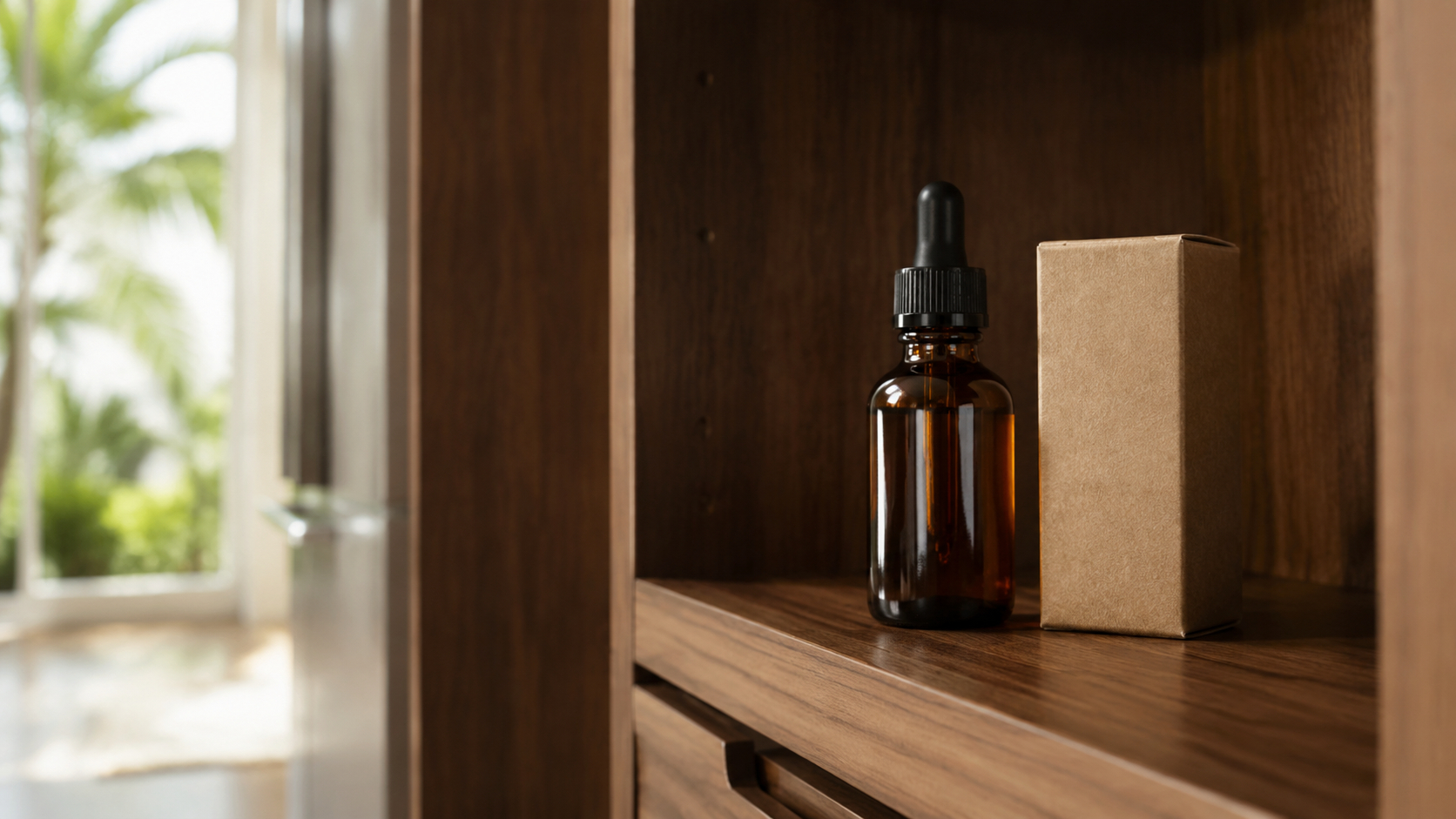
CBD oil storage · buyer guide
Does CBD Oil Need to Be Refrigerated? Storage, Shelf Life and Spoilage Signs
Most CBD oil does not need a refrigerator. The label, bottle ingredients and conditions inside your home matter more than a one-rule-fits-all answer. Here is how to choose a safe storage spot, handle a chilled bottle and recognize changes that deserve a closer look.
Featured answer
Most CBD oils can stay in their original, tightly closed bottle inside a cool, dark and dry cabinet. Refrigeration is usually optional unless the product label or manufacturer requires it. A refrigerator may make some carrier oils thick or cloudy. If you live in a hot home, check the label before chilling the bottle rather than guessing.
Original bottle in a shaded, climate-controlled cabinet.
Parked cars, sunny windows, stovetops and steamy bathrooms.
Cloudiness or thickness may be temporary after refrigeration.
Use the printed storage direction and date for your exact formula.
Quick storage decision table
| Your situation | Refrigerate? | Best next step |
|---|---|---|
| Air-conditioned home and one bottle in regular use | Usually no | Use a closed cabinet away from light and appliances. |
| Label says “refrigerate after opening” | Yes | Follow the label exactly and keep the cap tightly closed. |
| Home stays hot or loses air conditioning | Maybe | Ask the manufacturer whether that formula can be chilled. |
| Bottle was left in a hot car | Do not use the fridge as a reset | Check the label, exposure history and bottle; contact the maker if uncertain. |
| Seal is damaged, date is missing or identity is unclear | No | Replace it. Cold storage cannot restore an uncertain product. |
CBD oil storage sounds simple until a bottle turns cloudy in the refrigerator or spends an afternoon in a Miami car. Then the usual advice—“keep it cool”—does not feel specific enough. The important distinction is between a stable room-temperature product, a harmless temperature-related texture change and a bottle with an uncertain date, seal or storage history.
There is also no universal shelf-life number for every CBD tincture. CBD may be mixed with MCT, hemp-seed, olive, sunflower or another carrier oil. Flavorings and other ingredients have their own stability limits. Start with the printed instructions for the exact bottle, then use the practical checks below.
Related guide: If your bottle is fresh and you need help reading its concentration, use the CBD tincture dosage and dropper-math guide.
Article note: Prepared by the Mary Jane’s Bakery Co Editorial Team · Updated August 2026 · Reviewed against peer-reviewed cannabinoid-stability research, current public-health guidance and live product information · Not medically reviewed.
1. Does CBD oil need to be refrigerated?
No, not in most ordinary home situations. A tightly closed CBD oil bottle can often be kept at room temperature when the manufacturer allows it and the storage spot is cool, dark and dry. A bedroom drawer or an interior cabinet away from appliances is usually more practical than the refrigerator.
Refrigeration becomes a reasonable question when a label requires it, the bottle will be stored for an unusually long period, or the indoor environment regularly becomes hot. Even then, the manufacturer’s directions matter because formulas differ. Chilling may thicken the carrier oil and make the dropper harder to measure.
2. What changes CBD oil during storage?
Heat
Controlled studies support the basic warning that heat can accelerate CBD degradation. One study of commercial CBD e-liquids found greater loss after storage at 37°C than under cooler conditions. Another year-long stability study found that CBD dissolved in sunflower oil was more sensitive to temperature, humidity and oxygen than solid CBD powder. These laboratory formulas are not identical to every retail tincture, so they support the direction of the advice—not an exact “safe for X hours” countdown for your bottle.
Light
Light can also contribute to cannabinoid degradation. Dark or amber bottles reduce exposure, but protective glass does not make a sunny windowsill a good storage location. Keep the bottle inside its original packaging when practical.
Air and handling
Every opening introduces some air. Close the cap promptly. Do not leave the dropper resting on a counter, and avoid touching it to your mouth or another surface before returning it to the bottle. A clean routine protects the formula from avoidable contamination.
Carrier oil and added ingredients
The bottle is a complete formula, not CBD alone. The carrier oil, flavoring and any added ingredients can influence texture, smell and shelf life. That is why a research finding about pure CBD or one carrier oil should not override the printed directions for another product.
3. Where should you store CBD oil in a Miami home?
Miami heat makes location more important than a simple room-versus-fridge debate. A room may be air-conditioned while a car, delivery box, beach bag or sunny kitchen shelf becomes much hotter.
| Location | Concern | Better choice |
|---|---|---|
| Parked car or glove box | High heat and large temperature swings | Bring the bottle indoors. |
| Sunny windowsill | Light plus heat | Use a shaded interior drawer. |
| Cabinet beside the oven | Repeated warming | Choose a cabinet away from appliances. |
| Steamy bathroom | Humidity and temperature changes | Use a dry bedroom cabinet. |
| Locked interior cabinet | Low, if the room stays climate controlled | Usually the practical default. |
If a delivered bottle arrives unusually hot, leaking or with a compromised seal, photograph the package and contact the seller before using it. A refrigerator does not reverse unknown heat exposure or repair damaged packaging.
4. Is the oil cold and cloudy, or has it gone bad?
Cold temperatures can make some carrier oils look cloudy or feel thicker. That change may reverse after the tightly closed bottle returns to its labeled room-temperature conditions. Spoilage or degradation cannot be diagnosed from cloudiness alone.
| What you notice | What it may mean | What to do |
|---|---|---|
| Cloudy or thick only while cold | Temporary carrier-oil change | Keep it closed and let it return to the label’s storage temperature. |
| Texture returns to normal after warming naturally | Cold was likely the main cause | Confirm the date, seal and normal smell before use. |
| Rancid or sharply unfamiliar odor | Carrier oil or another ingredient may have deteriorated | Do not taste-test it. Replace it or contact the maker. |
| Unexpected particles, growth, leaking or damaged seal | Contamination or packaging failure is possible | Stop using it. |
| Date and storage history are unknown | Quality cannot be verified | Replacement is the safer choice. |
Do not microwave the bottle, place it in hot water or use direct heat to thin it. Gentle return to normal room conditions is different from heating a cannabinoid oil.
5. How long does CBD oil last?
Many consumer guides quote a broad one-to-two-year range, and older storage research found some cannabis extracts reasonably stable for one to two years in the dark at room temperature. That is context, not a replacement for the date on your bottle. Modern retail formulas vary, and the product’s label, lot details, ingredients and manufacturer guidance are the better decision points.
Write the opening date on the box or save a photo of the label and batch number. If you cannot find a date, contact the manufacturer. Do not create a new deadline from a generic article.
6. When should you replace CBD oil?
- The printed use-by or expiration date has passed and the manufacturer does not confirm continued use.
- The cap, dropper, tamper seal or bottle is cracked, loose or leaking.
- The product identity, batch or storage history cannot be confirmed.
- The odor has become rancid, sour, musty or sharply different.
- Unexpected particles, growth or persistent texture changes remain after the bottle returns to its labeled storage temperature.
- The product was exposed to serious heat and the manufacturer cannot confirm whether it remains suitable.
Do not transfer questionable oil into another container, dilute it, filter it or repurpose it as a topical. Those steps do not restore the original formula or verify its condition.
7. Seven practical CBD oil storage steps
- Read the label first. Look for storage wording and the printed date.
- Keep the original bottle and box. They preserve identification, batch information and directions.
- Choose a dark, dry interior space. Avoid windows, cars, bathrooms and appliance heat.
- Close the cap promptly. Limit unnecessary exposure to air.
- Keep the dropper clean. Do not touch it to the mouth or another surface.
- Lock it away. The CDC advises keeping cannabis products in a locked childproof container, out of the sight and reach of children and pets.
- Ask before refrigerating. If the formula or your home conditions create doubt, contact the manufacturer with the product and batch number.
8. What should you check before buying a CBD tincture?
A storage-friendly purchase starts with a readable label, intact packaging, an identifiable batch, a clear ingredient list and accessible product support. Check whether the bottle tells you where to store it and where to find the date. When available, review the certificate of analysis for product identity and batch details.
Mary Jane’s current CBD oil tincture collection includes full-spectrum strengths for buyers who want to compare concentration. Use the label on the selected bottle for storage directions. Miami shoppers can also review the Miami locations and store information. Storage questions should be answered before purchase, especially if the bottle will travel through heat.
Different formulas need different checks. For a separate format, see the guide to CBD cream expiration and storage signs.
9. Authoritative sources and what they support
| Source | Support used here |
|---|---|
| Scientific Reports: CBD e-liquid thermal and photo-stability | Heat and light can accelerate CBD loss under the tested conditions; the formula was e-liquid, not every tincture. |
| Pharmaceutics: CBD powder and sunflower-oil stability | CBD in oil was more sensitive than solid CBD to temperature, humidity and oxygen in the study. |
| Journal of Pharmacy and Pharmacology: cannabis preparation storage | Dark room-temperature storage and limited air exposure supported stability in the tested preparations. |
| CDC: Cannabis and poisoning | Locked childproof storage, out of children’s and pets’ sight and reach. |
| FDA: Cannabis-derived products including CBD | Regulatory context and the warning against unapproved disease-treatment claims. |
10. Frequently asked questions
Should CBD oil stay in the fridge after opening?
Not automatically. Follow the bottle. Many products can remain in a cool, dark cabinet after opening, while a specific formula may call for refrigeration.
What happens if CBD oil gets cold?
Some carrier oils become thick or cloudy. Keep the bottle closed and let it return naturally to the temperature permitted on its label. Do not use direct heat.
Can I freeze CBD oil?
Do not freeze it unless the manufacturer explicitly instructs you to do so. Freezing can change texture and makes routine measuring inconvenient.
Can I leave CBD oil in the car?
A parked car is a poor storage place because temperature can rise and swing quickly. Bring the bottle indoors. If it became very hot, contact the manufacturer instead of assuming refrigeration will reverse the exposure.
How do I know if CBD oil is expired?
Check the printed date, seal, batch information, storage history, odor and appearance. Persistent abnormal changes, a rancid smell, damage or an unknown history are reasons to stop and replace it.
Where is the best place to store CBD oil?
A locked, dry, shaded interior cabinet in a climate-controlled room is a practical default when the product label permits room-temperature storage.
A simple storage choice protects the bottle
For most buyers, the answer is not “put every CBD oil in the fridge.” It is “keep this exact bottle within its labeled conditions.” Use the original container, limit light and heat, close the cap, keep the dropper clean and record the opening date. In a Miami home, a locked interior cabinet is usually safer than a car, windowsill or humid bathroom.