

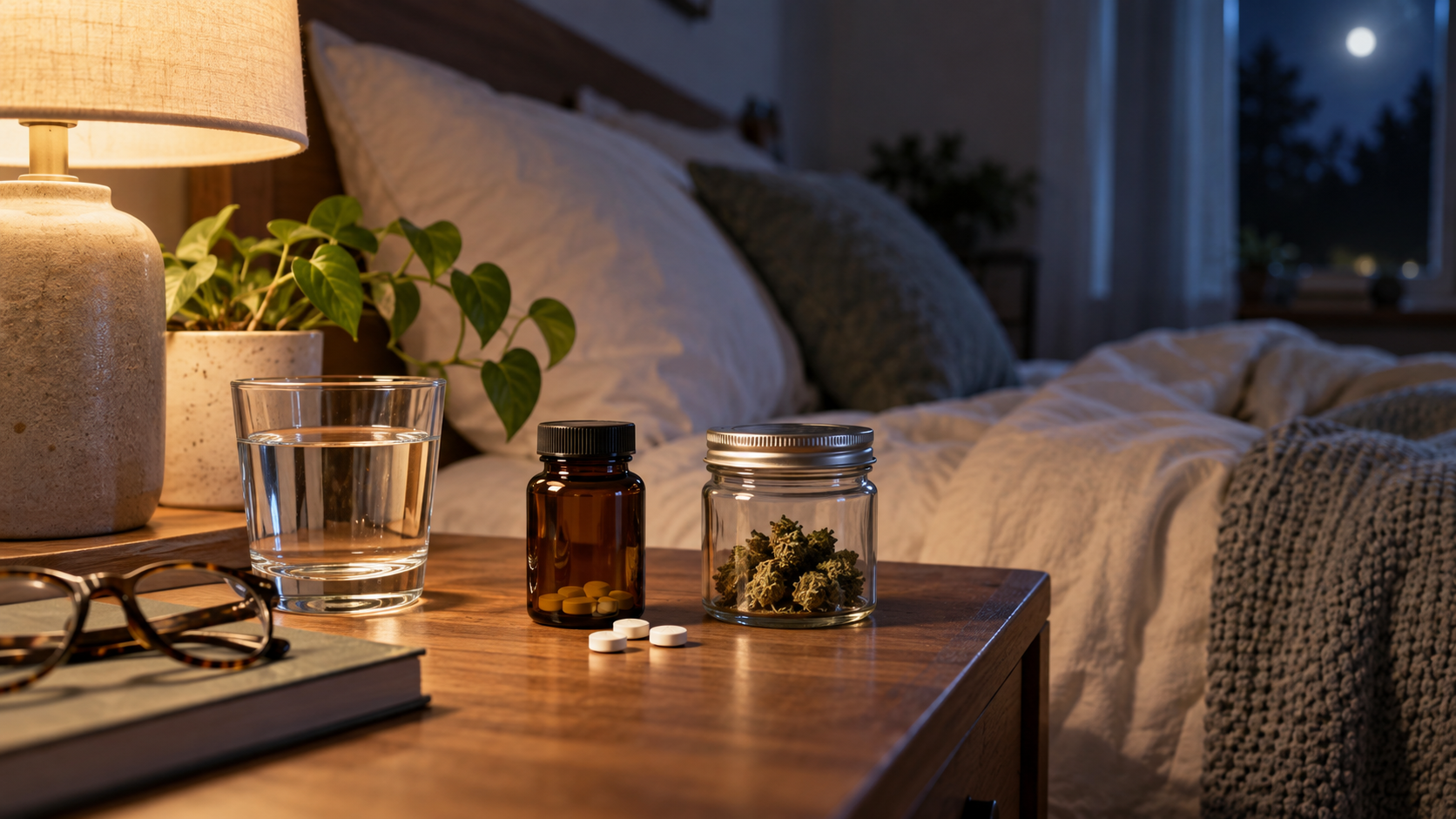
Cannabis and sleep safety
Melatonin and cannabis can both affect alertness. This evidence-led guide explains the potential interaction, differences between THC, CBD and CBN, timing limitations, next-day grogginess, and what to do if you have already taken both.
Featured answer
There is not enough evidence to say that melatonin and weed are predictably safe to combine. Both may contribute to sleepiness, dizziness, confusion and reduced coordination. No scientifically validated waiting period or dose guarantees safety. Ask a pharmacist or clinician before combining them, especially if you take other medicines or use alcohol.
The main human study involved only 10 active participants and a specific oral formulation.
Drowsiness, dizziness and impaired coordination are the clearest practical concerns.
A one-hour or two-hour gap does not guarantee that the effects will not overlap.
Alcohol and other sedating substances can make the situation less predictable.
What the evidence can and cannot tell us
| Evidence question | What is supported | Important limitation |
|---|---|---|
| Can both affect alertness? | Yes. Cannabis and melatonin can each be associated with drowsiness or dizziness. | Individual reactions vary considerably. |
| May their effects overlap? | Overlapping sleepiness and impairment are plausible. | The size of the added effect has not been established. |
| Is there direct human research? | A small Phase 1 report evaluated a specific oral THC-melatonin formulation. | It cannot establish general safety for ordinary cannabis consumers. |
| Is there a safe waiting period? | No evidence-based universal interval has been established. | Product format, amount, medicines and individual response all matter. |
People often ask about mixing melatonin and weed because both are associated with bedtime. That shared use does not prove that the combination improves sleep, and it does not make the outcome predictable.
The type of cannabis matters. THC is intoxicating, while CBD is not intoxicating in the same way. Edibles may begin later and remain active longer than inhaled cannabis. Melatonin supplements may also differ from their stated label amounts. These variables make a simple yes-or-no safety answer unreliable.
Related guide: Learn why weed can make some people feel sleepy and why feeling sedated does not necessarily mean sleep quality improved.
Article note: Prepared by the Mary Jane’s Bakery Co Editorial Team. Updated September 9, 2026. Research basis includes NIH, FDA, CDC, Poison Control, AASM guidance and peer-reviewed research. This article has not received medical review.
1. What happens when you mix melatonin and weed?
Melatonin is a hormone involved in the body’s sleep-wake timing. Over-the-counter supplements add to the melatonin naturally produced by the body. According to the National Center for Complementary and Integrative Health, short-term melatonin use appears safe for most people, but information about long-term safety remains limited. Melatonin can also interact with certain medicines.
THC can cause relaxation or sleepiness in some adults, but it may also produce dizziness, anxiety, confusion, altered perception and reduced coordination. Responses vary with the THC amount, product format, tolerance, timing and individual biology.
When melatonin and THC are used together, their effects may overlap. A person could become more tired, dizzy, unsteady or mentally foggy than expected. That does not mean everyone will experience a dangerous reaction, but it does mean the combination is not reliably predictable.
2. What did the small human study actually find?
A Phase 1 report evaluated a specific oral product containing 2.5 mg of THC and 1.5 mg of melatonin. The active group included 10 participants with Alzheimer disease. Researchers reported a higher THC peak concentration per dose than comparison data from other adults and suggested that melatonin might affect THC absorption or transport.
Why the result must be interpreted carefully
- The active group included only 10 participants.
- The participants had Alzheimer disease and do not represent every adult.
- The researchers used a specific oral formulation and specific doses.
- The pharmacokinetic comparison relied partly on previously published data.
- A change in THC concentration does not independently prove that the combination is safe or dangerous.
The study raises a legitimate question about whether melatonin can influence oral THC exposure. It does not prove that melatonin will make every cannabis high stronger, and it cannot predict what will happen with a dispensary edible, vape, flower product, tincture or homemade combination. Read the published Phase 1 report.
3. Do cannabis and melatonin reliably improve sleep?
Feeling sleepy is not the same as improving sleep quality. A person may fall asleep faster but still experience disrupted sleep, unusual waking or next-day fog.
A 2025 systematic review and meta-analysis found that cannabis administration did not consistently improve sleep duration, sleep latency, time awake after falling asleep, sleep efficiency or sleep stages. The findings do not mean that nobody feels sleepy after cannabis. They show that the broader evidence for predictable sleep improvement remains inconsistent.
Melatonin also has limitations. The American Academy of Sleep Medicine issued a weak recommendation against using melatonin for adult sleep-onset or sleep-maintenance insomnia. This guideline applies to chronic insomnia treatment. It does not mean that melatonin never influences sleepiness, but it does challenge the assumption that it is a reliable treatment for persistent insomnia.
| Claim | Evidence-based interpretation |
|---|---|
| “It made me sleepy, so it improved my sleep.” | Sedation, sleep onset, sleep stages and next-day function are different outcomes. |
| “Combining two sleep products should work better.” | Combining substances may increase unwanted effects without improving sleep quality. |
| “Persistent insomnia only needs a stronger product.” | Ongoing insomnia can have underlying medical, medication-related or behavioral causes that need proper assessment. |
4. Does the answer change for THC, CBD or CBN?
| Cannabinoid | Main distinction | Concern with melatonin |
|---|---|---|
| THC | Intoxicating and potentially impairing | Drowsiness, dizziness, confusion and coordination problems may overlap. |
| CBD | Not intoxicating like THC | CBD may still cause sleepiness and interact with medicines. |
| CBN | Frequently marketed for nighttime use | Direct human evidence remains limited, and marketing claims are not clinical proof. |
A randomized trial examined non-THC cannabinoid formulations used with melatonin. Low-dose CBD produced similar improvements to 5 mg of melatonin, but adding low doses of CBN or CBC did not produce additional improvement. Because the study did not evaluate intoxicating THC, it cannot establish the safety of mixing THC and melatonin.
The FDA also warns that CBD may affect how other medicines work, while other medicines may change the amount of CBD that can be used safely. Review the FDA guidance about cannabis and CBD and Mary Jane’s guide to CBD side effects and drug interactions.
For a closer look at nighttime cannabinoid marketing and research limitations, see our comparison of CBD and CBN sleep gummies.
5. Do edibles, drinks, tinctures, flower and vapes differ?
The main safety concern may be similar, but product format changes how quickly cannabis effects begin and how long they may remain noticeable.
| Format | Timing consideration | Common mistake |
|---|---|---|
| THC edible or gummy | Effects can begin later and last longer than expected. | Taking melatonin or more THC before the edible has fully developed. |
| THC drink | Onset and duration vary by formulation. | Assuming the entire container equals one serving. |
| Tincture | Timing changes depending on whether it is held under the tongue or swallowed. | Misreading the dropper or concentration per milliliter. |
| Flower or vape | Effects may begin faster than with swallowed cannabis. | Assuming faster onset means impairment will end quickly. |
Read how long a weed high may last by product format. General duration ranges should not be treated as personal clearance to take another substance, drive or work.
6. How long after weed can you take melatonin?
No evidence-based waiting period guarantees that combining cannabis and melatonin will be safe. Advice to wait one or two hours is not a universal safety rule.
The amount of overlap can depend on:
- The amount and type of THC consumed
- Whether the cannabis was inhaled or swallowed
- Whether an edible is still developing
- The melatonin amount and product accuracy
- Alcohol, medicines and other supplements
- Age, tolerance, metabolism and health conditions
- How much time is available for uninterrupted sleep
Melatonin labels add another uncertainty
A JAMA analysis tested 25 melatonin gummy products. Twenty-two contained melatonin amounts that differed from their labels, ranging from 74% to 347% of the declared amount. Five products also declared CBD as an ingredient. This small product sample does not represent every melatonin supplement, but it shows why the printed dose may not always match the amount consumed.
7. Who should talk with a clinician or pharmacist first?
- People taking prescription sleep medicines or benzodiazepines
- People taking opioids, sedating antihistamines or muscle relaxants
- Anyone using alcohol, kava or another substance that may cause drowsiness
- Older adults or people with a history of falls, fainting or confusion
- People with liver disease, seizure disorders, sleep apnea or serious heart conditions
- Anyone pregnant, planning pregnancy or breastfeeding
- Anyone experiencing persistent or unexplained insomnia
- People who must drive, supervise children, use machinery or make safety-critical decisions
Show the pharmacist or clinician the exact cannabis label, cannabinoid amount, melatonin label, medication list and usual timing. Evaluating the complete combination is more useful than checking one pair of ingredients in isolation.
8. What should you do if you already took melatonin and weed?
Do not panic, but do not take more substances while waiting to see what happens. The appropriate response depends on the symptoms, amounts, product format and other substances involved.
| Situation | Safer response |
|---|---|
| Mild sleepiness but otherwise responsive | Stop consuming more substances, remain somewhere safe and do not drive. |
| Edible effects are still increasing | Do not redose. Delayed effects can make accidental overconsumption more likely. |
| Alcohol or sedating medicine was also used | Contact a pharmacist, clinician or Poison Control for case-specific guidance. |
| Severe confusion, repeated vomiting, chest pain or seizure | Call emergency services. |
| Abnormal breathing, loss of consciousness or inability to awaken | Call 911 immediately. |
In the United States, Poison Control is available at 1-800-222-1222. Visit Poison Control’s cannabis edible guidance for additional exposure information.
9. Can melatonin and weed make you groggy the next day?
Next-day tiredness, dizziness or mental fog is possible. The likelihood may increase when a high amount of THC is consumed, an edible develops late, melatonin is taken late, sleep time is short, or alcohol and other sedating substances are involved.
- Do not drive if you feel foggy, dizzy, unsteady, unusually sleepy or slow to react.
- Do not assume coffee, food or a shower has removed impairment.
- Do not use a general duration chart as proof that you are safe to drive.
- Seek medical advice when symptoms are severe, unusual or persistent.
The CDC advises that the safest option for someone who intends to drive is not to use cannabis. Read the CDC cannabis and driving guidance and our guide to weed hangovers and next-day fog.
10. What should Miami adults check on product labels?
This article does not recommend combining cannabis with melatonin. Adults comparing legal products in Miami should still examine the complete label rather than relying on a product name such as “night,” “sleep” or “calm.”
Check THC, CBD, CBN and other cannabinoids per serving.
Compare the serving amount with the total amount in the container.
Look for melatonin, herbs or other ingredients associated with drowsiness.
Check the batch number, current certificate of analysis and storage instructions.
The FDA generally does not approve dietary supplements for safety and effectiveness before they reach consumers. Review the FDA dietary supplement overview before treating a melatonin label as a safety guarantee.
Mary Jane’s Bakery Co customers can ask to review available cannabinoid labels and batch information before purchasing. Product availability does not establish that combining a product with melatonin is medically appropriate.
11. Authoritative sources
| Source | What it supports |
|---|---|
| NCCIH: Melatonin | Melatonin safety limitations and interaction awareness |
| Phase 1 THC-melatonin report | Direct oral combination research and study limitations |
| Cannabis and sleep systematic review | Inconsistent effects on sleep outcomes and architecture |
| AASM insomnia guideline | Melatonin and chronic adult insomnia guidance |
| Cannabinoid and melatonin randomized trial | CBD, CBN, CBC and melatonin sleep findings |
| JAMA melatonin gummy analysis | Label variation among the tested melatonin gummies |
| FDA: Cannabis and CBD | CBD safety and medicine-interaction cautions |
| CDC: Cannabis and driving | Impaired-driving prevention |
| Poison Control | Urgent exposure guidance and contact information |
12. Frequently asked questions
Can you take melatonin after smoking weed?
No validated waiting period makes the combination universally safe. If cannabis is still affecting you, adding melatonin may increase overlapping drowsiness or reduced coordination. Ask a pharmacist or clinician for individual guidance.
Can you take melatonin after a THC edible?
An edible may begin later and remain active longer than expected. Taking melatonin before the edible has fully developed could increase overlapping effects. Do not redose because the edible seems slow.
Can CBD and melatonin be taken together?
CBD is not intoxicating like THC, but it can still cause sleepiness and affect medicines. A pharmacist or clinician should consider the CBD amount, melatonin amount and complete medication list.
Does melatonin make a THC high stronger?
A small Phase 1 report found altered THC pharmacokinetics with a specific oral THC-melatonin formulation. It does not prove that melatonin makes every cannabis experience stronger.
How long should you wait between weed and melatonin?
There is no evidence-based universal interval. Cannabis format, THC amount, melatonin amount, other substances, medicines and individual response all affect how long the effects may overlap.
Can melatonin and weed make you groggy the next morning?
Yes. Next-day fog or sleepiness is possible, particularly after late use, higher THC exposure, delayed edible effects, short sleep or combining other sedating substances.
What should you avoid mixing with melatonin and THC?
Avoid adding alcohol, prescription sleep medicine, sedating antihistamines, opioids or other substances that affect alertness unless a qualified clinician has reviewed the combination.
When should you get emergency help?
Call 911 for abnormal breathing, seizure, chest pain, loss of consciousness, severe confusion or a person who cannot be awakened. Contact Poison Control for case-specific exposure guidance.
Melatonin and weed: the responsible conclusion
There is not enough direct evidence to call melatonin and weed a predictably safe combination. The clearest practical concern is overlapping sleepiness, dizziness, confusion, impaired coordination and next-day fog.
A small human report also raises a question about whether melatonin can alter oral THC exposure. However, its findings cannot be generalized to every person, dose or cannabis format. Evidence involving CBD or CBN should not be used to declare a THC combination safe.
Do not rely on a fixed waiting period, a low dose or the absence of a listed interaction as proof of safety. A pharmacist or clinician can assess the exact products, medicines, health conditions and responsibilities that determine the individual risk.