

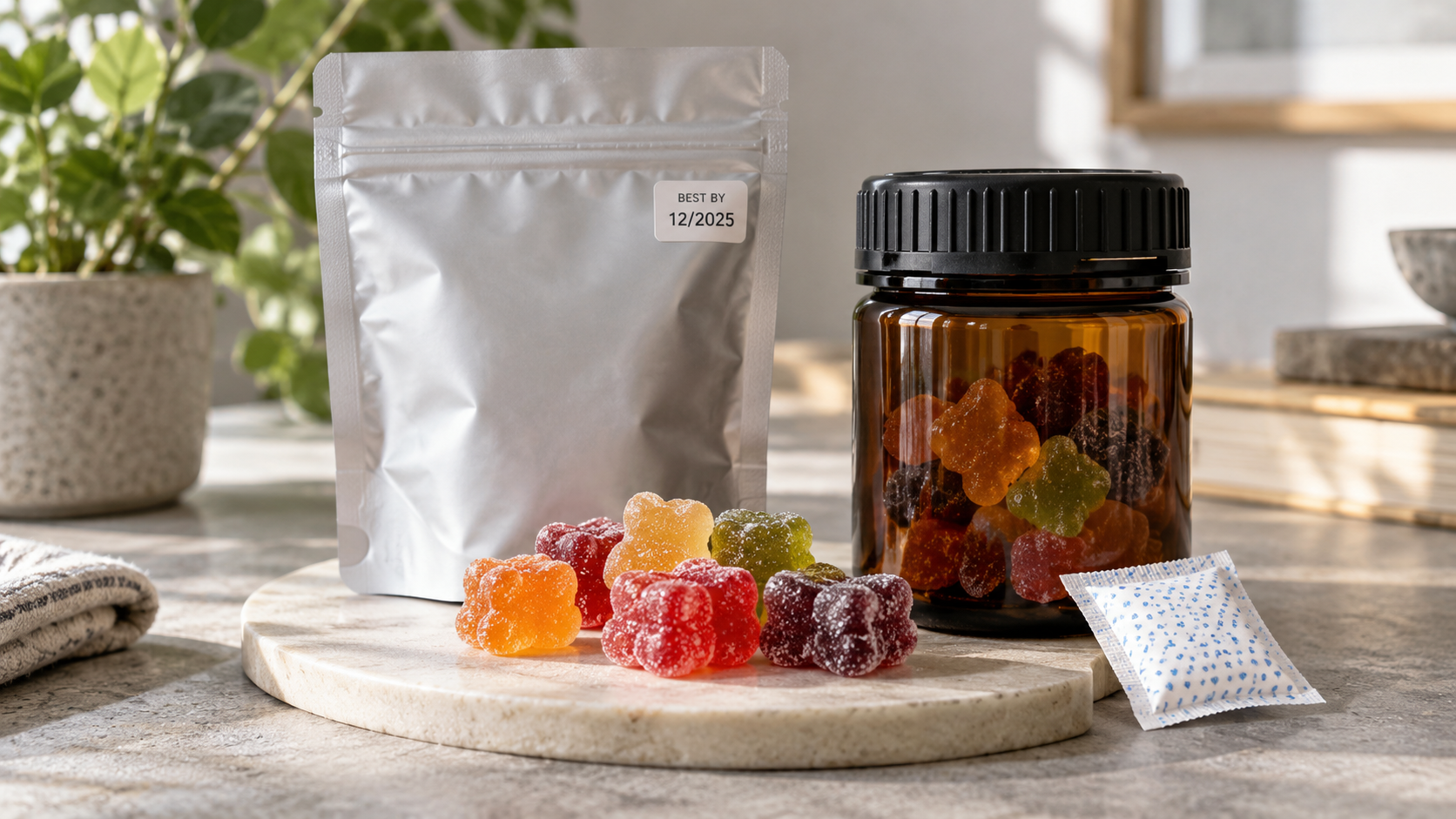
Edible storage & expiration | Adults 21+ | Updated October 17, 2026
Do THC gummies expire? Yes. A gummy's ingredients can age or spoil, and its cannabinoid content may change during storage. There is no universal safe shelf life for every THC gummy. Check the finished product's date, storage instructions, seal and handling history. A gummy that looks normal is not proof that it is safe—or that the listed THC amount remains accurate.
Found an old pouch in a drawer? Or discovered your gummies stuck together after a hot day in Miami? The important question is not only “How old are these?” It is “What can I actually verify about this specific product?” This guide walks through that decision, including a real historical laboratory report linked from Mary Jane's Bakery Co.
How Long Do THC Gummies Last? The Useful Answer
Use the date on the package, not a universal six-month or one-year rule. Commercial gummies differ in gelatin or pectin base, sugars, acidity, moisture, preservatives, cannabinoid formulation and packaging. Those differences—and the conditions in which the finished product was actually stored—affect its shelf life. A fresh, homemade gummy also should not be treated as equivalent to a commercially sealed shelf-stable product.
You may find online guides that suggest gummies last six to twelve months or even longer. Some technical literature discusses approximately one-to-two-year stability for certain chewable gel formulations under controlled conditions. Neither statement supplies a tested expiration period for the unidentified THC gummy in your hand. A manufacturer needs product-specific evidence to justify its claimed storage window. Research on chewable gels addresses moisture and microbiological behavior; cannabis-edibles stability testing guidance explains the additional testing required for infused products.
| Your situation | What you can know | Practical next step |
|---|---|---|
| Unopened and within date | Printed date, legible potency information, original seal and intended storage conditions | Follow the label; a seal alone does not guarantee safety if storage was improper. |
| Opened but resealed | Date opened, handling, after-opening instructions and possible humidity exposure | Follow any “use after opening” directions; avoid mixing batches or removing the original label. |
| Past the printed date | Whether the date says “best by,” “use by” or “expires,” plus storage history | Do not assume a grace period; contact the manufacturer when in doubt, or discard. |
| Melted in a car or exposed to humidity | Visible changes and possibly the length of exposure—but not microbial safety or remaining THC | If the handling history or serving boundaries are uncertain, discard rather than guess. |
| Homemade, unmarked, or unidentified | Often no validated shelf-life testing, reliable lot information or verified milligrams | Use trustworthy preparation-specific food-safety guidance; when identity or history is uncertain, do not consume. |
What about “best by” versus “expiration”? The FDA explains that “Best if Used By” generally describes peak flavor and quality for conventional packaged foods, not a universal food-safety cutoff. Date terms are not used uniformly. That distinction is useful when reading a gummy label, but it does not establish that a THC edible is safe past its date. Respect the actual manufacturer's instructions, especially a product-specific use-by or refrigeration requirement.
Three Different Changes: Food Safety, THC Potency and Freshness
“Expired” can describe three separate problems. Treating them as one is why a gummy that merely looks dry can be mistakenly called safe—and why a gummy that melted is sometimes mistakenly assumed to have lost all its THC.
Food safety
Contamination, spoilage and ingredient-specific hazards. Mold, damaged packaging and unknown handling are reasons to avoid consumption. Appearance alone cannot rule out every hazard.
THC potency
Measured cannabinoid content may change during storage. Looking, smelling or tasting cannot confirm the milligrams remaining in an old gummy.
Product quality
Flavor, texture, coating and shape can change as a gummy gains or loses moisture or warms up. A quality change does not automatically measure safety or strength.
Why water activity matters more than a gummy's appearance
Manufacturers study water activity—water available for microbial growth—alongside acidity, manufacturing conditions and packaging. Two gummies can feel equally firm yet behave differently microbiologically. Conversely, a sticky surface might reflect moisture pickup or a coating change, but it cannot identify the organisms, if any, present. Technical research on gummy-like chewable gels explains why water activity, pH and packaging are important stability variables. That research is not a safety certificate for cannabis edibles.
Expired or Questionable Gummies: Discard, Verify or Follow the Label?
Use this decision path instead of a sniff test or an arbitrary number of days after a printed date.
1. Discard
Visible mold, unusual liquid, obvious contamination, damaged or leaking packaging, an unidentifiable product, or significant unknown exposure to heat or moisture. Never taste-test a suspect gummy.
2. Verify
Date terminology or storage history is unclear, but the original manufacturer, lot and package remain identifiable. Ask for guidance based on that product. If doubt remains, discard.
3. Follow the label
The original package is intact, in date and stored as instructed. Continue the specified handling and locked storage practices. This is a practical check, not a guarantee of safety.
Does a white coating mean mold?
Not always. Gummies may be intentionally sugar-coated, and moisture changes can produce a different surface texture. But unexpectedly fuzzy growth, off odors, visible spots or unfamiliar residues should not be diagnosed from appearance alone. If you cannot confidently establish what a change is, do not eat the gummy.
Can you eat THC gummies that melted together?
Several gummies fused into one piece no longer have reliably visible individual serving boundaries. Re-chilling can firm up the block, but it does not restore the original portions. Do not divide a fused block by eye or assume its THC is distributed evenly. For the separate question of what Miami heat does to edibles and related products, read our Miami gummy-melting and storage guide.
Do not try to test potency by eating more. Cannabis edibles can take time to produce effects and can be unpredictable. The CDC notes that intoxicating effects may begin about 30 minutes to two hours after ingestion. For a separate explanation of delayed effects, see why THC gummies may not seem to kick in.
A Real Mary Jane Gummy Lab Report: What It Proves—and What It Cannot
A certificate of analysis (COA) can be more useful than a vague “lab tested” badge—but only when you read what was tested, when, and for which sample. A cannabinoid test conducted once is not automatically a microbial test, a product-label accuracy check or a study proving shelf life.
Historical example, not current inventory verification
Mary Jane's Hybrid Canna Gummies product page links to an ACT Laboratories report (two-page PDF) for a submitted Hybrid CBD gummy sample analyzed on September 23, 2024 (sample ID SFLMJB0917-IGUM-0000596). It reports cannabinoid results including CBD and Delta-9 THC for a report-defined unit. That unit cannot safely be assumed to equal one individual gummy, and those 2024 measurements cannot establish any product's potency in 2026.
| Test area | Status in report | What this means for an expiration question |
|---|---|---|
| Cannabinoid analysis | Tested | Identifies measured cannabinoids in the submitted sample at its test date; not today's product strength. |
| Microbials | Not tested | This document does not report a microbial screening result. |
| Water activity and moisture | Not tested | It does not document moisture-related shelf stability or water activity for this sample. |
| Heavy metals and pesticides | Not tested | This report cannot serve as proof that those panels were completed. |
| Long-term shelf-life study | Not shown | No repeated stability measurements over an established storage period appear in this report. |
What a stronger product-specific claim would require: correctly matched package and batch numbers, clearly defined serving units, a reliable manufacturer's date and storage instructions, plus appropriate stability and safety documentation for that formulation. A useful stability study takes measurements over time under specified conditions; the lab-testing process may include cannabinoid concentration, water activity, microbiology and package performance. Labstat's technical explanation outlines those distinctions.
Why is that important here? The linked product listing currently uses both CBD and THC descriptions that require reconciliation against the physical label and current batch record. This guide therefore does not present the historic report's milligrams as a present-day dose or use it to recommend a particular product. For general cannabinoid-document navigation, see Mary Jane's COA information page.
Do THC Gummies Get Weaker—or Stronger—with Age?
Cannabinoids can change with storage, but the direction and rate of change for a particular finished edible require product-specific measurements. Exposure to light, oxygen, heat and the surrounding gummy formulation can matter. A 1976 study by Fairbairn and colleagues examined cannabinoid solutions, herbal cannabis and resin under different storage conditions. It is useful background on how cannabis constituents behave; it did not test finished THC gummies and cannot establish a reliable percentage of THC lost per year for them.
Similarly, “my gummies are a year old” is not enough to determine whether they contain the original labeled milligrams. A change in flavor is not a potency assay. Melting does not mean THC is absent. And any common online calculation that turns a plant-material degradation figure into a precise gummy dose should be treated cautiously.
The safest takeaway is to rely on the verified package information and avoid attempting to compensate for presumed aging by consuming more. If potency, manufacturer identity or handling history is uncertain, do not guess.
How to Store THC Gummies in Miami Heat and Humidity
Miami adds a familiar problem: indoor storage may be fine, but a short transfer through a car, beach bag or sunny window can expose gummies to very different conditions. You do not need to guess a universal “melting temperature” to make good storage choices.
- Keep the original labeled container. Preserve the date, lot number, ingredients, serving information, warning text and manufacturer contact. Do not transfer gummies into a regular candy bag or unmarked container.
- Follow the specific temperature directions. For products labeled as shelf stable, a cool, dry, dark indoor place is preferable to sun and heat. If the maker specifies refrigeration, follow that instruction.
- Close the package properly after opening. Avoid humid bathrooms, wet hands and repeated exposure to warm air. Record the opening date when the brand gives an after-opening time limit.
- Avoid hot cars and direct sunlight. A dashboard, glove compartment, trunk or bag left on the beach is not controlled storage. A gummy that melts together may be impossible to portion reliably.
- Keep it locked away from children and pets. THC gummies can resemble ordinary candy. The CDC recommends a locked, childproof container out of sight and reach.
Should THC gummies go in the refrigerator or freezer?
Only when the package requires it or the manufacturer confirms it suits that formulation. Some products are meant for shelf storage, while others contain ingredients that need refrigeration. Freezing can change texture, and thawing can introduce condensation. Neither refrigeration nor freezing reverses spoilage, confirms potency or creates an unlimited shelf life.
Miami example: the pouch that sat in a parked car
Imagine bringing a labeled pouch on an afternoon errand in Wynwood, then finding that the contents have fused into one mass. Cooling the pouch may restore some firmness, but it does not establish microbial safety, restore separate portions or tell you the current THC concentration. When heat exposure is substantial or details are unknown, replacing the product is more prudent than trying to “fix” it.
Before You Keep or Replace Gummies, Check These Five Label Details
- Product identity: exact brand, variant and intended ingredients—not just the word “gummies.”
- Date wording: best by, expiration/use by, and any after-opening period.
- Storage instructions: especially any refrigeration requirement or heat warnings.
- Units and servings: milligrams per individual serving versus milligrams per package; do not infer one from the other.
- Batch identification: lot number and a matching COA with a clear date and actual panel coverage.
Labels and laboratory reports should agree on the product identity and measured unit. If the marketing page, packaging and batch report conflict, ask the seller or manufacturer to clarify before treating any number as trustworthy.
Need to Review a Product Label Before Replacing Gummies?
Mary Jane's Bakery Co. customers can review the site's current shop catalog and product documentation, or contact the store to request clarification about an identifiable item. Verify the exact listing, test scope, availability and applicable local restrictions rather than assuming all gummies share the same shelf-life or dosing information.
Frequently Asked Questions
Can you eat THC gummies after the expiration date?
No universal post-date period can be called safe. The date's wording, product formulation, packaging and storage history all matter. Ask the manufacturer if the information is complete; when the condition is uncertain, discard rather than taste-test.
Are two-year-old THC gummies still good?
Age alone cannot establish safety or potency. Unless the product has a manufacturer-supported dating window that covers it and an appropriate known storage history, do not assume a two-year-old gummy is suitable to consume.
How long do THC gummies last after opening?
There is no one-size-fits-all number. Follow brand-specific after-opening guidance, reseal the original package and watch for compromised storage or handling. “Still soft” is not proof of safety.
Do unopened THC gummies expire?
Yes. Original packaging may reduce exposure to air and moisture, but it cannot stop every chemical or quality change or protect an edible from improper storage.
Does a THC gummy with white spots have mold?
The surface could be sugar coating, crystallization or contamination. You cannot reliably identify a suspicious coating from a description alone. Do not consume it when you cannot confirm what changed.
Can you freeze THC gummies to extend their life?
Ask the manufacturer. Freezing is not appropriate for every formula, can alter texture and may add moisture as a package thaws. It does not make a previously unsafe gummy safe.
Do CBD gummies expire too?
Yes. Comparable CBD gummies still contain food ingredients whose quality and safety depend on formulation and handling. Cannabinoid composition can differ, so use the individual product's instructions and properly matched testing.
How long do THC gummy effects last? Is that the same as shelf life?
No. Shelf life concerns the stored product; duration concerns how long effects may be felt after ingestion. Edible effects can take time to begin and last longer than expected. See our separate onset and duration guide for that question.
What if a child or pet ate a THC gummy?
For a child, call Poison Control at 1-800-222-1222 right away—do not wait for symptoms. Call 911 for an emergency. For a pet, contact a veterinarian or animal poison-control service promptly. The FDA and CDC outline risks from accidental edible ingestion.
Sources and Editorial Transparency
This guide distinguishes general food-label advice, gummy-formulation science, cannabinoid research and one historical product report. None of these sources establishes a universal safe expiration date for THC gummies.
- U.S. FDA — Food dating and food safety (general packaged-food date terminology).
- U.S. CDC — Cannabis and poisoning (edibles, delayed effects, storage and poison control).
- Cundell, 2024 — Microbiological attributes of chewable gels (water activity, pH and food-like gummy matrix behavior; not THC-gummy testing).
- Labstat — Ensuring shelf stability in cannabis edibles (what stability protocols may measure; industry laboratory guidance).
- Fairbairn et al., 1976 — Cannabis storage stability (solutions, herb and resin; not finished gummies).
- ACT Laboratories — Historical Hybrid CBD gummy COA, analyzed September 23, 2024 (scope and results for the submitted sample only).
- U.S. FDA — Accidental ingestion of THC food products (child-safety response).
Editorial scope: Source-checked October 17, 2026. This page does not claim new laboratory testing, a current-batch verification or review by an unnamed medical professional. It is educational content, not personalized medical, food-safety or legal advice. THC can be intoxicating. Do not drive while impaired; keep products secured from children and pets. Follow local laws and product-specific instructions.