

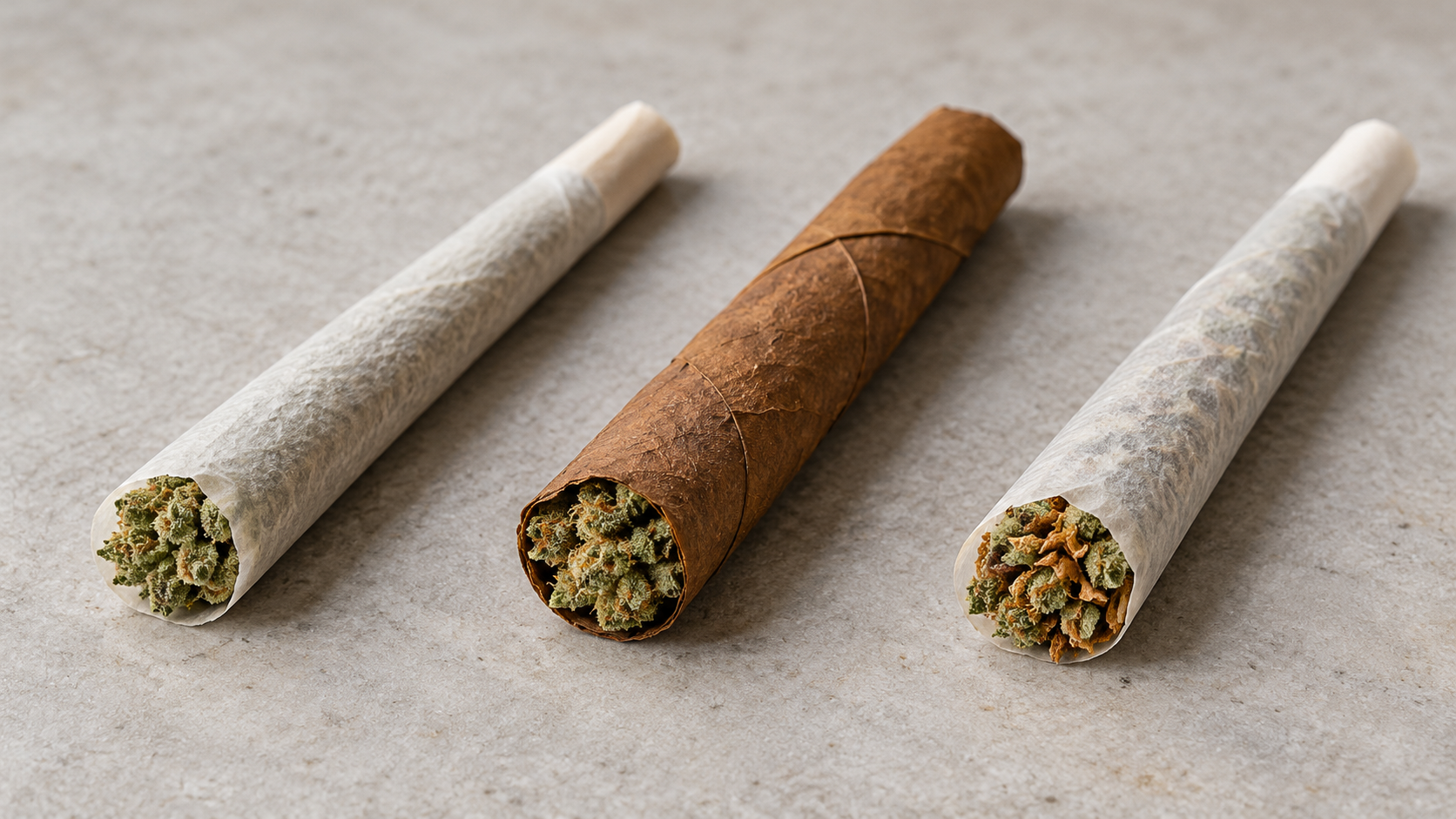
Cannabis format comparison · Adults 21+
Compare the wrapper, filling and tobacco content, then see what research and a real product listing can tell you.
Featured answer
A joint usually contains cannabis flower in thin rolling paper. A traditional blunt uses a tobacco or cigar wrapper. A spliff usually mixes cannabis and tobacco inside rolling paper. Modern blunt-style products may use non-tobacco wraps, so check the wrapper and filling separately. These are common U.S. distinctions; regional names can differ.
Color cannot confirm tobacco
Read the wrapper material and the filling ingredients.
Larger does not define strength
Compare actual contents and cannabinoid information.
Hemp is not a full specification
Check what the term describes: paper, wrap or flower.
Pre-roll describes preparation
It does not identify every ingredient in the finished product.
| Format | Usual filling | Wrapper | Where tobacco may appear |
|---|---|---|---|
| Joint | Cannabis flower | Thin rolling paper | Not intentionally added in this U.S. definition; confirm the item. |
| Traditional blunt | Cannabis flower | Tobacco leaf or cigar wrapper | In the wrapper, even after loose cigar filler is removed. |
| Spliff | Cannabis mixed with tobacco | Usually rolling paper | In the filling; there is no fixed mixing ratio. |
| Non-tobacco blunt-style roll | Check the actual ingredients | A labeled non-tobacco wrap | A non-tobacco wrapper alone does not verify the filling. |
If you are choosing between these formats, the most useful distinction is the location of the tobacco. It may be mixed into the flower, present in the wrapper, or absent from both. The product name is only a starting point.
You can use the table for the basic definitions. The sections below address the less obvious questions: whether a blunt must contain tobacco, whether it is automatically stronger, and how to check a ready-made product.
Related guide: For the broader buying checklist, see what a pre-roll is.
Prepared for the Mary Jane’s Bakery Co Editorial Team · Research checked October 23, 2026 · Sources include published study abstracts, public-health guidance, the live product listing and its linked lab report. This is editorial research, not a medical review or hands-on product test.
1. Look at the wrapper and filling separately
Joint
OUTSIDE · ROLLING PAPER
INSIDE
CANNABIS FLOWER
No tobacco added in the definition used here.
Traditional blunt
OUTSIDE · TOBACCO / CIGAR WRAPPER
INSIDE
CANNABIS FLOWER
The outside layer introduces tobacco.
Spliff
OUTSIDE · ROLLING PAPER
INSIDE
CANNABIS + TOBACCO
The mixture inside introduces tobacco.
This visual separates construction from appearance. A paper can be brown, and a wrap can be made from a non-tobacco plant. Ask what each layer contains instead of identifying it by color.
Regional language: FRANK’s U.K. guide uses “spliff” and “joint” for some tobacco mixtures and also describes weed-only spliffs. If someone uses a different name, clarify the ingredients rather than assuming the U.S. definition applies.
2. What the research says about tobacco and nicotine
Does a blunt contain nicotine after the loose tobacco is removed?
It can. Peters and colleagues’ 2016 product study found measurable nicotine in the wrappers of all five cigar products tested. That supports checking the wrapper even when the filling is only cannabis. It measured nicotine content in selected wrappers, not a universal amount absorbed by a person.
Can a blunt be tobacco-free?
Yes. A 2023 study on blunt classification distinguishes tobacco-based products from tobacco-free blunt wraps and explains why treating every blunt as tobacco–cannabis co-use can be inaccurate. The research concerned adolescents; it does not establish how common each format is among adult shoppers.
Can a tobacco-free wrap still contain a tobacco mixture?
Yes. Research published online in July 2025 documented tobacco being put inside tobacco-free wraps in an adolescent sample. It appeared in the January 2026 journal issue. This supports a second ingredient question—what is in the filling—rather than any estimate of adult use.
None of these distinctions makes smoke harmless. CDC’s lung-health guidance states that smoking cannabis can damage lung tissue regardless of the smoking method. Nicotine exposure and cannabis-smoke exposure are separate concerns.
3. Do blunts hit harder than joints?
A blunt is not automatically stronger than a joint. Format names do not specify cannabinoid concentration, flower weight, added concentrates or individual response. CDC’s overview identifies THC concentration, other substances, prior experience and personal factors among the reasons effects vary.
What one controlled study found
In a 2009 study of 24 participants, joints produced higher plasma THC and reported intoxication; blunts produced higher carbon monoxide after controlled three-puff sessions.
Limit: These findings concern specific older products and THC concentrations. They do not predict every modern joint, blunt-style product or infused pre-roll.
Compare the actual product label and matching cannabinoid report. Treat “infused” as an additional ingredient disclosure, and keep package content separate from the amount a person absorbs. Neither a larger roll nor a harsher sensation is a reliable dose measurement.
4. Compare size, flavor, burn and convenience
| Comparison | Useful distinction | What to check |
|---|---|---|
| Size | Joints and blunt-style rolls come in different sizes. | Net weight and piece count; “king-size” is not a personal dose. |
| Flavor | Tobacco, added flavoring and the flower itself are separate ingredients. | Which components are flavored; preference is subjective. |
| Burn | The format name does not guarantee a number of minutes. | Paper/wrap, product size and preparation; avoid fixed-time promises. |
| Preparation | A product may be hand-rolled or prepared before sale. | Whether it is an empty cone, filled pre-roll or another construction. |
A thin paper joint avoids the tobacco wrapper of a traditional blunt, but it may still use flavored paper or contain added cannabis ingredients. “Hemp” can describe the paper, wrap or flower; the rest of the label matters.
A pre-roll is prepared before purchase. A cone describes the tapered shell or shape. Neither term establishes all the ingredients. For preparation instructions, use the joint-rolling guide; for uneven burning, use the joint-canoeing guide.
5. Check three things before choosing a pre-roll
- Wrapper: What is it made from, and does its disclosure identify tobacco or nicotine?
- Filling: Is it flower alone, a tobacco mixture, or flower with added concentrate?
- Evidence: Does the current package identify the product and batch, and does the relevant report match?
A useful question to send a seller is: “Please confirm the wrapper material, whether tobacco or nicotine is added anywhere, and which current package and batch report support that answer.” Our COA reading guide explains the report check. A cannabinoid-only panel does not establish a nicotine result.
Apply the checks to three examples
These are hypothetical label-reading examples, not Mary Jane’s product specifications.
- Flower + paper; no tobacco added: consistent with a joint under this guide’s definition, if both disclosures match.
- Flower + cigar-leaf wrapper: a traditional blunt, with tobacco in the outer layer.
- Hemp wrap; filling not disclosed: incomplete information. Ask about the filling before treating the finished roll as tobacco-free.
6. A practical example from Mary Jane’s Miami offering
Mary Jane’s current CBD Pre Roll listing provides a real example of why product-format checks matter. The page calls it a king-sized pre-roll and describes whole hemp flower. Those are seller-provided descriptions, not an independent inspection of a current package.
What the listing does—and does not—answer
- Visible on the page: the CBD Pre Roll name, king-size description and whole-hemp-flower description.
- Still to confirm for the item being ordered: exact wrapper material, finished-product tobacco/nicotine disclosures and a report matching the current package.
What the linked lab report can verify
The listing links to a CBD Hemp Flower Preroll COA (PDF) identifying ACT Laboratories Florida, retail batch 1 and a May 30, 2024 completion date. It reports cannabinoid testing and does not list a nicotine test. That document does not establish the wrapper material or nicotine status of today’s finished roll. Match the report to the actual package before using it as product evidence.
Adults comparing the current offering can review Mary Jane’s CBD hemp flower category or ask the team for those package details. For a local visit, use the Miami location page. Confirm availability and destination restrictions for the exact item before ordering.
7. Sources and the limits of this guide
| Source | What it supports and limits |
|---|---|
| Cooper and Haney, 2009: controlled joint–blunt comparison | Controlled joint–blunt results; small older study, not a universal stronger-format rule. |
| Morean et al., 2023: classifying tobacco-free blunts | Why non-tobacco blunt wraps change classification; adolescent sample. |
| Morean et al.: tobacco added to tobacco-free wraps | Tobacco can be added inside a non-tobacco wrap; online 2025, journal issue 2026; adolescent sample. |
| Peters et al., 2016: nicotine in cigar wrappers | Nicotine measured in selected wrappers; content is not an absorbed-dose estimate. |
| CDC: cannabis and lung health | Cannabis-smoke risks; does not identify a harmless smoked format. |
| CDC: factors affecting cannabis effects | Factors affecting effects; format name is not a potency measurement. |
| FRANK: cannabis terminology in the U.K. | U.K. usage illustrates regional naming differences. |
The study discussion is based on published abstracts checked against bibliographic records. The linked retail COA was checked for its date and testing scope. No current product was tested, no medical reviewer signed off on this article, and no lab report was used to certify a particular wrapper or finished roll. The visual illustrates definitions; it is not a product-identification test.
8. Frequently asked questions
Is a blunt a cigar?
A traditional cannabis blunt uses a cigar shell or tobacco wrapper with cannabis inside. Modern products called blunt-style may use non-tobacco wraps. Check the actual construction.
Does “hemp wrap” mean the whole roll is THC-free?
No. A wrapper description does not establish the cannabinoid content of the filling. Read the finished product’s ingredients and matching cannabinoid information.
Is a CBD pre-roll automatically tobacco-free?
The CBD name describes cannabinoid positioning, not a full wrapper specification. Confirm both the wrapper and the filling for the exact product.
Does a paper tip or smooth taste make a joint safe?
No. A structural tip or subjective sensation is not evidence that smoke is harmless. CDC warns that cannabis smoking can harm lung tissue.
Is a spliff always half tobacco?
No fixed ratio defines it in this U.S. comparison. The relevant distinction is that tobacco is mixed into the filling. Regional terminology varies.
9. Let the ingredients finish the comparison
Use the common names to orient yourself, then check the wrapper, filling and evidence. That approach handles both traditional tobacco-wrapped blunts and modern alternatives without assuming the product’s strength, size or safety from its name.