

Adult product education · Sources checked November 6, 2026
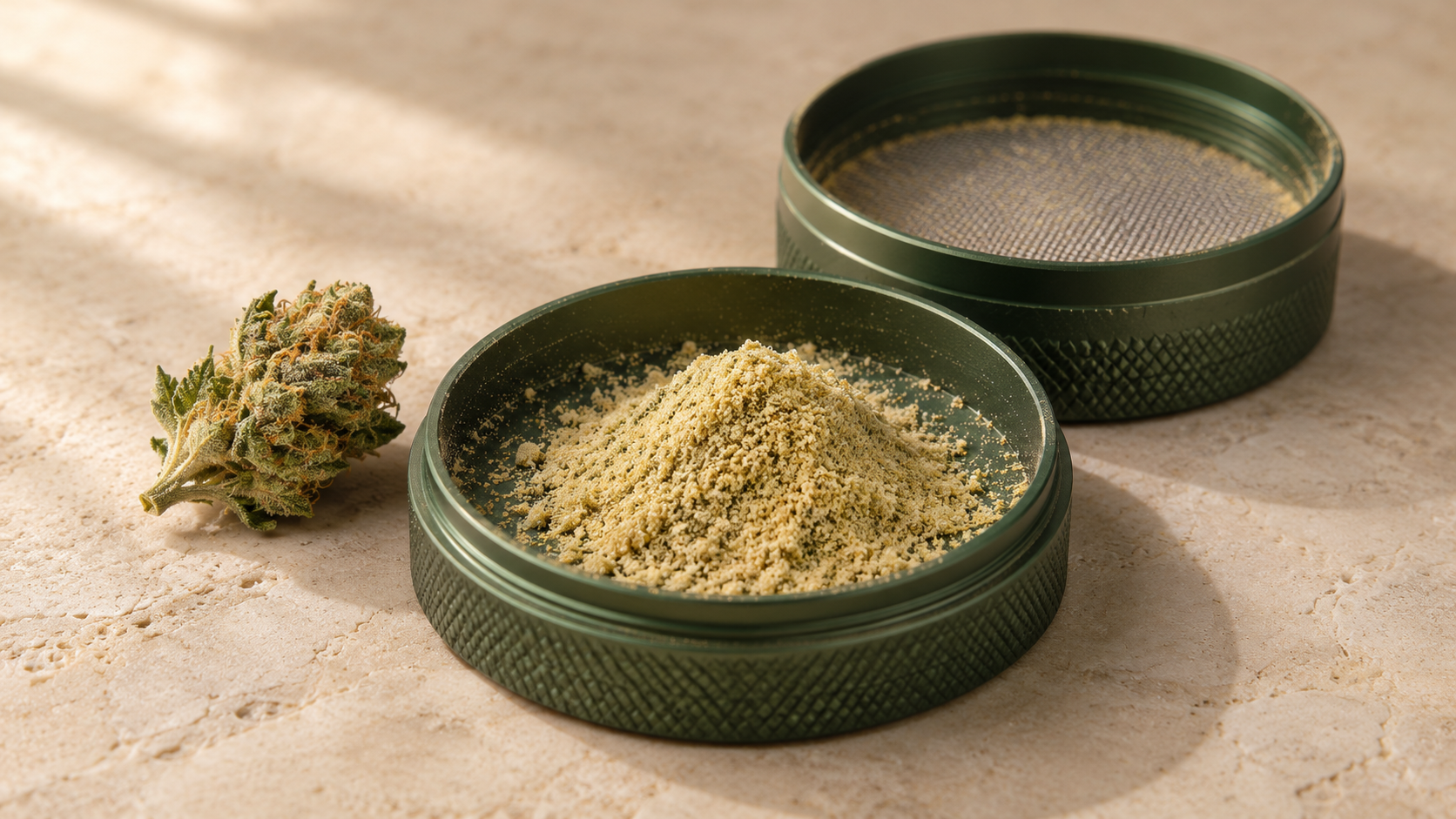
Kief is the loose, resin-rich material made up largely of trichomes that separate from cannabis or hemp flower. It often looks like fine powder in a grinder’s bottom chamber. Kief is different from shake, which contains broken flower fragments, and from pressed hash. The name alone does not tell you its THC or CBD content.
If you found powder below your grinder’s screen, or saw kief listed on a moon-rock product, the same starting question applies: which material are you looking at? Here is how to identify the format, understand the equipment and check a finished product.
Kief, hash, shake and moon rocks at a glance
| Term | What it describes | What it cannot establish |
|---|---|---|
| Kief | Loose, trichome-rich particles separated from flower. | An exact THC percentage or absence of contaminants. |
| Pressed hash | Resin-rich material compressed into a cohesive form. | That it is stronger than every loose kief product. |
| Shake | Loose flower fragments, potentially mixed with leaf and trichome material. | That everything at the bottom of a bag is kief. |
| Moon rocks | Flower combined with concentrate and commonly coated in kief. | The cannabinoid profile of the finished item. |
What is kief made of?
Cannabis flowers carry tiny glandular structures called trichomes. These glands produce and hold cannabinoids and aromatic compounds called terpenes. When trichome-rich material separates from dried flower, the loose collection is commonly called kief. Research on cannabis glandular trichomes helps explain why this material can have a different composition from the surrounding plant tissue.
Everyday grinder material is not necessarily a collection of perfectly isolated resin heads. Fine leaf particles and other plant fragments may be mixed in. The amount of other plant material varies from sample to sample.
You may also hear “dry sift” or “pollen.” Dry sift describes mechanically separated material, although sellers use the term with varying precision. “Pollen” is a common accessory or retail term here; it should not be confused with the plant’s reproductive pollen.
Kief vs. hash: what is the difference?
Kief usually describes loose trichome-rich particles. Traditional pressed hash is resin-rich material compressed into a more cohesive form. Hash is a broader family of products, so not every type is simply grinder powder pressed into a block.
The BC Cannabis Stores glossary identifies kief as cannabinoid-rich trichome material and a primary component of hash. Loose and pressed forms are related, but their names describe different physical formats.
Pressed hash is not automatically stronger than loose kief. A meaningful comparison uses batch-specific results in the same units.
Is kief the same as shake?
Shake consists mainly of loose fragments that break away from flower. Kief describes a collection enriched in trichome material. A bag of shake may contain some kief, but the entire mixture does not become kief because fine powder has collected at the bottom.
For a closer look at flower fragments, leaf content and buying considerations, read our guide to shake weed. Look at the mix of flower, leaf and stems when comparing shake.
Where does kief collect in a grinder?
In a grinder with a separate sifting screen, fine particles can pass into the collection chamber below it. Ground flower remains above the screen. A grinder without that screen-and-catcher arrangement will not separate a dedicated pile of kief, even if its flower is resinous.
- Lid and teeth
Upper grinding area - Ground-flower chamber
Plant material sits above the screen - Sifting screen
Fine particles can pass through - Bottom catcher
Trichome-rich particles collect here
The screen is the useful design check.
A storage chamber alone is not a separate kief catcher. Check the model’s diagram rather than relying only on how many pieces are advertised.
For a manufacturer example, the Santa Cruz RIPPER four-piece description specifies a sifting screen and collection chamber. This verifies that model’s construction, not every grinder sold under the same piece count.
Why is there little or no kief in the catcher?
- No separate screen: the model may collect ground flower without separating finer material.
- A coated or blocked screen: residue can obstruct openings. Inspect it and follow the exact model’s care directions.
- Different source material or handling: the amount that separates is variable; an empty catcher is not a potency test.
For maintenance, use our grinder cleaning guide by material and model. Avoid forcing mesh with sharp tools, and never consume residue exposed to cleaning liquid.
Does kief always contain a lot of THC?
No single THC percentage applies to all kief. Its cannabinoid profile depends on the source plant and the mixture collected. Use a matching laboratory result for a number; a generic online potency range cannot measure your sample.
Separating resin-rich material can concentrate cannabinoids relative to the source flower, but that does not make every sample equally potent. CBD-rich hemp material and THC-rich cannabis material should not be treated as interchangeable.
Can kief get you high? Kief containing sufficient THC can be intoxicating. A CBD-rich description does not guarantee that a product contains no THC. THC can cause impairment. The CDC’s cannabis guidance explains that effects vary with the product, amount, individual and other substances used.
Where does kief fit into moon rocks?
Moon rocks combine flower with an added concentrate and an outer coating, commonly kief. The coating is one component of the finished item. Its appearance cannot identify the cannabinoids in the flower base or added concentrate.
Our Special Sauce CBD Moon Rocks description lists hemp flower, CBD oil and CBD kief. This is an example of kief used as an outer coating. It is a finished, layered flower product; its ingredients should not be confused with loose kief sold separately.
Our moon rocks guide compares CBD, Delta-8 and other versions of the format. Read the flower, concentrate and coating descriptions separately when comparing products.
A real example: read the report, not only the headline
The Special Sauce description states “90%+” CBD. Its linked CBD Moon Rocks report, completed May 30, 2024, reports 76.6661% total CBD. It marks the cannabinoid profile tested and panels including microbials, pesticides, heavy metals and residual solvents not tested.
That report does not establish the composition or contaminant results of current stock. Ask for the report matching your package before relying on a strength or testing claim. A potency result is not a complete safety assessment.
Check the report identity, too. The public CBD moon-rock directory link and the two inspected CBD moon-rock product links carry report order 86985. Different download filenames do not establish separate tested batches. Use the identifiers inside the document, then match them to your package.
What should you check before buying?
- Product form: loose kief, pressed material, coated flower or another infused item.
- Ingredients: what the manufacturer says is present in each component.
- Batch identity: the package and laboratory report should refer to the same product and lot.
- Test scope: cannabinoid results and contaminant panels answer different questions.
A report for an ingredient answers a different question from a report for the finished mixture. When flower, oil and a coating are combined, ask which material was actually sampled. Matching the product form is just as important as matching the batch number.
Our cannabis COA guide walks through report units and testing limits. A report for the starting flower does not describe every added ingredient in a finished product.
How should you store loose kief?
Use a clean, dry container with a secure closure, keep its identity clear and follow the seller’s storage directions. Loose material is easy to spill or confuse with something else, so a labeled container matters as much as the storage location.
- Keep it closed: do not leave powder spread across an open tray between uses.
- Limit heat and sunlight: choose a stable, cool, dark location rather than a hot car or windowsill.
- Keep moisture out: use clean, dry handling tools and do not add water or wet food to the container.
- Keep the record: retain the original label, batch details and any storage directions when transferring material.
- Lock it away: keep all cannabis and hemp materials out of sight and reach of children and pets.
Health Canada’s dried-cannabis research identifies heat, light and oxygen as factors in cannabinoid degradation. It does not establish a universal expiry date for loose kief. Follow the product’s instructions instead of assuming every container lasts a fixed number of months.
The agency’s household storage guidance supports secure, locked storage. These are storage references, not statements of U.S. product law.
Does old or clumped kief mean it is unsafe?
Age or clumping alone cannot establish safety. If it became wet, has visible suspicious growth, was exposed to chemicals or has an uncertain storage history, stop using it and ask the seller about disposal or replacement. Appearance and smell cannot rule out contaminants.
Smoking carries health risks. Do not drive after using an impairing cannabis product; see the CDC’s cannabis and driving guidance.
Frequently asked questions
Is kief a concentrate?
It is commonly described as a mechanically separated cannabis concentrate because it collects resin-rich trichome material. That description does not guarantee purity or a specific THC percentage.
Is lighter kief always better?
Color alone cannot establish cannabinoid content, contaminant results or freshness. Use product information and batch-specific testing rather than a color chart to make those judgments.
Does “not tested” mean a product failed?
No. It means that the report does not provide a result for that panel. It is neither a pass nor a fail. Ask for the relevant testing rather than treating an absent result as proof of safety.
What is kief used for?
Kief appears as an ingredient or coating in some cannabis and hemp products, and resin-rich material is used in hash production. Those uses explain product construction; they do not make every powder suitable for every device or establish a safe personal amount.
Is a moon rock the same as kief?
No. A moon rock is a layered flower product that commonly includes a kief coating. Loose kief is only one possible component.
Sources
- Livingston and colleagues, The Plant Journal: cannabis glandular trichome research, linked above.
- BC Cannabis Stores: Cannapedia glossary.
- CDC: cannabis frequently asked questions and driving guidance.
- Health Canada: safe storage and dried-cannabis research.
- Santa Cruz Shredder: the screened four-piece model linked above.
- Mary Jane’s product description and its linked historical ACT Laboratories cannabinoid report, discussed above.
Research method: checked the linked scientific, manufacturer and public-health sources, compared the seller’s product descriptions with public laboratory documents, and checked report identifiers. This is document-based product education; no product was purchased or independently tested. Sources checked November 6, 2026.