

THC beverage comparison · Adults 21+
Information checked November 4, 2026 · Publisher: Mary Jane’s Bakery Co. · Educational information, not medical advice
THC drinks vs alcohol: they are not interchangeable. A 5 mg or 10 mg THC beverage does not equal a certain number of beers, glasses of wine, or cocktails. Alcohol is measured in ethanol and ABV; THC drinks are measured in milligrams per serving. Both can impair you, but they differ in onset, duration, health risks, and what the label should tell you.
The short answer: There is no scientifically reliable THC-to-beer conversion. Many THC seltzers are alcohol-free, but some cannabis beverages contain alcohol or caffeine, so check the ingredients. Neither is universally safer; even a low THC serving may impair judgment, and combining THC with alcohol increases risks.
THC Drinks vs Alcohol: Side-by-Side Comparison
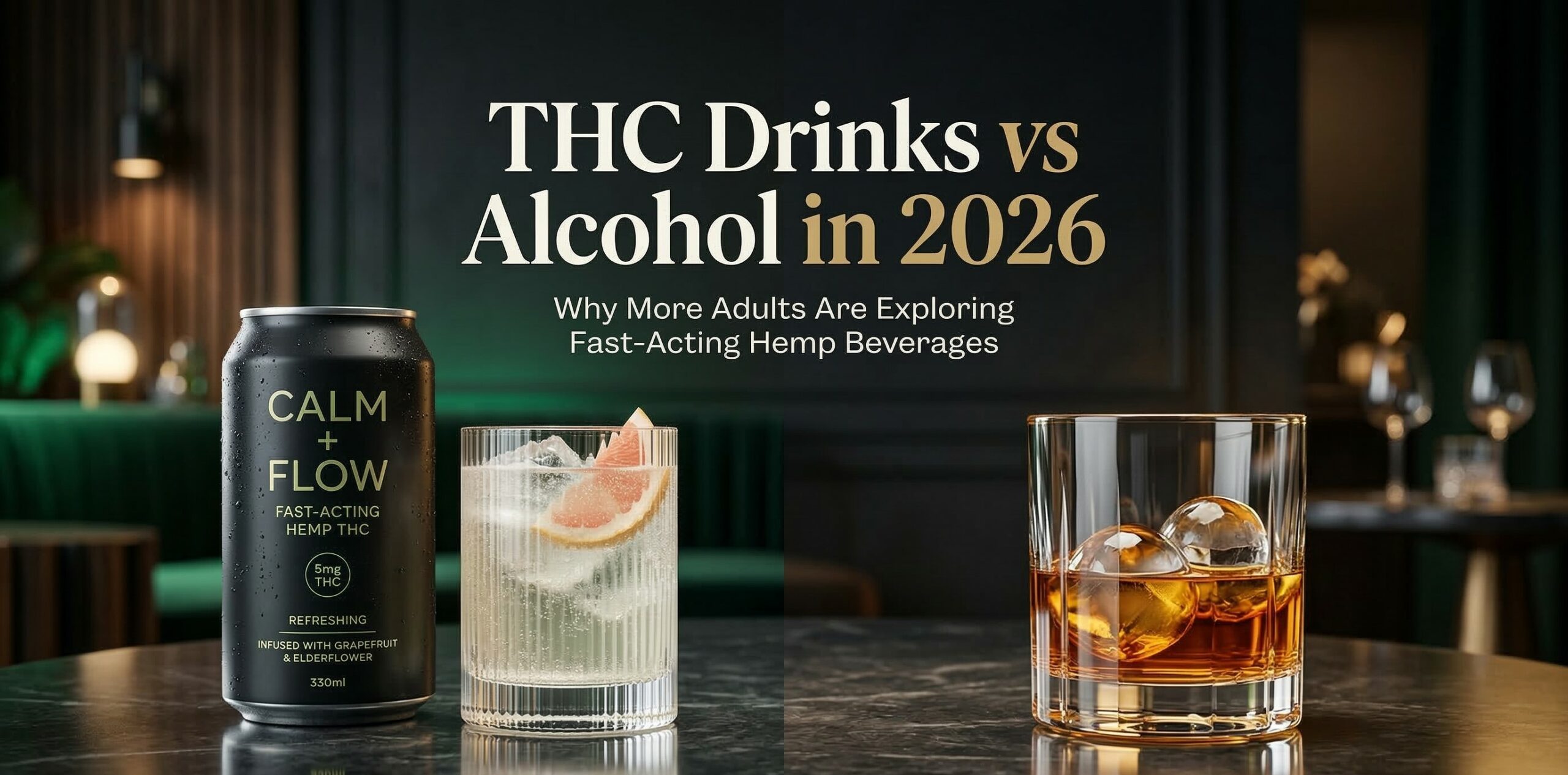
The two products may appear beside each other at a party, but a similar can size tells you almost nothing about equivalent strength. Compare the active ingredient, the label, and the risks instead.
| Question | Alcoholic drink | THC beverage |
|---|---|---|
| What causes intoxication? | Ethanol | THC, the psychoactive cannabinoid |
| How is a serving measured? | Alcohol by volume (ABV), serving volume, and standard drinks | Milligrams of THC per serving and per container |
| Does it have a universal equivalent? | U.S. standard drinks share a defined amount of ethanol | No recognized THC-to-alcohol equivalent exists |
| When do effects begin? | Often noticed relatively soon, varying with amount, food, and pace | May begin in 30 minutes to 2 hours for ingested cannabis; some drinks feel faster |
| What can the effects feel like? | Reduced inhibitions, slower reactions, and poor coordination; individual experience varies | Altered perception, intoxication or anxiety; dose and individual response vary |
| Common concerns | Impaired judgment, injuries, dependence, and long-term health risks | Impairment, anxiety or panic, unexpected strength, delayed overconsumption |
| What should you check? | ABV, pour size, standard drinks, ingredients | THC mg, number of servings, other ingredients, batch-specific lab report |
For context, the U.S. National Institute on Alcohol Abuse and Alcoholism defines one standard alcoholic drink as about 14 grams of ethanol: roughly 12 fl oz of 5% beer, 5 fl oz of 12% wine, or 1.5 fl oz of 40% spirits. That standard is useful for comparing alcoholic beverages to each other—not converting them to THC.
Two labels. Two different measurements.
Approximately 14 g of ethanol — one U.S. standard drink.
The number describes THC quantity, not comparable impairment.
Original editorial illustration using hypothetical THC labeling. These values do not describe a product sold by Mary Jane’s Bakery Co. and are not a dose-conversion chart.
Is a 5 mg or 10 mg THC Drink Equivalent to a Beer?
No. Searches such as “10 mg THC equivalent to alcohol” and “how many beers is 5 mg THC?” have a tempting answer: a simple number. But any chart claiming that a fixed number of milligrams equals a fixed number of beers would be misleading. The substances act differently, and effects vary by individual, dose, product formulation, and other factors.
The better comparison is within each substance: 10 mg contains twice the THC of 5 mg, while a 12-ounce beer at 10% ABV contains about twice the ethanol of a 12-ounce beer at 5% ABV. Neither doubling proves that someone will feel exactly twice the effect, and it still does not produce a THC-to-beer conversion.
How might 5 mg THC feel compared with one beer?
Someone might describe a small THC drink as more relaxing or more intense than a beer. That is a personal report, not a reliable dose comparison. THC may change perception and attention, while alcohol can lower inhibitions and reduce coordination. Either can be unpleasant or impairing, and someone else's experience cannot predict yours. The Harvard Health comparison notes that even small amounts of THC can feel uncomfortable to some people.
| THC on a drink label | What the number actually tells you | Important caution |
|---|---|---|
| 2.5 mg | A smaller THC quantity than 5 mg or 10 mg | Even a low amount may cause impairment |
| 5 mg | Twice the THC of a 2.5 mg serving | Can feel strong to a first-time consumer |
| 10 mg | Twice the THC of a 5 mg serving | Not the same as two beers; greater potential for unwanted effects |
| 20 mg total in a bottle | Total bottle content, not necessarily one serving | Read the number of servings before consuming |
Health Canada advises people new to edible cannabis to choose products with 2.5 mg THC or less if they decide to consume it. That is a precaution, not a promise of mild effects. See our separate 2.5 mg vs 5 mg THC guide for a deeper explanation of individual sensitivity.
Do THC Drinks Have Alcohol in Them?
Most THC seltzers and cannabis mocktails sold as alcohol alternatives are designed to be alcohol-free, but do not assume every THC-containing beverage is. Products differ, and some infused beverages may contain alcohol, caffeine, CBD, or other active ingredients. The ingredient list and any ABV declaration matter more than the word “mocktail” on the front.
- Regular beer or wine: contains ethanol but does not ordinarily contain THC.
- Alcohol-free THC seltzer: contains labeled THC, with no intentionally added alcohol; verify the actual product.
- THC-infused mixer: may be a concentrated beverage intended for portions; confirm its THC amount and whether the base contains alcohol.
- “THC wine” or “THC beer”: the name alone cannot tell you whether the product is non-alcoholic; read the label.
This distinction matters especially for anyone avoiding alcohol entirely. The National Capital Poison Center notes that infused beverages can contain additional substances, including alcohol or caffeine.
How Long Do THC Drinks Take to Kick In Compared With Alcohol?
Alcohol can begin affecting someone relatively soon after drinking. Swallowed THC typically takes longer and can be less predictable. The CDC states that cannabis edibles, including drinks, may take 30 minutes to 2 hours to produce intoxicating effects. Health Canada advises that the full effects of ingested cannabis can take up to four hours to develop, with effects lasting many hours and possible residual impairment the following day.
Some specially formulated THC beverages are marketed as fast-acting, and some people notice them sooner than a conventional gummy. However, a brand's advertised onset is not a guarantee for a particular person. Eating beforehand, other substances, the formulation, and sensitivity can change the experience.
Do not use a short advertised onset as a reason to take more quickly. Delayed effects are one reason people unintentionally consume more THC than intended. Do not drive or operate machinery after either alcohol or THC—even if you feel fine.
For a more detailed format comparison, read how THC drinks compare with gummies for onset and our explanation of nano-infused THC drinks.
Are THC Drinks Healthier or Safer Than Alcohol?
There is not enough evidence to call THC beverages a universally healthier or safer alternative to alcohol. Avoiding ethanol removes alcohol exposure, but it does not remove the risks of intoxication. The two substances also have different long-term evidence bases.
As the CDC explains, alcohol has well-established links to liver disease, certain cancers, injuries, dependence, and other harms. THC can impair attention, coordination, and judgment; some people experience rapid heartbeat, anxiety, panic, or confusion. The strength and consistency of labeling also vary across cannabis beverage products. The Poison Control review emphasizes that research on the long-term safety of cannabis drinks is limited.
What does the newest research say about THC dose and impairment?
A randomized trial published August 31, 2026 studied 40 adults who used cannabis regularly. Researchers found reduced simulated-driving lane control after 10 mg and 20 mg oral THC at two and five hours compared with placebo; the 2 mg result was not statistically significant for the trial’s primary lane-control measure. Participants consumed THC edible candies, not beverages. The results reinforce that a 10 mg serving is not inherently “like one beer,” and they do not prove that 2 mg or any beverage is safe for driving.
Why that distinction matters: A study of cannabis edibles cannot establish exactly how a fast-acting THC seltzer behaves. Beverage formulation, other ingredients, individual sensitivity, and study population still matter. We do not use the research to promise a particular feeling or timeline.
Do THC drinks have fewer calories?
Some alcohol-free THC drinks contain fewer calories than sugary cocktails, while others contain sugar or sweeteners. You cannot determine calories from THC milligrams. Check the nutrition panel for the specific product rather than assuming all cannabis drinks are low-calorie.
Do THC drinks cause a hangover?
An alcohol-free THC drink does not cause an ethanol-related hangover. It can still leave someone tired, foggy, anxious, or otherwise unwell after the main high fades. Neither an “alcohol-free” label nor a small serving guarantees feeling normal the following morning.
Three common comparison claims worth checking
- “5 mg THC equals a beer.” Not established. There is no accepted equivalence in intoxication or driving risk.
- “Alcohol-free THC means no next-day effects.” Not guaranteed. Some people report residual tiredness or fogginess.
- “All THC drinks are low-calorie.” Not necessarily. Read the actual nutrition panel and serving size.
Can THC drinks replace alcohol without the same health risks?
Choosing an alcohol-free drink avoids that drink's ethanol exposure. It does not establish that THC is a safe replacement for everyone. The long-term evidence for frequent THC-beverage use is less developed than the evidence about alcohol harms. If the aim is to reduce substance-related risks altogether, an ordinary non-intoxicating beverage avoids both ethanol and THC.
People who are pregnant or breastfeeding, take interacting medicines, have relevant health conditions, or have experienced adverse reactions should avoid self-prescribing THC and consult an appropriate healthcare professional. This article is product education, not an individualized health recommendation.
Can You Mix THC Drinks and Alcohol?
Avoid mixing them. Using cannabis and alcohol together can increase impairment beyond either substance alone. The CDC warns about greater impairment from simultaneous use. A 2026 JAMA Network Open trial involving 25 adults found greater simulated-driving impairment when oral THC and alcohol were combined. That study tested THC brownies rather than beverages, so its exact experimental results should not be presented as a beverage-specific dose comparison.
Mixing also makes it harder to judge whether you are still impaired. Arrange transport with someone who has not used either substance; feeling alert is not a reliable driving test. If someone has severe symptoms, seek urgent medical help.
THC Drink Mixers vs Alcohol Mixers: How to Read the Label
An ordinary cocktail mixer such as tonic or juice may have no alcohol until someone adds liquor. A THC mixer may already contain an active dose before anything is added. Diluting a THC-containing concentrate with soda can change the taste and concentration per ounce, but not the total THC you pour into the glass.
Worked example: verify the stated serving count
Imagine a THC drink label reads 12 mg THC per container and 3 servings per container. Each labeled serving contains 12 ÷ 3 = 4 mg THC. Adding that serving to plain sparkling water changes the volume, not the milligrams already poured. Finishing the container would mean consuming all 12 mg, even if the drink was diluted.
Illustrative numbers only; not a recommendation to consume any quantity. Follow the product label and never mix THC with alcohol.
When comparing cost, check price per labeled serving, not only per can or bottle. For instance, a hypothetical $16 package with four labeled servings works out to $4 per labeled serving ($16 ÷ 4). That arithmetic measures cost, not comparable intoxication, health impact, or value. Prices are examples, not live product quotes.
THC drink label checklist
- THC per serving and total per container: do the numbers match the stated serving count?
- Other active ingredients: is there CBD, caffeine, alcohol, or another cannabinoid?
- Independent COA: can the QR code open the report for the relevant batch?
- Batch number and expiration date: do they match the package and report?
- Ingredients and storage instructions: check allergens, sugar content, and handling guidance.
What Should Adults Buying THC Drinks in Miami Check?
For hemp extract products in Florida, Florida Statute 581.217 includes requirements involving independent batch testing, a COA-linked scannable code, batch details, an expiration date, and milligrams of marketed cannabinoids per serving. The statute also prohibits sales of covered ingestible or inhalable hemp extract products to people under 21. These rules do not mean every THC product, dose, or formulation is automatically authorized for sale.
November 2026 federal-law update: According to Congressional Research Service analysis published October 28, 2026, selected federal hemp-definition changes are scheduled for November 12, 2026, while most others—including a revised definition affecting products above 0.4 mg combined THC per container—are scheduled for December 11, 2026, unless further action changes those dates. The interaction between federal and state rules is complex; do not treat an existing COA or storefront listing as proof a future sale will be lawful. Businesses should obtain qualified compliance advice.
When shopping in Wynwood or elsewhere in Miami, check the specific product's current label and lab results. Availability and applicable rules can change; neither a product name nor a shop display substitutes for those checks. Our Miami THC drinks buying guide goes deeper into local label questions.
Comparing THC Drink Options in Miami?
Mary Jane’s Bakery Co. serves adults 21+ in the Wynwood/Miami area. If you choose to shop for a THC beverage, compare the milligrams, servings, ingredients, and batch report before making a decision. Availability varies.
Explore the Delta-9 THC drinks collectionWhat If a THC Drink Feels Too Strong?
Stop consuming THC or alcohol. Move to a safe setting, avoid driving, and ask a sober adult to stay nearby if needed. Do not try to counter the effect by adding alcohol or another drug. For unwanted or unexpected effects in the U.S., contact Poison Control at 1-800-222-1222; seek emergency services for severe symptoms. Keep THC beverages in their original labeled containers, secured away from children and pets.
Additional Questions About THC Drinks and Alcohol
Does alcohol-free mean that a THC drink is non-intoxicating?
No. A drink can have 0% ABV and still contain intoxicating THC. A conventional non-alcoholic beer and a THC-infused seltzer may look similar, but their active ingredients are different.
Why can two drinks labeled 5 mg THC feel different?
The cannabinoid blend, formulation, food intake, other substances, and individual sensitivity can differ. A matching milligram number does not guarantee matching onset, intensity, or duration. Check the full ingredient list and batch report.
Does drinking half of a multi-serving can mean half the THC?
If the contents are uniformly mixed and the label is accurate, half the can contains about half its listed total THC. For example, half of a hypothetical 12 mg container is approximately 6 mg. This arithmetic is not a way to predict whether someone will be impaired.
Does “hemp-derived” mean a THC drink is automatically legal?
No. Product type, concentration, testing, federal law, and the rules of the relevant state all matter. Requirements are changing in late 2026, so check current rules and seek qualified advice for business compliance.
The Bottom Line
THC drinks and alcohol may share a social setting, but there is no valid 5 mg-to-beer or 10 mg-to-cocktail equivalence. The useful comparison is how each is labeled, how long its effects can take, what risks it carries, and what is actually in the container. For any THC product, read the dose per serving, check the lab report, avoid alcohol combinations, and plan not to drive.
How this comparison was prepared
Publisher and commercial interest: Mary Jane’s Bakery Co. sells hemp-derived products, including THC beverages. This article is general consumer education, not an independent medical review or a product-safety certification. No physician or outside expert is claimed to have reviewed this draft.
Fact-checking scope (November 4, 2026): The definitions and safety statements were checked against NIAAA, CDC, Health Canada, Harvard Health, Poison Control, two 2026 JAMA Network Open studies, the 2026 Florida Statutes, and Congressional Research Service legal analysis. Links to those sources appear beside the relevant statements. All label and price calculations are clearly identified as hypothetical, and we have not independently lab-tested any beverage.
Updates: Federal hemp rules, product availability, and health evidence can change. Confirm the publication date, product details, and applicable rules again before or after the scheduled December 2026 federal-law changes. No dose, drinking interval, or label example here guarantees safety.