

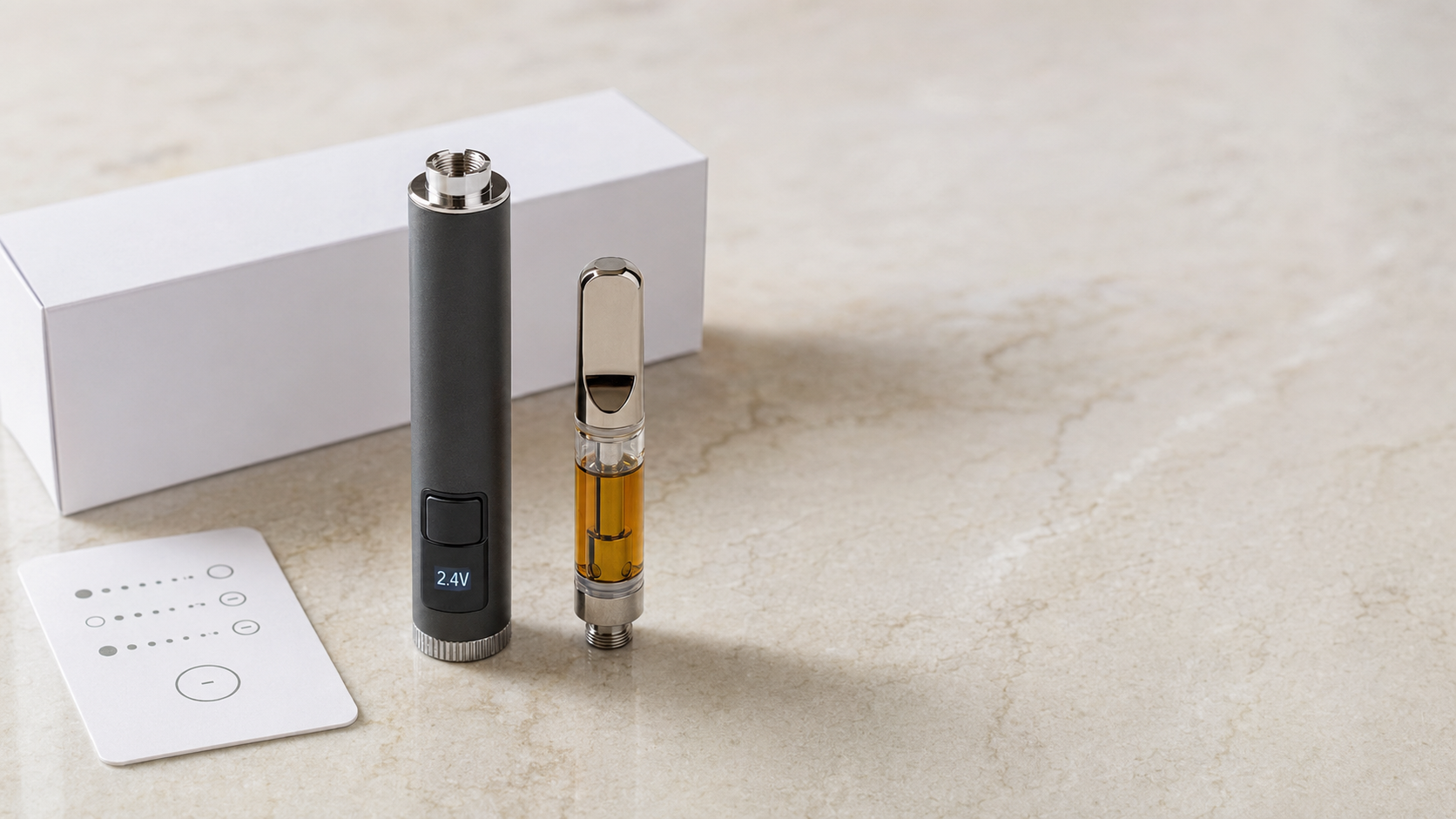
Quick answer: There is no universal best voltage for every THC cart. Follow the cartridge maker and compatible battery instructions first. If both allow adjustment but give no exact setting, begin at the lowest supported setting and increase only in small steps when vapor is too light. Stop if flavor turns burnt, oil leaks, or the device becomes unusually hot or damaged.
Best Voltage for THC Carts: Start With Compatibility, Not a Magic Number
Search results make this look easier than it is. One guide may recommend a range beginning near 2.0V, another may begin around 2.5V, and another may place a standard distillate cart above 3.3V. Copying any one of those numbers without checking your hardware can produce weak vapor, a harsh hit, a flooded airway, or a damaged wick.
The correct first question is not “What number does everyone use?” It is “What range do the cartridge and battery manufacturers support together?” Once compatibility is confirmed, the practical target is the lowest supported setting that produces normal flavor and consistent vapor without excessive heat.
- Read both labels. Check the cartridge package and the battery manual or product page.
- Confirm compatibility. A 510 thread describes the connection; it does not guarantee that every voltage suits every cartridge.
- Begin at the lowest supported setting. Do not start on high simply because the cart looks full or the oil looks thick.
- Take one short, gentle draw. Avoid a long pull while testing a new cartridge or setting.
- Assess three signals. Flavor should be normal, vapor should be consistent, and the device should not become unusually hot.
- Change one step at a time. Increase only by the smallest available increment if vapor remains too light.
Why Current Voltage Guides Disagree
The disagreement is visible in current results, including hardware manufacturers, retailers, cannabis publishers, and user forums.
| Current source type | Example guidance observed | Why it cannot be copied blindly |
|---|---|---|
| Hardware manufacturer | CCELL describes a broad 2.5–3.5V context for THC carts and recommends beginning low | Its guidance still varies by oil and cartridge design |
| Cannabis publisher | Some guides keep THC carts around 2.0–2.8V | That range may reflect different coils, oils, and battery calibration |
| Retailer guide | Some separate live resin around 2.0–2.8V and distillate around 2.5–3.2V | Product-specific instructions still override a category average |
| Dispensary guide | Some place standard distillate closer to 3.4–3.7V | A different cart at that setting may taste harsh or run too hot |
| Forum comments | User reports range from roughly 1.8V to 4V or more | The device, resistance, oil, draw style, and accuracy are usually unverified |
This table is not a menu of settings. It shows why there is no responsible one-number answer. Use the range printed for your exact product, then adjust within that range only.
Voltage Is Not the Same Thing as Coil Temperature
Voltage helps determine how much electrical power reaches a cartridge, but the cartridge’s resistance matters too. Basic circuit relationships are expressed as I = V ÷ R and P = I × V. Combined, the estimated power is P = V² ÷ R.
Consider two hypothetical cartridges used at the same 2.8V setting:
- At 1.2 ohms:
2.8² ÷ 1.2 ≈ 6.5 watts. - At 1.8 ohms:
2.8² ÷ 1.8 ≈ 4.4 watts.
The displayed voltage is identical, but calculated power differs by about 48%. Real performance also changes with battery regulation, coil construction, airflow, oil viscosity, fill level, and ambient temperature. That is why a chart claiming that one voltage always creates one exact temperature across all carts is incomplete.
Voltage Context by Oil and Device Type
| Cartridge or device | Conservative starting approach | What to watch |
|---|---|---|
| Live resin or live rosin cart | Use the low end of the exact maker-supported range | Terpene-rich flavor may become muted or harsh when the coil runs too hot |
| Distillate cart | Start low within the supported range, then use small increases only if vapor is too light | High heat can consume oil faster and leave the wick temporarily dry |
| CBD or full-spectrum cart | Follow that product’s instructions rather than borrowing a THC-cart setting | Formulation and hardware may differ even when the connector is the same |
| Fixed-voltage 510 battery | There is no setting to adjust; confirm compatibility and use short draws | Persistent harshness or weak output may indicate a mismatch or failing cart |
| Sealed disposable | Do not open it or attempt to alter its internal output | Repeated burnt taste, leaking, swelling, hissing, or unusual heat means stop |
| Unknown or unverified cart | Do not use voltage testing as a purity or authenticity check | Replace a product whose source, label, batch, or contents cannot be verified |
How to Adjust a 510 Battery Without Chasing Bigger Clouds
- Inspect first. Do not test a cracked, leaking, expired, swollen, or unverifiable cartridge or device.
- Attach gently. Make a removable cart snug without forcing or overtightening the threads.
- Let the cart reach a stable room temperature. Do not use a flame, hot hair dryer, stove, radiator, or hot water.
- Select the lowest supported setting. If the manual gives a range, stay inside it.
- Take one short draw. Long or forceful pulls can flood the airway and confuse the diagnosis.
- Wait before changing anything. Give the wick and device time to settle.
- Raise one small step only when needed. Stop as soon as vapor becomes consistent and flavor remains normal.
A denser puff is not proof that the oil became more potent. Higher voltage adds heat and may vaporize more material during a pull, but it does not raise the labeled concentration inside the cartridge. Too much heat can waste oil, flatten flavor, dry the wick, and shorten hardware life.
Too Low, Too High, or a Different Vape Problem?
| What you notice | Possible explanation | Best next step |
|---|---|---|
| Light vapor, normal flavor, normal temperature | Setting may be low, oil may be cold, or electrical contact may be weak | Check the instructions and connection before one small increase |
| Harsh, dry, or burnt taste | Excess heat, dry wick, low oil, or damaged coil | Stop and let it cool; see why a disposable vape tastes burnt |
| Hard draw or no airflow | Clogged airway, residue, blocked intake, or flooding | Do not force it with more voltage; use safe clog checks |
| Battery blinks or does not activate | Charge, cutoff, connection, incompatibility, or hardware failure | Review the blinking and connection guide |
| Oil reaches the mouthpiece | Flooded airway, hard pulls, sideways storage, failed seal, or excess heat | Stop pulling, keep it upright, wipe only visible residue, and replace it if leaking repeats |
| Oil leaks near the battery or charging port | Seal, tank, or internal hardware failure | Stop using and charging it; detach only if the cart is designed to detach |
| Good airflow but no vapor | Empty cart, failed coil, poor contact, or dead battery | Check charge and connection; do not keep raising voltage without a diagnosis |
Battery Light Colors and Preheat Are Device-Specific
Green, blue, white, and red do not have standardized voltage meanings across vape batteries. On one model, green may be low; on another, the order or actual values may be different. Use the manual, package, or manufacturer’s current product page for the exact model.
Preheat is not a universal repair button either. If the manufacturer supports it, one approved cycle may help a compatible cart with thick or cool oil. Repeated cycles can add excessive heat, thin the oil, flood the airway, or worsen leaking. Never improvise preheat by holding the button for an unspecified period.
When to Stop Adjusting and Replace the Cart
Stop testing when the cartridge or device has any of these signs:
- A cracked tank, loose mouthpiece, broken seal, or exposed internal part
- Repeated leaking, especially near the battery or charging port
- Persistent burnt taste even after cooling and returning to a supported low setting
- Swelling, hissing, smoke, an unusual smell, or unusual heat
- An unreadable or missing label, batch, source, or expiration information
- A connection or activation failure that continues after normal external checks
Do not open a sealed cart, refill a disposable, add oil or thinning agents, insert metal tools deeply into the airway, apply direct heat, or improvise a charger. The FDA advises consumers not to modify vaping products or add substances and warns about THC vaping products from informal sources.
If age or storage history is the concern, use Mary Jane’s guide to signs an old cart should be replaced. A test puff cannot prove that an old, damaged, or unverifiable product is acceptable.
Replacement Checklist for Online Vape Buyers
- Readable cannabinoid and ingredient information
- A batch or lot identifier connected to relevant lab information
- Clear cartridge-storage and battery-setting instructions
- Stated compatibility with the battery you intend to use
- An intact, sealed package with no cracks, leaks, or loose components
- A seller that applies current age and shipping restrictions
Adults comparing a replacement can browse Mary Jane’s current CBD vape cartridges or shop current products online. Check the individual product instructions before pairing any cartridge with a battery.
Frequently Asked Questions About THC Cart Voltage
Is 2.5V a good setting for a THC cart?
It is within the published range for some cartridges, but it is not a universal answer. Confirm the cartridge and battery instructions first. If 2.5V is supported, evaluate normal flavor, consistent vapor, and device temperature rather than assuming the number is automatically correct.
Should live resin use lower voltage than distillate?
Many current guides place terpene-rich live resin toward the lower end of a compatible battery’s range, while distillate is often used somewhat higher. Published ranges still conflict, so the cartridge maker’s instructions take priority over a category-wide number.
Does higher voltage make a THC cart stronger?
No setting increases the THC concentration printed on the label. More heat may create a denser puff and consume more oil, but it can also produce harsh flavor, dry the wick, or damage the cart. Use the lowest supported setting that works consistently.
Can low voltage cause a clog?
Insufficient heat may contribute to weak vapor with thick oil, but clogs also come from cold conditions, residue, hard draws, sideways storage, flooding, and hardware defects. Check airflow and the connection before increasing voltage.
What if my battery has only low, medium, and high lights?
Read the manual for that exact battery. Color order and voltage values are not standardized across brands. Begin with the maker’s low setting only when it is listed as compatible with the cartridge.
Is voltage the same as wattage?
No. Voltage is one electrical input. Wattage describes power and depends on voltage, current, and resistance. Two carts used at the same voltage can receive different calculated power when their coil resistance differs.
Can I keep using a cart after one burnt hit?
Stop and let it cool. Check that oil remains, the cart is upright, and the setting is within the maker’s range. If the burnt taste returns, the wick or coil may be damaged; continuing to raise or lower voltage is not a reliable repair.