

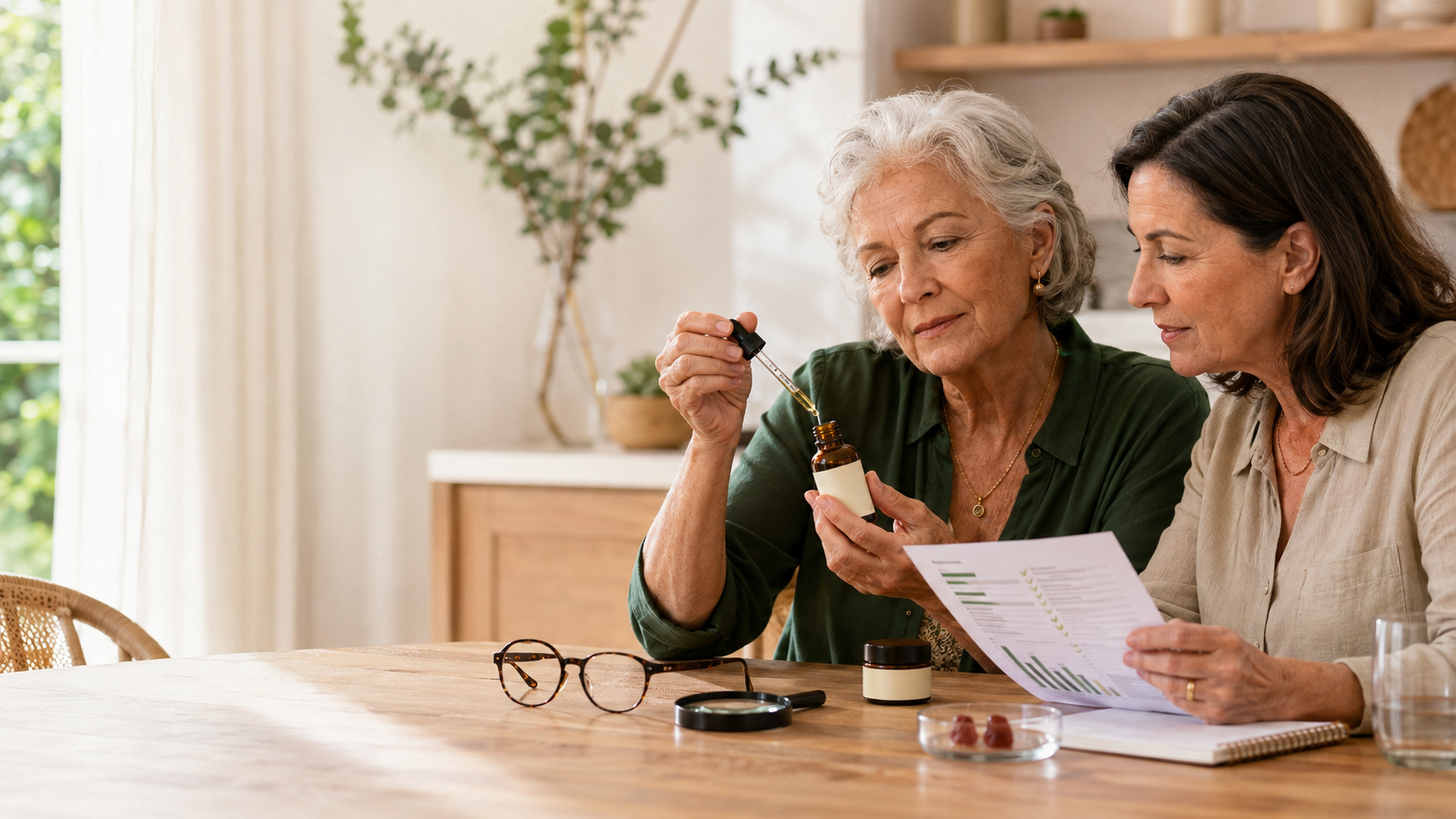
CBD for older adults • safety-first buyer guide
CBD for Seniors and Older Adults: Tinctures, Gummies, Topicals and Safety
A practical guide for adults 65+, families and caregivers who want to compare CBD formats without guessing about strength, THC content, medication interactions or lab reports.
Featured answer
There is no single best CBD product for every older adult. Tinctures offer flexible measurement, gummies offer pre-measured pieces, and topicals are applied to a selected skin area, but each format has different label and safety questions. Before using an oral or sublingual CBD product, bring the label, lab report and complete medication list to a clinician or pharmacist.
CBD format fit for older adults
| Format | Practical advantage | Main mistake to avoid | What to verify |
|---|---|---|---|
| Tincture | Small measured changes are possible. | Treating a full dropper as a universal serving. | mg/mL, dropper marks, spectrum and THC. |
| Gummy | No liquid measuring is required. | Confusing total jar strength with CBD per gummy. | CBD and THC per piece, sugar and other active ingredients. |
| Topical | Applied to a selected skin area. | Assuming every cream is risk-free or suitable for broken skin. | Ingredients, directions, patch-test guidance and warnings. |
| Drink or edible | Familiar food or beverage format. | Taking more before the first serving has been fully assessed. | Amount per serving, servings per container and THC. |
| Flower or vape | Different route from swallowed products. | Choosing inhalation when respiratory health or device safety is a concern. | Clinician guidance, product identity and local rules. |
This table compares shopping and handling factors. It does not rank medical benefits or recommend a dose.
Interest in CBD among older adults is no longer unusual. A U.S. study using 2022 survey data found that 14.3% of adults age 65 and older reported past-year CBD use. That does not prove CBD works for a particular symptom. It does show why clear product education matters.
Older adults are also more likely to manage several prescriptions, over-the-counter medicines or supplements at once. Product choice should therefore begin with the medication list and the label—not with a promise about pain, sleep, anxiety or another condition.
Related guide: For the site’s general safety overview, read CBD side effects, safety and drug interactions.
1. What changes when an older adult is comparing CBD?
CBD is cannabidiol, a compound found in cannabis. The CDC describes CBD itself as non-impairing, but that does not make every retail product non-intoxicating or risk-free. A full-spectrum product may contain THC, and mislabeled products can contain ingredients or amounts a shopper did not expect.
The practical questions also change with age. Can the person read the dropper marks? Can they remember whether a serving was already taken? Are there swallowing, dexterity, balance or vision concerns? Is a caregiver helping, and does the older adult understand and agree with the plan?
Medication load
CBD may change how other medicines work, or other medicines may affect CBD.
THC sensitivity
Trace THC, product errors or taking more than intended may matter more for someone worried about dizziness or balance.
Measurement
A high-concentration tincture leaves less room for a measuring error than a lower-concentration option.
Caregiver handoff
The product name, batch, measured amount and timing should be clear to everyone involved.
| What current evidence can support | What a retail guide should not promise |
|---|---|
| CBD use among older U.S. adults is common enough to require clear safety education. | That CBD will treat pain, insomnia, anxiety, dementia or another condition. |
| CBD can cause side effects and interact with medicines. | That one online interaction list can clear a specific person or prescription. |
| Labels and batch reports can be checked for identity, cannabinoid content and reported contaminants. | That a COA proves clinical benefit or eliminates every risk. |
2. Have the medication conversation before choosing a CBD format
The FDA warns that CBD can affect other medicines. The result can be more side effects or reduced effectiveness. A broad online list cannot tell you whether one specific product is appropriate with one person’s prescriptions, health history and lab results.
A pharmacist is often the most useful first stop because they can review prescriptions, over-the-counter products and supplements together. Do not use the “grapefruit warning” shortcut as the only check. It may flag some concerns, but it is not a complete interaction screen.
Bring these four things
- A complete medication and supplement list, including products used only as needed.
- A photo of the front label and Supplement Facts or ingredient panel.
- The batch-specific COA showing CBD, THC and contaminant results.
- The intended format: tincture, gummy, topical, drink or another product.
- Could this product interact with anything on the medication or supplement list?
- Do the CBD, THC or added ingredients create a specific concern for this person?
- Which side effects or changes should trigger a call or urgent help?
- Should the person avoid driving, alcohol or other sedating products while assessing it?
- What information should the caregiver record and bring to a follow-up?
3. Compare CBD formats by the task they require
“Best” depends less on age than on what the person can use correctly and consistently. Compare the task, not the marketing language.
CBD tinctures: flexible, but only when measured
A tincture can suit an adult who wants a liquid format and can read a marked dropper. The advantage is flexibility. The risk is measurement confusion, especially with very concentrated products. Never assume that “one dropper” means the same number of milligrams across bottles.
Stronger is not automatically better. A high-concentration bottle can make a small volume error equal a much larger milligram difference. Compare concentration, dropper markings and handling ability before price per milligram.
Mary Jane’s currently carries full-spectrum options in its CBD oil tincture collection. Full-spectrum means THC may be present, so the COA matters.
CBD gummies: simple pieces, complicated labels
Gummies remove the dropper step, but the front of the jar may show the total CBD in the entire package. Check the amount per gummy and the amount of THC per gummy. Also look for sugar, melatonin, botanicals or other active ingredients that may add separate medication or drowsiness questions.
If this format is easier to handle, compare the current CBD edibles and gummies by per-piece details, not the largest number on the jar.
CBD topicals: local application, still label-dependent
Creams, balms and lotions are applied to the skin rather than swallowed. That can make them easier to separate from an oral routine, but “topical” does not mean every formula is harmless. Check menthol, camphor, fragrances, essential oils and skin warnings. Do not use a product on broken or irritated skin unless its directions allow it.
Compare ingredient panels in the CBD topicals collection.
CBD drinks, flower and vapes
A drink may feel familiar, but it is still an ingestible product and may contain more than one serving. Flower and vapes add inhalation and device questions. The pharmacist-oriented literature advises that a person with respiratory disease avoid inhaled CBD. For an older adult with lung or device-safety concerns, do not treat inhalation as the automatic fast option.
4. Tincture strength: use mg per mL, not the front-label number
A bottle marked 1,000 mg usually means 1,000 mg of CBD in the whole bottle. It does not mean one dropper contains 1,000 mg. To compare two tinctures, divide total CBD by bottle volume.
Total CBD (mg) ÷ bottle volume (mL) = CBD per mL
Generic example: 1,000 mg ÷ 30 mL = about 33.3 mg/mL. A clearly marked 0.25 mL measurement would contain about 8.3 mg. This is label math, not a recommended amount.
| Bottle example | Concentration | Measurement consequence |
|---|---|---|
| 1,000 mg in 30 mL | About 33.3 mg/mL | More liquid is needed to measure the same milligram amount than with a concentrated bottle. |
| 5,000 mg in 30 mL | About 166.7 mg/mL | Small volume errors create larger milligram differences. |
| 10,000 mg in 30 mL | About 333.3 mg/mL | Accurate dropper marks and experienced handling become especially important. |
Higher concentration is not automatically better for an older adult. It can be convenient for an experienced user, but it also reduces the margin for a measuring mistake. For a deeper breakdown, use the CBD tincture strength guide and the mg/mL and dropper-math guide.
5. Check the label and COA as one document set
A label tells you what the company says is in the product. A certificate of analysis shows what a laboratory reported for a particular sample or batch. They should agree.
1. Match the batch
The lot or batch number on the bottle should connect to the COA being reviewed.
2. Compare cannabinoids
Check reported CBD and THC against the label. Full-spectrum products may contain THC.
3. Review contaminants
Look for available results for pesticides, heavy metals, residual solvents and microbes.
4. Read all ingredients
Carrier oils, flavors, sweeteners and added sleep or herbal ingredients matter too.
If the batch cannot be matched, the serving information is incomplete, or the product makes disease-cure claims, pause the purchase. The CBD products hub can help compare currently available formats, but the individual product label and COA remain the source of truth.
6. A caregiver-friendly CBD decision checklist
Helping is not the same as deciding for someone. The older adult should understand the product and agree to its use whenever they are able to do so. Never hide CBD in food or replace a prescribed medicine without the prescriber’s direction.
Before purchase
- Write down the reason the person is considering CBD, without turning it into a treatment claim.
- Ask a clinician or pharmacist to review the complete medication list and proposed product.
- Choose one clearly labeled format rather than stacking several new products.
- Confirm CBD and THC per measured amount, not only per package.
- Save the label, receipt and batch-specific COA.
Keep a simple product record
Record the product name, batch, format, label-directed measured amount, time used and any unwanted change. Do not use the log to increase an amount on a fixed schedule. Use it to give the clinician or pharmacist accurate information if a question appears.
| Date/time | Product + batch | Label-directed amount | What changed? | Action |
|---|---|---|---|---|
| Example only | Name / lot | Record label amount | No change or specific observation | Continue only as agreed, pause, or call |
7. Product red flags and signs to stop
Skip the product
- No readable CBD or THC amount
- No matching batch report
- Claims to treat or cure a disease
- Unclear serving size
- Damaged or unsealed package
Pause and call
- Unusual drowsiness or confusion
- Dizziness, unsteadiness or a fall
- Persistent diarrhea or appetite change
- Unexpected mood or alertness change
- Any reaction the clinician identified in advance
The CDC lists possible CBD risks including drowsiness, diarrhea or appetite changes, mood changes, liver injury concerns and medication interference. Severe symptoms, trouble breathing, loss of consciousness, a serious fall or suspected poisoning require urgent help. In the United States, call 911 for an emergency or Poison Control at 1-800-222-1222.
8. Shopping for CBD in Miami: use the store for labels, the pharmacist for medicines
Adults 21+ in Miami can compare CBD formats online or at Mary Jane’s Bakery Co. In-person shopping can make it easier to inspect bottle size, dropper marks, ingredient panels and available lab reports before purchase.
Store staff can help locate product information. They should not replace a clinician or pharmacist for interaction, disease or prescription questions. If you want to compare options before visiting, use the Miami location guide and confirm current availability on the product category.
Start with the CBD products hub. If measurement flexibility is the priority, compare CBD tinctures. If a pre-measured piece is easier, compare CBD gummies. Verify the exact label and COA before checkout.
9. Authoritative sources used for this guide
| Source | What it supports |
|---|---|
| CDC: About CBD | CBD definition, non-impairing distinction, side effects, interaction and product-quality cautions. |
| FDA: What to Know About Cannabis and CBD Products | Medication interactions, safety uncertainty and clinician discussion. |
| NCCIH: Cannabis and Cannabinoids | Evidence limits and adverse-effect cautions. |
| Peer-reviewed review: CBD Use by Older Adults | Older-adult evidence gaps and labeling inconsistency. |
| U.S. study: CBD Use Among Older Adults | Past-year CBD-use estimate for adults 65+. |
| U.S. Pharmacist: Cannabidiol Use in Older Adults | Medication review, comorbidities and route-of-administration counseling. |
Frequently asked questions
What is the best CBD for seniors?
There is no universal best format. The safer choice is the product an older adult can measure or count correctly, whose THC and ingredient content are verified by a matching COA, and whose medication questions have been reviewed by a clinician or pharmacist.
Are CBD tinctures easier for older adults than gummies?
Tinctures allow smaller measurement changes but require clear vision, steady handling and an understandable mg/mL label. Gummies avoid liquid measuring but may be difficult to split accurately and can contain sugar or additional active ingredients.
Can a senior take CBD with prescription medicines?
CBD can interact with medicines. The answer depends on the exact product, amount, prescriptions, supplements and health history. Bring the product label, COA and complete medication list to a pharmacist or prescribing clinician before use.
Does CBD make older adults feel high?
CBD itself is not impairing in the way THC is, according to the CDC. However, full-spectrum products may contain THC, and mislabeled products can differ from expectations. Check THC per measured amount and the batch COA.
Is a 1,000 mg CBD tincture a 1,000 mg serving?
Usually no. The large front-label number commonly describes total CBD in the bottle. Divide total CBD by bottle volume to find mg per mL, then use the marked dropper and product directions.
Are CBD topicals safer with medications?
Do not assume that. Topical absorption and ingredients vary, and research is limited. A pharmacist or clinician can help evaluate the particular product and the person’s medicines and skin concerns.
Should a caregiver give CBD to an elderly parent?
A caregiver should not secretly add CBD, replace medication or make an independent treatment decision. Involve the older adult when possible, obtain clinician or pharmacist guidance, and keep a clear record of the exact product and batch.
The right product is the one that can be verified and used correctly
Tinctures can be a practical fit for older adults because they allow measured flexibility. That same flexibility creates room for error when the bottle is highly concentrated or the dropper is hard to read. Gummies and topicals solve different handling problems, but they bring their own label and ingredient questions.
The strongest first step is not buying the highest milligram bottle. It is matching the format to the person, checking the label against the COA, and giving a pharmacist enough information to review medication risk.