

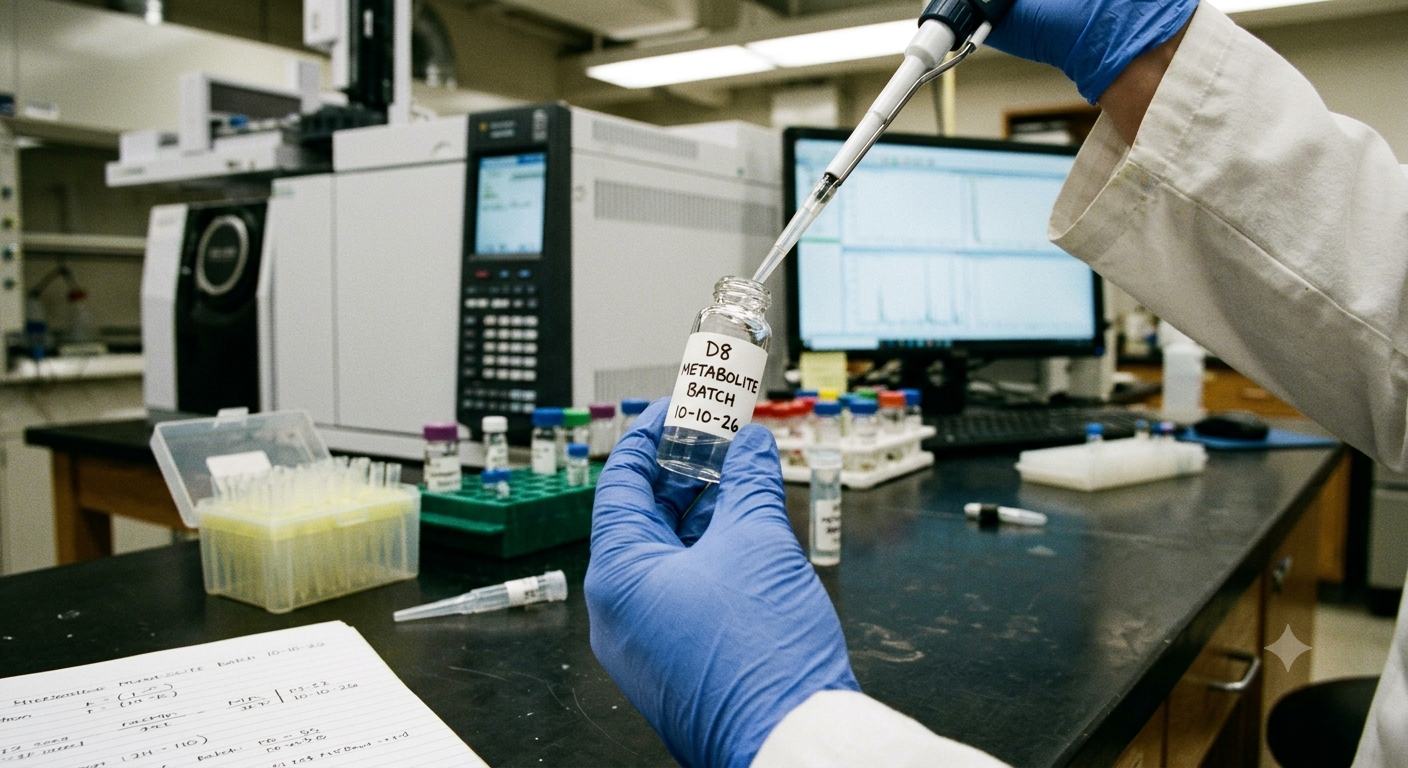
Yes, delta 8 can show up on a drug test. Standard urine screens use antibodies that react to delta-8's main metabolite much like they react to marijuana's, so you'll usually screen positive for cannabinoids. What happens on the follow-up lab test depends on the lab's method, and nobody has a delta-8 safe window.
6 of 6
commercial urine screening kits reacted to delta-8 in a 2023 lab study
2 of 4
delta-8-only cases a hospital confirmation panel reported as a delta-9 metabolite
0 of 27
delta-8 vapes with accurate delta-8 labeling in a 2021 analysis
15 ng/mL
federal DOT confirmation cutoff for the marijuana metabolite
Does Delta 8 Show Up on a Drug Test? The Short Answer
For most people, yes. If you've used delta-8 gummies, vapes, flower or tinctures and you take a standard workplace urine test, plan on a positive cannabinoid screen. The type of product you used, how often you used it and how sensitive the test is all change the odds, but none of them make delta-8 a safe bet.
The confusing part is that delta-8 was sold as legal hemp. Drug tests don't check where a product came from or what the label said. They check for chemical markers in your urine, saliva, blood or hair. If you want the same breakdown for THCA flower, read our guide on whether THCA shows up on a drug test.
Why Delta-8 Trips a Standard THC Screen
Delta-8 THC and delta-9 THC (the main compound in marijuana) differ by the position of a single double bond. Your liver processes both the same way, first into an active 11-hydroxy form and then into an inactive carboxylic acid that leaves the body in urine.
Most workplace tests start with an immunoassay, a fast and cheap screen that uses antibodies tuned to the marijuana metabolite. Because the delta-8 metabolite looks so similar, the antibodies grab it too. A 2023 study in the Journal of Analytical Toxicology tested six commercially available urine kits and found that delta-8, its 11-hydroxy metabolite and its carboxy metabolite all cross-reacted, with sensitivity that varied by kit and cutoff (Wolf et al., 2023).
That same study found plain CBD didn't cross-react. That's useful context, but it doesn't make CBD products risk-free, because many contain some THC. We cover that in our CBD gummies drug test guide.
Can a Lab Tell Delta-8 From Delta-9?
This is where almost every article online gets it wrong. Many say the two "turn into the same metabolite," so a test could never tell them apart. That's not accurate. They become two different molecules that happen to look alike, and whether a lab separates them depends on its equipment and its method.
Here's how a typical test moves from screen to final result:
Screen (immunoassay)
Antibodies react to delta-8 and delta-9 metabolites alike. Delta-8 use usually reads as a cannabinoid positive.
Confirmation (lab instrument)
A positive screen goes to mass spectrometry, which looks for the delta-9 metabolite at a lower cutoff.
Result
Depending on the method, delta-8 can be reported as delta-9, can muddy the reading, or can be identified on its own.
Two documented cases show why the outcome isn't predictable:
| Source | What happened | What it means for you |
|---|---|---|
| NIH-indexed case series, 2023 | Four patients exposed only to delta-8 all screened positive. A hospital's in-house confirmation panel reported a delta-9 metabolite in two of them. A specialist lab later found only the delta-8 metabolite and no delta-9 at all. | Delta-8 can come back as a marijuana positive even on a confirmation test. |
| Quest Diagnostics lab note, 2021 | The two metabolites share a molecular weight and similar chemistry, so delta-8's can interfere with detecting delta-9's on definitive testing, risking a false negative. | Results can also skew the other way, which is why online stories conflict. |
| Specialist forensic labs | Advanced high-resolution panels can tell delta-8 and delta-9 metabolites apart. | Separation is possible, but it isn't what most routine workplace labs report. |
Sources for this table: Shaker et al., Journal of Medical Toxicology, 2023 and Quest Diagnostics, 2021. The practical takeaway: you can't plan around a lab catching the difference, and you can't plan around it missing it either.
How Long Does Delta-8 Stay in Your System?
Here's the honest answer most pages skip: nobody has published solid human data on how long delta-8 stays detectable. The numbers you'll see are estimates borrowed from delta-9 research, on the reasonable assumption that two near-identical molecules clear the body in a similar way. Even the delta-9 numbers vary a lot by person.
Use the table below as a rough planning guide, not a promise. The evidence column tells you how much weight each line can carry.
| Test | Occasional use | Frequent or daily use | Evidence behind the number |
|---|---|---|---|
| Urine (most common) | A few days, up to about a week | Several weeks; past 21 days is documented in chronic delta-9 users | Extrapolated from delta-9 studies |
| Saliva | Usually a day or two, mostly after smoking or vaping | Up to 8 days in one study of heavy delta-9 users | Extrapolated from delta-9 studies (Andås et al., 2014) |
| Blood | Mainly hours, so it reflects recent use | Can extend with heavy use | Extrapolated from delta-9 studies |
| Hair | Commonly cited as about 90 days | Commonly cited as about 90 days | Reflects the hair length tested; rarely used for routine screens |
The urine figures line up with drug-court research reporting cannabinoids detectable for up to about 7 days in occasional users and beyond 21 days in chronic users at standard cutoffs (Drug Court Review, 2005). For saliva, one study of heavy users in monitored abstinence found THC in oral fluid for up to 8 days (Andås et al., 2014). THC is stored in fat and released slowly, so body fat, frequency and dose matter more than anything else.
Even federal health officials flagged the data gap. The CDC's 2021 health advisory on delta-8 noted that how well hospital lab tests detect delta-8 still wasn't fully characterized (CDC HAN 00451).
What doesn't change the window: detox drinks, niacin, cranberry juice or chugging water. Diluted samples are often flagged and retested, so overhydrating can create a new problem instead of solving the old one.
What Your Delta-8 Use Means for an Upcoming Test
Readers usually want to know what their own situation looks like. The table below gives a rough read on each common case. It's built on delta-9 detection research, so treat it as risk guidance, not a countdown clock.
| Your situation | Likely risk on a urine test | What to keep in mind |
|---|---|---|
| One gummy or a few puffs, more than a week ago | Lower, not zero | Occasional delta-9 use is often undetectable within about a week, but dose, body fat and the kit's cutoff all shift that. |
| Used a few times in the past few days | High | Recent use is the most likely to screen positive at a 50 ng/mL cutoff, and lower cutoffs extend the window. |
| Weekly user who stopped recently | Moderate to high | Metabolites build up with repeat use, so expect a longer window than a one-time user. |
| Daily user for months | High for weeks | Chronic delta-9 users have tested positive beyond 21 days after stopping. Assume the same is possible here. |
| DOT or other safety-sensitive job | High consequence | A confirmed positive is verified even if you say it was hemp, CBD or delta-8. See the next section. |
What Happens After a Positive: Will "It Was Delta-8" Help?
In federally regulated testing, a lab-confirmed positive goes to a medical review officer (MRO), a physician who checks for a legitimate medical explanation before the result is reported. Hemp products don't count as one. The Department of Transportation said in its 2020 CBD notice that MROs will verify a confirmed marijuana positive even when an employee says they only used CBD, and it warned that product labels may understate THC (DOT ODAPC CBD Notice, 2020).
DOT went further in May 2026. Its updated guidance says a legitimate medical explanation requires a legally prescribed controlled substance under federal law, so state medical cards, doctor recommendations and dispensary receipts don't qualify, even with marijuana rescheduling in the news (DOT Part 40 Q&A, May 2026). If you're following the rescheduling story, our explainer on whether weed is Schedule III now covers where that stands.
Private employers aren't bound by DOT rules, and some will listen to context. Don't count on it, though. Most written policies treat any confirmed THC metabolite as a positive, no matter which product it came from.
Delta-8 Drug Test Risk by Product Type
No form of delta-8 is test-safe. The table compares the formats people ask about most, including the one detail that catches buyers off guard: some delta-8 products also contain delta-9 THC.
| Format | Risk | Why |
|---|---|---|
| Gummies and edibles | High | Each piece carries a measured dose, and regular use builds up metabolites. No study shows edibles clear faster than vapes. |
| Vapes and carts | High | Frequent small puffs add up quickly, and you rarely track total milligrams the way you do with gummies. |
| Delta-8 flower and pre-rolls | High | Usually hemp flower sprayed or coated with delta-8, which can also carry THCA that turns into delta-9 when lit. |
| Tinctures | High | Dose is easy to measure, but daily use is common and that extends detection. |
| Any delta-8 product | Plus a hidden factor | The FDA warns delta-8 is usually made by chemically converting CBD and that content varies between products. Check the COA for a delta-9 line. |
The FDA's consumer update explains how delta-8 is made and why product content varies (FDA, 5 Things to Know About Delta-8 THC).
Labeling is a real problem too. A 2021 analysis in Chemical Research in Toxicology, summarized by NORML, found that none of 27 delta-8 vape products tested had accurate delta-8 labeling, and 11 contained unlabeled cutting agents. If the label can be wrong about delta-8, it can be wrong about delta-9. If you're not sure how to read a lab report, our 60-second COA guide shows where to find the delta-9 and total THC numbers.
Drug Test Cutoffs: What 50 ng/mL and 15 ng/mL Mean
A cutoff is the amount of metabolite a test needs to see before it calls a sample positive. Federal Department of Transportation testing sets the screening cutoff for marijuana metabolites at 50 ng/mL and the confirmation cutoff at 15 ng/mL (49 CFR 40.85). Marijuana is one of the drug classes in the standard DOT five-panel test, and most expanded 10-panel and 12-panel workplace tests include it too. Many private employers copy the federal numbers, though some screens use a lower 20 ng/mL cutoff that catches use for longer.
- Lower cutoff: a longer detection window for the same amount of use.
- Two steps, two cutoffs: you can screen positive at 50 and still be confirmed at the lower 15 threshold.
- The confirmation target is delta-9's metabolite: that's why the lab's method decides how delta-8 gets read.
Why Some People Say They Passed After Using Delta-8
Search Reddit and you'll find threads where people swear they passed after delta-8, right next to threads where people failed. Both can be true, and the research above explains why.
- Kits differ. Cross-reactivity varies between immunoassay brands and cutoffs, so a light user might land under one kit's threshold and over another's.
- Confirmation methods differ. One lab's instrument may report delta-8 as delta-9. Another's may produce a muddied or negative delta-9 reading.
- Use patterns differ. One gummy two weeks ago isn't the same as a daily vape habit.
A stranger's result tells you about their test, their lab and their body. It can't tell you what yours will show.
Does the December 2026 Hemp Rule Change Affect Drug Tests?
No, not for testing purposes. The federal hemp redefinition limits hemp-derived products to 0.4 mg of total THC per container, with restrictions phasing in on November 12 and December 11, 2026 unless Congress changes course. Our hemp ban dates explainer breaks down which products are affected on which date.
That change is about what can legally be sold. It doesn't alter how immunoassays react or how labs confirm results. Delta-8 used before or after those dates leaves the same metabolites behind, and federal workplace testing panels didn't relax this year, as we covered in our 2026 federal drug testing update.
What to Do If You've Used Delta-8 and a Test Is Coming
- Stop using THC products now. Time is the only thing that reliably lowers metabolite levels.
- Read the actual policy. Some employers treat any THC positive as a violation. Others allow disclosure. DOT and safety-sensitive roles don't make exceptions for hemp.
- Keep your product records. A receipt and COA won't change a DOT result, but a private employer reviewing a case may still want the full picture.
- Skip detox products. They aren't evaluated for this purpose, and diluted or adulterated samples create their own problems.
- Ask a professional when stakes are high. For probation, licensing or a federal job, talk to the program, an employment attorney or a medical review officer before guessing.
Lower-Risk Options If You Get Tested
If passing a test matters for your job, the safest move is avoiding THC in every form, including delta-8, delta-9, THCA and full-spectrum CBD. Shoppers who still want a hemp product usually look at CBD isolate or broad-spectrum CBD with a batch COA that shows non-detectable THC. Lower risk still isn't zero risk, since labeling errors happen.
It also helps to understand how labels and lab numbers relate. Our guide to total THC vs delta-9 THC explains why a low delta-9 number on the front of a package doesn't tell the whole story, and our delta-8 vs delta-9 comparison covers how the two differ in effects. If you'd rather skip THC entirely, you can compare CBD edibles and check each batch COA before you buy.
Shopping Delta-8 at Mary Jane's Bakery Co.
If drug testing isn't a factor for you and delta-8 is legal where you live, you can browse our delta-8 edibles online or visit our 24-hour shop in Wynwood, Miami. Sales are for adults 21+ only, delta-8 doesn't ship to every state, and federal rules for hemp THC products are changing in late 2026, so check your state's rules and the product's COA before you order.
Delta-8 Drug Test FAQ
Will one delta-8 gummy make me fail a drug test?
It can. A single gummy may or may not push you over a screening cutoff, depending on the dose, your body and the kit used. Light, one-time use usually clears from urine within days, but there's no delta-8 specific data to promise a safe date, so treat any recent use as a real risk.
Is delta-8 harder to get out of your system than delta-9?
There's no good evidence either way. Delta-8 is stored in fat and broken down like delta-9, so most experts assume similar timelines. What clearly matters more is how often you use it, how much you take and your body fat, not which isomer you used.
How long does a delta-8 gummy stay in urine?
For occasional use, estimates run from a few days to about a week. Daily users can stay positive for several weeks. These figures come from delta-9 research, because no published study has measured delta-8 clearance in people. Edibles don't leave the body faster than vapes.
Can a drug test tell the difference between delta-8 and delta-9?
A routine screen can't. Some confirmation methods can separate the two metabolites, but published cases show labs have reported delta-8 as delta-9, and Quest Diagnostics warns delta-8 can also distort delta-9 readings. Don't count on the lab sorting it out in your favor.
Will CBD make me fail a drug test?
Pure CBD didn't trigger urine screens in the 2023 six-kit study, but many CBD products contain THC, especially full-spectrum ones. If testing matters, choose CBD isolate or broad-spectrum products with a batch COA showing non-detectable THC, and accept that small risks remain.
Can I tell my employer I used legal hemp delta-8?
You can, but in DOT-regulated testing it won't change a confirmed result. DOT says medical review officers verify confirmed marijuana positives even when an employee says the source was CBD or hemp. Private employers set their own policies, and most treat any confirmed THC metabolite as positive.
Sources
- Wolf CE et al. Cross-reactivity of cannabinoid analogs in six commercial urine immunoassays. Journal of Analytical Toxicology, 2023
- Shaker K et al. Delta-8-THC Exposure and Confirmation in Four Pediatric Patients. Journal of Medical Toxicology, 2023
- Quest Diagnostics. Delta-8-THC: A new synthetic cannabinoid poses problems for testing, 2021
- U.S. DOT. 49 CFR 40.85, drug test cutoff concentrations
- Drug Court Review. Marijuana detection window, 2005
- U.S. FDA. 5 Things to Know About Delta-8 Tetrahydrocannabinol
- U.S. DOT ODAPC. Notice on CBD products and drug testing, February 2020
- U.S. DOT. Part 40 Questions and Answers, May 2026
- CDC Health Alert Network. Increases in availability of cannabis products containing delta-8 THC, 2021
- Andås HT et al. Detection time for THC in oral fluid after frequent cannabis smoking. Therapeutic Drug Monitoring, 2014
- NORML summary of a 2021 Chemical Research in Toxicology analysis of 27 delta-8 vape products