

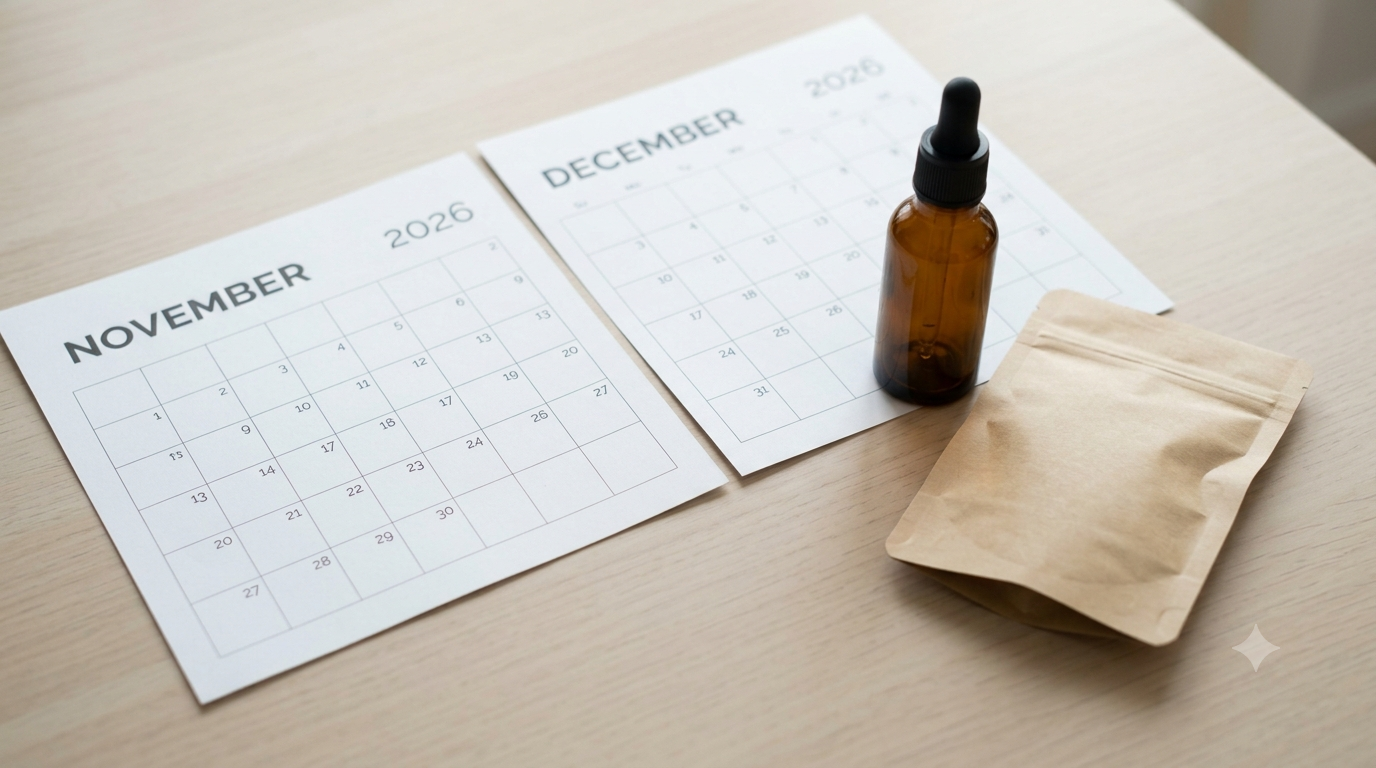
Quick answer: The federal hemp ban dates now split in two. Cannabinoids the cannabis plant can’t produce at all, like HHC and THC-O, lose federal hemp status on November 12, 2026. Everything else the new definition reaches, including delta-8, THCA and hemp delta-9, gets until December 11, 2026. Neither date was softened, only moved.
What changed on September 2, 2026
For most of this year, one date mattered: November 12, 2026. That’s when Section 781 of Public Law 119-37 was set to rewrite the federal definition of hemp, one year after it was signed.
Then Congress moved it. The House voted 370 to 48 on September 1 to accept the Senate’s version of H.R. 6500, the Continuing Appropriations and Extensions Act, 2027. The President signed it the next day. Section 2019 of that bill pushes most of the Section 781 restrictions back 29 days, to December 11, 2026, which is also the day the government funding in the same bill runs out.
What it didn’t do is change the rules themselves. The total THC standard is intact. The 0.4 milligram per-container cap is intact. A product that would’ve failed the test on November 12 still fails it on December 11. You got four more weeks, not a reprieve.
The two hemp ban dates, by product
This is the part most coverage gets muddy, because Section 2019 doesn’t move everything to the same date. It splits the market in two. Here’s where the common product categories land.
| What you’re holding | Federal date | Why |
|---|---|---|
| HHC, THC-O and other lab-made cannabinoids the plant can’t produce | November 12, 2026 | Excluded by the one part of Section 781 that wasn’t delayed |
| Delta-8 and delta-10, including converted versions | December 11, 2026 | The plant does make these in trace amounts, so the delay reaches them |
| THCA flower, pre-rolls and plant-derived concentrates | December 11, 2026 | Fails the new total THC test once THCA counts |
| Hemp delta-9 gummies, chocolates and drinks | December 11, 2026 | Fails the 0.4 mg per-container cap |
| Full-spectrum CBD above 0.4 mg total THC per container | December 11, 2026 | Also fails the cap, depending on how the product is formulated |
| CBD isolate and broad-spectrum products under the cap | No change | Stays inside the hemp definition |
| Industrial hemp for fiber, grain and seed | No change | Written into the new definition and protected |
If you buy delta-8 online, your date is December 11. If you buy THCA flower, your date is also December 11, and the reason is different: the federal yardstick switches from delta-9 alone to total THC, which is delta-9 plus 0.877 times THCA. Most smokable THCA flower doesn’t survive that math.
One nuance worth holding onto: through December 10, the older 0.3% delta-9 standard still applies. That’s what keeps THCA flower federally compliant right up until the switch.
Why some sites say delta-8 is banned on November 12
Search this topic and you’ll find reputable sources giving two different answers for delta-8. Some say November 12. Some say December 11. They’re reading two different parts of the same statute, and the difference is real.
Section 781 pushes products out of the hemp definition through two separate exclusions. According to the Congressional Research Service, the new definition excludes hemp-derived cannabinoid products containing:
- cannabinoids that are not capable of being naturally produced by a Cannabis sativa L. plant, or
- cannabinoids that can occur naturally but were synthesized or manufactured outside the plant.
Section 2019 only carved out the first one. Attorney Rod Kight, who tracks this statute closely, put it plainly the day the House voted: Congress didn’t postpone the restriction on cannabinoids the plant can’t make, while the exclusion covering naturally occurring cannabinoids that were manufactured outside the plant sits with the provisions delayed to December 11.
So where does that leave delta-8? The cannabis plant does produce delta-8, just in tiny quantities. That means delta-8 isn’t in category one. It’s in category two, which got the extra month. Commercial delta-8 made by converting CBD still loses federal hemp status, but on December 11, not November 12.
The sites saying November 12 aren’t inventing anything. They’re treating “converted” and “not naturally producible” as the same test. Under the text, they’re not.
What the 0.4 mg per container cap actually does
The cap is the quiet part of this law, and it’s the piece that reaches the most products. A finished hemp-derived cannabinoid product falls outside the hemp definition if it holds more than 0.4 milligrams of total THC per container.
Per container. Not per serving. Not per gummy. The container is the innermost package that physically holds what you buy.
Run the numbers on something ordinary. A 20-count jar of 5 mg gummies holds 100 mg of THC in total. That’s 250 times the cap, in a package plenty of people would call low-dose. A single 10 mg seltzer is 25 times the cap on its own. This is why industry groups keep estimating that roughly 95% of today’s hemp cannabinoid products fall outside the new definition.
We’ve written a fuller breakdown of how the per-container cap works, and a walkthrough of what it means for gummies specifically, if you want the longer version.
What happens to products you already own
This is the question we hear most, and the honest answer has three parts.
There’s no grandfather clause. Section 781 doesn’t say “except for anything purchased before the deadline.” The transition relief Congress built in was the one-year runway itself. A jar you bought in June and a jar bought next week land in exactly the same place once the definition changes.
Section 781 also doesn’t create a new possession offense. It changes what counts as hemp. It doesn’t, by itself, write a consumer-possession crime into federal law.
What actually applies to you runs product by product, and state by state. The sequence is: does the product still fit the amended hemp definition? If not, how is it classified federally? And what does your state say, which may be stricter and may have arrived sooner? The Congressional Research Service has also noted that it isn’t clear how federal agencies plan to enforce any of this.
One practical takeaway from all of that: a big pre-deadline order isn’t the safe move some people think it is. With no grandfather clause, buying a year’s supply mostly means holding a lot of something that stops being federal hemp on a known date. Buy what you’ll use.
What this means if you shop in Florida
Florida buyers are in an unusual spot, because part of this change already happened here.
Florida regulates hemp extract through FDACS under Rule 5K-4.034, which measures compliance on a total delta-9 THC basis rather than delta-9 alone. FDACS began enforcing the amended rule on June 16, 2025. In practice, high-THCA flower has been restricted at Florida retail since then, which is why compliant Florida shelves already look different from shelves in states with no total-THC standard.
So the THCA half of the federal change landed in Florida more than a year ago. What’s coming on December 11 for Florida shoppers is mostly the other half: the 0.4 mg per-container cap hitting edibles, gummies and drinks that are fully legal under Florida rules today, plus delta-8 losing federal hemp status.
Our Florida hemp rules guide covers the state-level labeling, COA and 21+ requirements that apply right now, separately from anything Congress does.
What’s still unsettled before December 11
Three things are still open, and anyone telling you otherwise is guessing.
The FDA hasn’t published what the law told it to publish. Section 781 directed the agency to release lists of naturally occurring cannabinoids, THC-class cannabinoids and cannabinoids with similar effects, and to add detail to the term “container,” within 90 days of enactment. That deadline was February 10, 2026. As of today, none of it has appeared. That leaves a real gap in how a multi-serving package gets measured.
December 11 is a double deadline by design. The same bill that moved the hemp date funds the government to that date. Congress has to pass something by then, which puts hemp back on a must-pass bill automatically.
Several bills are pending and none has moved. Proposals to push the date to 2028, repeal the change outright, replace it with a federal regulatory framework, or carve out hemp beverages are all sitting in committee. Meanwhile 35 state attorneys general have written to Congress asking it to reject further delay. We’re not going to predict which way that goes.
What’s likely still on shelves in January
Assuming the law lands as written, the products that survive intact are the ones that were never built around a high THC number.
CBD isolate and broad-spectrum products that stay under 0.4 mg of total THC per container fit the amended definition without reformulation. Some full-spectrum products will too, depending on how they’re made and how the per-container measurement gets applied once the FDA weighs in. Topicals, tinctures and non-intoxicating formats are the categories least disturbed by the change. If you’re thinking about what to try before the market shifts, our CBD oil tinctures sit in that group.
Whatever you buy, between now and December the habit that helps most is checking the batch COA and matching the batch number on the package. That was good practice before any of this, and it’s better practice now.
Frequently asked questions
Is delta-8 illegal on November 12, 2026?
Under the statutory text, no. Delta-8 occurs naturally in the plant, so it falls into the group of cannabinoids the Section 2019 delay covers. Its federal date is December 11, 2026. Cannabinoids the plant can’t produce at all, such as HHC and THC-O, keep the November 12 date.
Is THCA flower still legal after November 12?
Federally, yes, through December 10, 2026. The delay preserves the older 0.3% delta-9 standard until then, and THCA isn’t counted under it. Starting December 11 the measure becomes total THC, and most smokable THCA flower won’t qualify. State rules can be stricter and often are.
Is there a grandfather clause for products I already bought?
No. Section 781 contains no exemption based on when you purchased something. It also doesn’t create a standalone federal possession offense on its own. What applies afterward depends on the specific product’s classification and on your state’s law, so the answer isn’t uniform.
Did the delay change the 0.4 mg per-container limit?
No. The limit was postponed, not raised or removed. Starting December 11, 2026, a finished hemp-derived cannabinoid product holding more than 0.4 milligrams of total THC per container falls outside the federal hemp definition, exactly as the original law wrote it.
Could the hemp ban be delayed again?
It’s possible. Government funding expires December 11, so Congress has to pass another bill by that date, and that bill is the obvious vehicle for another change. Bills to delay, repeal or replace the law exist but none has advanced past committee, and the White House has said this was the last extension it supports.
Sources
- Congressional Research Service, Change to Federal Definition of Hemp and Implications for Federal Enforcement (IN12620)
- H.R. 5371, Public Law 119-37, Section 781
- The White House, statement on H.R. 6500 signed into law, September 2, 2026
- Kight Law, analysis of Section 2019 of H.R. 6500, September 2026
- Florida Administrative Code Rule 5K-4.034, Hemp Extract for Human Consumption
- FDACS, enforcement reminder on amended Rule 5K-4.034, June 16, 2025 enforcement date