

Adults 21+ • Education only
Full-spectrum CBD is popular because it includes a wider range of hemp compounds. The tradeoff is simple:
full-spectrum products often contain some THC (even if it is “trace”).
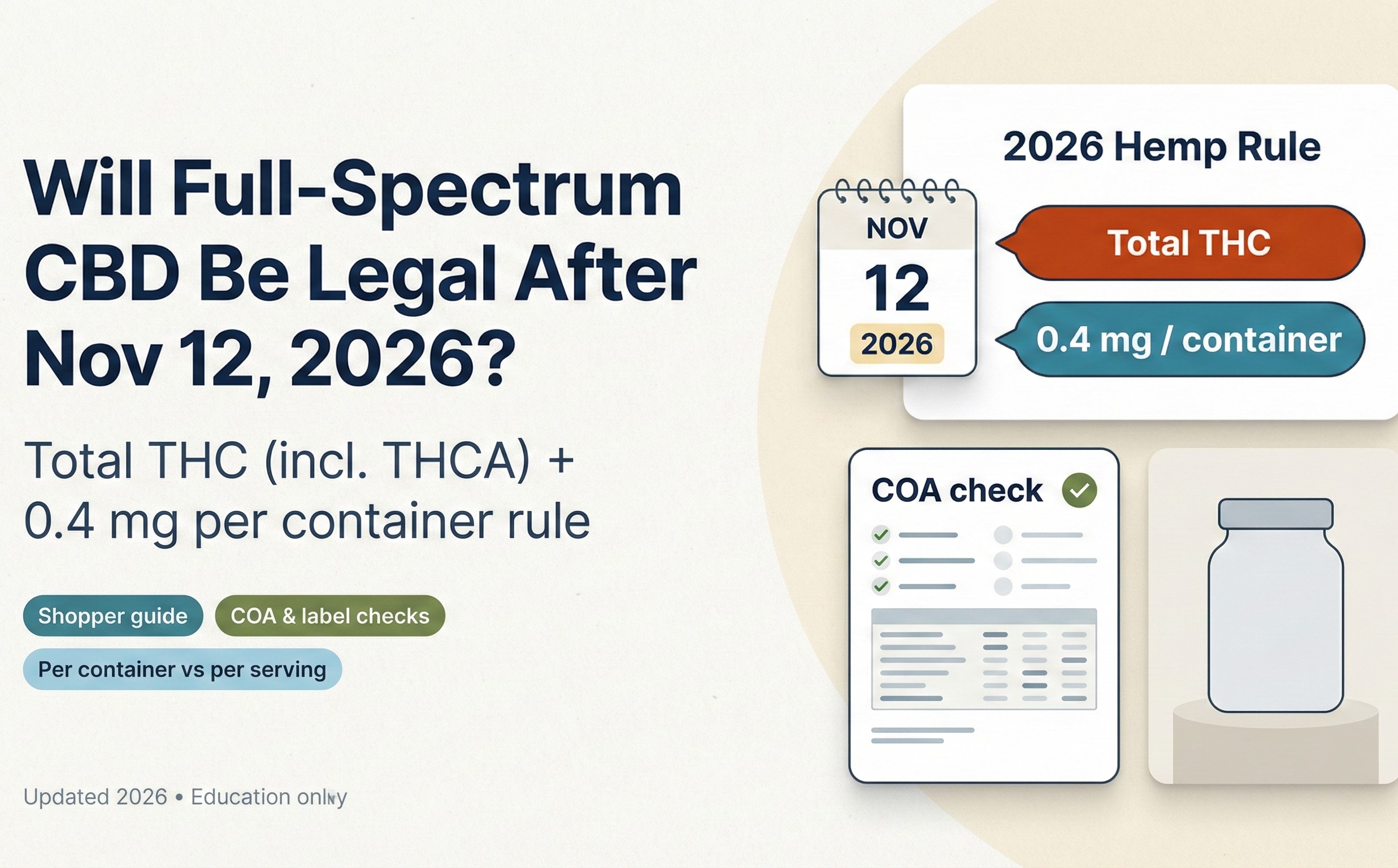
And the 2026 hemp definition change is heavily focused on Total THC and a strict 0.4 mg total THC per container cap for many finished retail products.
Quick answer
It depends on the product’s total THC per container. After Nov 12, 2026, many final hemp-derived cannabinoid products with
more than 0.4 mg combined total per container may fall outside the federal “hemp” definition.
Because full-spectrum CBD can include THC, some full-spectrum oils, gummies, and drinks may be impacted unless they are formulated and tested
to stay under that per-container limit.
If you want the two “must-know” primers first:
0.4 mg per container rule explained •
Total THC formula (THCA × 0.877 + Δ9)
Laws and enforcement can change, and some states are stricter than federal baseline.
If you are subject to workplace drug testing or licensing rules, do not guess—read COAs and talk to a qualified professional.
1) Why full-spectrum CBD is the main “at risk” label
The term full-spectrum usually means the product contains CBD plus other hemp compounds—often including some THC.
That is not automatically “bad,” and many people actively prefer it. But under a strict per-container THC cap,
even small amounts can matter when you add them up across an entire bottle, jar, or bag.
A product can look “low THC” per serving and still exceed limits once you calculate the total across the whole container.
If you want a clear breakdown of what these labels really mean, this guide helps:
CBD isolate vs full-spectrum vs broad-spectrum (what’s the difference?)
2) What changes on Nov 12, 2026 (shopper version)
A lot of hemp marketing historically fixated on one number: delta-9 THC.
The federal summary changes discussed by government references shift toward Total THC (including THCA)
and place a strict restriction on many final hemp-derived cannabinoid products sold in retail packaging.
| What shoppers will notice | What it means | Why it affects full-spectrum CBD |
|---|---|---|
| Total THC matters more | “Total THC” includes more than delta-9 alone (often including THCA where relevant). | Full-spectrum products can contain multiple THC-related lines on a COA. |
| Per-container totals matter | Some restrictions are based on total THC in the entire package, not one serving. | Even “trace” THC can add up in a 30 mL tincture or a multi-gummy jar. |
| Finished products get attention | Packaged items like gummies, drinks, oils are treated as final consumer products. | Full-spectrum often shows THC in the finished item’s COA. |
If you want an overview of the broader 2026 change, see:
2026 Hemp Cliff guide.
3) Per container vs per serving (the biggest confusion)
Per container = the total across the entire package (the bottle, jar, bag, or cartridge that directly holds the product).
This difference is why so many shoppers feel confused. A label may list “per serving” amounts that look small,
but the rule people are discussing for 2026 is about the total in the whole retail container.
If you want a dedicated explanation that stays simple:
Is the 0.4 mg THC limit per serving or per container?
4) Full-spectrum vs broad-spectrum vs isolate (2026 reality)
These words are used everywhere, but they are not equally strict. The only reliable truth is what the COA shows.
Still, here is the plain shopper version:
- Full-spectrum: CBD + other hemp compounds, often including some THC.
- Broad-spectrum: multiple cannabinoids, but THC is removed (quality varies; COA still matters).
- CBD isolate: CBD only (lowest THC exposure risk in theory, but still verify with a COA).
Full-spectrum might still exist, but it becomes much more dependent on the exact mg totals shown on the COA.
Deep guide :
Isolate vs full-spectrum vs broad-spectrum
5) How to check a COA for 2026 (simple math)
If you only do one thing before buying in 2026: learn how to translate a COA into a per-container total.
You do not need to be a chemist. You just need to avoid one mistake: mixing “per serving” thinking with “per container” rules.
Step 1: Find the THC lines on the COA
- Look for Δ9-THC
- Look for THCA (if present)
- Look for any “Total THC” line (some labs list it directly)
For Total THC clarity (and why you see the 0.877 factor):
Total THC vs delta-9 THC (THCA × 0.877)
Step 2: Convert to “per container” totals
These are the two most common label/COA patterns shoppers see:
Pattern A: COA shows mg per serving
If the COA (or label) shows THC in mg per serving, multiply by the number of servings in the package:
Total mg in container ≈ (mg per serving) × (servings per container)
Example (illustration only): 0.05 mg THC per serving × 30 servings = 1.5 mg THC per container.
Pattern B: COA shows mg/mL for tinctures
If the COA shows THC as mg per mL, multiply by the bottle size:
Total mg in container ≈ (mg per mL) × (mL in bottle)
Example (illustration only): 0.02 mg/mL × 30 mL bottle = 0.6 mg THC per container.
do not guess. Choose a product with clearer reporting or contact the brand for clarification.
If drug testing is part of your life, this guide is especially relevant:
CBD tincture + drug test guide (full-spectrum vs isolate)
6) Product-path guidance (calm, non-salesy)
This section is not telling you what to “take.” It is a practical way to think about products when rules tighten.
Your best friend is still the COA.
If your goal is “lowest THC exposure risk”
- Start with CBD isolate or broad-spectrum products.
- Verify THC lines show ND/LOQ where appropriate (and the COA matches the batch).
- Use the simplest format you can read confidently (often gummies or a clearly labeled tincture).
If you prefer full-spectrum (and want to keep shopping responsibly)
- Make sure the COA shows clear THC numbers (not just “compliant”).
- Always convert to per container totals (not just per serving).
- Be cautious with larger containers and multi-packs, because totals add up.
Helpful “format-first” guide for shoppers:
CBD Products Guide 2026
“Can you send the COA for this exact batch and confirm the total THC across the entire container (not just per serving)?”
If you want a category example that is actively changing fast, see:
Hemp-derived THC gummies in 2026.
7) What is still unclear (and what to watch)
Even when a rule is written down, real-world outcomes depend on implementation, agency guidance, and enforcement priorities.
Government summaries note that FDA is expected to publish lists of cannabinoids and provide more clarity around the term “container.”
- FDA lists of “THC class” and “similar effects” cannabinoids (this affects what gets counted).
- How “container” is applied to multi-packs, inner pouches, sampler packs, and bundles.
- State rules (some states may align early or set stricter retail sales requirements).
Miami readers: local enforcement patterns can change before federal deadlines. See:
Florida hemp law update 2026 and
CBD vs Delta-8 vs THCA in Miami.
FAQ
Will full-spectrum CBD be legal after Nov 12, 2026?
It depends on the product’s total THC per container and how it is classified where you live.
If a finished retail product exceeds strict per-container THC thresholds, it may fall outside the federal “hemp” definition after the effective date.
Always verify with the product’s COA and your state rules.
Is the 0.4 mg THC limit per serving or per container?
It is per container—the total across the entire retail package (bottle/jar/bag/cart), not one serving.
Deep explanation:
0.4 mg per container rule explained.
Does THCA count toward “total THC” and these limits?
In Total THC reporting approaches, THCA is included because it can convert to delta-9 THC with heat.
See:
Total THC vs delta-9 THC.
What is the safest label if I want to avoid THC?
Broad-spectrum and isolate products may reduce THC exposure risk, but the only reliable answer is the COA.
If your job depends on drug testing, consider avoiding cannabinoid products unless you have professional guidance.
More:
CBD + drug test guide.
What should I do now (before 2026)?
Learn COA basics and “per container” math. Then choose products with clear batch-matched lab reports.
Start here:
CBD Products Guide 2026.
Official sources (for readers who want the original documents)
These links are included so readers can verify definitions and timelines directly.
- CRS: Change to Federal Definition of Hemp and Implications for Federal Enforcement (IN12620):
congress.gov - CRS In Focus: Changes to the Statutory Definition of Hemp and Issues for Congress (IF13136):
congress.gov - CRS Legal Sidebar (PDF): Changes to the Federal Definition of Hemp—Legal Considerations Under the CSA (LSB11381):
congress.gov (PDF) - U.S. Code reference (reader-friendly): 7 U.S.C. § 1639o (hemp definition):
law.cornell.edu - USDA Hemp Program FAQs (background on federal hemp testing framework):
usda.gov - FDA overview: Regulation of cannabis and cannabis-derived products (including CBD):
fda.gov