

Written by: Mary Jane’s Bakery Co. Editorial Team | Reviewed: September 29, 2026
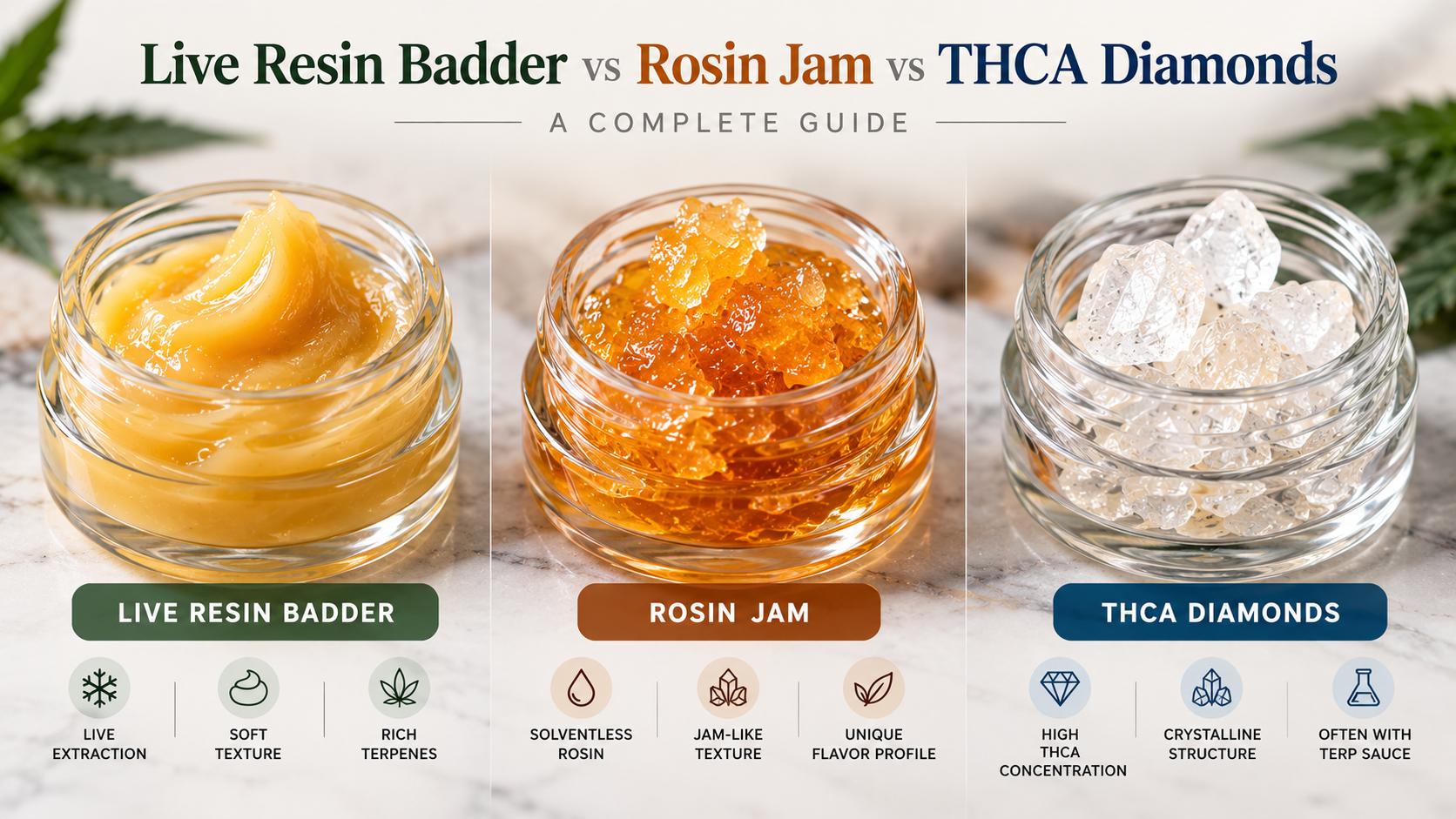
Live resin badder, rosin jam, and THCA diamonds can appear beside one another on a concentrate menu, but the names do not describe three perfectly equivalent product categories. Some words describe how the plant material was handled, some describe extraction, others describe texture, and others describe cannabinoid structure.
Process ≠ Texture ≠ Cannabinoid Composition ≠ Quality.
Live Resin Badder vs Rosin Jam vs THCA Diamonds at a Glance
| Concentrate | What the name mainly describes | Typical form | What the name does not prove |
|---|---|---|---|
| Live Resin Badder | Starting-material context + extraction family + texture | Soft, creamy, whipped or batter-like | Exact potency, terpene level, freshness or quality |
| Rosin Jam | Solventless extraction family + finished consistency | Saucy, jam-like or semi-crystalline | That it is automatically stronger, safer or better |
| THCA Diamonds | Cannabinoid-rich crystalline structure | Visible crystals, sometimes combined with sauce | Extraction method, terpene profile or overall quality |
Why Concentrate Labels Are So Easy to Misread
Cannabis concentrate names often combine several pieces of information into two or three words. That is why terms such as live resin badder, live rosin jam, diamond sauce, live resin sugar, and THCA diamonds can sound like completely different categories even when some of the words describe different characteristics of the same concentrate.
A better approach is to break the label apart before comparing products.
The Four-Layer Concentrate Decoder
| Layer | Question it answers | Examples | What it does not tell you |
|---|---|---|---|
| Starting material | What condition was the plant material in before processing? | Live / fresh-frozen, cured | Potency or quality |
| Extraction family | How was resin separated from the starting material? | Resin, rosin | Finished texture |
| Texture / finish | What consistency does the concentrate have? | Badder, sugar, sauce, jam | Extraction method or THC percentage |
| Composition / structure | What physical or cannabinoid-rich structure is emphasized? | THCA diamonds, crystals, terpene-rich sauce | Complete production history |
LIVE → tells you about the starting-material context.
RESIN → tells you about the extraction family.
BADDER → tells you about the finished consistency.
It still does not tell you the exact THCA percentage, delta-9 THC, terpene content, contaminant testing, age of the batch, or whether the product matches your priorities.
What Is Live Resin Badder?
Live resin badder is generally a live-resin concentrate finished into a soft, whipped or batter-like consistency. In common industry usage, “live” usually refers to plant material preserved through freezing rather than undergoing a conventional drying and curing period before extraction.
“Badder” describes consistency. It is not an extraction method by itself. A product labeled only as badder therefore does not automatically tell you whether it is live resin, cured resin, rosin, a particular potency, or a particular terpene percentage.
If your question is specifically about cartridges rather than jarred concentrates, read our live resin vs distillate carts guide.
What Is Rosin Jam?
Rosin belongs to the solventless concentrate family. Rosin production uses mechanical separation and pressure with controlled heat rather than the solvent-based extraction methods commonly associated with resin concentrates.
“Jam” describes a finished consistency. Rosin may be processed into different textures, so the words rosin and jam should not be treated as synonyms.
A rosin jam may appear glossy, saucy, or semi-crystalline depending on the starting material and post-extraction processing.
What Are THCA Diamonds?
THCA diamonds are crystalline formations containing a high concentration of tetrahydrocannabinolic acid, or THCA. THCA is an acidic cannabinoid precursor that can convert to delta-9 THC through decarboxylation, including exposure to sufficient heat.
Diamonds may appear as distinct crystals or be combined with a more fluid concentrate fraction commonly described as terp sauce or diamond sauce.
The word “diamonds” therefore tells you primarily about crystalline structure. It does not reveal the product's complete extraction history.
THCA Diamonds vs Diamonds in Terp Sauce
THCA Diamonds
The emphasis is on the crystalline cannabinoid-rich portion of the concentrate. The actual batch report should be used to determine measured cannabinoid concentrations.
Diamonds in Sauce
Crystalline material is combined with a more fluid concentrate fraction. The exact cannabinoid and terpene profile can vary by product and batch.
Terms such as diamond sauce and liquid diamonds are not necessarily standardized across every producer. When terminology becomes unclear, the product label, ingredient information, batch COA and manufacturer documentation are more useful than the nickname alone.
Live Resin Badder vs Rosin Jam: What Is Actually Different?
| Factor | Live Resin Badder | Rosin Jam |
|---|---|---|
| Extraction family | Typically solvent-based live-resin extraction | Solventless rosin extraction |
| Starting material | Commonly fresh-frozen | Varies; live rosin generally begins with fresh-frozen material |
| Finished texture | Soft, creamy, whipped or batter-like | Jam-like, glossy, saucy or semi-crystalline |
| Does the name reveal potency? | No | No |
| Does it prove quality? | No | No |
| Price tendency | Often more scalable to produce | Often more labor- and yield-intensive |
Why Does Rosin Jam Often Cost More Than Live Resin Badder?
The price gap is usually better explained by production economics than by a simple claim that one concentrate is “better.”
Solventless rosin production may involve several labor-intensive steps, including separating trichomes, carefully drying the resulting material, and pressing it into rosin. Yields can also be lower than more scalable solvent-based extraction systems.
Several factors can therefore increase the price of a rosin product:
- lower finished yield from the starting material;
- more hands-on labor;
- specialized cold handling or drying equipment;
- small-batch production;
- quality and cost of the starting material;
- storage and distribution requirements; and
- brand and retail pricing.
THCA Diamonds vs Live Resin: Which Is Stronger?
Live resin may contain a broader mixture of cannabinoids and aromatic compounds, while diamonds emphasize a crystalline cannabinoid-rich portion. Products vary by batch, formulation and processing.
This is why “diamonds” should not automatically be translated into “better,” just as “rosin” should not automatically be translated into “stronger.”
Texture Does Not Equal Potency
| Term | Usually describes | Does not automatically tell you |
|---|---|---|
| Badder / Budder | Soft or whipped consistency | Extraction method or potency |
| Sugar | Grainy or crystalline texture | Overall cannabinoid concentration |
| Sauce | More fluid concentrate fraction | Exact terpene level or whether diamonds are present |
| Jam | Jam-like or semi-crystalline finish | Potency or quality |
| Diamonds | Crystalline cannabinoid-rich structure | Complete extraction history or overall quality |
How Should Live Resin Badder, Rosin Jam and Diamonds Be Stored?
Storage matters because heat, light, air and repeated temperature changes can affect concentrate consistency and volatile aromatic compounds over time.
Always follow the manufacturer's storage instructions first. Different formulations and packaging can have different requirements.
| Format | General storage priority | What to avoid |
|---|---|---|
| Live Resin Badder | Keep sealed, cool, dark and protected from repeated temperature swings. | Heat, prolonged light exposure, unnecessary opening and moisture. |
| Rosin Jam | Cold storage is commonly used for longer freshness; follow the producer's instructions. | Opening a very cold jar immediately, repeated warming/cooling and moisture exposure. |
| THCA Diamonds / Sauce | Keep sealed and protected from heat, light and air. | Leaving the jar open, warm environments and contamination from handling. |
Do not assume that refrigeration is required for every concentrate. Product-specific instructions should take priority over a generic rule.
How to Read the COA When Comparing Concentrates
A certificate of analysis moves the comparison from marketing language to batch-specific evidence.
Mary Jane’s Bakery Co. maintains a Certificate of Analysis library. If laboratory reports are new to you, see our 60-second cannabis COA guide.
| COA field | Why it matters |
|---|---|
| Product identity | Confirm that the report describes the correct product or matrix. |
| Batch / lot number | Helps confirm that the laboratory report belongs to the product being evaluated. |
| THCA | Shows the measured THCA concentration in the tested sample. |
| Delta-9 THC | Shows measured delta-9 THC rather than relying on the front-label name. |
| Other cannabinoids | Provides more context than one headline potency number. |
| Terpenes | Useful if a terpene panel was actually performed. |
| Residual solvents | Relevant when reviewing solvent-extracted products if this panel was performed. |
| Other contaminant panels | Check the report itself rather than assuming every category was tested. |
| Test date | Helps determine how current the laboratory report is. |
How to Decode a Real Concentrate Label in 30 Seconds
- Read the complete product name. Separate words describing starting material, extraction, texture and cannabinoid structure.
- Find the cannabinoid information. Do not infer potency only from terms such as diamonds or live.
- Find the batch or lot number. This is what should connect the package with its laboratory report.
- Use the QR code or batch lookup. Open the report associated with that exact product batch.
- Compare package and COA. Product identity, batch information and cannabinoid results should make sense together.
- Check test scope. Look for which contaminant, solvent, terpene or other panels were actually performed.
- Check date and storage instructions. A technically impressive label cannot correct poor storage or outdated documentation.
What Florida Buyers Should Verify
Product format and legal status are separate questions. A label saying rosin, badder, live resin, diamonds or sauce does not by itself determine whether a product qualifies under Florida's hemp framework.
Florida's 2026 hemp statute requires covered hemp extract sold in the state to have an independent laboratory certificate of analysis and requires specified package information, including a scannable barcode or QR code linked to the batch COA, a batch number, expiration date, website for batch information and marketed cannabinoid amounts per serving.
Florida also restricts hemp extract intended for ingestion or inhalation from sale to people under 21.
Why a High THCA Number Does Not Automatically Mean a Better Jar
A laboratory result tells you what was measured in the tested sample. It does not independently tell you whether:
- the product is fresh;
- the texture was stored correctly;
- the aroma profile matches your preference;
- every contaminant category was tested;
- the product represents good value for its price; or
- you will prefer it over a different concentrate.
The highest number on a label is therefore not a complete product score.
What About Terpenes?
Terpenes are volatile aromatic compounds found in cannabis and many other plants. Extraction conditions and storage can influence the chemical profile of a finished extract.
A 2026 scientific review of Cannabis sativa extraction methods found that variables including extraction technique, temperature, solvent, time and pressure can influence cannabinoid and volatile-compound profiles.
However, the word “live” does not guarantee a particular terpene percentage. If terpene concentration matters to you, check whether the actual batch received terpene testing and read those results.
Which Concentrate Gives You the Best Value?
“Best value” is different from “lowest price” and different again from “highest potency.”
| Your priority | What to compare | Do not rely only on |
|---|---|---|
| Understanding process | Resin vs rosin, starting material and producer information | Texture name |
| Comparing consistency | Badder, jam, sugar, sauce or crystals | THCA percentage |
| Comparing cannabinoid concentration | Batch COA | Words such as premium or diamonds |
| Comparing aroma composition | Terpene panel when available | The word live alone |
| Comparing price | Process, batch size, starting material, testing and storage | Assuming expensive always means better |
The 30-Second Concentrate Buying Decision
Step 1: Identify whether the unfamiliar word describes process, texture or cannabinoid structure.
Step 2: Decide what matters most to your comparison: process, texture, batch composition, documentation or value.
Step 3: Ignore unsupported superlatives such as “best,” “purest,” or “strongest.”
Step 4: Match the product with its batch-specific COA.
Step 5: Check storage instructions and current legal requirements before treating the product name as enough information.
Shopping for Concentrates in Miami?
Miami shoppers may encounter many overlapping terms across hemp-derived concentrate menus. Technical-sounding names can still leave important questions unanswered.
Use this sequence:
Mary Jane's Bakery Co. serves Miami shoppers as a CBD/THC smoke shop, not as a Florida medical marijuana treatment center. Inventory can change, so verify the specific current product and its documentation instead of assuming every concentrate format discussed in this guide is always in stock.
View our Miami store information, browse the current online shop, or review our COA library.
Final Comparison: What Each Label Really Tells You
| If the label says... | You can reasonably infer... | You should still verify... |
|---|---|---|
| Live Resin Badder | A live-resin product finished with a badder-like consistency | Batch potency, testing, freshness and storage |
| Live Rosin Jam | A solventless rosin-family product with a jam-like finish | Batch cannabinoids, source material, testing and storage |
| THCA Diamonds | Crystalline material rich in THCA | Actual cannabinoid results, extraction details and testing |
| Diamonds in Sauce | Crystals combined with a more fluid concentrate fraction | Exact formulation, terpene results and batch COA |
The best way to compare concentrates is not to ask which marketing term sounds most impressive. Identify what each word on the label actually describes and then verify the product with batch-specific evidence.
Frequently Asked Questions
Is live resin badder the same as live resin?
Live resin is a broader extract category. Badder is one consistency live resin can take. A live-resin product may also appear as sugar, sauce or another finished texture.
Is badder the same as rosin?
No. Badder primarily describes consistency. Rosin describes a solventless extraction family. Rosin can itself be finished into different textures.
Is rosin jam the same as live resin badder?
No. Both may have soft or saucy textures, but the names indicate different extraction families and different finished forms.
Why is rosin jam often more expensive than live resin badder?
Solventless rosin production can involve lower yields, more hands-on labor, specialized processing and smaller production batches. Those factors can raise production cost, but a higher retail price does not automatically make a specific jar better.
Are THCA diamonds stronger than live resin?
THCA diamonds can contain a highly concentrated crystalline THCA fraction, but two specific products should be compared using their batch cannabinoid results rather than the category name alone.
What is diamond sauce?
Diamond sauce generally describes cannabinoid-rich crystals combined with a more fluid concentrate fraction. Exact formulations differ, so check the specific label and batch report.
Does live resin badder need refrigeration?
Storage recommendations vary by product. Protect concentrates from heat, excessive light, air and repeated temperature changes, and follow the producer's instructions. Do not assume every badder requires the same storage method.
Should rosin jam be refrigerated?
Cold storage is commonly used to preserve rosin quality over longer periods, but follow the manufacturer's instructions. If a product has been refrigerated, allowing the sealed jar to approach room temperature before opening can reduce condensation risk.
Does solventless mean safer?
Not automatically. Solventless describes an extraction method. Product quality and safety depend on additional factors including the starting material, processing controls, storage and batch testing.
Does a COA prove a concentrate is high quality?
No. A COA provides laboratory information about the tested sample or batch. Check the product match, batch number, test date, cannabinoid results and the panels that were actually performed.
Are THCA diamonds legal in Florida?
The word “diamonds” does not determine legal status. The actual cannabinoid composition, product category, applicable hemp requirements and current state and federal rules matter.
How This Guide Was Researched
This guide was reviewed on September 29, 2026 by the Mary Jane's Bakery Co. Editorial Team. Its purpose is to help adult shoppers decode concentrate terminology, compare batch information and understand what product labels can and cannot prove.
The research process included current scientific literature on cannabis extraction, Florida's 2026 hemp statute, Mary Jane's existing COA and concentrate-related educational material, and current concentrate terminology used by retailers and producers.
Terms such as badder, jam, sauce, diamonds and liquid diamonds are not always used identically by every manufacturer. Where terminology varies, this guide treats the label as descriptive and directs readers back to the specific product and batch documentation.
Primary research sources reviewed:
2026 Florida Statutes, Section 581.217 — State Hemp Program
2026 scientific review: From Plant to Extract — extraction factors in Cannabis sativa inflorescences
NIH-hosted review of medicinal cannabis processing and extraction methods
Systematic review of high-potency cannabis use and health outcomes
Editorial Standards
We do not treat marketing words such as premium, strongest, cleanest, live, solventless or diamonds as substitutes for batch evidence. Laboratory claims in this guide should only be applied to a specific Mary Jane product when the current matching report supports them.
If a current product label, photograph or COA is added to this article, the product name and batch information should be checked again before publication.