

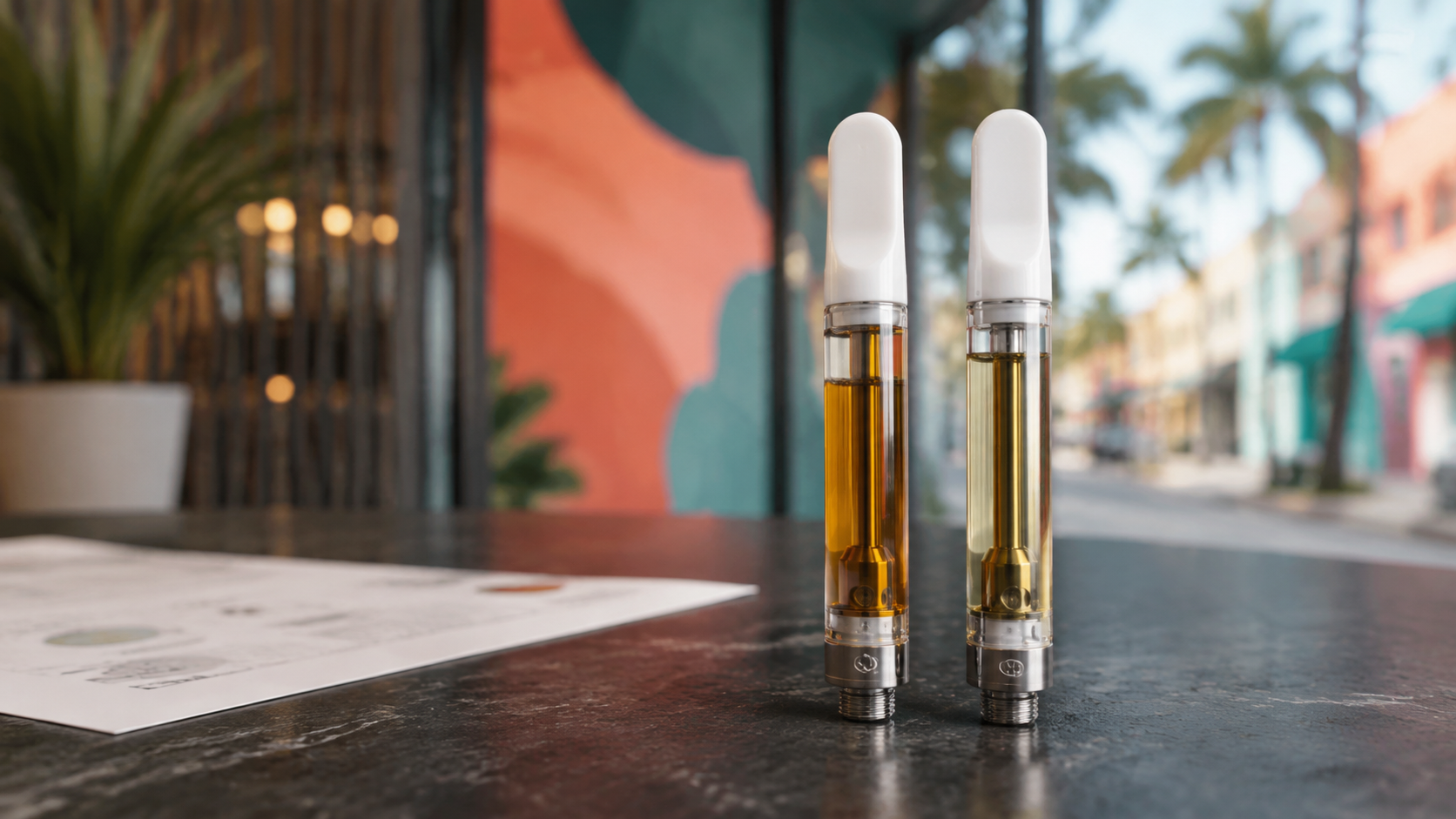
Vape Cartridge Buyer Guide
Live resin and distillate carts are made with different extraction goals. One usually focuses on preserving more of the original plant profile. The other focuses on refining and concentrating a selected cannabinoid. The right choice depends on flavor, formulation, verified potency, hardware, and the batch information you can confirm.
Featured answer: live resin or distillate cart?
Choose live resin when you care most about a broader plant profile and strain-linked aroma. Choose distillate when you prefer a refined cannabinoid concentration and consistent formulation. Neither is automatically stronger, safer, or better. Verify the ingredients, cannabinoid panel, batch-matched COA, hardware, and manufacturer directions before buying either type.
Live Resin Priority
Plant profile
Often chosen for strain-linked aroma, flavor, and a broader mix of retained compounds.
Distillate Priority
Refined consistency
Often chosen for a concentrated cannabinoid base and a more controlled formulation.
Best Evidence
Batch + COA
Match the package batch number to a readable laboratory report before comparing claims.
Do Not Guess
Looks are not proof
Color, thickness, smell, strain name, and price cannot authenticate the extract by themselves.
Quick answer table
| Question | Live resin cart | Distillate cart |
|---|---|---|
| Main production goal | Retain more of the source plant profile | Refine and concentrate selected cannabinoids |
| Starting material | Usually fresh or promptly frozen plant material | A crude extract refined through additional processing |
| Flavor direction | Often more strain-linked and aromatic | More neutral before terpenes or flavors are added |
| Potency | Read the exact batch panel | Read the exact batch panel |
| Added terpenes | Possible, especially in blends | Common, but the source can differ |
| Best proof | Label, ingredients, batch, and matching COA | Label, ingredients, batch, and matching COA |
If you searched “live resin vs distillate carts,” you probably want to know which one is stronger, tastes better, costs less, or gives you more confidence at the counter. A simple winner would be convenient, but it would also be misleading. The words on the front of the package only describe part of the finished product.
This guide compares extraction, flavor, cannabinoid concentration, blends, label language, COAs, cartridge hardware, storage, and value. It also shows Miami shoppers what to verify before buying a hemp-derived vape product at Mary Jane’s Bakery Co.
Adult-use + responsible-use note:
This article is for adult product education only. It is not medical advice. Vaping is not risk-free. Do not use an intoxicating product before driving or operating machinery. Avoid cannabis during pregnancy or breastfeeding. Keep cartridges away from children and pets.
Related guide: Before changing a device setting, read Mary Jane’s battery compatibility and voltage guide.
Jump to what you need
Written by: Mary Jane’s Bakery Co Editorial Team. Last updated: August 2026. This guide is for adult shopping education only.
1) Live resin vs distillate: what is the difference?
Live resin and distillate name two different processing goals. Live resin production is usually designed to preserve more of the original plant’s aromatic and chemical profile. Distillate production is designed to refine an extract and concentrate a selected cannabinoid.
What is a live resin cart?
A live resin cart generally starts with fresh or fresh-frozen cannabis material. Prompt freezing helps limit changes that happen during drying and storage. Controlled extraction then aims to retain more of the plant’s terpenes and minor compounds than a highly refined distillate.
That is why live resin is often associated with a more strain-linked aroma and flavor. It does not mean every live resin cart has the same terpene level, potency, ingredients, or hardware quality.
What is a distillate cart?
Distillate is an extract refined to concentrate a selected cannabinoid. Processing removes many other plant compounds. Manufacturers may then formulate the concentrated oil with terpenes or flavors so it works in the intended cartridge.
The word “distillate” does not tell you which cannabinoid is present. CBD distillate, Delta-8 distillate, and Delta-9 THC distillate are different products. Read the complete label.
Simple rule: extract type and cannabinoid type are separate facts. “Live resin” or “distillate” alone does not tell you whether a cart is intoxicating.
2) How live resin and distillate carts are made
Both products can begin with cannabis or hemp, but the processing path changes what remains in the final oil. Exact methods vary by manufacturer, so the steps below describe common production goals rather than one universal recipe.
| Production stage | Live resin path | Distillate path |
|---|---|---|
| Plant preparation | Fresh material is processed or frozen promptly | A crude extract is prepared for further refinement |
| Extraction goal | Preserve a broader aromatic and chemical profile | Separate and concentrate selected cannabinoids |
| Refinement | Purified enough for a stable, usable formulation | Winterization, refinement, and distillation may be used |
| Final formulation | Can be pure live resin or a blend | Terpenes or flavors may be added |
A peer-reviewed review of cannabis processing notes that drying, extraction method, temperature, solvent, and refinement can change the cannabinoids and terpenes recovered. A 2024 hemp extraction study also found differences in cannabinoid and terpene profiles among extraction and refinement methods.
Live rosin is a different product. Rosin uses mechanical, solventless processing, while live resin is generally produced with solvent-based extraction. Resin and rosin are not alternate spellings.
3) Flavor, consistency, and value: which priority fits you?
Start with the feature you actually care about. Then verify whether the specific product delivers it. A category name is useful, but the package and batch report make the comparison real.
| Your priority | Start by comparing | Do not assume |
|---|---|---|
| Strain-linked aroma | Live resin label, terpene information, ingredients, and COA | The word “live” proves an unblended extract |
| Consistent cannabinoid concentration | Distillate products with clear milligram or percentage data | A larger percentage guarantees a better experience |
| Value | Price, fill amount, verified cannabinoid amount, and hardware quality | The cheapest or most expensive cart is automatically better |
| Easy verification | Readable label, short ingredient list, working QR code, and seller support | A familiar strain name proves the extraction method |
Price ranges change by cannabinoid, jurisdiction, fill amount, hardware, brand, and local taxes. Compare the real products available to you instead of using an old national price estimate as a quality rule.
4) Is live resin stronger than distillate?
There is no universal winner. Distillate products often aim for a high concentration of one cannabinoid, but that pattern is not a rule for every batch. Live resin may retain more minor cannabinoids and terpenes, but that does not create a reliable dose conversion or guarantee a stronger experience.
Use the current cannabinoid panel for the cartridge in your hand. Compare the named cannabinoid, measured concentration, manufacturer directions, hardware, and your prior experience. Do not turn “live resin” or “distillate” into a suggested number of puffs.
CDC notes that highly concentrated THC products can produce stronger intoxicating effects and increase the risk of overconsumption. A high percentage is not a purity, safety, or quality score.
About the entourage effect: terpenes and minor cannabinoids may shape how a product is experienced, but the phrase does not prove that one live resin cart is stronger than a specific distillate cart.
5) How to verify live resin and distillate label claims
Front-label terms can help you narrow the choice. They cannot complete the verification. Use the ingredient list, batch details, manufacturer information, and matching laboratory report together.
| Front-label term | What to verify | What it does not prove |
|---|---|---|
| Live resin | Fresh or fresh-frozen process claim, ingredients, batch report, and maker details | An unblended oil, a certain terpene level, safety, or stronger effects |
| Distillate | Which cannabinoid is concentrated, measured amount, and added ingredients | That the cart contains THC, CBD, or one particular cannabinoid |
| Full spectrum | Cannabinoid panel, terpene panel if supplied, and ingredient list | A specific extraction method or a true live resin |
| Live resin terpenes | Whether the base oil is distillate with live-resin-derived terpenes added | That the complete oil is live resin |
| Solventless | Whether the finished extract is rosin and whether it is blended | That the finished device is risk-free or contaminant-free |
Do not authenticate by eye: oil color and thickness can change with formulation, temperature, light, age, and batch. Smell and price are not proof either.
6) What a cart COA can and cannot prove
A certificate of analysis, or COA, is most useful when it matches the product in your hand. A report for another flavor, strength, or lot does not verify your cartridge.
Five COA checks before buying
- Match the batch or lot number on the package to the report.
- Confirm the named cannabinoid and its measured amount.
- Read the ingredient list and note added terpenes or flavors.
- Check which contaminant panels were actually run.
- Confirm the report date and independent laboratory identity.
A Matching COA Can Support
- Measured cannabinoids for that batch
- Panels actually shown on the report
- Results against the lab’s stated limits
- Batch and test-date verification
A COA Cannot Prove Alone
- How the cart will feel for you
- That every ingredient is disclosed
- That a marketing term is used consistently
- That the battery, coil, seals, and complete device cannot fail
A QR code is useful only when it opens a readable report and the package identifiers match. If the page is missing, the batch is different, or the report is difficult to identify, ask the seller before buying.
7) Blends, liquid live resin, CDT, and BDT
Some cartridges combine distillate with a live resin component. Others use a distillate base with terpenes captured from live resin. Both can be legitimate formulations, but the wording should be clear enough for a shopper to understand what makes up the oil.
What does liquid live resin mean?
“Liquid live resin” is not enough detail by itself. Ask whether the complete oil is live resin or whether the product is a blend. Read the ingredient list and manufacturer description. Do not guess from color, thickness, or aroma.
What do CDT and BDT mean?
CDT usually means cannabis-derived terpenes. BDT usually means botanically derived terpenes. A distillate cart can use either source. The abbreviations describe terpene sourcing, not the cannabinoid concentration, complete extraction method, or safety of the finished cartridge.
Is full spectrum the same as live resin?
No. “Full spectrum” describes a broader compound profile. It does not require one production method. A product can use broad-profile language without being made from fresh-frozen material as live resin.
8) Hardware, voltage, and storage still matter
The extract inside the cartridge is only one part of the product. The coil, wick, seals, battery compatibility, storage history, and manufacturer directions also affect whether the cart works correctly.
Use the cartridge and battery maker’s compatibility guidance. Do not copy a generic voltage from a forum simply because a cart is called live resin or distillate. A 510 thread describes a connection. It does not create one universal heat setting.
Storage checklist
- Keep the cartridge upright when practical.
- Protect it from direct sunlight and excessive heat.
- Do not leave it in a hot Miami car.
- Keep caps and packaging closed when not in use.
- Stop if the cart is cracked, leaking, swollen, or unusually hot.
- Do not use an old cartridge that cannot be batch-verified.
Read Mary Jane’s guide on how to check an old vape cartridge. If a device blinks and does not hit, use the blinking and no-hit troubleshooting guide.
Do not: use a flame, puncture a sealed device, add thinning agents, refill a cartridge not made for refilling, or repeatedly heat a leaking or damaged cart.
9) Are live resin or distillate carts safer?
Neither extract name makes a cartridge automatically safe. Source, formulation, contaminant testing, ingredient disclosure, hardware condition, and correct use all matter. Vaping cannabis or hemp extracts is not risk-free.
FDA advises consumers to avoid THC vaping products obtained from informal sources and not to modify vaping products or add substances to them. Seek medical attention for cough, shortness of breath, chest pain, or other concerning symptoms after vaping.
Can either cart affect a drug test?
Yes. A cart that contains THC or another cannabinoid that produces THC-related metabolites can create drug-test risk. “Live resin” and “distillate” do not protect a user from a positive result. Read the cannabinoid panel instead of relying on the extraction name.
Is a higher percentage safer or cleaner?
No. Potency is not a cleanliness score. A percentage does not show whether the hardware is reliable, all ingredients are disclosed, or every relevant contaminant panel was run.
10) What Miami shoppers should ask before buying
For hemp extract products sold in Florida, current state requirements include package and batch information such as a QR code linked to a COA, a batch number, a website for batch information, an expiration date, and marketed cannabinoid milligrams per serving. Inhalable hemp extract products cannot be sold to a person under 21.
- Is the oil live resin, distillate, or a blend?
- Which cannabinoid does the cart contain?
- Are the terpenes part of the extract or added later?
- Does the QR code open the correct batch report?
- Does the batch number match the package?
- Which safety panels were actually tested?
- What is the expiration date?
- Is the cartridge compatible with the intended battery?
- Is the package sealed and undamaged?
- Are the current ingredients and directions readable?
Miami shoppers who want to inspect a package and ask questions in person can visit Mary Jane’s Bakery Co in Wynwood. Do not buy a loose, relabeled, damaged, or unverifiable cartridge.
11) Compare vape and CBD options at Mary Jane’s
Mary Jane’s Bakery Co offers CBD vape cartridges, distillate-based products, and non-vape CBD formats. Availability can change, so check the current ingredients, package condition, batch report, and store inventory before buying.
CBD Vape Cartridges
Compare current CBD cartridge formulations, labels, and availability.
Delta-8 Distillate Cartridges
Compare a Delta-8 THC distillate option made with added terpenes.
All CBD Products
Compare non-vape CBD formats if a cartridge is not the right fit.
Visit in Wynwood
Inspect current packaging and ask product-format questions in person.
12) Research and safety sources
This guide uses peer-reviewed processing research and primary public-safety and Florida sources instead of relying only on commercial cartridge comparisons.
| Source | What it supports |
|---|---|
| Processing and extraction methods of medicinal cannabis | How drying, extraction, and refinement affect cannabinoid and terpene recovery. |
| Hemp extraction procedures and chemical profiles | Differences involving distilled extracts and cannabinoid or terpene diversity. |
| CDC cannabis overview | Concentrates, THC concentration, additives, and contaminant context. |
| CDC routes of cannabis use report | Vaping prevalence and contaminant or adulterant risk context. |
| FDA THC vaping-products notice | Avoid informal-source products and product modification. |
| Florida Statutes §581.217 | Florida hemp-extract labeling, COA, packaging, and age requirements. |
13) FAQ: live resin vs distillate carts
Is live resin better than distillate?
No universal winner exists. Live resin may suit shoppers who value a broader plant profile and strain-linked aroma. Distillate may suit shoppers who value a refined cannabinoid concentration and consistent formulation. Verify the exact product and batch either way.
Does live resin get you higher than distillate?
Not predictably. A distillate may show a higher concentration of one cannabinoid, while live resin may retain a broader profile. The batch panel, amount used, tolerance, hardware, and individual response all matter.
Is live resin safer than distillate?
No. Neither extract label makes a vape automatically safe. Source, ingredients, contaminant testing, hardware condition, and correct use matter. Vaping itself is not risk-free.
Does live resin taste better?
Live resin often aims for a more strain-linked aroma and flavor. “Better” is personal, and formulations vary. Read the terpene and ingredient information before choosing.
Is distillate always stronger?
No. Distillate often concentrates one cannabinoid, but category-level claims cannot replace the current batch panel. Compare the measured amount in the exact products.
Can color prove whether a cart is live resin?
No. Color can vary with extract, formulation, age, light, heat, and batch. Use the label, ingredients, batch information, and manufacturer documentation.
What does “live resin terpenes” mean?
It may mean that terpenes collected from live resin were added to another base oil, including distillate. It does not automatically mean the complete oil is live resin.
Is live resin the same as live rosin?
No. Live resin is generally made with solvent-based extraction from fresh or fresh-frozen material. Live rosin uses mechanical, solventless processing.
Will either cartridge type affect a drug test?
If the cartridge contains THC or another cannabinoid that produces THC-related metabolites, there is drug-test risk. The extraction label does not prevent a positive result.
What should I check first on a cartridge?
Start with the named cannabinoid, ingredient list, batch number, expiration date, working QR code, matching COA, package condition, and hardware compatibility.
Conclusion: choose the verified cart, not the loudest claim
Live resin and distillate carts serve different priorities. Live resin generally aims to retain more of the plant’s original aromatic and chemical profile. Distillate aims to refine and concentrate a selected cannabinoid, then may add terpenes or flavors during formulation.
Choose live resin when strain-linked aroma and a broader plant profile matter most. Choose distillate when a refined cannabinoid concentration and predictable formulation fit your goal. In both cases, the package, ingredients, batch-matched COA, hardware, and current manufacturer directions matter more than color, price, or hype.
Adults in Miami can compare current vape options and inspect package information at Mary Jane’s Bakery Co in Wynwood. Product availability and batch documents can change, so verify the current item before buying.
Safety note: Adults 21+ only. Vaping cannabis or hemp extracts is not risk-free. Do not buy street-source cartridges, modify a vape, or add substances to it. Stop using the product and seek medical attention for cough, shortness of breath, chest pain, or other concerning symptoms.
Responsible-use note: Do not drive after using an intoxicating product. Avoid cannabis during pregnancy or breastfeeding. Keep cartridges away from children and pets. Follow product labels and current Florida and local requirements.