

Delta 9 Topicals Guide
Delta 9 Topicals: How THC Creams Work, Uses, Effects & Safety
Delta 9 topicals include THC creams, balms, lotions, salves, gels, and roll-ons applied directly to the skin. This guide explains how standard topicals differ from transdermal products, what current research actually supports, and how to compare strength, ingredients, testing, and safety.
Answer: what is a Delta 9 topical?
A Delta 9 topical is a skin-applied product containing Delta 9 THC. Standard THC creams and balms are generally designed for area-focused external use rather than a full-body high. Transdermal products are different because they are formulated to move cannabinoids through the skin and into circulation. Product type, ingredients, cannabinoid concentration, and batch testing matter more than the word “topical” alone.
Common Forms
Cream, balm + roll-on
Texture affects spread, residue, portability, and the size of the application area.
Typical Goal
Area-focused use
A standard topical is generally selected for one area rather than systemic effects.
Key Distinction
Topical ≠ transdermal
Transdermal formulas are designed to move cannabinoids into circulation.
Best Evidence Check
Batch-specific COA
Confirm cannabinoid amounts, batch identity, report date, and contaminant panels.
Quick answer table
| Buyer question | Short answer |
|---|---|
| Do standard THC topicals get you high? | They are generally not designed for intoxication; transdermal products require separate consideration. |
| Are topical and transdermal the same? | No. Transdermal products aim to deliver cannabinoids through the skin into circulation. |
| Does cooling prove the THC is working? | No. Menthol, peppermint, or camphor may create the immediate sensation. |
| Is a 1,000 mg jar always stronger? | Not necessarily. Compare the cannabinoid amount, container size, formula, and directions. |
| Can a THC topical affect a drug test? | Do not treat any THC product as guaranteed drug-test safe. |
| What should buyers verify? | Product type, ingredients, cannabinoid concentration, warnings, and a matching batch COA. |
People searching for Delta 9 topicals usually want practical answers. Will THC cream cause a high? Is a balm different from a lotion? Can a topical help with an uncomfortable area? How do you compare a 500 mg jar with a 1,000 mg product, and what does the research actually say?
The category is more complicated than the front label suggests. A standard topical is not the same as a transdermal patch. Total milligrams do not explain concentration without the container size. Added ingredients can create sensations that shoppers may incorrectly attribute to THC. This guide separates the product format, scientific evidence, label information, and realistic buyer expectations.
Adult-use + responsible-use note:
This guide is for adults 21+ and provides general product education only. It is not medical, legal, employment, or drug-testing advice. Delta 9 THC topicals are not approved to diagnose, treat, cure, or prevent disease. Keep all cannabinoid products away from children and pets.
Related guide: If you need the cannabinoid basics first, read Delta 8 vs Delta 9 THC.
Jump to what you need
Article note: Written by Mary Jane’s Bakery Co Editorial Team. Last updated June 24, 2026. Reviewed against cannabinoid-delivery research, FDA consumer information, Florida’s published hemp statute, and available topical THC drug-testing research.
1) What are Delta 9 topicals?
Delta 9 topicals are products containing Delta 9 tetrahydrocannabinol that are applied to the skin. Common forms include cream, balm, lotion, salve, gel, body butter, stick, spray, and roll-on products. They may contain THC alone, a THC-to-CBD ratio, or several cannabinoids in one formula.
The term “topical” describes how a product is used, but it does not fully explain how it was formulated. A standard external-use cream is generally intended for area-focused application. A transdermal product is designed to carry ingredients through the skin barrier and into circulation. That distinction affects expected effects, safety questions, and drug-test considerations.
Standard THC topicals are also different from gummies, drinks, tinctures, vapes, and flower because those formats are designed to deliver cannabinoids into the body through ingestion, absorption in the mouth, or inhalation.
Simple answer: a Delta 9 topical is a THC-containing skin product. Read the full label to determine whether it is a standard external-use topical or a transdermal formula.
2) How do Delta 9 THC topicals work on the skin?
The skin is designed to act as a barrier. Its outer layer, called the stratum corneum, limits what can pass into the body. When a standard THC topical is applied, cannabinoids and other formula ingredients remain primarily around the application area rather than behaving like an edible or inhaled product.
Human skin contains components associated with the endocannabinoid system, including cannabinoid-related receptors. That finding helps researchers study topical cannabinoids, but it does not prove that every retail THC cream will create the same effect. Concentration, carrier oils, waxes, water content, emulsifiers, penetration enhancers, skin condition, application area, and other active ingredients can all change the experience.
A scientific review available through the National Library of Medicine explains topical and transdermal cannabinoid delivery through skin. It also shows why these two product categories should not be treated as interchangeable.
Why formulation matters
THC is lipophilic, which means it has an affinity for fats and oils. This is one reason many topical formulas use oils, waxes, or plant butters. An oil-rich base does not automatically make a product effective, however. The cannabinoid concentration, complete ingredient system, product stability, and intended delivery method all matter.
Damaged skin, added heat, tightly covering the application area, or penetration-enhancing ingredients may change absorption. Do not apply a THC topical to cuts, burns, rashes, or broken skin. Avoid using a heating pad unless the product directions specifically say it is permitted.
3) Do THC topicals work? What current evidence shows
The responsible answer is that topical cannabinoid research is still developing. Scientists have identified plausible biological pathways, completed preclinical work, and published limited human research. Customers also report personal experiences with topical products. The evidence is not strong enough to claim that an ordinary retail Delta 9 cream reliably treats arthritis, chronic pain, nerve pain, inflammation, or another medical condition.
A research review of the safety and sourcing of topical cannabinoid products notes that safety and efficacy data remain limited. A study involving CBD, an animal model, a compounded cannabis preparation, or a transdermal delivery system should not automatically be used as proof for every THC cream sold at retail.
| Claim or statement | Responsible interpretation |
|---|---|
| Cannabinoid-related receptors exist in human skin. | Supported by scientific research. |
| Topical and transdermal products have different delivery goals. | Supported and important for buyers. |
| Some adults report area-focused comfort. | Reasonable as a customer experience, not a guaranteed result. |
| Every THC cream relieves arthritis or chronic pain. | Not established by adequate clinical evidence. |
| Cooling proves THC is working. | No. Menthol, camphor, or peppermint may create that sensation. |
What about THC topicals for pain?
Searches for THC cream commonly include joint, back, muscle, post-workout, and arthritis-related terms. Search demand does not increase the quality of clinical evidence. A formula may feel cooling, warming, moisturizing, or soothing during massage, but those experiences should not be converted into disease-treatment promises.
The FDA distinguishes approved prescription drugs from unapproved retail cannabis products in its cannabis research and drug-approval guidance. Persistent, severe, unexplained, or worsening pain should be evaluated by a qualified healthcare professional.
For a routine-focused comparison without treatment guarantees, read Mary Jane’s guide to topicals for post-workout use in Miami.
Evidence reminder: a cooling or warming sensation can be real without proving that Delta 9 THC is treating the underlying cause of discomfort.
4) Do Delta 9 THC topicals get you high?
A standard non-transdermal THC cream, balm, lotion, or salve is generally not selected to produce intoxication. It is designed for external application to a particular area and differs from products intended to deliver THC systemically.
That answer requires one important qualification. “Applied to skin” does not always mean “standard topical.” A patch, gel, or cream labeled transdermal may use a formula designed to move cannabinoids through the skin and into circulation. Such products may present different effects and risks.
Read the label for terms such as topical, external use only, transdermal, systemic delivery, extended release, or patch. If the product type is unclear, do not assume it is non-intoxicating or suitable before driving, working, or performing another safety-sensitive activity.
5) Can THC topicals affect a drug test?
No THC-containing consumer product should be marketed as guaranteed drug-test safe. Standard topical and transdermal products create different levels of concern, but product accuracy, formula, amount, frequency, application conditions, test type, and individual circumstances can vary.
One small controlled study of topical THC application and blood or urine findings did not produce positive cannabinoid findings under the specific tested conditions. That result should not be expanded into a promise covering every cream, potency, use pattern, damaged-skin application, or transdermal system.
Employment, DOT, probation, licensing, court, athletic, and school testing programs may use different methods and thresholds. If a negative result is essential, avoiding THC exposure is safer than relying on an online claim. For broader context, review the 2026 THC-related drug-testing guide.
6) Delta 9 topical vs transdermal THC
| Comparison | Standard THC topical | THC transdermal product |
|---|---|---|
| Common forms | Cream, balm, lotion, salve, roll-on | Patch or specially formulated gel or cream |
| Delivery goal | Localized external application | Delivery through skin and into circulation |
| Expected experience | Area-focused and typically non-intoxicating | May create broader or systemic effects |
| Drug-test concern | Do not call it zero-risk | Greater concern because systemic delivery is intended |
| Label wording | Topical, external use, cream, balm | Transdermal, systemic, patch, extended release |
Do not decide from the package shape alone. A product in a jar may contain penetration-enhancing ingredients, while a roll-on may be designed only for ordinary external use. Read the complete directions and warnings.
7) Delta 9 THC topicals vs CBD topicals
THC and CBD topicals can look almost identical on a shelf. Both can be sold as cream, balm, lotion, salve, body butter, or roll-on products. The cannabinoid profile is one difference, but the complete formula controls the texture, scent, residue, cooling or warming sensation, and suitability for sensitive skin.
| Product type | Main label check | Important buyer question |
|---|---|---|
| Delta 9 THC topical | Delta 9 amount and topical/transdermal wording | Does THC exposure or drug testing matter to me? |
| CBD topical | CBD amount and extract type | Is it isolate, broad spectrum, or full spectrum? |
| CBD + THC topical | Amount and ratio of each cannabinoid | Does the batch COA match the label? |
There is not enough comparative research to declare THC cream universally better than CBD cream or the reverse. Compare cannabinoid content, other ingredients, testing, texture, and THC exposure concerns.
Shoppers seeking CBD-focused formulas can browse the CBD topical collection and read what evidence says about CBD topicals.
8) THC cream vs balm vs lotion vs salve vs roll-on
Format affects how a product spreads, how heavy it feels, whether it transfers to clothing, and how easy it is to carry. It does not establish medical effectiveness.
| Format | Typical texture | Practical fit | Buyer watch-out |
|---|---|---|---|
| THC cream | Smooth and spreadable | Shoulders, legs, back, or wider areas | Check residue before dressing |
| THC balm | Thick and usually wax-based | Hands, knees, elbows, or focused massage | May feel heavy in warm weather |
| THC lotion | Lighter and easy to spread | Body-care style application | A large bottle may have a lower concentration |
| THC salve | Oil-and-wax rich | Slow, targeted application | May transfer to clothing |
| THC roll-on | Gel or liquid | Portable application with less hand contact | Cooling may come primarily from menthol |
Texture often matters more than the product name. Compare Mary Jane’s guide to balm vs cream vs roll-on formats for a closer look at spread, residue, and application style.
9) How strong is a Delta 9 topical?
The largest number on a topical label is often the total cannabinoid amount in the entire container. It is not necessarily the amount applied each time. It also does not support a fair comparison unless the container size is known.
For example, a hypothetical 500 mg topical in a one-ounce jar and a 500 mg topical in a four-ounce jar contain the same total amount but not the same concentration. A multi-cannabinoid formula may advertise the combined amount of THC, CBD, CBG, and CBN instead of the Delta 9 amount by itself.
Numbers to compare
- Total Delta 9 THC in the container
- Total cannabinoids in the container
- Container weight or fluid volume
- THC-to-CBD ratio, when applicable
- Application guidance supplied by the manufacturer
- Batch COA potency results
A higher total does not automatically make one product better. Clear labeling, an appropriate format, formula quality, and reliable batch testing are more useful than a “maximum strength” phrase without context.
10) Ingredients that change how THC cream feels
A topical is a complete formula, not cannabinoids by themselves. Added ingredients control texture, scent, moisture, cooling, warming, and skin tolerance.
| Ingredient type | Possible role | What to consider |
|---|---|---|
| Menthol or peppermint | Cooling sensation | Can feel intense; keep away from eyes |
| Camphor or warming ingredients | Counterirritant-style sensation | Follow the label and avoid added heat |
| Shea or cocoa butter | Rich texture and moisturization | May feel heavy or greasy |
| Coconut, jojoba, or similar oils | Carrier and skin-conditioning role | Check for sensitivities and residue |
| Fragrance and essential oils | Scent and sensory experience | Potential concern for sensitive skin |
If a topical feels active immediately, the sensation may come from menthol, camphor, peppermint, or massage. It is not a reliable measurement of cannabinoid absorption.
11) How to use Delta 9 THC topicals carefully
- Read the complete label. Confirm whether the product is standard topical or transdermal.
- Review the ingredients. Look for fragrance, essential oils, menthol, and possible allergens.
- Patch test first. Apply a small amount to a limited area and wait as directed.
- Use clean, dry, intact skin. Avoid cuts, burns, rashes, and broken skin.
- Start with a small amount. Follow the manufacturer’s directions rather than a universal online dose.
- Wash your hands. Prevent accidental contact with eyes, mouth, children, pets, or another person.
- Do not add heat. Avoid a heating pad or tight covering unless the label permits it.
- Stop if irritation develops. Redness, burning, itching, swelling, or rash is a reason to discontinue use.
- Store securely. Keep the container away from children, pets, heat, and direct sunlight.
Speak with a qualified healthcare professional before using cannabinoid products if you are pregnant, breastfeeding, taking medication, managing a health condition, or dealing with persistent pain or a skin problem. The FDA advises consumers to avoid THC during pregnancy and breastfeeding.
12) What to check before buying a Delta 9 topical
| Step | What to verify |
|---|---|
| 1. Delivery type | Standard topical or transdermal formula. |
| 2. Cannabinoid identity | Delta 9 THC, CBD, minor cannabinoids, and their amounts. |
| 3. Container size | Needed to interpret concentration instead of total mg alone. |
| 4. Batch match | The package number should match the laboratory report. |
| 5. Testing scope | Check potency and applicable contaminant panels, not only a “lab-tested” badge. |
| 6. Full ingredients | Review allergens, fragrance, cooling, and warming ingredients. |
| 7. Warnings | External use, broken-skin restrictions, storage, and age limits. |
| 8. Current legality | Confirm applicable state rules and current product availability. |
A useful COA should match the batch and show cannabinoid potency rather than displaying only a generic laboratory logo. Mary Jane’s label and COA checklist for first-time buyers explains what to inspect before checkout.
Florida law includes testing, COA, labeling, packaging, and contaminant requirements for covered hemp-extract products. Review Florida Statute 581.217 instead of relying on an undated summary. Product classification matters, and laws can change.
Avoid relying on these claims alone: “maximum strength,” “legal everywhere,” “guaranteed pain relief,” “drug-test safe,” “no side effects,” or “lab tested” without access to the matching report.
13) Where to buy Delta 9 THC topicals in Miami
Miami shoppers who want to inspect a label or ask about product format in person can visit Mary Jane’s 24-hour CBD and THC smoke shop in Wynwood. Before buying, ask whether the product is topical or transdermal, how much Delta 9 it contains, whether the COA matches the batch, and which ingredients produce its cooling, warming, scent, or moisturizing feel.
Availability, shipping eligibility, and legal treatment can change. Review the current product page, local rules, label, and batch report at the time of purchase. Adults can compare the current Delta 9 THC topical collection.
If you prefer a CBD-focused option, compare the 1,000MG Full Spectrum CBD Topical Relief Cream. It belongs to a different cannabinoid category and should not be treated as the same product as a Delta 9 cream.
Useful in-store questions:
Is this topical or transdermal? How much Delta 9 is in the complete container? What is the container size? Does the batch COA match? Are menthol, camphor, fragrance, or essential oils included? What warnings appear on the label?
14) Recommended image placement plan
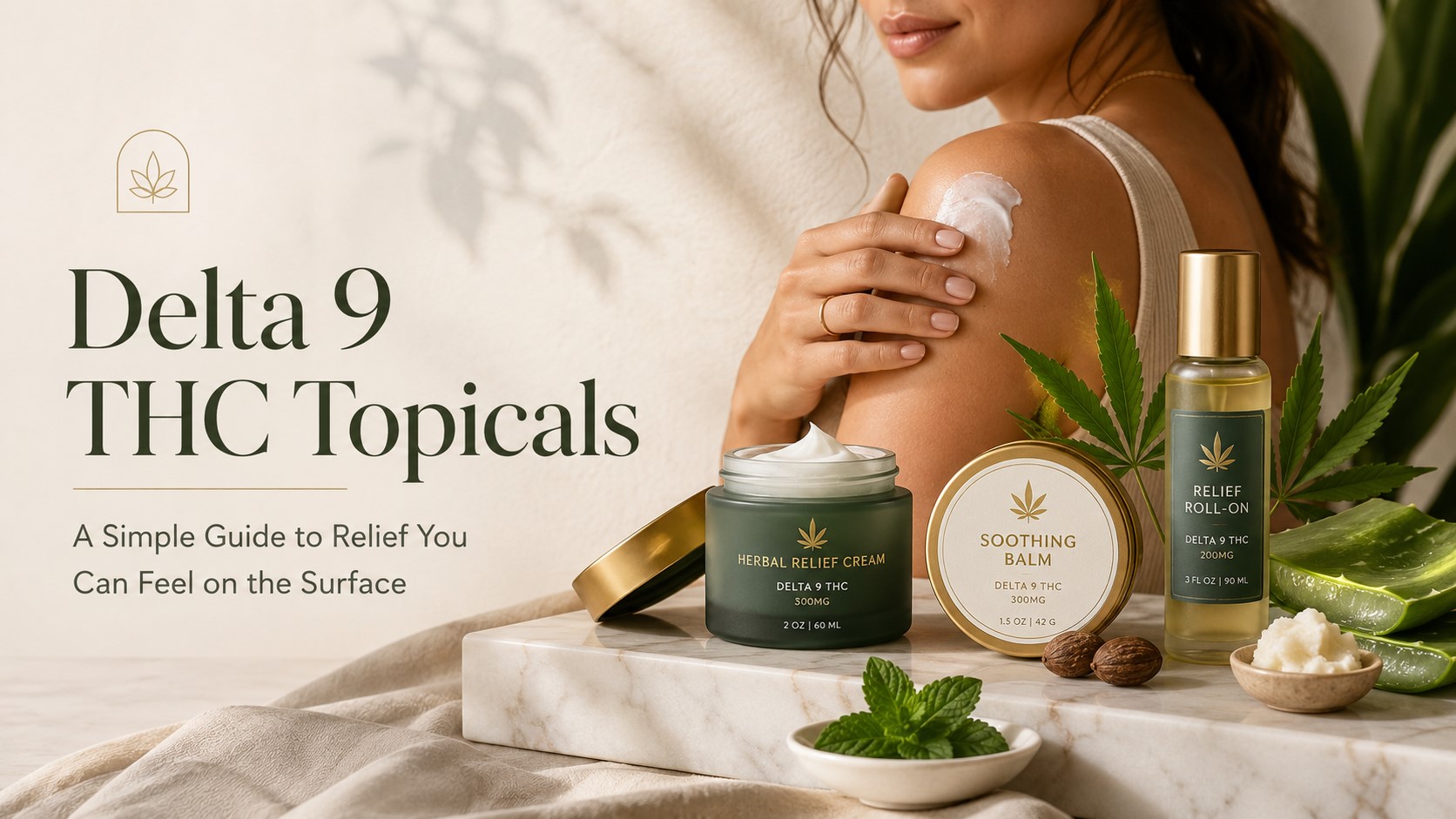
- Hero image: place above the opening panel. Show a professional Delta 9 cream jar, balm tin, and roll-on on a clean bathroom or wellness counter, with the title positioned safely toward the center-left.
- Infographic 1: place after section 2. Compare localized topical use with transdermal delivery through the skin.
- Infographic 2: place after section 12. Show cannabinoid amount, container size, batch match, report date, ingredients, and contaminant testing.
- Format comparison graphic: place before the FAQ. Compare cream, balm, lotion, salve, and roll-on textures and practical uses.
15) Research and official sources used
This guide uses scientific and government sources for skin delivery, evidence limitations, drug-testing context, FDA consumer guidance, and Florida hemp-product requirements.
| Source | What it supports |
|---|---|
| NIH/PMC review of topical and transdermal cannabinoids | Skin barrier, formulation, and local versus systemic delivery. |
| NIH/PMC topical cannabinoid safety review | Limits in efficacy, safety, labeling, and sourcing evidence. |
| PubMed topical THC study | Blood and urine findings under limited controlled conditions. |
| FDA cannabis research and drug approval | Approved-drug distinction and limits on treatment claims. |
| FDA pregnancy and breastfeeding guidance | Consumer safety guidance concerning THC exposure. |
| Florida Statute 581.217 | Florida hemp definitions, testing, COA, packaging, and retail requirements. |
FAQ: Delta 9 THC topicals
What is a Delta 9 topical?
A Delta 9 topical is a skin-applied product containing Delta 9 THC. Common formats include creams, balms, lotions, salves, gels, body butters, and roll-ons. Check whether the product is a standard topical or a transdermal formula.
Do Delta 9 topicals get you high?
Standard non-transdermal topicals are generally intended for localized external use rather than intoxication. A transdermal THC product may be designed to move THC into circulation and can require different precautions.
Do THC topicals actually work?
Some adults report area-focused comfort, but results vary and human evidence for ordinary retail THC creams remains limited. Formula, other ingredients, massage, expectations, and individual response can influence the experience.
Does THC cream work for pain?
THC creams are marketed for localized comfort, but they should not be described as proven treatments for arthritis, chronic pain, nerve pain, or other conditions without adequate evidence. Persistent pain should receive professional evaluation.
Can a THC topical show up on a drug test?
A small study did not find positive blood or urine results under its tested conditions, but it does not prove that every product or use pattern is risk-free. Transdermal products are a greater concern because systemic delivery is intended.
What is the difference between topical and transdermal THC?
A standard topical is generally intended for localized external use. A transdermal product is formulated to carry cannabinoids through the skin and into circulation. Look for wording such as transdermal, systemic, patch, or extended release.
Is THC cream better than CBD cream?
Current evidence does not establish a universal winner. Compare cannabinoids, extract type, other ingredients, batch testing, texture, and THC exposure concerns.
Is THC balm stronger than THC lotion?
Not automatically. Balm is usually thicker, while lotion is lighter and easier to spread. Strength depends on cannabinoid concentration and formula, not texture alone.
How long does a THC topical take to work?
There is no universal onset time for every formula. Menthol may feel cool quickly, but that sensation is not a reliable measurement of cannabinoid activity.
How long do THC topical effects last?
Duration varies with formula, amount, application area, skin, other ingredients, and individual response. A broad online estimate is not a guarantee for a specific product.
Where should THC cream be applied?
Follow the label. Standard topicals are commonly applied to clean, dry, intact skin on a specific area. Keep them away from eyes, mouth, sensitive areas, cuts, burns, rashes, and broken skin.
Can I use a heating pad with THC cream?
Do not add heat unless the product directions specifically allow it. Heat or tightly covering the area may alter absorption and increase irritation.
How do I compare two THC creams?
Compare the Delta 9 amount, total cannabinoids, container size, cannabinoid ratio, application directions, ingredients, and matching batch COA. Total milligrams alone are incomplete.
Where can I buy Delta 9 THC topicals?
Adults can compare available Delta 9 topical products from Mary Jane’s Bakery Co where permitted. Check current availability, labeling, batch testing, and applicable law before ordering.
Conclusion: compare the formula, not only the THC number
Delta 9 topicals are more complicated than the phrase “THC cream” suggests. Standard topicals, transdermal formulas, cooling roll-ons, thick balms, and light lotions can look related while behaving differently. A useful comparison begins with delivery type, cannabinoid concentration, complete ingredient list, application directions, warnings, and a batch-specific COA.
Keep expectations realistic. Current evidence does not justify cure-style promises, a precise universal onset time, or guaranteed drug-test safety. Choose a product with clear labeling, testing that matches the batch, and a format suited to the way you plan to use it.
Safety note: Cannabis, hemp, CBD, and THC products are for adults only. Keep products away from children and pets. Follow label directions, avoid broken skin and unapproved heat, check batch COAs, and stop use if irritation develops.
Information note: This guide is not medical, legal, employment, or drug-testing advice. Laws, product availability, formulations, and individual responses can change.