

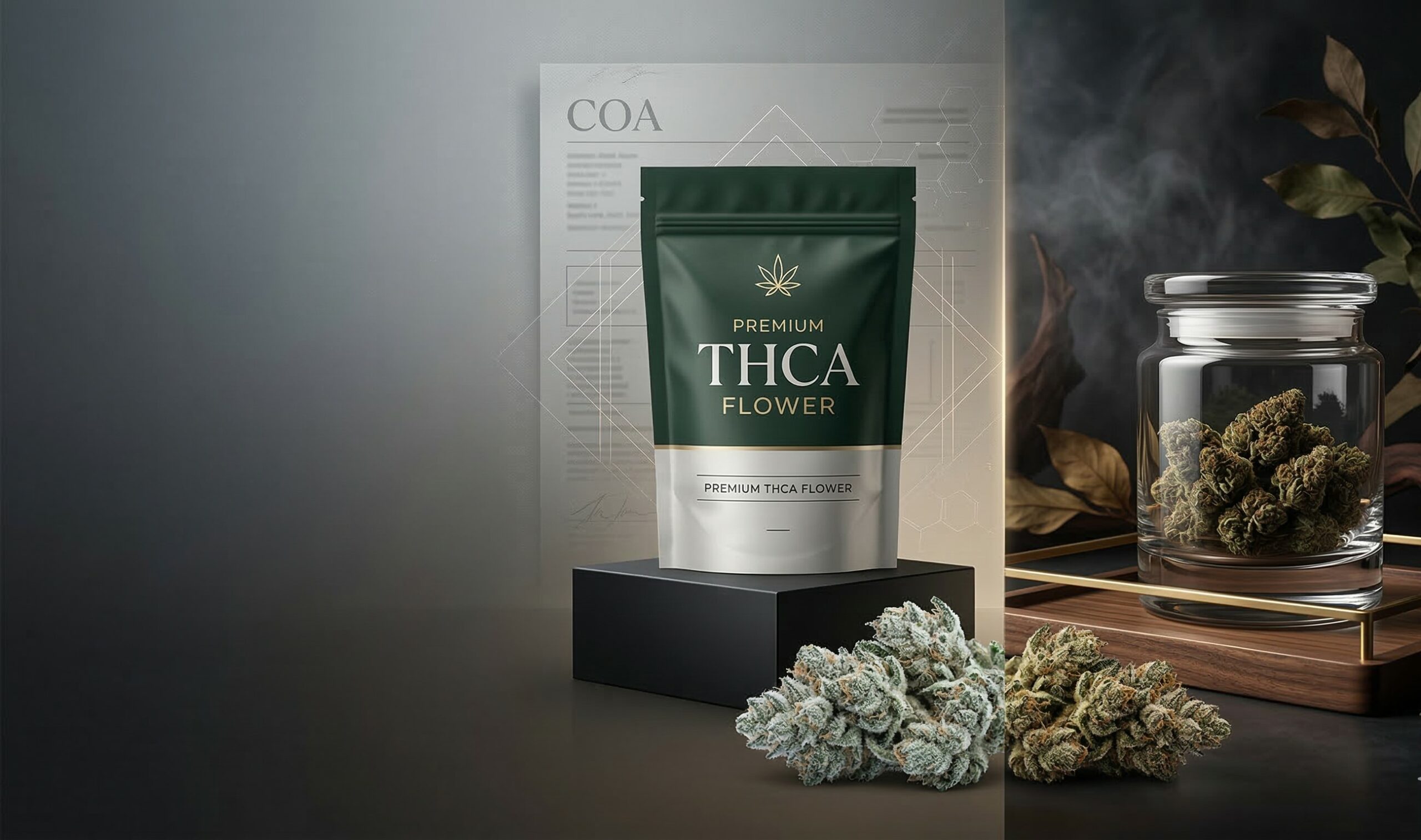
THCA Flower Comparison Guide
Last Update :- August 10
THCA flower is real cannabis flower, and it can produce effects comparable to regular weed after it is heated. The important differences are not simply how the buds look. They involve the cannabinoid report, potential total THC, testing, sales channel, product handling, and the law that applies where the product is sold or used.
Is THCA flower the same as regular weed?
In plant form, they can be remarkably similar because both are cannabis flower and both may contain substantial THCA before heating. Once smoked or vaped, THCA converts into intoxicating Delta-9 THC. However, “THCA flower” and “weed” should not be treated as identical legal or retail labels because testing rules, regulation, sourcing, and batch quality may differ.
Plant
Real cannabis flower
High-THCA flower is not automatically fake, synthetic, or sprayed.
Before Heat
THCA is the precursor
Unheated THCA is chemically different from intoxicating Delta-9 THC.
After Heat
THC effects become possible
Smoking, vaping, and cooking can convert part of the THCA into THC.
Best Comparison
Read the batch COA
The product name alone does not establish strength, purity, or legality.
| Comparison | THCA flower | Regular weed or dispensary flower |
|---|---|---|
| Plant material | Cannabis flower marketed around a high THCA profile | Cannabis flower sold through a marijuana or informal retail context |
| Before heating | Often high in THCA with relatively little already-formed Delta-9 THC | May also show substantial THCA on the laboratory report |
| After heating | Part of the THCA converts into Delta-9 THC | Heat also activates the flower’s THC potential |
| Possible effects | Can be intoxicating after smoking, vaping, or cooking | Commonly associated with intoxicating cannabis effects |
| Testing and regulation | Testing scope and hemp-market requirements vary | State-licensed dispensary systems use their own testing and retail rules |
| Drug-test risk | Yes, especially when the flower is heated and used | Yes, because it exposes the user to THC |
| Legal treatment | Depends on current federal, state, local, product, and testing rules | Marijuana remains federally controlled while state cannabis laws differ |
Adult-use and responsible-use note
This guide is for adults 21+ and provides general product education. It is not legal, medical, employment, or drug-testing advice. Laws change, effects vary, and no product name guarantees legality or a negative drug test. Do not drive after using an intoxicating product. Keep cannabis and hemp products away from children and pets.
If you want the cannabinoid basics before comparing flower, start with what THCA flower is and how heat changes it.
Editorial transparency: Prepared by the Mary Jane’s Bakery Co Editorial Team from the cited peer-reviewed and government sources. Last fact-checked August 10, 2026. No medical or legal review is claimed.
1) Is THCA flower the same as weed?
THCA flower is real cannabis flower. “Weed,” however, is an informal word rather than a precise scientific or product category. It commonly refers to cannabis flower associated with marijuana and intoxicating THC. “THCA flower” is a retail description that emphasizes tetrahydrocannabinolic acid, the acidic precursor that can become Delta-9 THC when heat is applied.
That makes the comparison uneven. One term describes a cannabinoid-focused product label; the other describes a broad category of cannabis flower. The buds may be visually similar, smell similar, and create comparable effects after heating, yet they can move through different testing, distribution, and regulatory systems.
Simple answer: THCA flower can be very similar to regular weed in plant form and heated use. The meaningful differences are found in the batch report, regulatory channel, product handling, and current law—not merely in what the buds look like.
2) THCA flower vs THC flower: what actually changes?
THCA and Delta-9 THC are related, but they are not the same compound. THCA includes an additional carboxyl group. When sufficient heat is applied, that group is removed through decarboxylation and part of the THCA becomes Delta-9 THC.
Smoking, vaping, and cooking can cause this conversion. Heat, light, oxygen, and storage conditions may also influence cannabinoid stability over time. A peer-reviewed review indexed by the National Library of Medicine explains THCA-A chemistry, stability, and decarboxylation.
The phrase “THC flower” is also less precise than it sounds. Cannabis plants mainly produce acidic cannabinoids, so conventional dispensary flower may show a large THCA percentage before use. That is why a complete laboratory report often lists THCA, Delta-9 THC, and a calculated potential total THC rather than only one headline number.
3) Does THCA flower get you high like regular weed?
Yes, THCA flower can be intoxicating when it is smoked, vaped, cooked, or otherwise heated. Heat converts part of its THCA into Delta-9 THC, the cannabinoid most closely associated with the conventional cannabis high.
That does not mean two flowers with similar percentages will feel identical. The result can change with the amount used, conversion efficiency, terpene and minor-cannabinoid profile, freshness, individual sensitivity, tolerance, and method of use.
The careful comparison is therefore “comparable,” not “guaranteed to be identical.” A high-THCA batch can feel much like conventional cannabis after heating, but the label cannot predict one person’s exact experience.
Important distinction: raw, unheated THCA is not the same practical experience as smoking THCA flower. Heating changes the cannabinoid profile and creates intoxicating potential.
4) Is THCA flower as strong as regular weed?
It can be, but “THCA flower” is not a strength grade. Compare the batch-specific cannabinoid numbers instead of assuming hemp-market flower or dispensary flower is automatically stronger.
Laboratories commonly estimate potential total THC with this calculation:
Total THC = Delta-9 THC + (THCA × 0.877)
For example, a report showing 25% THCA and 0.2% Delta-9 THC gives a calculated potential total THC of approximately 22.125%:
(25 × 0.877) + 0.2 = 22.125%
The 0.877 factor accounts for the difference in molecular weight when THCA loses carbon dioxide during conversion. Published cannabinoid-testing research describes this potential total-THC calculation.
This remains an analytical estimate. It is not a promise that every molecule will convert during use, and it does not tell you how much THC a person will absorb. See the dedicated guide to calculating total THC from THCA for a closer look at the math.
5) THCA flower vs dispensary weed
The physical flower may look nearly identical, but the path to the shelf can be different. Licensed marijuana dispensaries operate under state cannabis programs. Flower sold as hemp-derived THCA may move through hemp cultivation, testing, distribution, and retail systems instead.
| Buyer question | What the evidence can tell you |
|---|---|
| Is dispensary weed always stronger? | No. Compare potential total THC and the wider cannabinoid profile. |
| Is THCA flower always cleaner? | No. Review the actual contaminant panels and batch match. |
| Will they feel identical? | They may feel similar when the cannabinoid and terpene profiles are close, but individual results vary. |
| Does a hemp label prove legality? | No. Product form, destination, test results, and current law all matter. |
A licensed sales channel provides a defined regulatory system, but it does not make every product excellent. A hemp label also does not prove that a product is low quality. Compare the individual batch, testing scope, source, freshness, and documentation.
6) Why does THCA flower look and smell like weed?
THCA flower looks like weed because it is cannabis flower. It has buds, trichomes, and aromatic compounds produced by the plant. Genetics, cultivation, harvest timing, trimming, curing, age, and storage all influence its appearance.
The smell comes mainly from terpenes and other volatile compounds—not from THCA acting as an aroma. Myrcene may contribute earthy notes, limonene can smell citrus-forward, and pinene may create a sharper pine character. Sulfur-containing compounds and other volatiles can also contribute to “skunky” or “gassy” aromas.
A quieter smell does not automatically mean the flower is fake, and a very strong smell does not prove high potency. Cure quality, moisture, temperature, packaging, and age can make one batch smell louder or flatter than another. Learn more about terpenes and cannabis aroma.
7) Is THCA flower natural, synthetic, or sprayed?
THCA is produced naturally by cannabis plants. High-THCA flower can therefore be grown without coating finished buds in THCA isolate or another cannabinoid.
That does not mean every flower-style product is made the same way. Some products may be infused, coated, or enhanced after harvest. A transparent product description should disclose post-harvest additions, and the laboratory report should match the exact batch being sold.
Questions worth asking
- Was the flower cultivated to express THCA naturally?
- Was anything added after harvest?
- Does the batch number on the report match the package?
- Does the report include contaminants or only potency?
8) Why the COA matters more than the front label
A certificate of analysis, or COA, records what a laboratory found in the sample it received. It does not guarantee that a product is risk-free, but it provides more useful evidence than a strain name, package color, or unsupported “lab tested” badge.
THCA flower COA checklist
- Exact product name and batch or lot number
- Laboratory name, sample date, and report date
- THCA and Delta-9 THC percentages
- Potential total THC, or enough data to calculate it
- Pesticide and heavy-metal panels
- Microbial and mycotoxin screening
- Clear pass, fail, or not-tested results
- A complete report that matches the package being considered
Do not assume every COA tests the same things. A potency-only page does not tell you whether pesticides, heavy metals, microbials, or mycotoxins were tested. Also check whether pages are missing, whether the report is current, and whether the batch identifiers match.
9) Is THCA flower legal in 2026?
There is no responsible nationwide yes-or-no answer. Federal production rules, the federal statutory definition, state laws, local restrictions, product form, test method, and sales channel can produce different answers. Some states apply total-THC rules or restrictions that are stricter than broad online claims about “legal hemp.”
USDA guidance already explains that hemp production testing must account for the conversion of THCA and report total available THC. Review the USDA Hemp Program FAQ for the federal production-testing baseline.
What is scheduled to change on November 12, 2026?
Public Law 119-37 was enacted on November 12, 2025. Section 781 is written to take effect 365 days later. The enacted language changes the federal hemp definition to use total tetrahydrocannabinols, explicitly including THCA, with a limit of no more than 0.3% on a dry-weight basis. It also creates exclusions affecting certain final hemp-derived cannabinoid products.
You can read the enacted text in Public Law 119-37. Unless Congress changes the law before the effective date, high-THCA flower would generally be expected to exceed the new total-THC threshold.
Could the federal effective date still change?
Yes, but a proposal is not the same as enacted law. Introduced measures have proposed delaying Section 781 for three years or repealing it. As of this August 10, 2026 review, the current enacted text still shows the November 12, 2026 effective date. Do not describe a proposed delay or repeal as if it has already become law.
Florida and Miami note
Florida’s published hemp statute includes definitions and requirements involving testing, COAs, contaminants, packaging, and sales to people under 21. Rules and pending proposals can change, so check the current law before buying, selling, shipping, or carrying a specific product. Review Florida Statute 581.217 and Mary Jane’s guide to the 2026 federal hemp change.
10) Will THCA flower show up on a drug test like weed?
Using THCA flower can create a real risk of a positive cannabis drug test. Smoking or vaping converts THCA into THC, and many testing programs look for THC-related metabolites rather than the marketing language on the package.
Do not assume that “hemp-derived,” “THCA,” or a low pre-existing Delta-9 result guarantees a negative test. A COA cannot promise that someone will pass a workplace, DOT, court, probation, school, or athletic test.
If a negative result is important, the conservative choice is to avoid THCA flower and other THC-exposing products. Read the complete guide to THCA and drug-test risk.
11) Is THCA flower safer than weed?
The two product labels do not provide enough information to make that conclusion. Potency, contaminants, method of use, frequency, product handling, and individual health factors matter more than whether the package says “THCA flower” or “weed.”
A broader COA can reduce uncertainty about the sample that was tested. It cannot make smoke harmless or predict how a specific person will respond. The CDC notes that secondhand cannabis smoke contains many of the same toxic and cancer-causing chemicals found in tobacco smoke. Review the CDC’s secondhand cannabis-smoke guidance.
COA limitation: A report describes the tested sample and the panels performed. It does not prove that inhaling smoke is harmless or guarantee a predictable effect.
12) How to compare THCA flower and weed before buying
| Step | What to check | Why it matters |
|---|---|---|
| 1. Intended use | Whether the flower will remain raw or be heated | Heat changes THCA into intoxicating THC |
| 2. Batch identity | Product, lot number, and report date | A report for another batch does not describe the package in hand |
| 3. Cannabinoids | THCA, Delta-9 THC, and potential total THC | Low Delta-9 before heating does not necessarily mean low THC potential |
| 4. Contaminants | Which safety panels were actually performed | “Lab tested” may refer only to potency |
| 5. Product treatment | Whether anything was infused or added after harvest | Natural flower and enhanced flower are not the same product |
| 6. Current law | Destination, product form, and current federal and state rules | Online availability does not prove universal legality |
| 7. Drug testing | Whether a negative result matters for work or another program | THCA labeling does not remove THC-metabolite risk |
Availability and shipping restrictions can change quickly. Before ordering, use Mary Jane’s educational guide to buying THCA flower online in 2026 and verify the seller’s current destination restrictions and batch documentation.
13) Scientific and government sources
The central chemistry, testing, legal, and smoke-safety statements in this guide are grounded in peer-reviewed or government sources rather than retailer claims.
| Source | What it supports |
|---|---|
| Peer-reviewed THCA-A review | THCA chemistry, stability, and decarboxylation |
| Cannabinoid-testing research | Potential total-THC calculation |
| USDA Hemp Program FAQ | Federal hemp-production testing and total available THC |
| Public Law 119-37 | The federal hemp-definition change scheduled for November 12, 2026 |
| Florida Statute 581.217 | Florida hemp definitions and covered testing, packaging, and retail requirements |
| CDC cannabis-smoke guidance | Secondhand smoke and shared-space safety context |
14) Frequently asked questions about THCA flower vs weed
Is all cannabis flower THCA flower?
No. “THCA flower” is a retail category, not a name for every flower product. However, many cannabis flowers—including flower sold in licensed dispensaries—contain substantial THCA before heating because cannabis plants naturally produce acidic cannabinoids.
Is THCA flower real weed?
THCA flower is real cannabis flower. It may look, smell, and behave much like conventional cannabis after heating. Its product label and regulatory channel can still be different.
Does THCA flower produce the same high as regular weed?
It can produce comparable intoxicating effects because heating converts THCA into Delta-9 THC. Exact effects still depend on the batch, amount, heating efficiency, terpene profile, tolerance, and individual response.
Is THCA flower stronger than THC flower?
Not automatically. Compare THCA, Delta-9 THC, and potential total THC on the batch report. The product name is not a potency measurement.
Is dispensary weed mostly THCA before heating?
Many conventional flower reports show substantial THCA before use. The precise cannabinoid breakdown varies by genetics, harvest, cure, age, storage, and testing method.
Why does THCA flower smell different from some dispensary weed?
Genetics, terpenes, cure, moisture, age, temperature, and storage affect aroma. THCA itself is not the main reason one batch smells louder or different from another.
Can appearance or smell prove that flower is legal?
No. Appearance and odor do not reliably establish cannabinoid content or legal classification. Laboratory evidence, documentation, and the applicable law may matter, and a package label or receipt does not guarantee protection from legal complications.
Will THCA flower fail a drug test?
It can. Heated THCA flower creates THC exposure, and cannabis drug tests may detect THC-related metabolites. Do not treat a hemp or THCA label as protection from a positive result.
Is THCA flower legal in every state?
No. State and local restrictions differ, and the federal definition is scheduled to change on November 12, 2026 unless Congress changes the enacted law first.
Will high-THCA flower remain federally classified as hemp after November 12, 2026?
The enacted language scheduled for that date measures hemp using total tetrahydrocannabinols and explicitly includes THCA. High-THCA flower would generally be expected to exceed the new 0.3% total-THC threshold, although later enacted legislation could change the result.
The bottom line
THCA flower versus weed is not a comparison between a real plant and a fake substitute. Both can be cannabis flower, and both may contain substantial THCA before heat is applied. Once smoked or vaped, high-THCA flower can create intoxicating effects comparable to conventional cannabis.
The useful differences are found in the batch report, cultivation and handling, testing scope, regulatory channel, product disclosure, and current law. Read the COA, compare potential total THC, verify what was tested, and do not assume that hemp-style wording means weak effects, universal legality, or protection from a drug test.
Safety note: Cannabis, hemp, CBD, and THC products are for adults only. Keep products away from children and pets. Do not drive after using THC. Follow the product label and review batch-specific laboratory documents where available.
Information note: This guide is not legal, medical, employment, or drug-testing advice. Laws, products, restrictions, and individual responses can change.