

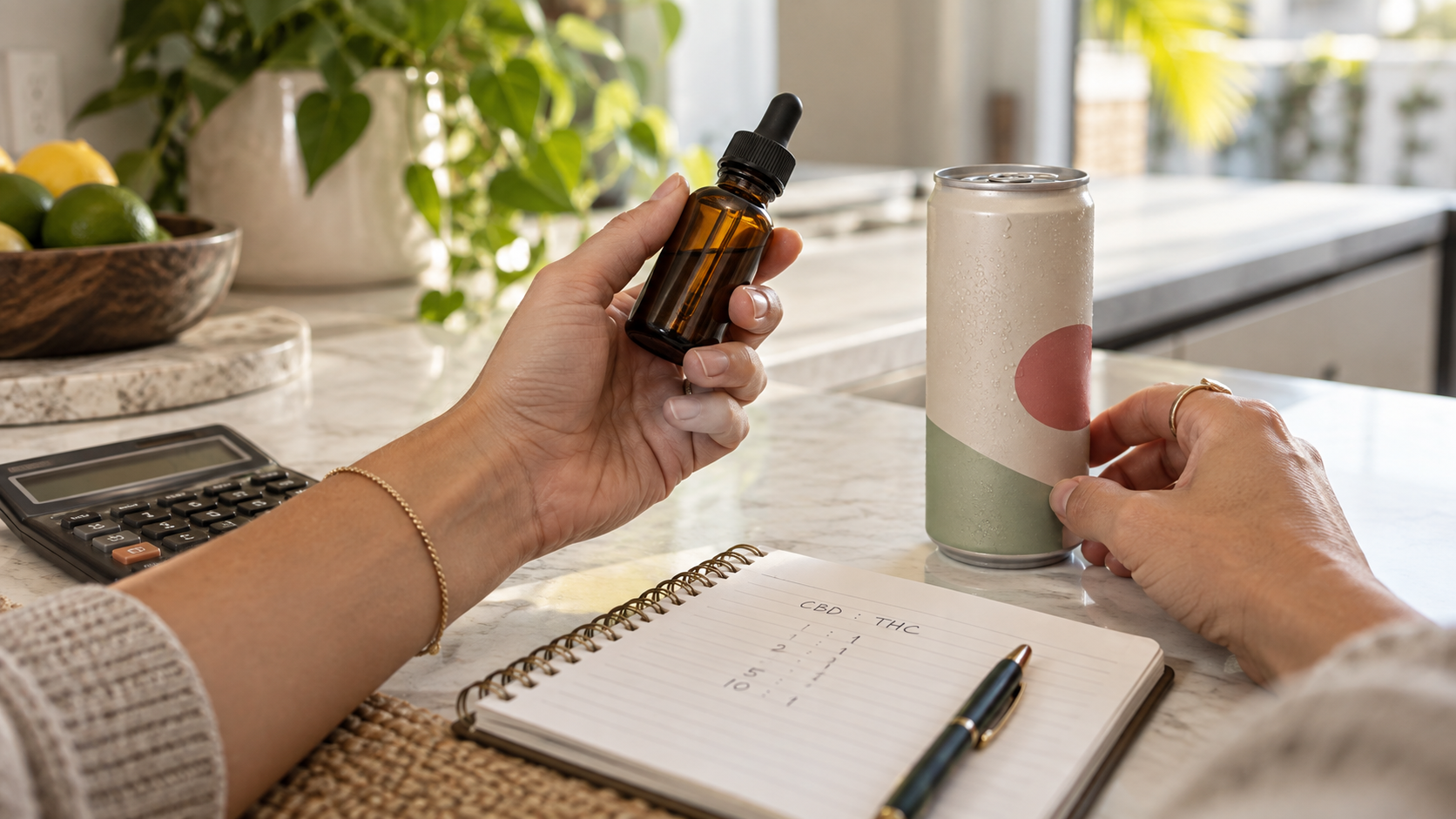
Cannabinoid ratio guide | Adults 21+
CBD and THC can appear in one product or be used together. CBD does not reliably cancel THC, and a ratio does not reveal a serving’s strength. This guide shows how to compare the actual milligrams, evidence, format, and safety considerations.
Featured answer
Yes, CBD and THC can be combined. The result depends on the amount of each cannabinoid, their ratio, the product format, timing, and the person. CBD is not an antidote to THC and does not guarantee less impairment. Check both milligram amounts and the serving count, allow the labeled onset time, and never drive after THC.
THC can still impair judgment, memory, and coordination.
A ratio alone cannot show how strong a serving may be.
CBD:THC 2:3 is the same blend as THC:CBD 3:2.
CBD can change THC effects, but not in one dependable direction.
The 60-second CBD and THC label check
| Order | Check | Question | Why it matters |
|---|---|---|---|
| 1 | THC per serving | How many mg will one serving provide? | THC drives intoxication risk. |
| 2 | CBD per serving | How many mg accompany the THC? | CBD may change the experience and can interact with medicines. |
| 3 | Ratio order | Is it CBD:THC or THC:CBD? | Reversing the order changes the meaning. |
| 4 | Servings per package | Is the container one serving or several? | Package totals are not always serving totals. |
| 5 | Batch report | Does the COA match the product and batch? | A generic report does not verify the item in hand. |
People often hear that CBD smooths the sharp edges of THC. Some people report that experience, but it is not a dependable rule. Human studies have produced different results depending on dose, ratio, route, timing, and the outcome researchers measured.
The practical lesson is straightforward: do not add CBD to THC and assume that impairment has disappeared. Treat every product containing THC as potentially intoxicating, even when the front label uses words such as balanced, mellow, or full spectrum.
Related guide: Learn how to match a product and batch before trusting potency numbers in Mary Jane’s 60-second cannabis COA guide.
Article note: Prepared by the Mary Jane’s Bakery Co Editorial Team in September 2026. Reviewed against current federal consumer guidance, peer-reviewed human studies, the live Mary Jane product label, and live U.S. search results. This is not a medical review.
1. What happens when CBD and THC are mixed?
THC and CBD are different cannabinoids. THC can produce intoxication and alter perception, reaction time, memory, coordination, heart rate, and mood. CBD does not usually produce the same high, but it is pharmacologically active and can cause side effects or interact with medicines.
When both are present, the outcome is not determined by the ratio alone. The THC amount remains important. The CBD amount, delivery method, food, personal tolerance, health factors, and other substances can also change what happens.
CBD-dominant
More CBD than THC does not mean zero impairment. Confirm the THC milligrams.
Equal amounts
A 1:1 ratio can still feel strong if the THC amount is high.
THC-dominant
More THC than CBD can produce clear intoxication even though CBD is present.
2. Does CBD reduce a THC high?
Not reliably. A research review of U.S. cannabis potency and ratios found that CBD’s relationship with THC varies across formulations and ratios. Two controlled oral studies also reported that high CBD doses increased THC exposure or psychotropic effects under the tested conditions rather than reducing them.
Those experiments do not prove that every consumer product will behave the same way. The doses and controlled conditions may differ from a drink or gummy on a store shelf. They do show why “CBD cancels THC” is too confident.
| Common claim | Evidence-aware answer | Practical meaning |
|---|---|---|
| CBD always makes THC gentler | Not established. Findings vary by dose, ratio, route, and study. | Do not increase THC because CBD is present. |
| CBD cancels impairment | False as a safety rule. | Do not drive or operate machinery. |
| A higher CBD ratio is automatically weak | No. Total THC can still be substantial. | Read THC milligrams per serving. |
| One ratio is best for everyone | No universal ratio is supported. | Health, medication, sensitivity, and product format matter. |
3. How CBD:THC ratios work
A ratio compares two amounts. It does not reveal the size of either amount unless the label also provides milligrams.
| CBD:THC | Plain meaning | Example | Important caution |
|---|---|---|---|
| 10:1 | Ten parts CBD to one part THC | 10 mg CBD + 1 mg THC | Another 10:1 product could contain much larger amounts. |
| 2:1 | Twice as much CBD as THC | 10 mg CBD + 5 mg THC | It still contains intoxicating THC. |
| 1:1 | Equal CBD and THC | 2 mg + 2 mg or 20 mg + 20 mg | The same ratio can represent very different THC amounts. |
| 1:2 | Half as much CBD as THC | 5 mg CBD + 10 mg THC | This is THC-dominant even though CBD is present. |
Ratio and strength answer different questions
- Ratio asks: How much CBD is present compared with THC?
- Milligrams ask: How much of each cannabinoid is in the serving?
- Format asks: How is the product designed to be absorbed?
4. A real label-math example
Mary Jane’s Blue Raspberry Cannabis-Infused Nano Beverage currently lists 30 mg Delta-9 THC and 20 mg full-spectrum CBD for the can.
- Write the amounts in the order used for the ratio.
- For CBD:THC, write 20:30.
- Divide both numbers by 10. The simplified CBD:THC ratio is 2:3.
- If a source writes THC:CBD instead, the same product becomes 30:20, or 3:2.
Per-serving formula
Cannabinoid per serving = cannabinoid in the package ÷ labeled servings per package
Use the actual serving count on the current container. Do not infer it from container size or flavor.
Dividing a product evenly changes the milligrams but not the ratio. Confirm the current serving instructions and matching batch report instead of guessing from the front label.
5. How format changes the decision
A drink, conventional gummy, tincture, and inhaled product can have different onset patterns. A product described as nano-emulsified may be designed for faster dispersion than a conventional oil-based edible, but the word “nano” does not supply an exact personal timeline.
| Format | What to verify | Mistake to avoid |
|---|---|---|
| Nano beverage | THC and CBD per serving, servings per can, label onset guidance | Finishing the container before early effects develop |
| Conventional edible | Amount per piece and expected delayed onset | Taking more because the first piece feels inactive |
| Tincture | mg per mL, dropper markings, and labeled route | Counting drops without knowing their volume |
| Multiple formats | Combined THC total and different onset clocks | Stacking a drink, gummy, and inhaled product |
Follow the product’s current directions and allow its stated onset window before deciding what to do next. If the label is unclear, do not improvise.
6. Safer-use checklist
- Read THC and CBD milligrams per serving, not only per package.
- Confirm whether the product is a conventional edible, tincture, or fast-acting nano format.
- Choose the lowest labeled THC option that fits your experience and avoid rapid redosing.
- Do not combine formats until you understand how each affects you separately.
- Do not add alcohol or sedating drugs. Ask a healthcare professional about prescription and over-the-counter medicines.
- Do not drive, cycle in traffic, swim alone, or operate machinery after THC.
- Assume that any THC product can affect a drug test.
- Store products in their original child-resistant containers, away from children and pets.
If a racing heartbeat is the concern, read why THC can make the heart race. For driving questions, use the separate guide to edibles and driving safety.
7. What to do if someone used too much
- Stop taking THC, CBD, alcohol, or other substances.
- Move to a calm, safe place and stay with a trusted sober adult.
- Do not drive. Do not use CBD as a guaranteed antidote.
- Call Poison Help at 1-800-222-1222 for case-specific guidance.
- Call 911 immediately if the person collapses, has a seizure, has trouble breathing, or cannot be awakened.
Mary Jane’s too-high safety guide covers the next steps in more detail. Severe or unusual symptoms need professional help, not another cannabinoid experiment.
8. What Miami shoppers should check
A local label check should take less than a minute. At the Mary Jane’s Bakery Co Miami location, compare the cannabinoid amount per serving, servings per container, ratio order, ingredient list, batch identifier, and matching laboratory report. Ask to see the current label rather than relying on an old product photo or remembered formula.
Do not choose a blended product only because the front label says “balanced.” A clear decision starts with the THC amount and ends with a batch-matched report.
9. Authoritative sources
| Source | What it supports |
|---|---|
| NIH NCCIH cannabis and cannabinoid overview | CBD and THC definitions, safety concerns, side effects, medicine interactions, and product-label limitations. |
| JAMA Network Open randomized oral study | High-dose oral CBD increased THC exposure and effects in the tested conditions. |
| 2024 randomized CBD and THC study | High oral CBD increased THC psychotropic effects in the study. |
| THC and CBD ratio review | Why actual potency and ratio need to be interpreted together. |
| CDC impaired-driving facts | Cannabis and driving-risk context. |
| America’s Poison Centers | 24-hour poisoning help and emergency warning signs. |
10. Frequently asked questions
Can CBD and THC be taken at the same time?
They can appear together in one product or be used at the same time. That does not make the combination risk-free. Read both milligram amounts and expect THC to remain intoxicating.
Does CBD cancel a THC high?
No. Some people report a different experience when CBD is present, but controlled evidence does not support CBD as a dependable off switch for THC.
Will a 1:1 CBD and THC product get you high?
It can. A 1:1 ratio means equal amounts, not low amounts. The THC milligrams per serving determine whether substantial intoxication is possible.
What is the best CBD:THC ratio?
There is no universal best ratio. A ratio must be read alongside actual milligrams, product format, health factors, medicines, and individual sensitivity.
Does CBD change how long THC lasts?
It may under some conditions, but no simple timeline applies to every combination. Dose, formulation, route, food, and metabolism can all matter.
Can CBD and THC together cause a positive drug test?
Yes. A product containing THC may produce a positive result. CBD does not prevent THC metabolites from being detected.
Can CBD and THC be mixed with alcohol?
Avoid that combination. Alcohol can add impairment and make the experience less predictable. CBD does not make alcohol plus THC safe.
What should I do if someone consumed too much?
Keep the person in a safe setting and do not let them drive. Call Poison Help at 1-800-222-1222. Call 911 if the person collapses, has a seizure, has trouble breathing, or cannot be awakened.
CBD and THC together: the useful conclusion
CBD and THC can share a formula, but “balanced” is not a safety guarantee. Start by finding THC per serving, then CBD per serving, ratio order, delivery format, and serving count. Verify those details against the matching batch report. If THC is present, plan for possible impairment regardless of the CBD amount.