

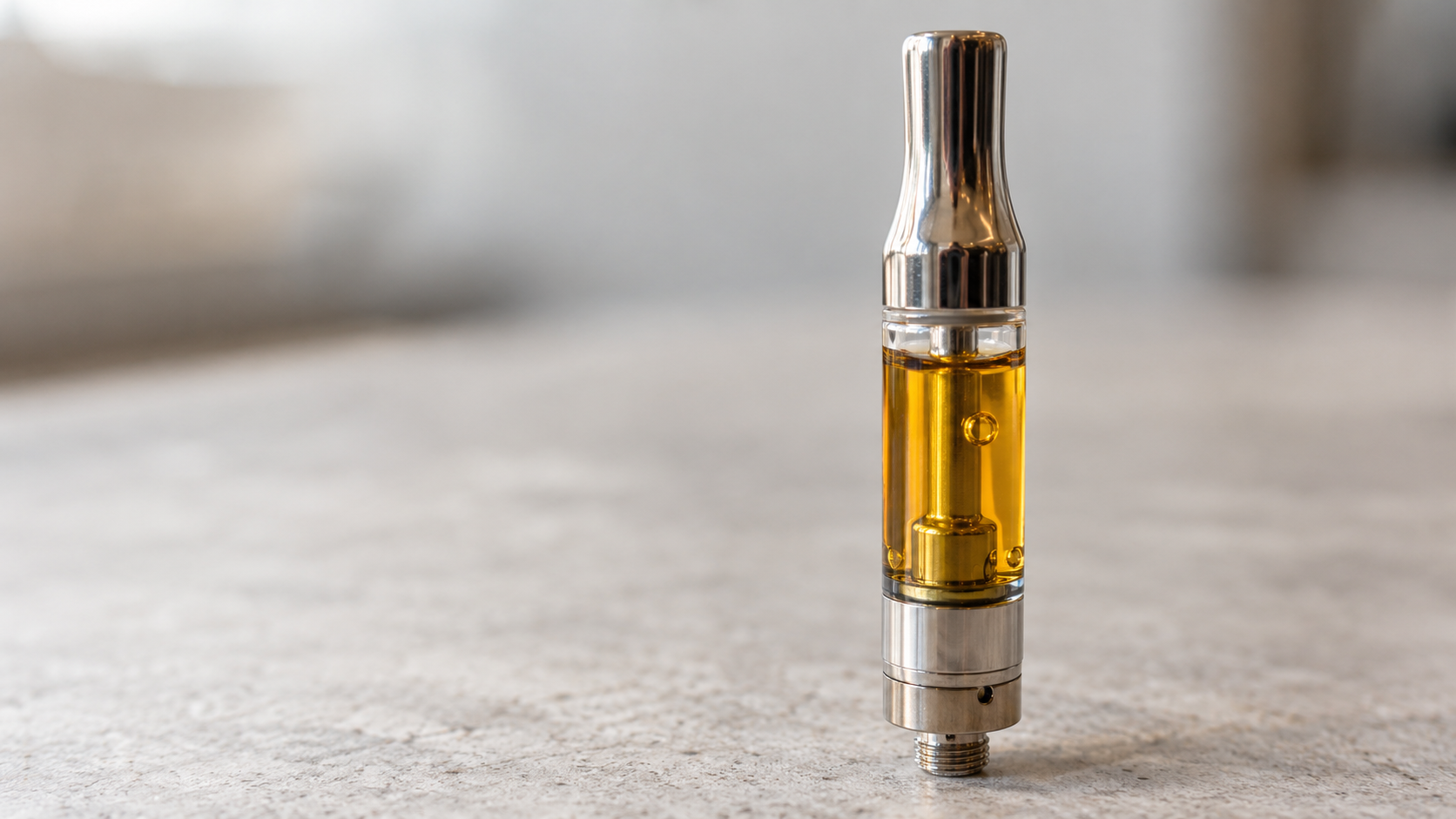
Vape cartridge guide · Adults 21+
A practical way to separate slow-moving oil from a cartridge that needs verification or replacement.
Featured answer
A vape-cart bubble may stay in place because the oil is thick, the cartridge is cool, or the air pocket is caught near the hardware. Bubble speed cannot prove that oil is pure, fake, safe, or unsafe. Check the product identity and batch, then inspect the device. Stop using it if it leaks, overheats, is damaged, or repeatedly tastes burnt.
Bubble alone
An observation about flow, not a purity test.
Bubble near intake
Check whether output is weak or tastes dry.
Package and batch
More useful than comparing bubble speeds.
Damage or heat
Stop using or charging the device.
The 30-second decision: observe, verify, or stop
| What you see | What it means | Next action |
|---|---|---|
| A stationary bubble; package and cart intact; normal device behavior | Thick or cool oil is one possibility. Contents remain unverified by sight. | Observe: follow the maker’s storage and use instructions. No need to force the bubble to move. |
| Bubble near an intake; repeated weak vapor or a dry hit | Oil feed, airway, coil, or battery could be involved. | Verify: stop forcing pulls and check the exact device instructions. Seek support if it persists. |
| Missing or mismatched batch, unclear source, or unknown storage history | Appearance cannot establish what is inside or what happened after sale. | Verify before use: contact the maker or seller with the package details. |
| Leak, cracked tank, unusual heat, swelling, hissing, or persistent burnt odor | The device has a stop-use sign, regardless of bubble movement. | Stop: do not use, charge, open, refill, or test-puff it. |
People sometimes turn a cartridge sideways, see a bubble stay put, and hear two opposite explanations: “thick oil means it is real” or “a stuck bubble means it is fake.” Neither statement can identify the contents of that particular cartridge. The same visible behavior can have more than one explanation.
The more useful approach is to check what you can actually verify: the package and batch, the condition of the hardware, the cartridge’s behavior, and its manufacturer’s instructions. This guide starts with the bubble, then shows where the decision changes.
Adult-use note: This is general product education for adults 21+. Vaping carries health risks. It is not medical advice and cannot assess a cartridge you own. Keep all products away from children and pets. Related guide: how to check cart expiration and batch details.
Article note: Prepared by the Mary Jane’s Bakery Co Editorial Team. Drafted September 2026 using the FDA and CDC sources linked below, published laboratory research, and current site pages. It has not received a medical review or a manufacturer review of any particular cartridge. No Mary Jane cartridge was tested for this article.
1. Why might the bubble in a vape cart stay still?
The air pocket can only shift as the surrounding oil flows. The formula, hardware, position, and temperature all matter. Cooler or more viscous oil may look almost motionless during a brief observation. A bubble can also appear trapped against the cartridge’s central tube or near an oil intake. That does not tell you which ingredient is present.
There is no universal number of seconds that every CBD, Delta-8, or THC cartridge bubble must take to move. A cartridge made with a different extract or hardware should not be judged against a friend’s device. Do not repeatedly turn a cart upside down or heat it to pass an online “bubble test.”
What bubble movement can and cannot tell you
| Observation | Reasonable interpretation | Cannot conclude |
|---|---|---|
| Slow or stationary bubble | The oil is moving slowly at that moment. | “Pure,” “high potency,” “authentic,” or “safe.” |
| Fast-moving bubble | The oil is flowing more readily at that moment. | Which ingredients, if any, explain the flow. |
| A change after cold or heat exposure | Temperature may be affecting flow. | That the exposure left the oil, seals, or battery in good condition. |
2. When does a stuck bubble become a device problem?
The cart still operates as expected
If the device is intact, documented, and behaving according to its instructions, bubble movement by itself does not call for a repair. Keep it under the conditions printed for that product. Do not use flavor or one test puff as a purity test.
The bubble sits near an intake and output becomes weak
Oil may not be feeding the heating element as expected. A clog, electrical connection, battery setting, or failing coil could also explain weak output. Stop taking longer or harder pulls. Check the exact cartridge and battery manuals; do not assume a higher voltage is the fix. Mary Jane’s voltage guide explains why settings differ by hardware.
The battery blinks or there is no vapor
A stationary bubble does not diagnose a dead battery. Charge, connection, compatibility, airflow, and hardware failure are separate possibilities. Use the blinking and no-vapor guide for external checks on an intact device.
There is a persistent burnt taste, leak, or unusual heat
Stop using it. A bubble explanation cannot override a damaged tank, wet charging area, swelling, hissing, or a recurring burnt odor. Do not take another puff to decide whether it is acceptable. If the product is new, save the box and receipt and contact the seller or manufacturer about replacement.
3. How to verify a cartridge without taking it apart
- Identify the exact product. Read whether the package describes CBD, Delta-8, another cannabinoid, or a blend. A familiar flavor name does not establish the formula.
- Match the batch. Compare the product name and lot number on the package with any accessible certificate of analysis (COA). A generic lab PDF or a report for another batch does not identify your cart.
- Read the date and instructions. Follow the maker’s stated storage, use, battery-compatibility, and expiry information. Do not replace these with a general internet shelf-life rule.
- Inspect the exterior. Look for cracked glass, loose parts, leaking seams, wet contacts, swelling, or abnormal heat. Do not disassemble the cartridge to check its contents.
- Record the problem. If you need support, photograph the intact cart, package, lot, date, and the visible bubble. Describe when you noticed the issue, how it was stored, and whether vapor or airflow changed.
A COA is a result for a tested sample or batch at a point in time. It does not measure the condition of the specific device in your hand today. In a 2024 study of nine CBD-labeled vape liquids, researchers found differences between some labels and laboratory measurements and examined storage and heat effects. That study did not validate a bubble test or examine Mary Jane’s current inventory.
The FDA warns about THC vaping products from informal sources and advises against adding substances or modifying products. Do not add thinner, transfer oil, puncture a sealed cart, or attempt to refill a disposable because a bubble looks wrong.
4. Does Miami heat or a cold room change the bubble?
Temperature can change how readily oil flows. A cartridge kept in an air-conditioned room may look different from one that has spent time in a hot parked car. That difference does not give a reliable countdown for how long a cart remains suitable. The FDA advises keeping vape batteries out of direct sun and hot cars and following the manufacturer’s instructions.
| Situation | Better response |
|---|---|
| Intact cart stored within its labeled indoor conditions | Leave it upright and follow the product instructions; do not force a movement test. |
| Cart became very cold but remains intact | Return it naturally to a temperature allowed by its label. Avoid direct heat or an improvised preheat cycle. |
| Cart was left in a hot car, then leaked, smelled unusual, or became hot | Stop using it. Photograph the condition and ask the maker or seller for advice; cooling it does not undo unknown damage. |
Do not use a lighter, hair dryer, hot water, microwave, or heating pad to make the bubble rise. Do not charge a wet, swollen, cracked, or abnormally hot device.
5. If you need a replacement in Miami or online
Replace a damaged or unverifiable cart through an appropriate seller or manufacturer process. For a new purchase, prioritize an intact sealed package, a readable batch and date, accessible batch-specific information, a clear ingredient list, and instructions for the battery you own. Ask the seller to clarify an ingredient or hardware claim rather than assuming that every item in a category has the same formula.
Adults can compare Mary Jane’s current CBD vape cartridge listings and read its CBD pen versus cartridge guide. Confirm the exact listing, package, batch, compatibility, availability, and checkout restrictions before ordering. At the Miami location, staff can help identify product-label information; no visual bubble check can certify what is inside.
6. Sources and evidence limits
| Source | What it supports |
|---|---|
| FDA: THC vaping products and illnesses | Informal-source and product-modification cautions. It does not establish a safe bubble speed. |
| FDA: vape battery safety | Manufacturer instructions and protection from extreme temperatures and hot cars. |
| Moreno and colleagues, 2024 | Laboratory analysis of nine CBD-labeled vape liquids. It does not test individual retail cartridges here. |
| CDC: cannabis questions | General cannabis and vaping health-risk context, not product certification. |
7. Frequently asked questions
Does a bubble that will not move mean my cart is fake?
No. Flow depends on the product and conditions. Verify the source, batch, date, and package; do not use bubble speed to declare a cart authentic.
What if the bubble moves quickly?
That does not identify a particular ingredient or prove dilution. Compare the cart with its own maker’s instructions. Clarify unexpected changes with the manufacturer.
Can a bubble near the bottom cause a dry hit?
It may coincide with poor oil feed near an intake, but a clog, battery, contact, or coil may also explain weak output. Stop forcing pulls and check the exact device instructions.
Should I keep hitting the cart until the bubble moves?
No. Repeated pulls are not a test. Stop if output stays weak, tastes burnt, leaks, or the device becomes unusually hot.
Can a lab report tell me whether this particular cart is safe?
A matching COA provides information about a tested batch. It cannot prove that your individual cart was stored correctly or that its hardware remained intact after testing.
Conclusion: start with the product, not the bubble
A stationary bubble is a reason to look at the whole situation. Check the package and batch, follow the exact device instructions, and pay attention to performance and damage. If identity cannot be confirmed or the cart has a stop-use sign, contact the seller or manufacturer instead of trying to change how the oil moves.