

Quick answer: Indica flower is cannabis flower that carries an Indica or Indica-dominant classification. The label gives you useful strain context. However, it cannot tell you everything about the flower. Cannabinoids, terpenes, batch testing, freshness, product format, and personal response can differ from one Indica product to another.
Two jars can both say Indica and still contain very different flower.
For example, one product may focus on CBD, while another may contain mostly THCA. A third product may use hemp flower with Delta-8. Even batches sold under the same strain name can show different cannabinoid numbers.
Therefore, the Indica label should start your comparison, not finish it.
This guide explains what Indica flower means, which strain names shoppers commonly encounter, and how to evaluate the actual flower before choosing a product.
Important: This guide provides general educational information. Cannabis and cannabinoid products can affect people differently. Product availability and rules vary by location. Do not drive or operate machinery while impaired. If you take medications, are pregnant or nursing, or have questions about cannabinoid use, speak with a qualified healthcare professional.
What Is Indica Flower?
Indica flower generally refers to cannabis flower sold under an Indica or Indica-dominant classification.
Today, cannabis retailers commonly use Indica alongside Sativa and Hybrid to organize strains. As a result, these labels can help shoppers narrow a large group of products quickly.
Still, the classification gives only part of the picture.
What the Indica label can tell you
The label can give useful context about how a breeder, producer, or retailer categorizes a strain. In addition, familiar names such as Northern Lights or Hindu Kush can help shoppers recognize product families.
However, the word Indica does not measure potency or freshness.
What the label cannot tell you
By itself, an Indica classification cannot confirm:
- how much CBD, THCA, THC, or Delta-8 the flower contains;
- which terpenes dominate a specific batch;
- whether the flower remains fresh;
- whether manufacturers infused the flower with another cannabinoid;
- how strong a specific batch is;
- or exactly how one person will respond.
For that reason, treat Indica as one layer of information. Next, check the actual cannabinoid panel, product format, batch documentation, and physical condition of the flower.
What Does “Indica” Actually Mean?
The meaning of Indica has changed as cannabis breeding and retail markets have developed.
Historically, researchers discussed Cannabis plants by looking at botanical characteristics and geographic origins. Modern retailers, on the other hand, usually use Indica as a practical strain classification.
Why modern labels have limits
Modern cannabis has undergone extensive hybridization. Therefore, a simple Indica or Sativa label does not describe every genetic or chemical difference between products.
Researchers writing in Nature Plants examined common Sativa and Indica labels and found that the labels did not neatly capture the full genetic and chemical variation among commercial cannabis samples.
You can review the
research on commercial Cannabis labeling.
What commercial cannabis testing shows
Another large study examined commercial cannabis chemistry in the United States. Again, researchers found substantial phytochemical diversity. They also found that conventional Indica, Sativa, and Hybrid labels did not perfectly align with the chemical groups in the tested products.
See the
PLOS ONE analysis of commercial cannabis chemistry.
What this means when shopping:
Use Indica, Sativa, and Hybrid labels as helpful context. Then compare cannabinoids, terpenes, product format, freshness, and batch information before you decide between two flower products.
Does Indica Always Make You Sleepy?
No. Retailers often associate Indica products with evening use, relaxation, or heavier experiences. However, the classification itself does not guarantee sleepiness.
Why experiences can differ
Several factors can change how a person experiences a cannabinoid product. For example, the cannabinoid profile matters. Terpenes may also differ between products.
In addition, amount used, previous cannabis exposure, tolerance, product format, and individual response can all influence the experience.
Therefore, the statement “Indica always means sleepy” works poorly as a buying rule.
Where to compare Indica and Sativa
If your main question involves the broader classifications, read Mary Jane’s guide to Sativa vs Indica vs Hybrid.
This guide stays focused on flower quality, product type, and buyer checks.
Popular Indica and Indica-Dominant Flower Strains
Once shoppers understand the Indica category, they often start comparing specific strain names.
Modern hybrids make classification less exact than it once appeared. Nevertheless, several names commonly appear under Indica or Indica-dominant flower.
| Strain | Common Classification | Why Buyers Recognize It | What to Check Next |
|---|---|---|---|
| Northern Lights | Indica | A long-established strain name used across several cannabis formats | Cannabinoids, product format, COA and freshness |
| Hindu Kush | Indica | A classic strain name strongly associated with traditional Indica classifications | Current batch chemistry and product condition |
| Granddaddy Purple | Indica-dominant | A widely recognized purple strain name | Potency, terpenes and batch variation |
| Bubba Kush | Indica / Indica-dominant | A familiar Kush-family strain name | Whether the product uses CBD, THCA, THC, or an infused format |
| Purple Urkle | Indica / Indica-dominant | A familiar purple strain commonly grouped with Indica products | The product’s actual cannabinoid and terpene information |
Why the strain name is only the first check
A strain name helps identify a product. However, it cannot replace the information on the label or laboratory report.
For example, Mary Jane’s Bakery Co. carries Northern Lights Delta-8 THC Flower. The Northern Lights name gives strain context. Meanwhile, the Delta-8 format and batch report explain what type of product a shopper is actually viewing.
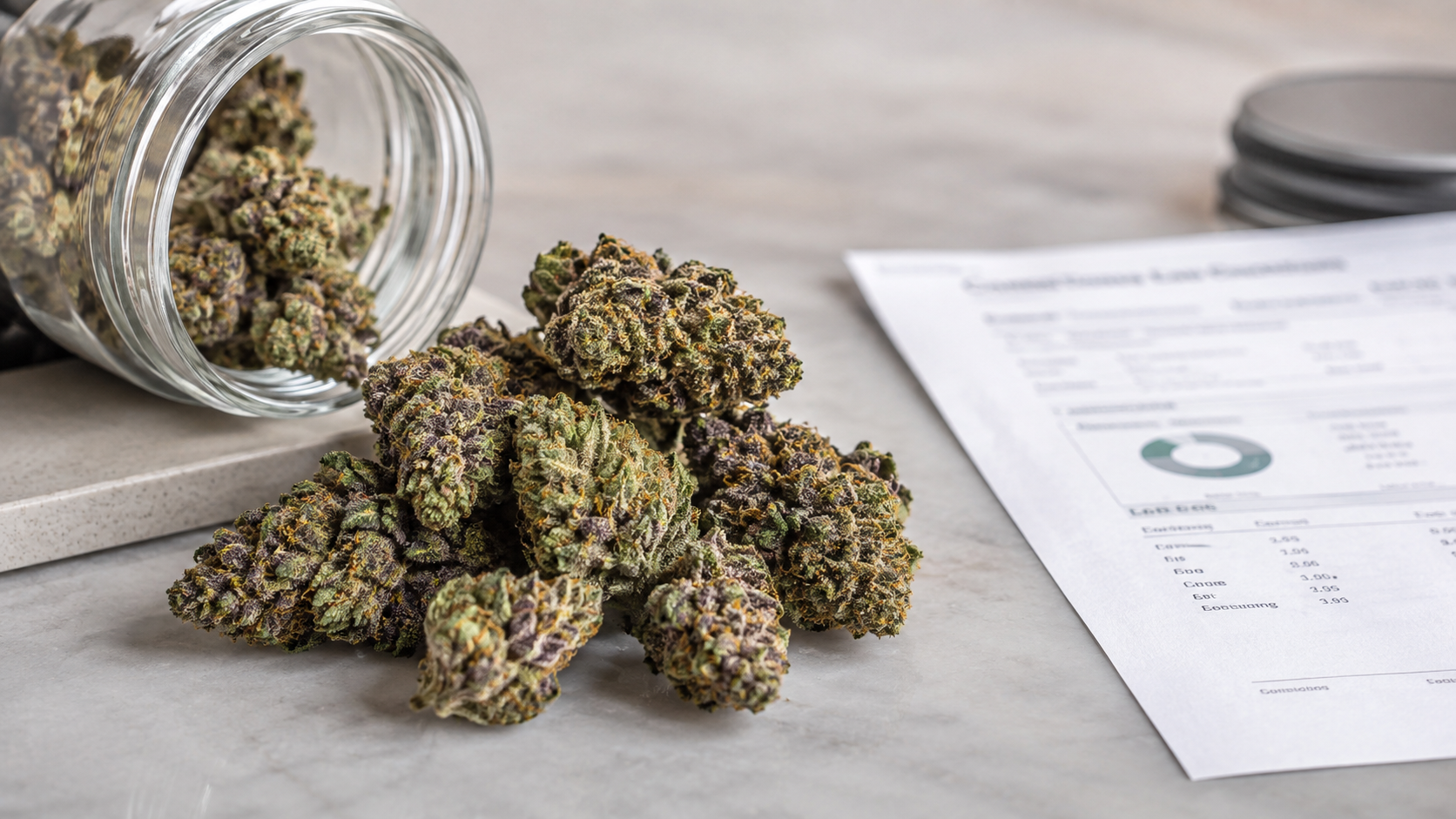
What Does Indica Flower Look Like?
Traditional Indica plants often grow shorter and bushier than classic Sativa plants. They also tend to have broader leaves. Likewise, retailers often associate Indica flower with dense or compact buds.
However, modern hybridization makes appearance much less reliable as an identification tool.
What you can inspect visually
Instead of trying to identify Indica from appearance alone, check the actual condition of the flower.
Useful visual checks include:
- overall bud condition;
- visible trichomes;
- unusual discoloration;
- excessive dryness;
- unexpected moisture;
- visible contamination;
- damaged packaging;
- and obvious changes in appearance.
What appearance cannot prove
A healthy-looking bud does not prove potency, purity, or lab compliance. Therefore, visual inspection should complement product information rather than replace it.
Simple rule:
Use your eyes to check condition. Use the label and laboratory report to check chemistry.
Indica Flower vs Sativa Flower
Indica and Sativa remain two familiar cannabis classifications. Retailers may also use Hybrid, Indica-dominant, or Sativa-dominant.
However, neither Indica nor Sativa works as a potency measurement. Likewise, neither label guarantees one exact experience.
Instead of repeating a full comparison here, read Mary Jane’s dedicated Sativa vs Indica vs Hybrid guide.
That separation keeps this article focused on the `indica flower` search intent.
Why Two Indica Flowers Can Be Very Different
This difference matters more than many shoppers realize.
For example, three flower products can all carry an Indica label while belonging to very different cannabinoid categories.
| Example | Classification | Product Type | Main Difference |
|---|---|---|---|
| Flower A | Indica | CBD hemp flower | CBD-focused cannabinoid profile |
| Flower B | Indica | THCA-rich flower | THCA-focused cannabinoid profile |
| Flower C | Indica | Delta-8 flower product | Delta-8 format and batch potency |
Ask two separate questions
First, ask how the retailer classifies the flower.
Next, ask what the specific product and batch actually contain.
The first question gives strain context. In contrast, the second question tells you much more about the cannabinoid product you are considering.
Why the distinction helps buyers
Once you separate classification from chemistry, comparisons become easier. As a result, you are less likely to assume that every product under the Indica label belongs to the same cannabinoid category.
CBD, THCA and Delta-8 Indica Flower Are Different Product Types
Indica describes a strain classification. CBD, THCA, THC, and Delta-8 describe cannabinoids or cannabinoid-focused product categories.
Therefore, shoppers should not treat these terms as interchangeable.
CBD Indica Flower
CBD-dominant hemp flower can still use Indica, Sativa, Hybrid, or dominant-hybrid strain language.
However, an Indica label does not automatically mean that a product contains high THC.
If you want hemp-derived CBD flower, compare Mary Jane’s current CBD hemp flower options and review the individual product details.
THCA Indica Flower
THCA-rich flower can also carry an Indica, Sativa, Hybrid, or Indica-dominant label.
In this case, the cannabinoid panel provides the useful potency information. Therefore, shoppers should check the current batch rather than estimate strength from the strain classification.
If THCA is unfamiliar, start with Mary Jane’s guide explaining what THCA flower is.
Delta-8 Indica Flower
Delta-8 flower belongs to a different product format.
Manufacturers commonly start with hemp flower and apply or infuse Delta-8 material. As a result, the finished product differs from raw flower that naturally contains high levels of another cannabinoid.
Mary Jane explains the category further in its Delta-8 THC flower buyer guide.
In addition, the FDA explains that cannabis naturally contains Delta-8 THC at relatively low levels and discusses how concentrated commercial Delta-8 products commonly come from hemp-derived CBD.
See the
FDA information on Delta-8 THC.
Why product type matters more than the strain label alone
A CBD Indica flower and a Delta-8 Indica flower can share a strain classification while differing substantially as products.
Therefore, always identify the cannabinoid category before you compare potency or laboratory results.
Terpenes and Indica Flower
Terpenes are aromatic compounds found in cannabis and many other plants. They help create differences in aroma between cultivars and batches.
Because terpene composition varies, every Indica flower should not smell exactly the same.
Common cannabis terpenes
Depending on the cultivar and batch, cannabis may contain terpenes such as:
- myrcene;
- beta-caryophyllene;
- limonene;
- pinene;
- linalool;
- and many others.
Why batch testing matters
If a laboratory tests terpenes for the specific batch, that information gives you more detail than a broad strain description.
For example, a retailer may describe a strain using typical aroma notes. However, a batch-specific terpene panel tells you what the laboratory actually measured in that sample.
For a deeper explanation, see Mary Jane’s guide to cannabis terpenes.
How to Read an Indica Flower COA
A Certificate of Analysis, often shortened to COA, can provide far more detail about a tested sample than the word Indica alone.
However, a simple lab tested claim does not tell you what the laboratory actually measured.
First, match the report to the product
Check the product name, batch information, or other identifying details. Ideally, the report should connect clearly to the flower you are evaluating.
In addition, check the report date. Cannabis products can change between batches, so an older COA should not automatically describe every later batch.
Next, read the cannabinoid panel
Look for the cannabinoids that the laboratory reports. Depending on the product, these may include CBD, THCA, Delta-9 THC, Delta-8 THC, CBG, CBN, CBC, or others.
Also check total cannabinoid information when the report provides it.
Then, check which other panels the lab tested
A cannabinoid test does not automatically include every other laboratory panel.
For example, a full report may or may not contain:
- terpene testing;
- microbial testing;
- residual solvent testing;
- agricultural agent or pesticide testing;
- heavy metal testing;
- mycotoxin testing;
- moisture testing;
- or water activity results.
Finally, notice anything marked “not tested”
This detail matters.
If a report marks a panel as not tested, do not interpret that statement as a passing result. Instead, it simply means the report does not provide data for that panel.
Real Example: Reading a Mary Jane Indica Flower COA
Instead of using a made-up laboratory example, we can look at a report linked from a real Mary Jane flower product.
Mary Jane’s Northern Lights Delta-8 THC Flower product identifies Northern Lights as Indica and links to an ACT Laboratories report.
What the cannabinoid panel reports
Northern Lights Delta-8 THC Flower example
- Retail Batch: #1
- Laboratory: ACT Laboratories Florida
- Sample completed: May 28, 2024
- Delta-8 THC: 47.046%
- CBG: 1.651%
- CBGA: 4.599%
- CBN: 0.691%
- CBC: 0.084%
- Total cannabinoids: 54.0708%
- Delta-9 THC: Not detected on this report
- THCA: Not detected on this report
- CBD: Not detected on this report
What this report does not tell us
The cannabinoid panel gives useful batch information. However, the document marks several other panels as not tested.
Those include terpenes, microbials, residual solvents, agricultural agents, heavy metals, moisture, water activity, and mycotoxins.
Therefore, the report cannot provide results for those categories.
Why this is a useful buyer example
Many shoppers stop when they see the words lab tested. Instead, read the report and ask what the laboratory actually measured.
For this Northern Lights example, the report gives cannabinoid data. Meanwhile, other testing categories remain outside the scope of this particular report.
Better COA question:
Do not ask only, “Does the product have a COA?”
Instead, ask:
“Does this report match the product or batch, and which panels did the laboratory actually test?”
Strain information and batch data are different
The product description may discuss general strain characteristics. In contrast, the COA shows measurements from a specific tested sample.
As a result, shoppers should not treat a strain description and a laboratory result as the same type of evidence.
Does Higher THC or Cannabinoid Percentage Mean Better Indica Flower?
No. Potency gives you one piece of product information. It does not provide a complete quality score.
What a potency number can tell you
A cannabinoid percentage tells you how much of a particular cannabinoid the laboratory measured in the tested sample.
Therefore, the number can help you compare potency when the reports refer to relevant batches.
What potency cannot tell you
A larger number does not automatically tell you:
- how fresh the flower is;
- how the seller stored it;
- whether you will prefer its aroma;
- which additional laboratory panels were completed;
- whether the product format matches your preference;
- or whether one flower is objectively better than another.
| Information | What It Can Tell You | What It Cannot Guarantee |
|---|---|---|
| Indica label | Classification or strain context | Exact effects |
| Cannabinoid percentage | Measured concentration in the tested sample | Overall flower quality |
| Terpene panel | Aromatic compounds measured in the batch | A guaranteed personal response |
| COA | Results for the panels shown on the report | Results for panels the lab did not test |
| Appearance | Visible condition and obvious warning signs | Potency or purity |
How Fresh Should Indica Flower Be?
Freshness matters whether the label says Indica, Sativa, or Hybrid.
Poor storage can reduce aroma, dry out flower, or create moisture-related problems. Therefore, buyers should inspect condition and packaging alongside strain information.
Signs worth checking
Before choosing or using flower, check for:
- unusual or musty odors;
- visible mold-like growth;
- extreme dryness or crumbling;
- unexpected wetness;
- damaged packaging;
- or obvious changes in color and condition.
When you need a deeper freshness check
If you are unsure whether older flower remains usable, read Mary Jane’s guide on how to tell whether cannabis flower is fresh.
That guide covers storage, dryness, aroma changes, mold warning signs, and other freshness questions in more detail.
How to Choose Indica Flower: 7 Checks That Matter
If you remember only one section from this guide, use the following process.
- Identify the product type.First, determine whether the flower is CBD-dominant, THCA-rich, Delta-8, or another cannabinoid format.
- Read the actual cannabinoid panel.Next, use the laboratory numbers rather than estimating potency from words such as Indica, Kush, or Purple.
- Match the COA to the product or batch.Whenever possible, connect the report to the flower you are evaluating.
- Check which panels the laboratory completed.Remember that cannabinoid testing does not automatically include microbial, pesticide, heavy metal, solvent, terpene, or other testing.
- Inspect freshness and storage.In addition, consider aroma, moisture, texture, packaging, and visible condition.
- Separate strain descriptions from batch measurements.A strain description can explain general characteristics. However, the COA tells you what a laboratory measured in a specific sample.
- Use Indica as one signal, not the entire decision.Finally, combine the classification with cannabinoids, testing, product format, and freshness.
Flower Options at Mary Jane’s Bakery Co.
Mary Jane carries several flower categories. Therefore, the best starting point depends on the cannabinoid format you want to compare.
Northern Lights Delta-8 THC Flower
An Indica-labeled Delta-8 flower product with publicly linked batch documentation.
CBD Hemp Flower
Compare CBD-focused hemp flower and review individual product information before choosing.
THCA Flower Education
If THCA is your main comparison point, learn how the cannabinoid category works before relying on a strain label.
Inventory, prices, cannabinoid concentrations, and batch documentation can change. Therefore, check the current product information before purchasing.
Indica Flower for Miami Shoppers
Miami shoppers can use the same comparison process whether they research flower online or inspect products in person.
First, identify the strain classification. Next, check the cannabinoid category and available batch documentation. Finally, inspect the actual condition of the flower where possible.
Mary Jane’s Bakery Co. operates in Miami’s Wynwood area. Before visiting, check the Mary Jane’s Bakery Co. location information for current store details.
Indica Flower FAQs
What is Indica flower?
Indica flower is cannabis flower sold under an Indica or Indica-dominant classification. The label provides strain context. However, it does not establish potency, cannabinoid composition, terpene profile, freshness, or exact effects by itself.
What does Indica mean in weed?
In the modern cannabis market, retailers use Indica alongside Sativa and Hybrid as a broad strain classification. However, scientific research suggests these labels do not perfectly represent the complete genetic and chemical profile of every cannabis product.
Does Indica always make you sleepy?
No. Retailers often associate Indica with evening or relaxing use. However, cannabinoids, terpenes, amount used, tolerance, product format, and personal response can all influence the experience.
What are some popular Indica flower strains?
Northern Lights, Hindu Kush, Granddaddy Purple, Bubba Kush, and Purple Urkle commonly appear under Indica or Indica-dominant classifications. However, modern hybrid classifications can vary between products and sellers.
Is Indica stronger than Sativa?
Not automatically. Indica and Sativa do not measure potency. Therefore, compare the cannabinoid information from the actual products rather than assuming that one classification is always stronger.
Can CBD flower be Indica?
Yes. CBD-dominant hemp flower can carry Indica, Sativa, Hybrid, or dominant-hybrid classifications. Therefore, the word Indica does not automatically mean high THC.
Can THCA flower be Indica?
Yes. A THCA-rich flower can use an Indica, Sativa, Hybrid, or Indica-dominant classification depending on the strain and product.
What is Indica-dominant flower?
Indica-dominant usually refers to hybrid cannabis that a breeder or seller classifies as leaning more toward Indica than Sativa. However, different Indica-dominant products can still have different cannabinoid and terpene profiles.
How can you tell whether Indica flower is good quality?
Start with the visible condition and freshness. Next, review the cannabinoid information and available batch COA. In addition, check which testing panels the laboratory completed and identify the actual product format.
Does a COA prove cannabis flower is safe?
Not by itself. A COA gives results for the tests shown on the report. Therefore, if the laboratory did not test a particular panel, the report cannot prove that the product passed that test.
Does Indica flower always contain the same terpenes?
No. Terpene composition can change between cultivars and batches. Consequently, batch-specific terpene testing provides more useful information than assuming every Indica flower shares the same aroma profile.
Final Takeaway
The word Indica remains useful. However, it should not carry more weight than the label can support.
First, use the classification to understand the strain context. Next, identify the product type and cannabinoid profile. After that, read the batch COA and check which panels the laboratory completed.
Finally, consider terpenes, freshness, packaging, and the current product information.
Simple buying framework:
Indica label → product type → cannabinoids → batch COA → tested panels → terpenes → freshness
That process gives you a clearer picture of the flower than the strain category alone.
Sources and Further Reading
Nature Plants: Cannabis labeling and genetic/terpene variation
PLOS ONE: Phytochemical diversity of commercial Cannabis in the United States
U.S. FDA: Cannabis research and cannabinoid overview
U.S. FDA: Consumer information about Delta-8 THC
ACT Laboratories: Northern Lights Delta-8 THC Flower, Mary Jane’s Bakery Co., Retail Batch #1
Editorial note: Cannabis strain classifications, inventory, product formulations, cannabinoid concentrations, and laboratory results can change between products and batches. Therefore, use current product labeling and batch-specific laboratory documentation when comparing flower.
Disclaimer: This content is educational and does not provide medical advice. Indica, Sativa, Hybrid, cannabinoid, and terpene labels do not guarantee a particular effect. Review current product information, available laboratory documentation, and applicable local requirements before purchasing or using cannabinoid products.