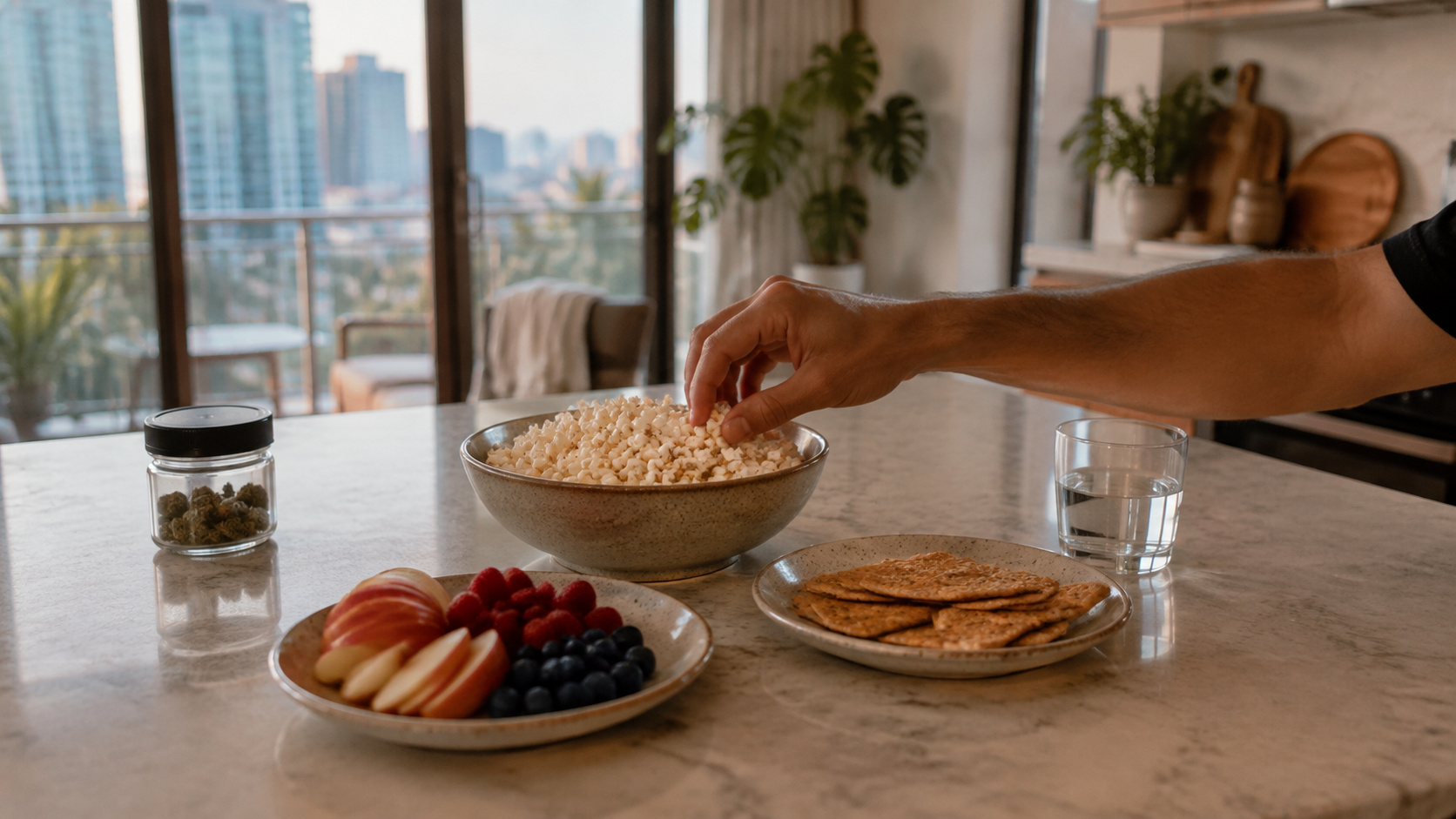
Cannabis Appetite Guide · Updated August 21, 2026
THC can increase interest in food by activating brain pathways connected with appetite, motivation and reward. Food may also smell or taste more appealing. The response is real, but it is not guaranteed. Dose, product format, tolerance and individual biology all matter.
Featured answer
Weed can make you hungry mainly because THC activates CB1 receptors involved in appetite and food reward. This can increase the desire to eat even after a recent meal. Flower, vapes, drinks and edibles can all cause munchies when they contain THC, but the strength and timing vary from person to person.
THC is the cannabinoid most clearly connected with the classic munchies.
CB1 activity can increase hunger signals and interest in food.
Edibles usually begin later than inhaled THC and may remain active longer.
Some adults notice little or no appetite change after using THC.
What the evidence supports
| Claim | Confidence | What it means |
|---|---|---|
| Active cannabis can increase food consumption. | Supported in controlled human research | The munchies are more than a cultural stereotype. |
| THC affects CB1 pathways involved in appetite and reward. | Well-supported mechanism | THC amount is more useful than a strain name alone. |
| Smell, taste and food reward may contribute. | Plausible with experimental support | Food can seem attractive even after a normal meal. |
| Edibles always cause stronger munchies. | Not established | Edibles may last longer, but the response still depends on dose and the person. |
| Indica always causes more hunger than Sativa. | Not established | Read the cannabinoid panel instead of relying on the strain category. |
The munchies can feel surprisingly convincing. Someone may finish dinner, use THC and soon become intensely interested in another snack. This does not necessarily mean the body suddenly developed a nutritional deficiency.
Researchers are still separating the roles of hunger signals, sensory appeal, reward and appetite-related hormones. The clearest conclusion is narrower: THC can increase food motivation, but no single mechanism or product label predicts every response.
Related guide: Compare how long a weed high may last across flower, vapes, edibles and drinks.
Article note: Prepared by the Mary Jane’s Bakery Co Editorial Team. Last reviewed August 21, 2026, using peer-reviewed research, government safety guidance and current consumer questions. This article has not received a medical review.
1. What are the munchies?
“The munchies” is the informal name for increased appetite or food-seeking after cannabis use. Researchers may call the same pattern cannabis-induced hyperphagia, which means increased eating.
The experience is not limited to an empty stomach. Someone may begin thinking about food, notice aromas more strongly, enjoy textures more than usual or find eating unusually rewarding.
2. How does THC make you hungry?
THC interacts with the endocannabinoid system
THC can activate cannabinoid type 1 receptors, usually shortened to CB1 receptors. These receptors form part of the endocannabinoid system and are found in brain regions involved in appetite, memory, motivation and reward.
Hunger and reward signals can rise together
The response is not only the stomach asking for food. THC may increase both the motivation to find food and the reward attached to eating it. That helps explain why a snack can sound appealing shortly after a complete meal.
Food may become more noticeable
Experimental research suggests that cannabinoid signaling can influence sensory and feeding pathways. In practical terms, aromas, sweetness, saltiness or texture may command more attention than usual.
Appetite hormones may contribute
Human studies have measured changes in appetite-related hormones, including ghrelin, following cannabis exposure. Results can differ between oral, smoked and vaporized administration. Hormones are therefore one part of the explanation, not a complete consumer formula.
3. What does human research actually show?
A controlled study published in Proceedings of the National Academy of Sciences assigned adults to active cannabis vapor or placebo. People exposed to cannabis consumed more food. The researchers did not find that cannabis simply pushed everyone toward one stereotypical category such as chocolate or chips.
Another human laboratory study compared oral, smoked and vaporized cannabis. Researchers measured subjective appetite alongside hormones such as ghrelin, leptin and peptide YY. Differences appeared between administration routes, but the findings do not provide a universal prediction for one individual.
4. Do edibles give you the munchies?
THC edibles can cause the munchies. The small amount of food in a gummy, chocolate or brownie does not prevent THC from influencing appetite.
The larger difference is timing. Swallowed THC usually develops more slowly than inhaled THC and may remain noticeable longer. Appetite changes may therefore begin later or continue longer for some edible users.
Munchies expectations by product format
| Format | General onset pattern | Appetite consideration |
|---|---|---|
| Flower or pre-roll | Usually begins relatively quickly | Hunger may emerge during the active inhaled experience. |
| Vape or cartridge | Usually begins relatively quickly | Concentrated oil can make total THC easy to underestimate. |
| Gummy or edible | Usually delayed | Munchies may begin later and overlap with a longer experience. |
| THC drink | Varies by formulation | Read total milligrams and servings per container. |
Do not use the presence or absence of hunger to decide whether an edible is working. Taking another serving before the first one develops can lead to a stronger and longer experience later.
5. Why do some people not get the munchies?
Not everyone becomes hungry every time. The appetite response may change with:
- Total THC consumed
- THC sensitivity and tolerance
- Edible, drink, vape or flower format
- Food consumed earlier
- Ordinary appetite before using THC
- Sleep, stress and mood
- The presence of food, smells and visual cues
- Other cannabinoids and ingredients in the product
The same adult may also react differently on another day. A missing appetite effect does not prove that a product is fake, weak or safe to redose.
Do stronger munchies mean stronger weed?
No. Hunger is not a reliable potency test. A high-THC product may cause little appetite change in one adult, while a lower serving may produce noticeable munchies in another.
6. Indica, Sativa, CBD and THCV: what do the labels really predict?
Does Indica or Sativa make you hungrier?
Neither label reliably predicts the munchies. Commercial cannabis can carry an Indica, Sativa or hybrid label without revealing the actual THC per serving or complete chemical profile.
Research analyzing commercial cannabis has found that these broad labels do not consistently reflect overall chemical diversity. Another genetic and chemical study found that much of the perceived Indica and Sativa difference was associated with a limited group of aroma-related terpenes rather than a dependable effect category.
Read Mary Jane’s guide to what an Indica label actually tells you before using the category as an appetite prediction.
Does CBD cause the munchies?
CBD does not create the classic intoxicating THC experience. A systematic review found signals that CBD may affect appetite and body weight, but the included research varied in population, dose, medical context and study design.
That evidence does not justify marketing an ordinary retail CBD product as an appetite suppressant or weight-management treatment. Multi-cannabinoid and full-spectrum products may also contain THC.
Can THCV stop the munchies?
THCV is frequently promoted using terms such as “diet weed.” Early and preclinical research has created interest in its metabolic and appetite effects, but that does not prove that a retail THCV product will stop hunger or cause weight loss.
Actual products may combine THCV with appetite-stimulating THC. Use Mary Jane’s THCV and THC comparison before judging a product from the front label.
7. How long do the munchies last?
There is no scientifically reliable universal duration for the munchies. Appetite changes often overlap with the active THC experience, but they do not always start or end at exactly the same time as the perceived high.
Inhaled THC generally begins faster. Swallowed THC usually begins later and may remain active longer. Dose, repeated use, tolerance, metabolism and product formulation can all change the timeline.
8. Why were the munchies stronger this time?
Before blaming the strain name, check the five variables that can be verified more easily.
Did you consume more THC than on the previous occasion?
Was it an edible or drink instead of an inhaled product?
Did two servings overlap because the first one felt delayed?
Had you skipped a meal, slept poorly or arrived already hungry?
Were appealing snacks, aromas or food videos already nearby?
This check cannot diagnose the response, but it gives adults more useful information than simply assuming one strain always causes stronger hunger.
9. How to manage the munchies responsibly
If cannabis-related hunger is unwanted, the most useful preparation happens before THC is used.
- Follow your normal meal routine. Deliberately becoming very hungry first may make later food decisions harder.
- Choose snacks beforehand. Portion what you intend to eat instead of carrying several open packages to the couch.
- Keep water available. Water may help dry-mouth comfort, but it does not remove THC or end impairment.
- Separate normal snacks and THC edibles. Never place similar-looking products together.
- Do not redose based on appetite. Hunger is not a potency meter.
- Notice repeat patterns. Record the product, THC per serving, format, time and whether another serving was taken.
- Speak with a professional when needed. Get qualified guidance if cannabis-related eating repeatedly feels uncontrolled or conflicts with a medical condition.
Adults learning how label milligrams work can use the 2.5mg versus 5mg beginner THC comparison.
10. Do the munchies make you gain weight?
One episode of increased appetite does not determine long-term body weight. Weight changes involve food intake over time, activity, sleep, health conditions, medications and many other variables.
Cannabis research presents a complicated picture. Acute THC exposure can increase appetite and food consumption. Observational studies of regular cannabis use and body weight have produced mixed or unexpected associations. Those observations do not prove that cannabis prevents weight gain or supports weight loss.
Do not use THC, CBD or THCV as a weight-management treatment without guidance from a qualified healthcare professional.
11. What should buyers check on a THC label?
| Check | Why it matters | Do not substitute |
|---|---|---|
| THC per serving | Shows the intoxicating amount in one serving | Total package milligrams |
| Servings per container | One package may contain several servings | Piece count alone |
| Cannabinoid profile | Shows whether THC, CBD, THCV or other cannabinoids are present | Indica or Sativa alone |
| Batch and COA match | Connects the package with its laboratory report | A generic or undated report |
| Storage instructions | Helps protect product quality and household safety | Guessing from the format |
12. Miami shopping and storage considerations
Miami heat can soften gummies, affect packaging and reduce the quality of flower, drinks or vape products. Do not leave cannabis products in a parked vehicle, beach bag or direct sunlight.
Keep edible products sealed in their original packaging and physically separate from ordinary candy, baked goods and snacks. This matters even in an adult household because visitors may not know what a product contains.
Adults can compare current product formats from Mary Jane’s Bakery Co. or check Mary Jane’s Miami location. Confirm current availability, serving information, local rules and checkout eligibility before buying.
13. When should you get help?
Ordinary hunger after THC is not usually an emergency. Speak with a qualified healthcare professional if cannabis-related eating repeatedly feels uncontrolled, causes significant distress, worsens an eating-disorder concern or conflicts with diabetes, medication use or another health condition.
Seek urgent help when appetite changes occur alongside severe confusion, repeated vomiting, chest pain, breathing difficulty, a seizure, collapse or inability to awaken.
The CDC warns that children who consume THC-containing products can become very sick. Store all gummies, chocolates, drinks and other cannabis products locked away and out of sight.
14. Authoritative sources
| Source | Used for |
|---|---|
| PNAS cannabis and food-intake study | Controlled human and animal evidence of increased food consumption |
| NIH oral, smoked and vaporized cannabis study | Appetite ratings and appetite-related hormones |
| NIH cannabis, weight and behavior review | Body-weight evidence and remaining limitations |
| Commercial cannabis chemical-diversity study | Limits of Indica, Sativa and hybrid labels |
| Nature Plants cannabis-labeling study | Genetic, chemical and aroma relationships behind strain labels |
| Systematic review of CBD, appetite and body weight | CBD evidence and study limitations |
| 2025 THCV metabolic review | Developing THCV research without retail-product guarantees |
| CDC cannabis poisoning guidance | Child ingestion and edible-storage safety |
| CDC cannabis and driving guidance | Impairment and driving caution |
| Poison Control | Free U.S. exposure assistance and emergency instructions |
15. Frequently asked questions
Why does weed make you hungry?
THC activates CB1 pathways involved in appetite, food motivation and reward. This can increase interest in eating even after a recent meal.
Do edibles give you the munchies?
They can. THC gummies, brownies, chocolates and drinks may affect appetite after the swallowed product begins taking effect.
Are edible munchies stronger than smoking munchies?
Not necessarily. Edible effects may begin later and last longer, but appetite intensity still depends on THC amount, tolerance, formulation and individual response.
How long do the munchies last?
There is no fixed duration. Appetite changes often overlap with the active THC experience. Swallowed products may create a later and longer pattern than inhaled cannabis.
Why do I get hungry when high even after eating?
THC can affect food motivation and reward rather than responding only to an empty stomach. Food may therefore seem appealing after a normal meal.
Why do I not get the munchies?
Responses differ according to THC amount, tolerance, format, food timing, stress, sleep and individual biology. Not feeling hungry does not mean a product is inactive.
Can the munchies start after the high begins?
Yes. Appetite changes do not always begin at the first noticeable effect. This is especially relevant with swallowed products that develop gradually.
Can you still feel hungry the next morning?
Appetite can be influenced by ordinary meal timing, sleep and residual product effects. Persistent or concerning appetite changes should be discussed with a healthcare professional.
Does CBD make you hungry?
CBD does not act like intoxicating THC and should not automatically be expected to cause classic munchies. Research on CBD and appetite is mixed and depends on dose and context.
Does Sativa give you fewer munchies than Indica?
That is not a reliable rule. THC per serving and the complete cannabinoid profile provide more useful information than an Indica or Sativa label alone.
Can THCV stop the munchies?
No retail product should guarantee that result. THCV research is still developing, and a formula may also contain appetite-stimulating THC.
Are strong munchies proof that THC is working?
No. Hunger is only one possible response. Do not use appetite as a potency test or a reason to take another serving.
Does weed make you gain weight?
Acute THC exposure may increase eating, but long-term body weight depends on many factors. Current observational research does not prove that cannabis directly causes or prevents weight gain.
Conclusion: the munchies are real, but the response is personal
THC can increase food motivation through appetite, reward and sensory pathways. Controlled human research supports a real increase in food consumption, but the strength, timing and duration differ across people and product formats.
The most dependable buying information comes from THC per serving, servings per container, the cannabinoid profile and a matching lab report. Indica, Sativa, flavor names and “diet weed” marketing cannot predict one adult’s appetite response.