

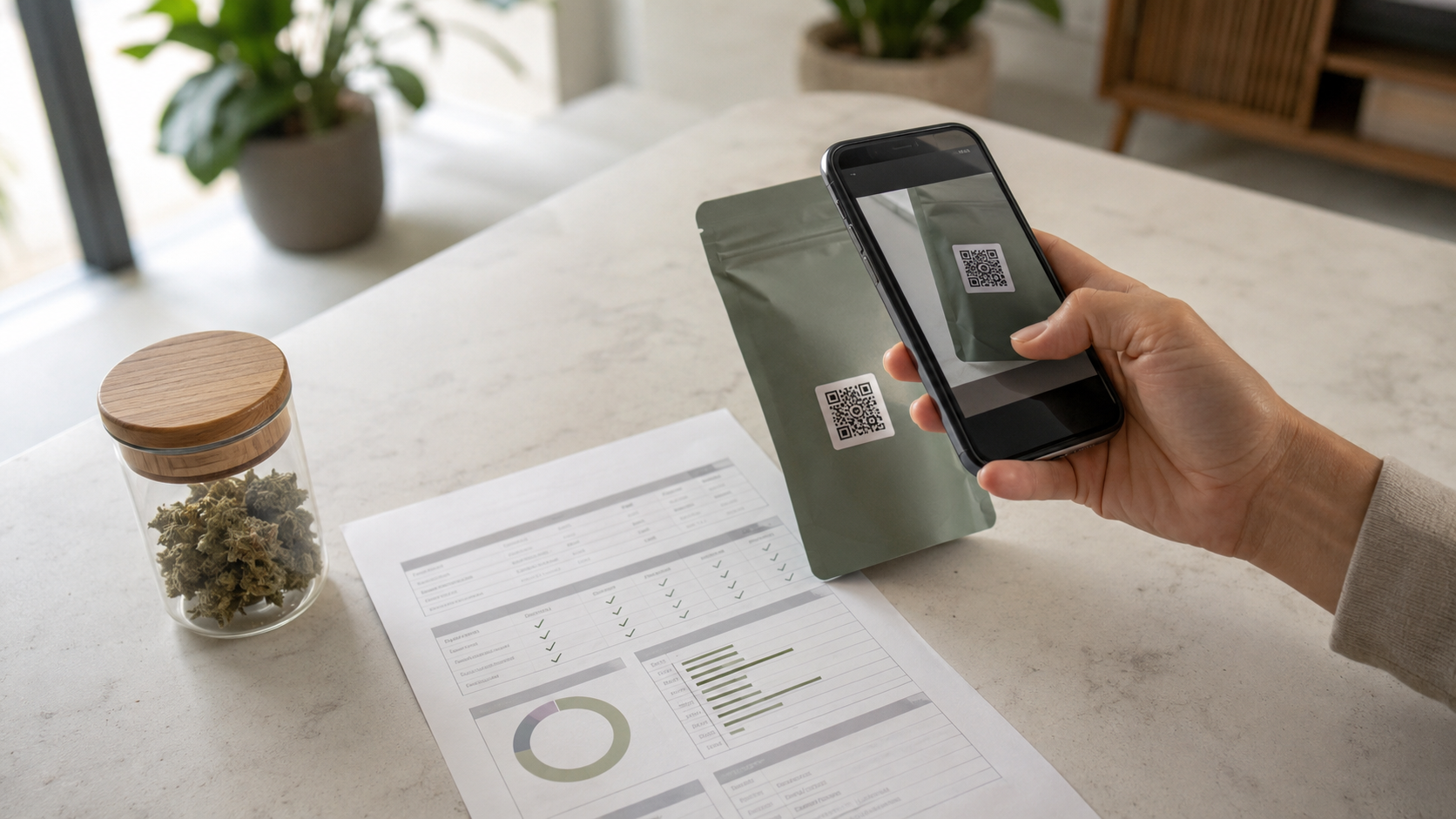
Learn how to match a lab report to the product in your hand, decode THC and CBD units, distinguish “not detected” from “not tested,” check contaminant panels, and recognize a COA that needs more questions.
Featured answer
To read a cannabis COA, first match its product and batch number to the package. Confirm the laboratory and test dates, read every cannabinoid with its unit, and check which contaminant panels were actually performed. “ND” does not always mean absolute zero, and a potency-only report is not a full safety panel.
The 60-second COA scan
| Time | Check | What you need to confirm | Pause when |
|---|---|---|---|
| 0–15 sec | Identity | Product, batch or lot, and product type match | The report is generic or belongs to another batch |
| 15–25 sec | Laboratory | Lab identity, report number, dates, and approval | No identifiable lab or report record appears |
| 25–40 sec | Potency | Named cannabinoids, measured results, and units | The unit is missing or does not fit the product |
| 40–55 sec | Safety panels | Which panels ran and whether each passed | “Lab tested” means potency only |
| 55–60 sec | Label comparison | Package claims agree with the report | Strength, serving, or identity does not reconcile |
A Certificate of Analysis looks technical because it was written to record laboratory work, not to function as a front label. You do not need to understand every instrument or chemical name. You do need a repeatable order of checks that prevents a polished QR code or a large THC number from doing all the persuading.
The most useful habit is to treat the package and the COA as one document set. The package makes claims. The COA records what the laboratory reported for a particular sample or batch. When the identifiers do not connect, the report does not verify the item you are considering.
Related guide: If THCA and Delta-9 appear on your report, use Mary Jane’s total THC formula guide for the separate calculation.
1. What is a cannabis Certificate of Analysis?
A cannabis COA is a laboratory report for a tested sample or batch. Depending on the product, laboratory, jurisdiction, and requested scope, it may show cannabinoid potency, terpenes, pesticides, heavy metals, residual solvents, microbes, mycotoxins, moisture, water activity, or other results.
The phrase lab tested is incomplete by itself. One report may contain only a cannabinoid panel. Another may contain potency plus several contaminant panels. You can only rely on tests that are actually shown.
2. Read the report in this order
- Identity: Match the product name, product type or matrix, and batch or lot.
- Laboratory record: Find the lab, report or sample number, dates, and approval details.
- Scope: Identify every panel that was performed.
- Potency: Read each cannabinoid together with its unit.
- Contaminants: Compare results with the stated limits and pass/fail status.
- Package reconciliation: Confirm that serving, package, and cannabinoid claims agree.
This order differs from the way many shoppers read. Potency feels interesting, so eyes go there first. Batch identity is more important. A precise number from the wrong batch is still the wrong evidence.
3. Worked example: follow one Mary Jane lab report
Mary Jane has a public historical gummy COA that shows how a laboratory report is organized. Use it as a reading exercise only. Its batch and results should not be used to verify a product being sold today.
| Reading stop | Field visible in the example | Question to ask on a current report |
|---|---|---|
| 1. Report identity | Order and sample identifiers | Can the laboratory or seller locate this exact record? |
| 2. Product identity | Product and batch description | Does it match the unopened package in front of me? |
| 3. Laboratory | Lab name, location and report details | Is the laboratory identifiable, and can its credentials be checked? |
| 4. Sample basis | Unit weight and tested sample size | Are the results expressed per gram, unit, serving or package? |
| 5. Results | Named cannabinoids with result columns | Which number and unit should be compared with the label? |
| 6. Scope | Tested, not-tested or not-applicable panels | Is this a potency report or a broader contaminant report? |
4. Match the batch, product, dates and laboratory
Match the package identifier
Look for a batch number, lot number, sample ID, production code, or another traceable identifier. The wording varies. The value on the report should correspond to the value on the product package. A report for the same flavor or strain but a different batch is not a match.
Confirm the product matrix
The matrix tells you what the lab received: flower, oil, tincture, edible, beverage, topical, concentrate, or another material. Matrix matters because sample preparation, units, expected panels, and interpretation change by product type.
Check more than one date
A COA may show a received date, sample date, analysis date, and report date. These are not the same as the product’s expiration date. There is no honest universal rule that every COA becomes invalid after one fixed number of months. Instead, ask whether the report fits the product’s batch and current inventory.
Identify the laboratory
Look for the lab name, address or contact information, report number, authorization, and available accreditation information. ISO/IEC 17025 is an international laboratory standard for competence, impartiality, and consistent operation. Accreditation is a meaningful trust signal, not a promise that every result is infallible.
5. Read THC, CBD and potency units correctly
A cannabinoid number without a unit is incomplete. The same-looking number can describe a percentage of weight, milligrams per gram, milligrams per milliliter, milligrams per piece, or milligrams in the full package.
| Unit | Common use | What it does not tell you alone | Quick check |
|---|---|---|---|
| % | Flower and concentrates by weight | Milligrams in the full package | On a mass basis, 1% equals 10 mg/g |
| mg/g | Concentration per gram | Total package amount without net weight | 100 mg/g equals 10% |
| mg/mL | Tinctures, oils and liquids | Amount in a dropper or bottle without volume | Multiply by measured mL |
| mg/piece | Gummies and unit-based edibles | Total package amount without piece count | Compare with pieces per package |
| mg/package | Complete container total | Amount per serving without serving count | Divide only after confirming servings |
For CBD oil, use Mary Jane’s mg-per-mL and dropper math guide. That page explains the calculation without turning label math into a personal serving recommendation.
For flower, find Delta-9 THC and THCA separately. A reported “total THC” value may use the common potential-THC calculation, but it remains an analytical estimate rather than a prediction of one person’s experience.
6. What do ND, LOD, LOQ, PASS and NT mean?
| Status | Plain meaning | Do not translate it as |
|---|---|---|
| ND | Not detected at or above the laboratory’s stated detection or reporting threshold | “Proven absolute zero” |
| <LOD | Below the method’s limit of detection | A reliable measured quantity |
| <LOQ | Below the level the method can reliably quantify with its stated performance | Automatically zero or automatically a failure |
| PASS | The reported result met the applicable limit used on that report | Every possible contaminant was tested |
| NT / Not tested | That analysis was not performed or not reported | “Not detected” |
Laboratory footnotes control the exact interpretation, so read them. The National Institute of Standards and Technology distinguishes detection from the level at which a quantitative measurement can be made with stated uncertainty.
7. How to read action limits, ppm and µg/g
Contaminant panels often show three separate facts: the measured result, the reporting or action limit, and the unit. Compare values only when they use the same unit and refer to the same analyte.
| Field | Plain meaning | Buyer check |
|---|---|---|
| Result | What the laboratory reported for that analyte | Read the number, status and footnote together |
| Action limit | The threshold used to determine the status on that report | Confirm which rule or specification supplies it |
| ppm | Parts per million | In a mass-to-mass comparison, 1 ppm commonly corresponds to 1 µg/g |
| µg/g | Micrograms of analyte per gram of sample | Do not compare directly with mg/g until converting units |
| PASS / FAIL | Comparison outcome under the limit used by that report | PASS covers the named test, not every possible contaminant |
Simple example: If a result and action limit are both reported in µg/g, compare them directly. If one value is in mg/g and the other is in µg/g, convert first. One milligram equals 1,000 micrograms.
8. Check what was tested beyond potency
A full-looking first page can still describe a narrow test. Find the results summary or page index, then confirm that each claimed panel has actual results.
Pesticides
Check analytes, action limits, measured results, and pass/fail status. The required list can vary.
Heavy metals
Common panels include lead, arsenic, cadmium, and mercury, but read the exact report.
Microbials and mycotoxins
Microbial organisms and mold-related toxins may appear in separate panels. One does not substitute for the other.
Residual solvents
Especially relevant to extracted and manufactured products. A solventless claim should still be verified rather than assumed.
Water activity, moisture, foreign material, filth, terpenes, and other panels may also appear. The peer-reviewed clinical framework for cannabis product quality treats third-party testing for pesticides, microbes, and heavy metals as an important quality check.
9. How to read a terpene panel without overpromising effects
Terpenes are volatile compounds that contribute to cannabis aroma. A terpene panel may name compounds such as myrcene, limonene, beta-caryophyllene, linalool or pinene and report each as a percentage, mg/g or another concentration unit.
Three checks for terpene results
- Read the unit: A percentage and mg/g can be converted on a mass basis, but neither is a personal effect score.
- Read the individual values: “Total terpenes” can hide which compounds make up the total.
- Check the scope: A terpene panel only reports compounds included in that laboratory method.
The NIH-hosted review of cannabis terpenes supports their role in aroma and summarizes developing research. It does not justify treating one terpene number as a reliable prediction of sedation, energy, pain relief or another personal outcome.
10. The COA completeness matrix by product format
There is no single universal panel for every product. Use the matrix below as a question guide, then compare it with the rules and manufacturer documentation that apply to the item.
| Format | Potency question | Panels to look for | COA blind spot |
|---|---|---|---|
| Flower / pre-roll | THCA, Delta-9 THC, CBD, total values, and units | Pesticides, metals, microbes, mycotoxins, moisture or water activity where applicable | Smoke risk, freshness after testing, and exact material inside a pre-roll |
| Vape / extract | Named cannabinoid and concentration, not only “live” or “distillate” | Residual solvents, pesticides, metals, and other required panels | Battery, coil, seals, complete ingredient disclosure, and device failure |
| Gummy / edible | mg per piece, serving, and package | Potency plus applicable microbial, metals, pesticides, or solvent panels | Food allergens, storage after opening, and individual response |
| Tincture / drink | mg/mL, mg per serving, bottle or can total | Potency and applicable contaminants for the formulation | Dropper accuracy, serving behavior, food interactions, and storage handling |
| Topical | Cannabinoid amount per jar and concentration when supplied | Potency and applicable contaminant panels | Skin sensitivity, ingredient allergies, and whether a product is transdermal |
For a current cartridge example, read Mary Jane’s live resin versus distillate cart guide. For flower-specific interpretation, use the THCA flower comparison.
11. Ten red flags that deserve a pause
- The batch or lot does not match the package.
- The QR code leads to a generic homepage, image, or unrelated PDF.
- The laboratory cannot be identified from the report.
- The product matrix or name does not match what is being sold.
- The report omits units or uses a unit that does not reconcile with the label.
- A seller claims “full panel,” but only cannabinoid potency appears.
- Pages, result summaries, footnotes, or signatures appear missing.
- “ND” and “not tested” are presented as if they mean the same thing.
- The cannabinoid amount per serving cannot be reconciled with the package total.
- The seller will not provide a readable batch report when asked.
A professional-looking package does not resolve a mismatch. For vapes, Mary Jane’s disposable vape red-flag guide explains why QR codes, hardware condition, source, and package identity must be considered together.
12. What Miami buyers should check under Florida’s hemp rules
For covered hemp extract products distributed or sold in Florida, Florida Statute 581.217 currently requires container information that includes a scannable barcode or QR code linked to the batch COA, the batch number, a website for batch information, the expiration date, and the milligrams of each marketed cannabinoid per serving.
Miami counter check
- Scan the code before purchase when practical.
- Match the report to the package batch.
- Check the expiration date separately from the laboratory dates.
- Read the cannabinoid amount per serving and the container total.
- Ask which contaminant panels were performed.
- Leave a loose, damaged, relabeled, or unverifiable product behind.
Adults can review current formats through Mary Jane’s CBD product hub or inspect current packaging and ask batch questions at the Wynwood location. Availability, batches, reports, and restrictions can change, so verify the exact item rather than relying on an older screenshot.
13. What a COA cannot prove
Testing is still valuable because it reduces uncertainty. It does not erase uncertainty. The FDA’s Delta-8 consumer update notes formulation, labeling, concentration, manufacturing, and contaminant concerns. A COA is one part of responsible verification, not permission to ignore the label, source, hardware, storage, or personal risk.
14. Authoritative sources and what they support
| Source | What it supports |
|---|---|
| Florida Statute 581.217 | Florida hemp-extract QR code, COA, batch, expiration, and cannabinoid label requirements |
| ISO/IEC 17025 overview | Laboratory competence, impartiality, and consistent operation |
| NIST detection and determination limits | Why detection and reliable quantitative measurement are different concepts |
| JAMA CBD labeling-accuracy study | Evidence that product labels and measured cannabinoid content can differ |
| Clinical cannabis quality framework | Third-party COAs and testing for pesticides, microbes, and heavy metals |
| Cannabis terpenes review | Terpenes as volatile aroma compounds and the developing evidence base |
| FDA Delta-8 consumer update | Product variability, manufacturing, labeling, adverse-event, and contaminant concerns |
15. Frequently asked questions
What does COA stand for in cannabis?
COA stands for Certificate of Analysis. It is a laboratory report describing results for a tested sample or batch.
What should I check first on a cannabis COA?
Match the product and batch or lot number to the package. Do this before reading THC, CBD, terpene, or contaminant results.
Does ND mean zero?
Not necessarily. ND generally means the analyte was not detected at or above the laboratory’s stated detection or reporting threshold. Read the report’s footnotes and limits.
Is a potency test a full-panel COA?
No. A potency page reports cannabinoids. A broader report may also contain pesticides, metals, residual solvents, microbes, mycotoxins, or other panels. Confirm what was actually performed.
How can I tell whether a QR code is useful?
It should open a readable report that identifies the laboratory and matches the product, batch, and relevant dates. A code that opens a generic homepage or another batch does not complete the check.
Does a COA guarantee that I will pass a drug test?
No. A COA can report cannabinoids in the tested sample. It cannot guarantee how your body, product use, or a testing program will produce a personal result.
Is 1% the same as 10 mg/g?
On a mass basis, yes: 1% equals 10 milligrams per gram. That conversion does not turn mg/mL, mg per piece, or mg per package into the same unit.
Does every cannabis COA include the same tests?
No. Requirements and test requests can vary by product, jurisdiction, laboratory, and matrix. Read the panel list rather than assuming.
What does ppm mean on a cannabis COA?
PPM means parts per million. In a mass-to-mass result, 1 ppm commonly corresponds to 1 microgram per gram. Confirm the report’s unit and footnotes before comparing a result with an action limit.
Can a terpene panel predict how cannabis will feel?
Not reliably. It can describe measured terpene composition and help compare batches, but it cannot predict one person’s response or guarantee a particular effect.
16. Bottom line: match, measure, verify
A useful COA check follows three verbs. Match the report to the product and batch. Measure every result with its correct unit and reporting limit. Verify which potency and contaminant panels were actually performed.
That one-minute habit is more useful than trusting a strain name, package color, “premium” badge, or isolated THC number. When the batch, report, units, or test scope do not connect, ask for clarification or choose an item with clearer documentation.