

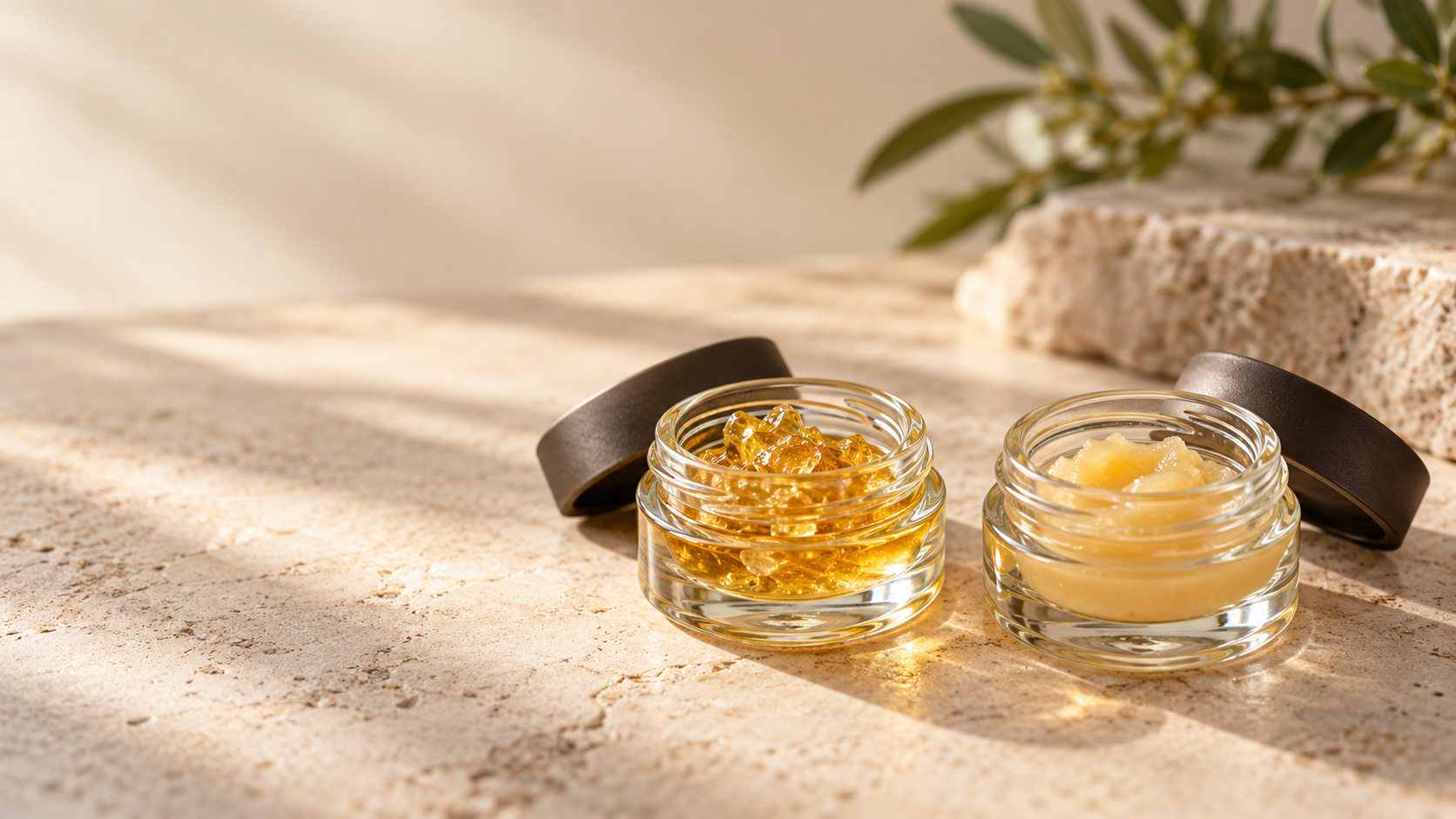
Concentrate comparison · Adults 21+
Live Resin vs Live Rosin: Differences, Price and Label Checks
Similar names. Different extraction methods. Here is what those differences tell you—and what still needs checking.
Featured answer
Live resin typically uses hydrocarbon solvents to extract fresh-frozen cannabis. Live rosin typically comes from pressing hash made from fresh-frozen cannabis, without hydrocarbon extraction solvents. That process difference does not tell you which finished product is stronger, better tasting, or better tested. Compare the actual formulation, batch information, quantity, and storage instructions.
Resin and rosin describe different extraction routes.
Compare batch results, not category reputation.
Check grams and format before comparing prices.
A jar and a filled vape may need different care.
| Claim | Useful evidence | Still not established |
|---|---|---|
| Solventless | Documented extraction process | Absence of every contaminant |
| Higher THC | Comparable batch cannabinoid results | A predictable personal experience |
| Premium | Traceable product details and price per gram | Better value for everyone |
| Live resin vape | Finished-product ingredients and manufacturer information | Identical formulation across brands |
One jar costs more. Another advertises a higher THC number. Both use words such as “live” and “premium.” It is easy to compare the marketing before comparing the products.
Start with extraction, then look at the finished format. A concentrate jar, cartridge, and all-in-one device involve different purchasing questions, even when the extract shares a name.
For adults 21+. Educational information, not medical advice or confirmation that a particular product is lawful where you live.
Related guide: For texture terms, see live resin badder, rosin jam, and THCA diamonds.
Article note: Prepared for Mary Jane’s Bakery Co. Editorial Team · October 2026. Draft pending editorial approval. Based on manufacturer documentation and regulator testing guidance; no hands-on product testing or medical review.
1. What is the difference between live resin and live rosin?
“Live” generally points to fresh-frozen starting material. The next word describes how the extract is obtained.
Live resin commonly uses butane or related hydrocarbon extraction. Live rosin commonly starts with ice-water hash that is pressed using heat and pressure. Proper Brands documents both routes for its concentrates, including solvent removal for its live resin.
Not every rosin product is live rosin. Check the starting-material description. Color and texture alone are poor substitutes for documented production details.
2. Is live rosin stronger or more flavorful?
Neither category establishes a potency winner. Compare the same cannabinoid measures, units, and product format on batch-specific reports. Do not compare one product’s total THC with another’s delta-9 THC as though they were the same field.
Flavor also needs more than a category name. A terpene report can describe measured compounds; it does not tell you which aroma you will prefer. Without comparable batch evidence, claims that one entire category always has more terpenes go beyond what the label proves.
3. Why can live rosin cost more?
Hash separation, pressing, and usable yield can affect production economics. Proper notes that some strains do not yield enough during washing to become its rosin. That illustrates a production constraint; it does not establish a universal retail markup.
Compare the amount first. These are hypothetical prices, not Mary Jane’s prices or market averages:
| Example | Price | Quantity | Per gram |
|---|---|---|---|
| A | $35 | 1 g | $35 |
| B | $30 | 0.5 g | $60 |
The smaller purchase costs less upfront but more per gram. Compare similar formats, and account for taxes and included hardware. Price per gram is a starting point, not a quality score.
4. What should you check before choosing?
- Match the product. The batch or lot on the package should match the report.
- Read the formulation. Ask what is actually in the finished jar or cartridge.
- Check testing scope. A potency result does not establish that other panels were performed.
- Resolve missing information. Ask for the relevant documentation instead of treating a marketing phrase as proof.
“Solventless” describes extraction, not a complete contaminant assessment. California’s Department of Cannabis Control testing guidance includes pesticides, metals, and microbial impurities alongside residual solvents. This illustrates separate testing categories; it is not a statement of Florida requirements.
For report units and result terminology, use our guide to reading a cannabis COA.
5. Live resin vs rosin carts: why format matters
A vape includes hardware and a finished formulation. The extraction name does not explain every ingredient or device instruction. If distillate is part of your comparison, read our live resin versus distillate cartridge guide.
Storage is a useful example. 710 Labs’ support instructions specify room-temperature storage for its solventless vape while giving different directions for several concentrate formats. Those are instructions for its products, not every rosin product.
Follow the exact manufacturer’s guidance. Do not automatically apply a jar’s refrigeration or freezing instructions to a filled electronic device.
6. Sources behind this comparison
| Source | Supports |
|---|---|
| Proper Brands concentrate guide | Its extraction methods and washing-yield limitations |
| California DCC | Distinct laboratory testing categories |
| 710 Labs product support | Product-specific storage distinctions |
7. Common questions
Is live resin the same as live rosin?
No. The similar names refer to different extraction routes, even when both begin with fresh-frozen cannabis.
Does solventless mean risk-free?
No. It describes the extraction approach. It does not replace batch testing or establish that consuming a product carries no risk.
Is the more expensive option always better?
No. Compare quantity, format, documentation, and your priorities before assigning value to the price difference.
8. Make a grounded comparison
Choose the process you prefer, then check the actual product. A clear ingredient description, matching batch information, comparable price, and appropriate care instructions are more useful than an unsupported “best” claim.