

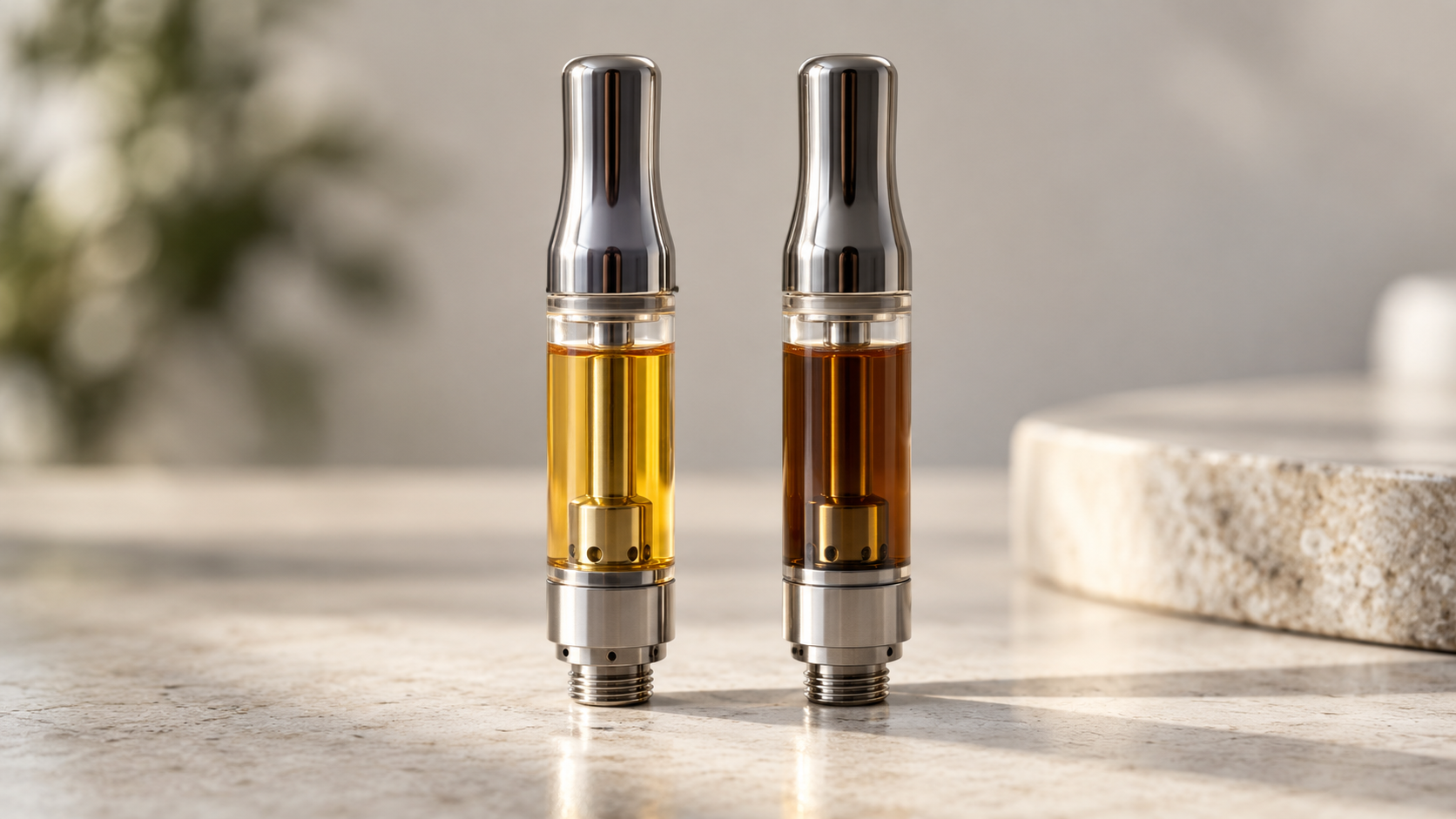
Home / Blog / Why Is My Cart Oil Dark?
A cartridge that arrived dark, oil that slowly turns brown, and a black-looking area near the heating assembly are different observations. This guide explains the possible reasons, the warning signs to recognize, and what a product label or batch report can actually tell you.
Mary Jane's Bakery Co. educational guide • Updated September 25, 2026
Quick answer: why is my cart oil dark?
Cart oil may look dark because of its original formulation or because its contents change during storage or use. Heat, air, light, and the product's ingredients may play a role. Color alone cannot identify the cause, measure remaining THC or CBD, or prove that a cartridge is safe. Note when and where the change appeared. If the device also leaks, overheats, activates on its own, contains unexpected particles, or develops a persistent burnt smell, stop using it and contact the manufacturer or seller.
Stop-use signs come first
Do not use or charge a damaged, unusually hot, swollen, leaking, hissing, or unexpectedly activating device. Do not open a sealed cartridge, warm it with a flame or hair dryer, add another oil, or take extra puffs to “test” it. Follow the manufacturer's device instructions. Seek urgent medical care for chest pain or significant trouble breathing after vaping. The FDA's vape battery guidance advises keeping devices out of extreme temperatures and following the maker's charging directions.
What happened to your cartridge?
Start with the observation that best matches your cartridge. These links take you to the relevant explanation; they do not diagnose the oil.
Cart oil color guide: four patterns to distinguish
Compare the cartridge with an earlier picture of the same unit, if you have one. A different brand, extract, batch, background, or lighting is not a reliable before-and-after comparison. A photograph documents appearance; it does not identify contaminants or chemical reactions.
Uniform amber or brown
What it may indicate: The original extract, added ingredients, or manufacturing process may have produced a deeper starting shade.
What to check: Compare the product name, label, maker's description, lot number, and documentation. Do not judge safety by comparing it with a different clear-looking cart.
Most of the oil darkens over time
What it may indicate: Age, storage conditions, and changes in the formulation are relevant questions.
What to check: Note when the change started, storage temperature, sunlight exposure, and whether the maker describes the change as expected for that specific product.
One area appears nearly black
What it may indicate: Material near the heating assembly, a change in the oil, or even an optical effect may be contributing to what you see.
What to check: Distinguish material in the oil from the visible hardware, outside residue, reflection, or shadow. Do not identify the dark material by sight.
Unexpected particles, leaks, or device faults
What it may indicate: The product or hardware needs specific assessment regardless of color.
What to do: Stop use, avoid further heating or attempts to transfer the oil, retain the original package, and contact the maker or retailer.
Illustrative cartridge anatomy
- Reservoir: the visible region that contains the formulated oil.
- Central tube or core: a visible hardware component, depending on the design.
- Heating area: often near the base; exact construction varies by manufacturer.
- Dark-looking area: shown for location only. The graphic cannot establish whether material is burnt, contaminated, or simply viewed through darker hardware.
A genuine, labeled product photograph can be added after it has been obtained and documented. This illustration is not a photo of a tested Mary Jane's cartridge.
Why does vape cart oil turn brown or black?
Original formulation and extract type
Distillate, live resin, and other extracts can start at different shades because their compositions and processing methods differ. Added terpenes and other ingredients can also affect appearance. Starting color does not verify cannabinoid concentration, authenticity, or product quality. For the separate question of what these extract names describe, read Mary Jane's live resin versus distillate cart guide.
Storage, time, air, and light
Cannabinoid formulations can change under certain storage and heating conditions. A 2024 laboratory analysis of nine CBD-labeled vape liquids found measured content differed from labels and that the samples changed under the tested time and temperature conditions. The study did not establish a color-to-potency conversion or a method for judging an individual cartridge by appearance.
Heat and hardware conditions
Conditions around a cartridge's heating assembly can differ from those in the rest of the reservoir. An area that appears dark after use may warrant a closer look at whether the appearance is localized, whether there are hardware faults, and whether the maker has product-specific guidance. It is not proof that a coil is burnt or that a particular chemical was formed. Do not increase voltage or repeatedly activate a questionable cartridge in an attempt to diagnose it.
Why is my cart dark at the bottom but clear at the top?
Many cartridge designs place the heating assembly and intake openings near the base. The visible bottom section may therefore look different from the upper reservoir. A dark patch could reflect changes in material, the appearance of a hardware component, or an optical effect. Its position does not prove which explanation applies. Record whether it was present when opened or appeared after use, and whether the device has been leaking, overheating, or producing an unusual persistent odor.
Why does the oil look darker at the top?
Check whether the dark area is actually inside the oil. A reflection, air space, residue on the outside, and the reservoir's shape can change what a reader sees. If the oil has genuinely changed, photograph the same cartridge in similar lighting without heating or opening it. The location alone cannot establish oxidation or separation. For questions about the general shelf life of other cannabis products, see Mary Jane's product freshness guide.
Why is my brand-new vape cartridge already dark?
Some formulations begin with a darker color, but “dark from day one” is not an authenticity or safety verdict. Match the product's actual name, stated ingredients, manufacturer, lot number, and any available batch documents. An unexplained difference from the maker's description, an altered seal, visible particles, or leaking is a reason to seek product-specific clarification before use. Mary Jane's separate vape authenticity guide covers packaging and sourcing concerns; color alone cannot confirm a product is genuine or counterfeit.
Is dark cart oil safe, and does it still have THC or CBD?
Neither safety nor potency can be determined by color. Laboratory testing may measure specific cannabinoids or contaminants in a defined sample, but the shade of a finished cartridge does not supply those measurements. A lighter cartridge is not automatically safer than a darker one. A matching certificate of analysis can provide evidence about the tests actually performed; it does not demonstrate that every ingredient or emission from the finished device was tested.
If the unit is hot, damaged, leaking, firing on its own, or showing unexpected particles, do not continue using it to see whether it “clears up.” For a different issue involving intact hardware that blinks but produces no vapor, read the blinking-vape guide. That troubleshooting content is not an instruction to use a questionable cart.
Why is my CBD vape oil turning brown?
CBD-labeled cartridges can differ in cannabinoid content, additional ingredients, extract type, and hardware. A THC cartridge photograph cannot establish what a particular CBD product should look like. The 2024 study of nine CBD-labeled liquids reinforces the need for product-specific information, but its findings are not a diagnosis of any cartridge sold at Mary Jane's.
Products intended to be swallowed are not interchangeable with products intended for inhalation. In particular, do not pour an oral CBD tincture into a vape cartridge. Read the full ingredient list and request manufacturer clarification about unclear formulations. For an overview of product types, see the store's CBD formats guide.
The five-step cartridge color investigation
This checklist helps document an unexpected appearance change for the manufacturer or retailer. It is not a procedure for clearing a questionable product for continued use.
- Identify the exact item. Record the maker, product name, listed extract type, purchase date, and lot number. Retain the box and receipt if available.
- Establish the original appearance. Was it dark before first use? An earlier image of the same cartridge is more informative than a comparison with another product.
- Map the observation. Is the apparent discoloration uniform, at the bottom, at the top, or outside the glass? Note particles or separation without opening the device.
- Record relevant conditions. Note storage near sunlight or a hot car and any leaking, overheating, unusual smell, or unexpected activation. Stop using or charging a faulty device.
- Request matching documentation. Ask the maker or retailer about the exact lot, ingredients, available report, and unexpected change. Do not rely on a generic test document for a different batch.
Example only — not a tested or observed Mary Jane's product
A cartridge develops a dark patch near its base
Documented facts: Assume a buyer has an earlier photograph showing an even amber appearance and now sees a localized dark area. They also have a legible product label and lot number.
What can be concluded: The appearance changed in that location. It is reasonable to ask the maker whether a known product-specific explanation exists and whether matching batch documentation is available.
What cannot be concluded: The photograph alone cannot identify burnt oil, metal contamination, THC degradation, or whether the product is safe to inhale. A laboratory report for another lot does not resolve the question.
What should a product label and certificate of analysis show?
Read the report as evidence of specific tests, not an all-purpose safety certificate. Compare the package and document for the exact product and lot or batch number, test date, named laboratory, sample type, tested substances, and results. A report covering only cannabinoid potency in bulk extract is not equivalent to comprehensive testing of the completed cartridge or emitted aerosol.
Mary Jane's has a public COA index. A matching finished-cartridge report for every listed product has not been independently verified for this article. If the matching document is missing or unclear, request it from the manufacturer or retailer instead of inferring safety from color or a QR code.
Can Miami heat make cartridge oil darker?
Strong sunlight and a parked car can expose a cartridge and battery to high temperatures. Heat and light are relevant to storage, while battery overheating is a separate hardware concern. Follow the maker's storage instructions, keep the product in its labeled package, and keep devices away from children and pets. Do not try to restore the oil's appearance by freezing, microwaving, or externally heating the cartridge. The FDA advises against leaving vape devices in hot cars or direct sunlight.
Mary Jane's Bakery Co. • Wynwood, Miami
Need product documentation or help with a Mary Jane's purchase?
If you purchased the cartridge at Mary Jane's, retain its original packaging, lot number, and purchase details when contacting the store. The team can be a point of contact for purchase questions and available product documents, although no staff member can determine inhalation safety by looking at a cartridge's color.
Ask about an existing purchase
Find the Wynwood location and contact details. Have the exact product name and batch information available for your inquiry.
Store location & contactReview available testing information
Check the public COA index and confirm that any report actually matches your product and batch.
View available COAsCompare CBD formats
Learn how CBD product categories differ and review their intended use and listed ingredients; oral products are not vape refills.
Explore CBD categoriesWynwood location: 175 NW 14th St, Miami, FL 33136. Mary Jane's location page advertises 24-hour service, pickup, and local delivery; confirm current availability, product restrictions, and delivery eligibility directly. Product listings and a general COA are not guarantees of safety.
Frequently asked questions
Why did my cart oil turn brown after a few days?
Product formulation, storage, time, and use conditions may be relevant, but a few days of darkening cannot identify the cause or remaining potency. Record the change and check for additional warning signs.
Does black oil at the bottom mean the coil burnt?
No firm conclusion can be made from that appearance alone. The location may be near the heating assembly, but visible darkening cannot establish what material changed. Stop use if the hardware is also damaged, leaking, overheating, or producing a persistent burnt odor.
Does dark cart oil mean the cartridge has expired?
Not necessarily. Check the product's own labeled dates, original appearance, storage history, and manufacturer guidance. Color alone cannot determine expiration or product condition.
Can I tell whether a cart is fake from its oil color?
No. Color is not an authenticity test. Review the product's sourcing, packaging, manufacturer, lot identifier, and available matching documentation. An unclear product identity is a reason to seek clarification before use.
Can I heat a dark cartridge to make the oil lighter?
Do not use a flame, hair dryer, hot water bath, added oils, or solvents to change a questionable cartridge's appearance. Heating cannot prove safety and may introduce additional device risks.
What if the air bubble in my cartridge is not moving?
Bubble behavior and oil color are separate observations; neither is a purity test. See Mary Jane's cart bubble guide for that distinct question.
Bottom line
When a cartridge looks dark, note what changed, where it changed, when it changed, and whether other warning signs appeared. Compare that information with the product's actual label and matching documentation. Do not use color, a generic COA, or an illustrative photograph to declare the contents or emitted aerosol safe.
Sources and editorial scope
- Moreno and colleagues, 2024, Journal of Forensic Sciences: analysis of nine CBD-labeled vape liquids under specified experimental conditions. Does not identify the cause of an individual cartridge's color.
- U.S. FDA, Tips to Help Avoid Vape Battery Fires or Explosions: device handling, charging, and extreme-temperature guidance; not evidence that an oil color is safe.
- U.S. FDA, Reporting Product Problems: examples of device faults, abnormal appearance, and product issues warranting reports.
Editorial scope: This article synthesizes public research and product-information guidance. It does not report an original Mary Jane's product test, an inspected batch, a first-hand color-change study, or a review by a named medical or technical professional. The cartridge drawing is illustrative. The page is not a diagnosis or a statement that any inhaled product is safe. Adults who do not already vape should not start.